Dumbbell exercises for back and biceps: rows first, curls second

The best dumbbell exercises for back and biceps are the one-arm row, bent-over row and chest-supported incline row for the back, the pullover for the lats, shrugs and rear delt flys for the upper back, then incline, alternating and hammer curls for the arms. Do the rows first while your biceps are fresh, since every row also works them, then finish with two curls. One session of 12 to 14 back sets and 6 biceps sets a week is enough to grow; split it over two shorter days if you have the time. Leave 1 or 2 reps in the tank on every set.

  1. One-Arm Dumbbell Row Lats, Upper Back
  2. Dumbbell Bent-Over Row Upper Back, Lats
  3. Incline Dumbbell Row Upper Back, Lats
  4. Dumbbell Lat Pullover Lats
  5. Incline Dumbbell Curl Biceps
  6. Hammer Curl Biceps, Forearms
  7. Dumbbell Curl Biceps

Rows and pullovers for the lats

Your lats pull the upper arm down and back toward the hip. Rows that keep the elbow tucked and finish near the pocket load them hardest, and the pullover trains them with the arm overhead, the one position a dumbbell row cannot reach.

Lats, one-arm row

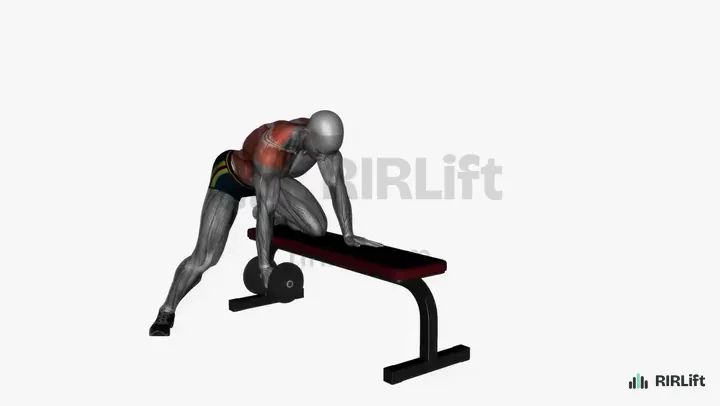
One-Arm Dumbbell Row

Lats, Upper Back

The heaviest pull you can do with a dumbbell, because your free hand on the bench holds your torso still. Start every back-and-biceps day here, while the biceps still have full strength to hold the weight.

How to do it

  1. Put one hand and the same-side knee on a bench, or your hand on a chair seat with both feet on the floor, so your back is flat.
  2. Hold a dumbbell in the other hand with your arm hanging straight.
  3. Pull your elbow back toward your hip until the dumbbell reaches your ribs.
  4. Lower it until your arm is straight again, finish all reps, then switch sides.

Cues

  • Elbow to your hip
  • Back flat as a table
  • Full stretch at the bottom

Common mistakes

  • Twisting your chest open to lift the dumbbell higher: keep both shoulders level.
  • Shrugging the shoulder up toward your ear: pull the elbow back, not the shoulder up.

Swap for: Band Bent-Over Row, Dumbbell Bent-Over Row, Seated Cable Row

Lats, underhand row

Reverse-Grip Dumbbell Row

Lats

Turning the palms forward keeps the elbows close to the body, so the lats and the biceps share the load. It is the row that does the most double duty on a day built around both.

How to do it

  1. Take a dumbbell in each hand, palms turned forward, and hinge at your hips until your torso is near parallel to the floor.
  2. Let the dumbbells hang under your shoulders with straight arms.
  3. Row them toward your hips, elbows close to your body, and finish each rep with a hard squeeze between the shoulder blades.
  4. Lower slowly to straight arms and repeat without standing up between reps.

Cues

  • Elbows brush your sides
  • Dumbbells travel to your hips, not your chest
  • Hold the hinge

Common mistakes

  • Curling the dumbbells instead of rowing them: keep your wrists straight and start the pull from the elbow.
  • Rounding your lower back as you tire: end the set when the hinge starts to fold.

Swap for: Dumbbell Bent-Over Row, One-Arm Dumbbell Row, Underhand Barbell Row

Lats, arm overhead

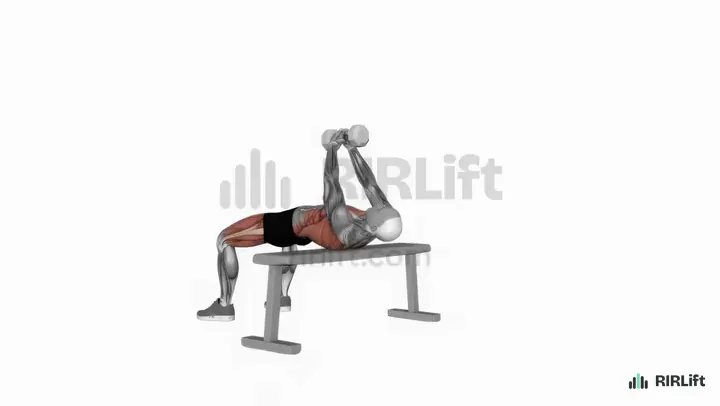
Dumbbell Lat Pullover

Lats

With no pull-up bar or pulldown, this is the only dumbbell lift that loads the lats from a long stretch overhead. Use it as the lighter back exercise between your rows and your curls.

How to do it

  1. Lie on a flat bench with your head near one end and your feet flat on the floor.
  2. Hold one dumbbell with both hands under the top plate, arms straight above your chest.
  3. Keep your elbows softly bent and fixed, and let the dumbbell travel back behind your head in an arc. Stop once your upper arms reach the line of your body.
  4. Pull it back over your chest along the same arc, feeling the pull come from your armpits, and repeat.

Cues

  • Ribs down, no arching
  • Pull with your armpits
  • Stop when upper arms line up with your torso

Common mistakes

  • Bending the elbows more as the dumbbell goes back, which turns it into a triceps extension: fix the elbow angle and lighten the load.
  • Letting your ribcage flare to go deeper: brace your abs and stop at the point where your back wants to arch.

Swap for: Kettlebell Pullover, Straight-Arm Pulldown, One-Arm Dumbbell Row

Upper back, traps and rear delts

Rowing with the elbows wider, around 45 degrees from your sides, moves the work to the muscles between and above the shoulder blades. A bench to lie on takes your lower back out of it so you can push these sets hard.

Upper back, two-arm row

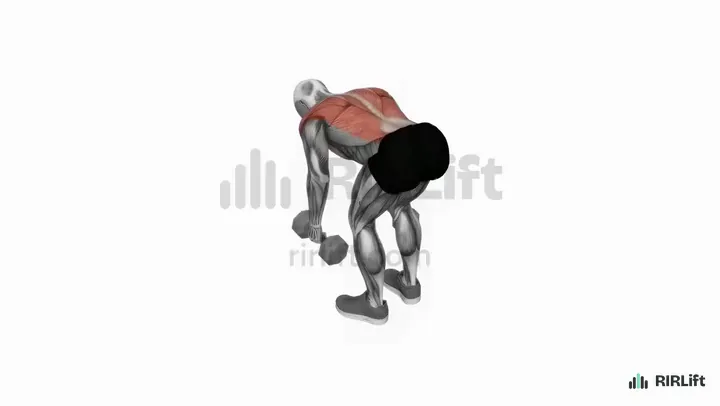
Dumbbell Bent-Over Row

Upper Back, Lats

Rowing two dumbbells at once trains both sides in half the time of a one-arm row and lets you pull with the elbows a little wider. It is the main row when you have no bench.

How to do it

  1. Take one dumbbell per hand, feet about hip-width apart, and hinge forward from the hips with soft knees until your torso is nearly level with the floor.
  2. Let the dumbbells hang straight down under your shoulders, palms turned in.
  3. Pull both dumbbells up to your lower ribs, keeping the elbows close, and hold the top for a beat.
  4. Lower to straight arms without letting your torso rise and repeat.

Cues

  • Torso angle stays locked
  • Pull to the ribs
  • Squeeze, then lower

Common mistakes

  • Letting the hinge rise until you are rowing upright: keep a mirror or phone camera to the side and stop the set when your chest climbs.
  • Yanking the dumbbells with your hips: the legs stay still and the elbows do the work.

Swap for: One-Arm Dumbbell Row, Kettlebell Gorilla Row, Band Bent-Over Row

Upper back, chest-supported row

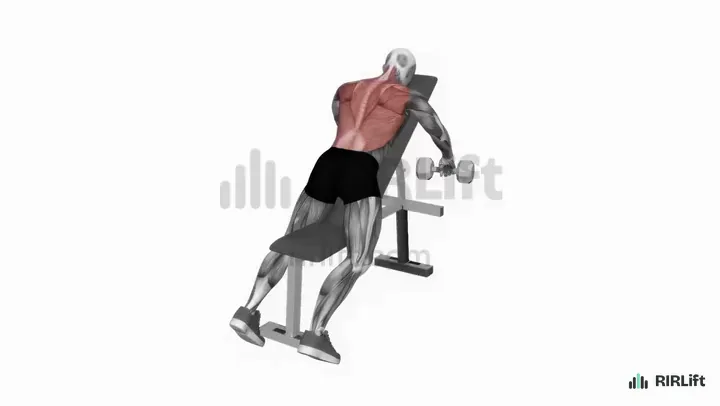
Incline Dumbbell Row

Upper Back, Lats

With your chest on the pad, the only thing that can quit is your upper back, so the final reps of each set land where you want them. Good second row after a heavy bent-over or one-arm row.

How to do it

  1. Set a bench to about 45 degrees and lie chest-down on it, a dumbbell in each hand, arms hanging straight toward the floor.
  2. Row the dumbbells up by driving your elbows back and slightly out, until your upper arms reach the line of your body.
  3. Squeeze your shoulder blades together for a second at the top with your chest still on the pad.
  4. Lower until your arms are straight and your shoulder blades slide forward, then repeat.

Cues

  • Chest glued to the pad
  • Elbows wide for upper back, tucked for lats
  • Full stretch between reps

Common mistakes

  • Lifting your chest off the pad to finish reps: that is your lower back joining in. Stop the set there.
  • Shrugging the dumbbells up instead of rowing them: pull the shoulder blades down and back before the elbows bend.

Swap for: Chest-Supported Row, One-Arm Dumbbell Row, Dumbbell Rear Delt Row

Upper back, strict row from the floor

Dumbbell Pendlay Row

Lats, Upper Back

The dumbbells settle on the floor between reps, which kills momentum and makes every pull start from a dead stop. Use it for the heavy, low-rep row of the week.

How to do it

  1. Place two dumbbells on the floor just in front of your feet and hinge down until your torso is level with the floor, back flat.
  2. Grip both dumbbells, take the slack out of your arms, and brace your trunk.
  3. Row both dumbbells to your lower ribs in one strong pull, elbows close to your sides.
  4. Lower them all the way back to the floor, let them settle, and reset your back before the next rep.

Cues

  • Dead stop on the floor every rep
  • Flat back before you pull
  • Explode up, control down

Common mistakes

  • Tapping the dumbbells and bouncing them back up: let them come to rest, then pull again.
  • Raising your torso as you row: the chest stays at the same height from the first rep to the last.

Swap for: Dumbbell Bent-Over Row, Pendlay Row, One-Arm Dumbbell Row

Traps, shrug

Dumbbell Shrug

Traps

Rows barely train the upper traps. Two or three sets of shrugs at the end of the back work fill in the slope between your neck and shoulders.

How to do it

  1. Stand tall holding a dumbbell at each side, palms facing in, arms straight.
  2. Lift your shoulders straight up toward your ears as high as they go.
  3. Hold the top for one full second.
  4. Lower slowly until your shoulders are fully dropped, then repeat.

Cues

  • Straight up, not rolled
  • One-second hold at the top
  • Arms stay straight

Common mistakes

  • Rolling the shoulders in a circle: it adds nothing for the traps and is hard on the joint. Up and down only.
  • Bending the elbows to lift the dumbbells higher: that is your biceps helping. Lighten the load and keep the arms long.

Swap for: Incline Dumbbell Shrug, Barbell Shrug, Farmer's Walk

Rear delts, seated fly

Dumbbell Rear Delt Fly

Shoulders

The rear delts sit on top of the upper back and get little from rows. A light fly with the chest on your thighs finishes the back from behind, and it pairs well with a curl to save time.

How to do it

  1. Sit on the end of a bench, feet together and planted, with a light dumbbell in each hand.
  2. Fold forward from the hips until your chest nearly touches your knees, and let the weights hang below your legs, palms turned in.
  3. Bend your elbows a little and lock that angle in for the whole set.
  4. Open your arms out and up in a wide arc, elbows leading, and stop when your upper arms line up with your back.
  5. Pause for a beat at the top, then take two to three seconds to bring them back down until your arms hang straight again.

Cues

  • Arms wide, like spreading wings
  • Reach for the walls, not the ceiling
  • Chest stays on your knees

Common mistakes

  • Sitting up as the weights rise: if your chest leaves your knees to finish the rep, drop to lighter dumbbells and stop where your upper arms reach your back.
  • Turning the fly into a row: if your elbows bend more and drift toward your ribs, your lats take over; keep the same small elbow bend from the first rep to the last.
  • Shrugging your shoulders toward your ears at the top: keep your neck long and think about reaching your hands toward the walls rather than the ceiling.

Swap for: Incline Dumbbell Rear Delt Raise, Band Pull-Apart, Reverse Pec Deck

Curls for the biceps

Pick curls that load the biceps at different arm angles: arms behind you on an incline, at your sides standing, and braced against the leg. Two of them after your rows covers the week.

Biceps long head, stretched curl

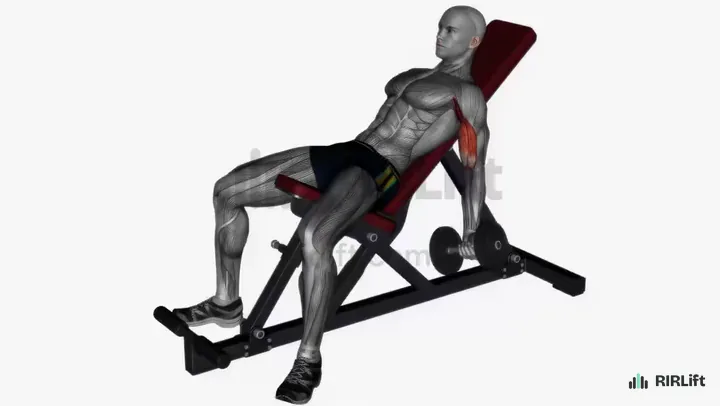
Incline Dumbbell Curl

Biceps

Your arms hang behind your body on the incline, which puts the biceps at full stretch where they grow fastest. Make it the first curl of the day, right after the rows.

How to do it

  1. Tilt an adjustable bench back to about 45 to 60 degrees and sit back holding a pair of dumbbells.
  2. Let your arms hang straight down behind your torso with your palms forward.
  3. Curl both dumbbells up without letting your elbows travel forward.
  4. Lower all the way until your arms hang fully stretched again.

Cues

  • Head and shoulders on the pad
  • Elbows point at the floor
  • Full stretch at the bottom

Common mistakes

  • Bringing the elbows forward to make the curl easier: that removes the stretch that makes this exercise worth doing.
  • Choosing your usual curl weight: this angle is harder, so start a little lighter.

Swap for: Spider Curl, Cable Curl, Dumbbell Curl

Biceps, alternating standing curl

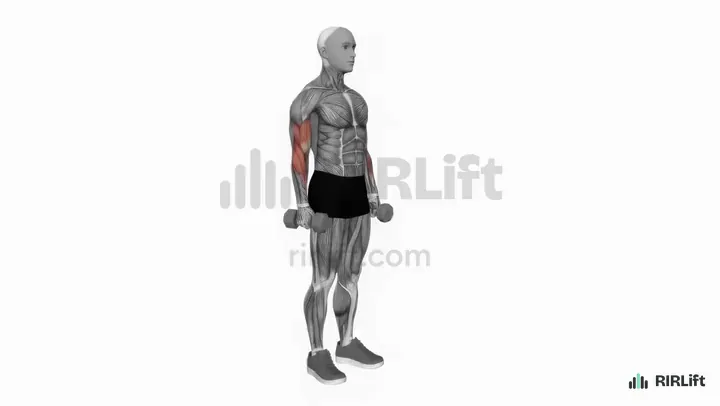
Dumbbell Curl

Biceps

Curling one arm at a time lets you turn each palm up through the whole rep and rest the other arm for a second. It needs nothing but the dumbbells, so it works in any of the sessions.

How to do it

  1. Stand tall with one or two dumbbells, palms facing forward.
  2. Curl the weight toward your shoulder, keeping your upper arm still.
  3. Squeeze the biceps hard when your forearm is upright.
  4. Lower until your elbow is straight.

Cues

  • Upper arm still
  • Squeeze at the top
  • Straight elbow at the bottom

Common mistakes

  • Rocking your body: brace against a wall.
  • Stopping short at the bottom: lower all the way.

Swap for: Kettlebell Curl, EZ-Bar Curl

Biceps, braced one-arm curl

Concentration Curl

Biceps

Bracing your elbow against the inside of the thigh stops any swing, so a light dumbbell still takes the biceps close to failure. Use it last, for 10 to 15 reps.

How to do it

  1. Sit on the end of a bench with your feet wider than your hips and flat on the floor.
  2. Pick up a dumbbell, lean forward slightly from the hips and set the back of your working upper arm against the inside of the same-side thigh, just above the knee.
  3. Let the arm hang straight with the dumbbell near the floor, palm facing the other leg, and rest your free hand on your other knee.
  4. Curl the dumbbell up toward your shoulder while your upper arm stays pressed against your leg, and squeeze for a second at the top.
  5. Lower slowly until your arm is straight again, finish the set, then switch sides.

Cues

  • Arm stays on the thigh
  • Pinky turns up at the top
  • Slow on the way down

Common mistakes

  • Lifting the elbow off the thigh: once the arm leaves your leg the shoulder starts to help. Keep the contact for the whole set.
  • Rocking the torso up to finish the rep: if you have to sit up to complete it, stop the set there or use a lighter dumbbell.
  • Stopping short of a straight arm: the bottom of the rep counts, so let the elbow open fully before each curl.

Swap for: Spider Curl, Kettlebell Concentration Curl, Dumbbell Curl

Hammer and Zottman curls for arm thickness

A thumbs-up grip shifts the curl to the brachialis and the forearm muscle on top of the elbow. Both add width to the arm seen from the front, and both handle heavier dumbbells than a palms-up curl.

Brachialis and forearm, neutral-grip curl

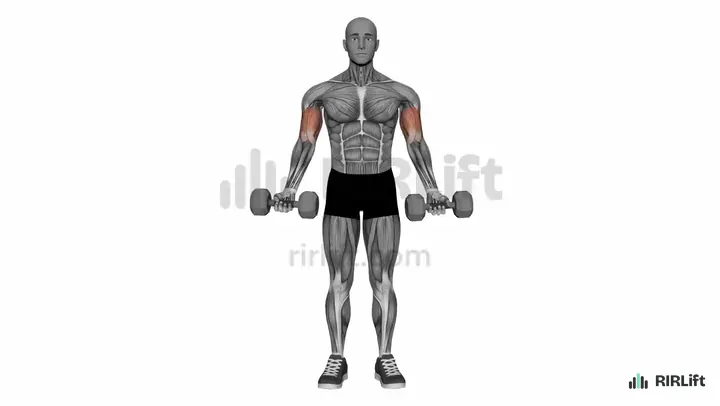
Hammer Curl

Biceps, Forearms

A thumbs-up grip lets you handle a heavier dumbbell than a palms-up curl and trains the brachialis under the biceps. If a session runs short, keep this curl and drop the others.

How to do it

  1. Hold the dumbbells at your sides with your palms facing your thighs.
  2. Bend one elbow to bring that dumbbell up, thumb leading.
  3. Keep the dumbbell vertical the whole way, then lower it slowly to the start.
  4. Curl the other arm, and keep alternating until the set is done.

Cues

  • Thumbs lead
  • Dumbbells vertical
  • Elbows by your sides

Common mistakes

  • Swinging heavier weight with your back: keep your torso still.
  • Curling across your body: keep each dumbbell in line with its shoulder.

Swap for: Band Hammer Curl, Alternating Hammer Curl

Biceps and forearm, curl up and reverse down

Zottman Curl

Biceps, Forearms

You curl palms up and lower palms down, so the biceps lift the weight and the forearm controls the way down. It covers two muscles in one exercise when a session is short.

How to do it

  1. Stand with your palms facing forward and the dumbbells at your sides.
  2. Curl them up to shoulder height.
  3. Rotate your palms to face down at the top.
  4. Lower slowly, palms down, and rotate back at the bottom.

Cues

  • Turn at the top
  • Slow lowering
  • Elbows stay at your sides

Common mistakes

  • Turning the palms on the way down: finish the rotation first.
  • Going too heavy: the palms-down lowering sets the weight.

Swap for: Hammer Curl, Reverse Curl

Put them together: example sessions

Each session below picks from the exercises above for one situation, with the sets, reps, rest and RIR filled in.

Session 1

One back and biceps day a week, dumbbells and a bench

  • Workouts1× a week
  • Working sets19 a week
  • Per workout~45 min
  • EquipmentDumbbells, Incline Bench

You run a four or five day split where one day is back and biceps, and you train with a dumbbell rack and an adjustable bench, at home or in a gym.

One weekly session works if it carries enough volume: 13 sets for the back and 6 direct biceps sets, plus the indirect biceps work from every row. That lands the back near the middle of the 12 to 20 weekly sets that grow most people.

Back and biceps
ExerciseSets × repsRIRRest
One-Arm Dumbbell Row2 warm-up sets firstPer arm. 4 × 8–10 2 2 min
Incline Dumbbell Row 3 × 10–12 2 90 s
Dumbbell Lat Pullover 3 × 10–12 1 90 s
Dumbbell Rear Delt Fly 3 × 12–15 1 1 min
Incline Dumbbell Curl 3 × 8–12 1 90 s
Hammer Curl 3 × 10–12 1 1 min
How to run it
Put it two or three days after your chest or push day so your shoulders are rested, and leave 48 hours before the next day that uses your grip hard.
How to progress
Climb the rep range first; once all sets of a lift hit the top with the planned reps in reserve, move to the next dumbbell and drop back to the low end. Log the reps in reserve on each set and RIRLift sets next week's weight from them.

Session 2

Back and biceps twice a week, 35 minutes each

  • Workouts2× a week
  • Working sets26 a week
  • Per workout~35 min
  • EquipmentDumbbells

You train upper and lower body on alternating days, or simply prefer two short pulling sessions to one long one.

Splitting the work over two days lets you train each row with fresh hands, and gives the back 16 sets and the biceps 10 direct sets a week. Each day is 13 sets, about 35 minutes with rests.

Day A: Bent-over row and curls
ExerciseSets × repsRIRRest
Dumbbell Bent-Over Row2 warm-up sets first 3 × 6–10 2 2 min
Reverse-Grip Dumbbell Row 3 × 10–12 2 90 s
Dumbbell Shrug 2 × 10–15 1 1 min
Dumbbell CurlPer arm. 3 × 8–12 1 75 s
Zottman Curl 2 × 10–12 1 1 min
Day B: Pendlay row and hammer curls
ExerciseSets × repsRIRRest
Dumbbell Pendlay Row1 warm-up set first 3 × 6–8 2 2 min
One-Arm Dumbbell RowPer arm. 3 × 10–12 2 90 s
Dumbbell Rear Delt Fly 2 × 15–20 1 1 min
Hammer Curl 3 × 8–12 1 75 s
Concentration CurlPer arm. 2 × 10–15 1 1 min
How to run it
Pair Day A with the start of your week and Day B with its second half, such as Monday and Thursday, placed after or in place of your pressing.
How to progress
Move the Pendlay and bent-over rows up one dumbbell size once every set reaches its top rep count with 2 reps still left. On curls and shrugs, add one rep a week until you pass the top of the range, then go up a size.

Session 3

No bench: rows and curls standing up

  • Workouts2× a week
  • Working sets30 a week
  • Per workout~35 min
  • EquipmentDumbbells

You have dumbbells at home but no bench, and you want one session you can repeat twice a week.

Without a bench, every row is done in a hinge, so the plan caps the back at 10 sets per session to keep your lower back from tiring before your lats do. Twice a week that is 20 back sets and 10 biceps sets.

Standing back and biceps
ExerciseSets × repsRIRRest
Dumbbell Pendlay Row2 warm-up sets first 3 × 6–10 2 2 min
Reverse-Grip Dumbbell Row 3 × 10–12 2 90 s
One-Arm Dumbbell RowPer arm. Free hand on a chair seat. 2 × 12–15 1 75 s
Dumbbell Shrug 2 × 12–15 1 1 min
Zottman Curl 3 × 8–10 1 75 s
Hammer Curl 2 × 12–15 1 1 min
How to run it
Do this one session on two days that sit far apart in the week, such as Tuesday and Friday.
How to progress
When the heaviest dumbbell you own gets easy on the Pendlay row, pause each rep one second at your chest and slow the lowering to three seconds before adding reps. On the curls, go heavier the session every set touches the top rep count.

Make it fit you

Questions

Should you work back and biceps together?

Yes, for most splits it is the efficient choice. Rows already work the biceps, so training them the same day means the arms recover once instead of being tired again a day later. Do the back first so the curls cannot weaken your rows.

Can you build a big back with only dumbbells?

You can build most of it. One-arm, bent-over and incline rows cover the lats and upper back, shrugs cover the traps, and the pullover adds an overhead stretch. The one missing piece is a vertical pull, which a pull-up bar fills.

Can I work biceps every day?

You can curl lightly every day, but you will not grow more from it. Two or three hard sessions a week, with a day off between, let the biceps recover enough to lift more next time. Your rows count toward that work.

What is the 7-7-7 bicep exercise?

That is the curl method known as 21s: seven half reps in the lower range, seven in the upper range, and seven full reps back to back. It is a hard finisher for the last set of a curl, not a replacement for regular sets you can add weight to.

How many sets for back and biceps per week?

Aim for 12 to 20 hard sets for the back and 6 to 12 direct sets for the biceps. Start at the low end and add sets only when you stop progressing.