Exercises to build muscle: squat, hinge, push and pull

The best exercises to build muscle cover four movement patterns: a squat (barbell back squat, leg press or goblet squat), a hip hinge (Romanian deadlift), a push (bench press, dumbbell press, shoulder press or push-up) and a pull (pull-up, lat pulldown, barbell row or one-arm dumbbell row). Train each pattern twice a week with 3 to 4 sets of 6 to 15 reps, ending each set 1 to 3 reps short of failure, and add weight or reps whenever you hit the top of the range. Those few lifts, done consistently for months, build more muscle than any long list of exercises.

  1. Barbell Back Squat Quads, Glutes, Adductors
  2. Romanian Deadlift Hamstrings, Glutes
  3. Barbell Bench Press Chest
  4. Pull-Up Lats
  5. Barbell Row Upper Back, Lats
  6. Dumbbell Shoulder Press Shoulders
  7. Leg Press Quads, Glutes
  8. Lat Pulldown Lats

Squats for the legs

A squat trains the quads and glutes, the largest muscles you have, so it trains more muscle per set than almost anything else. Pick one barbell or machine squat as your main lift, and use the goblet squat at home or to learn the pattern.

Quads, glutes and adductors, squat

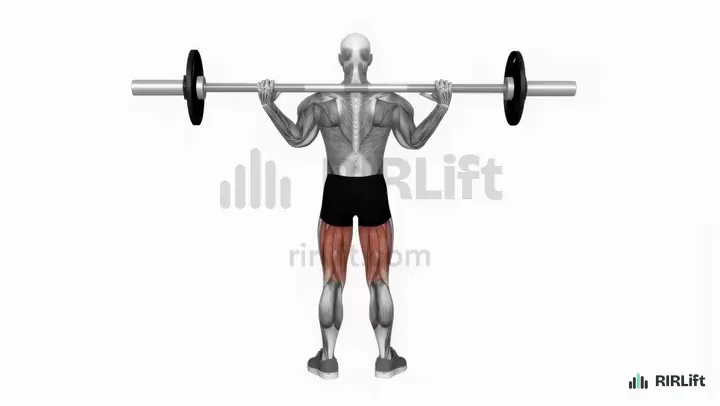
Barbell Back Squat

Quads, Glutes, Adductors

Few lifts put as much muscle under as much load at once, and the bar lets you add 5 pounds at a time for months. For muscle, squat to at least parallel and work in sets of 5 to 10.

How to do it

  1. Set the bar across your upper back below the neck, hands just outside your shoulders, and unrack it.
  2. Stand with your feet about shoulder-width apart, toes turned out a little.
  3. Breathe in, tighten your stomach as if bracing for a punch, and sit down between your heels.
  4. Stand back up keeping your chest and hips rising together.

Cues

  • Breathe and brace
  • Chest and hips rise together
  • Whole-foot pressure

Common mistakes

  • Hips shooting up first out of the bottom: lighten the bar and keep your chest rising with them.
  • Letting the stomach go soft between reps: re-brace at the top of each one.

Swap for: Front Squat, Box Squat

Quads and glutes, machine squat

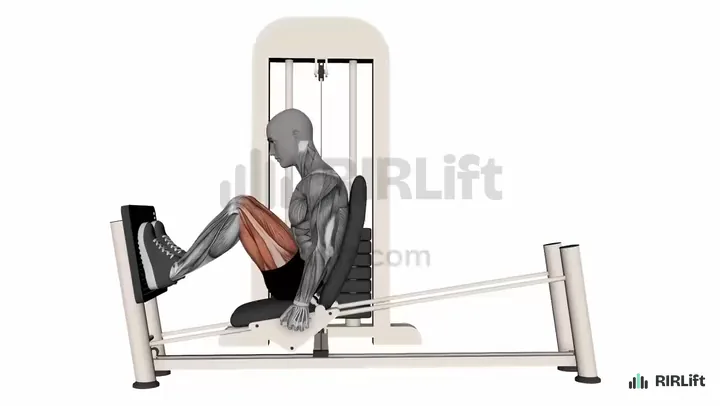
Leg Press

Quads, Glutes

It trains the same muscles as the squat with your back supported, so it is easy to learn and easy to push close to failure without your form breaking down. Beginners can use it as their main squat while they learn the barbell.

How to do it

  1. Sit in the machine with your whole back against the pad and your feet hip-width on the platform.
  2. Release the safety handles and bend your knees, bringing the platform toward you under control.
  3. Lower until your knees are bent to about 90 degrees or a little deeper, without your lower back curling off the pad.
  4. Press the platform away until your legs are nearly straight, and repeat.

Cues

  • Lower back stays on the pad
  • Whole foot pushes
  • Stop just short of locking out

Common mistakes

  • Going so deep that your hips roll up off the seat: stop where your back stays flat.
  • Snapping the knees straight at the top: keep a soft bend.

Swap for: 45-Degree Leg Press, Hack Squat, Barbell Back Squat

Quads and glutes, dumbbell squat

Goblet Squat

Quads, Glutes

Holding one dumbbell at your chest is the easiest way to learn a deep, upright squat. It is the squat in the home plan, where higher reps make up for the lighter load.

How to do it

  1. Hold a dumbbell or kettlebell vertically against your chest.
  2. Sit down between your knees, elbows inside them at the bottom.
  3. Stand up tall.

Cues

  • Elbows nudge the knees out at the bottom.
  • Chest stays up behind the weight.

Common mistakes

  • Letting the weight pull you forward.

Swap for: Bodyweight Squat, Barbell Back Squat

Hinges for the back of the body

Squats leave the hamstrings mostly untrained. A Romanian deadlift loads them, the glutes and the long back muscles in one lift, which covers the whole back of your body.

Hamstrings, glutes and lower back, hinge

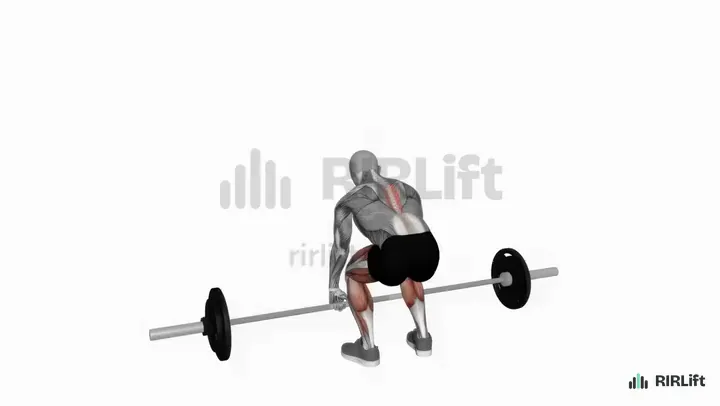
Romanian Deadlift

Hamstrings, Glutes

Lowering the bar along your legs with your hips pushed back loads the hamstrings in their stretched position, which is where they grow best. It is easier to recover from than a full deadlift, so you can do it twice a week.

How to do it

  1. Stand with a barbell at your thighs, hands just outside your legs, feet under your hips.
  2. Soften your knees and push your hips back, sliding the bar down your thighs.
  3. Stop when your hamstrings are fully stretched, usually just below the knee, with your back flat.
  4. Push your hips forward to stand up, glutes tight at the top.

Cues

  • Hips back
  • Bar stays on your legs
  • Back flat

Common mistakes

  • Bending the knees into a squat: keep them soft and still.
  • Reaching for the floor: stop where your back would round.

Swap for: Weighted Back Extension

Hamstrings and glutes, dumbbell hinge

Dumbbell Romanian Deadlift

Hamstrings, Glutes

The same hinge with dumbbells, for home training or a lighter second hinge in the week. Keep the dumbbells close to your legs and stop when your back starts to round.

How to do it

  1. Stand hip-width apart with a dumbbell in each hand resting against the front of your thighs, palms facing you.
  2. Push your hips straight back and let your torso fold forward, knees softly bent, the dumbbells brushing your legs.
  3. Lower until the dumbbells pass your knees and you feel a strong stretch in your hamstrings, with your back still flat.
  4. Drive your hips forward to stand back up, squeezing your glutes at the top, and repeat.

Cues

  • Hips back, not down
  • Dumbbells slide down your legs
  • Flat back, chin tucked

Common mistakes

  • Bending the knees into a squat so the dumbbells go lower: the depth comes from the hips, and most people stop just past the knees.
  • Rounding the lower back at the bottom: end the rep where your back stays flat, and lighten the load if that is high.

Swap for: Single-Leg RDL, Dumbbell Good Morning, Kettlebell Deadlift

Presses for chest, shoulders and triceps

A horizontal press builds the chest and triceps, and an overhead press builds the shoulders. Do one of each per week at minimum; two horizontal presses and one overhead suits most people.

Chest, front delts and triceps, press

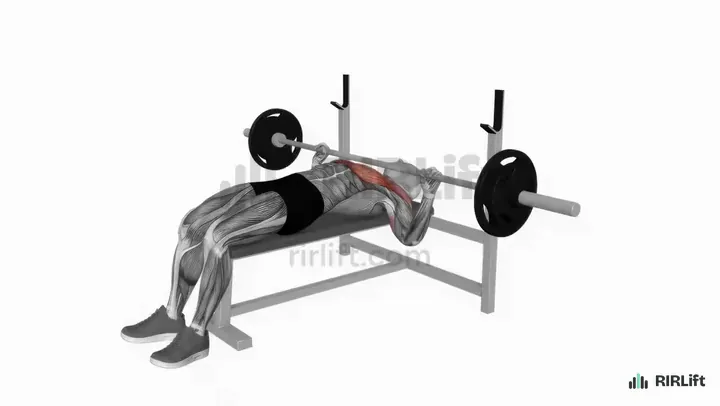
Barbell Bench Press

Chest

The bench press lets you load your chest, shoulders and triceps heavier than any other upper body lift, so it is the main upper body muscle builder in a gym.

How to do it

  1. Lie on the bench with your eyes under the bar, feet planted, and squeeze your shoulder blades back and down into the pad.
  2. Grip the bar a little wider than shoulder width, unrack it, and hold it over your shoulders with locked elbows.
  3. Lower the bar to your lower chest, around nipple height, with your elbows angled roughly 45 to 70 degrees from your sides.
  4. Touch your chest without bouncing, then press the bar up and slightly back until it is over your shoulders again.

Cues

  • Shoulder blades stay pinned
  • Bar to the nipple line
  • Drive your feet into the floor

Common mistakes

  • Flaring the elbows straight out to the sides: let them sit a bit closer to your ribs so your shoulders stay comfortable.
  • Lifting your hips off the bench to finish a rep: keep your glutes down and count that rep as your last.

Swap for: Flat Dumbbell Press, Smith Machine Bench Press, Machine Chest Press

Chest and triceps, dumbbell press

Flat Dumbbell Press

Chest

Dumbbells let your hands travel lower and come together at the top, a longer range than the bar, and each side has to press its own share. Use it as the second press of the week or as the main press at home.

How to do it

  1. Lying on a flat bench, hold two dumbbells above your chest.
  2. Lower the bells to the sides of your chest with elbows at about 45 degrees.
  3. Press them back up over your shoulders.

Cues

  • Shoulder blades pinched.
  • Control the lowering.

Common mistakes

  • Flaring the elbows straight out.

Swap for: Push-Up, Barbell Bench Press

Chest and triceps, bodyweight press

Push-Up

Chest

A push-up works the same muscles as the bench with no equipment. It finishes a session well, in sets taken close to failure, and it is the press for anyone who cannot get to a bench.

How to do it

  1. Set your hands slightly wider than your shoulders with your body straight from head to heels.
  2. Lower until your chest nearly touches the floor, elbows at about 45 degrees.
  3. Press back up to straight arms.

Cues

  • One straight line
  • Elbows angled back

Common mistakes

  • Flaring the elbows straight out: tuck them toward your ribs.

Swap for: Kneeling Push-Up, Incline Push-Up, Push-Up Plus

Shoulders and triceps, overhead press

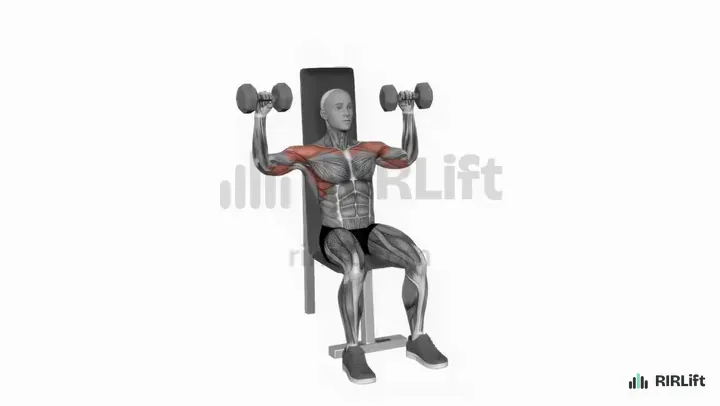
Dumbbell Shoulder Press

Shoulders

Pressing overhead builds the front and side delts that the bench only partly reaches. Seated with dumbbells, it is stable and easy to learn.

How to do it

  1. Set a bench upright or one notch back from vertical, sit with your feet flat, and rest a dumbbell on each thigh.
  2. Kick one knee up at a time to bring the dumbbells to shoulder height, then set your back against the pad.
  3. Turn your elbows slightly forward so they sit a little in front of your torso, palms facing forward or angled in.
  4. Drive both weights overhead on a slight inward arc until your elbows are straight, keeping your ribs down and your back on the pad.
  5. Lower slowly until the dumbbells are around ear height or a bit below, then press again.

Cues

  • Ribs down, back on the pad
  • Elbows a little forward
  • Press up and slightly in

Common mistakes

  • Arching your lower back off the pad to finish reps: that turns it into an incline press, so lighten the weight and keep your ribs stacked over your hips.
  • Flaring the elbows straight out at shoulder height: bring them a little forward so the shoulder joint stays comfortable at the bottom.
  • Stopping each rep well above your ears: lower to around ear height so the delts work through a full range.

Swap for: Machine Shoulder Press, Barbell Overhead Press, Arnold Press

Pulls for the back and biceps

A vertical pull builds the lats that widen your back, and a row builds the middle back that thickens it. Both train the biceps too. Match your pulling sets to your pressing sets each week.

Lats and biceps, bodyweight pull

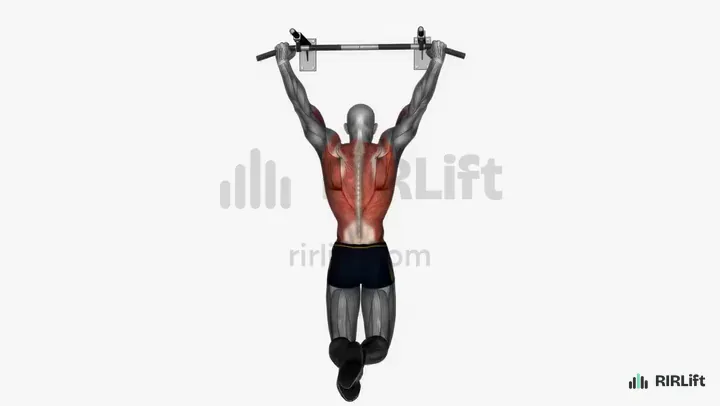
Pull-Up

Lats

Pulling your body up to a bar builds the lats and biceps together and needs only a bar. If you can do five, it is the pull to build your week around.

How to do it

  1. Grab the bar overhand, hands a little wider than your shoulders, and hang from fully straight arms.
  2. Pull your shoulders down away from your ears before your elbows start to bend.
  3. Drive the elbows toward your ribs until your chin passes over the bar.
  4. Lower slowly to a dead hang and pull again.

Cues

  • Shoulders down, then pull
  • Legs still and together
  • Two seconds on the way down

Common mistakes

  • Swinging the legs to cheat reps: cross your ankles and brace the abs.
  • Half reps from a bent-arm start: finish each rep at a full hang.

Swap for: Lat Pulldown, Assisted Pull-Up, Chin-Up

Lats and biceps, cable pull

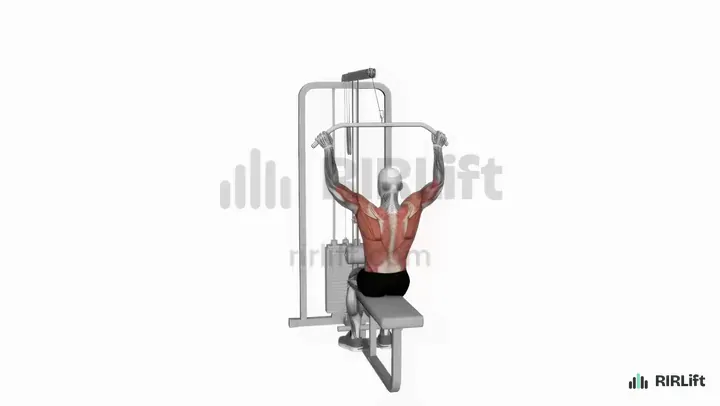
Lat Pulldown

Lats

The pulldown is the pull-up with a load you choose, which makes it the vertical pull for beginners and for higher-rep work after heavy rows.

How to do it

  1. Set the thigh pad so your legs are locked under it, then stand up and take the bar a little wider than your shoulders, palms forward.
  2. Sit down with your arms fully stretched overhead and lean back only slightly.
  3. Pull the bar to your upper chest by driving your elbows down toward your hips.
  4. Let the bar rise until your arms are straight and your shoulders lift toward your ears, then pull again.

Cues

  • Elbows to your back pockets
  • Bar to the top of the chest
  • Let the stack lift you at the top

Common mistakes

  • Leaning far back and rowing the bar to your stomach: stay nearly upright so it remains a vertical pull.
  • Stopping with the arms still bent at the top: the stretch overhead is half of what makes the pulldown work.

Swap for: Pull-Up, Neutral-Grip Lat Pulldown, Single-Arm Lat Pulldown

Middle back, lats and rear delts, row

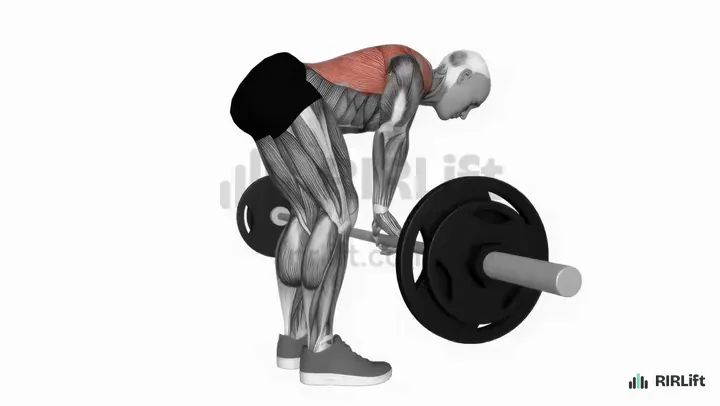
Barbell Row

Upper Back, Lats

Rowing a barbell to your stomach while bent over loads the whole back heavier than any other row. It is the pull to pair with the bench press, set for set.

How to do it

  1. Hold the bar at your thighs, hinge forward until your torso is near 45 degrees, back flat.
  2. Row the bar to your lower ribs with the elbows tucked near your sides.
  3. Lower to straight arms and keep the torso angle.

Cues

  • Brace before every rep
  • Bar to the belly button

Common mistakes

  • Standing taller each rep as it gets heavier: if the hinge goes, the set is over.

Swap for: Pendlay Row, Dumbbell Bent-Over Row, T-Bar Row

Lats and middle back, dumbbell row

One-Arm Dumbbell Row

Lats, Upper Back

Bracing on a bench takes your lower back out of it, so you can row heavy with one arm while the back works through a long range. It is the row in the home plan and the easier row for beginners.

How to do it

  1. Put one hand and the same-side knee on a bench, or your hand on a chair seat with both feet on the floor, so your back is flat.
  2. Hold a dumbbell in the other hand with your arm hanging straight.
  3. Pull your elbow back toward your hip until the dumbbell reaches your ribs.
  4. Lower it until your arm is straight again, finish all reps, then switch sides.

Cues

  • Elbow to your hip
  • Back flat as a table
  • Full stretch at the bottom

Common mistakes

  • Twisting your chest open to lift the dumbbell higher: keep both shoulders level.
  • Shrugging the shoulder up toward your ear: pull the elbow back, not the shoulder up.

Swap for: Band Bent-Over Row, Dumbbell Bent-Over Row, Seated Cable Row

Put them together: example sessions

Each session below picks from the exercises above for one situation, with the sets, reps, rest and RIR filled in.

Session 1

Beginner, three full-body days in a gym

  • Workouts3× a week
  • Working sets33 a week
  • Per workout~35 min
  • EquipmentBarbells, Flat Bench, Lat Pulldown, Leg Press +1

You are new to lifting or coming back after a long break, you train in a gym, and you want to build muscle across your whole body.

New lifters grow from fewer sets than experienced ones, and training each pattern three times a week teaches the movements faster. Each day has a squat, a hinge, a push and a pull at 2 reps in reserve, 11 sets in all, about 45 minutes. Across a week of A, B and A, each muscle gets about 6 to 9 sets.

Day A: Squat and bench
ExerciseSets × repsRIRRest
Barbell Back Squat2 warm-up sets first 3 × 6–10 2 2:30 min
Barbell Bench Press 3 × 6–10 2 2:30 min
Lat Pulldown 3 × 8–12 2 90 s
Romanian Deadlift 2 × 8–10 2 2 min
Day B: Leg press and shoulder press
ExerciseSets × repsRIRRest
Leg Press 3 × 10–12 2 2 min
Dumbbell Shoulder Press1 warm-up set first 3 × 8–12 2 2 min
One-Arm Dumbbell RowPer arm. 3 × 8–12 2 90 s
Dumbbell Romanian Deadlift 2 × 10–12 2 90 s
How to run it
Train three non-consecutive days a week, alternating A and B: A, B, A one week and B, A, B the next.
How to progress
Start light enough that the first week feels easy. Each time a lift reaches the top of its rep range on every set with 2 reps still in reserve, add the smallest weight step: 5 pounds on barbell lifts, one dumbbell size on dumbbells. Expect the lifts to go up almost every week for the first few months.

Session 2

Past the beginner stage, four days a week

  • Workouts4× a week
  • Working sets45 a week
  • Per workout~35 min
  • EquipmentBarbells, Flat Bench, Dumbbells, Pull-Up Bar +2

You have lifted consistently for six months or more, your beginner gains have slowed, and you can train four days a week in a gym.

Splitting upper and lower body lets each session hold more sets per muscle, about 9 to 13 hard sets a week for chest, back and legs. Each session opens with a heavy compound at 2 reps in reserve and moves to lighter, higher-rep work taken to 1. Upper days are 14 and 11 sets; lower days are 10 each.

Upper 1: Bench and rows
ExerciseSets × repsRIRRest
Barbell Bench Press2 warm-up sets first 4 × 5–8 2 3 min
Barbell Row 4 × 6–10 2 2:30 min
Dumbbell Shoulder Press 3 × 8–12 1 2 min
Pull-Up 3 × 6–10 1 2 min
Lower 1: Squat
ExerciseSets × repsRIRRest
Barbell Back Squat3 warm-up sets first 4 × 5–8 2 3 min
Romanian Deadlift 3 × 8–10 2 2:30 min
Leg Press 3 × 10–15 1 2 min
Upper 2: Dumbbell press and pulldowns
ExerciseSets × repsRIRRest
Flat Dumbbell Press1 warm-up set first 3 × 8–12 1 2 min
Lat Pulldown 3 × 10–12 1 90 s
One-Arm Dumbbell RowPer arm. 3 × 10–12 1 90 s
Push-Up 2 × 10–25 1 90 s
Lower 2: Romanian deadlift
ExerciseSets × repsRIRRest
Romanian Deadlift2 warm-up sets first 4 × 6–10 2 2:30 min
Leg Press 4 × 10–15 1 2 min
Goblet Squat 2 × 15–20 1 90 s
How to run it
Run Upper 1, Lower 1, a rest day, Upper 2, Lower 2, then two rest days. Keep Lower 1 and Lower 2 at least two days apart.
How to progress
Main lifts move in weekly steps: when all sets land at the top of the range at 2 reps in reserve, add 5 pounds. The lighter accessory work moves by reps first. If a main lift stalls for three weeks running, take a lighter week, then build again.

Session 3

At home with dumbbells and a pull-up bar

  • Workouts3× a week
  • Working sets41 a week
  • Per workout~40 min
  • EquipmentDumbbells, Flat Bench, Pull-Up Bar

You train at home with adjustable dumbbells, a flat bench and a pull-up bar, and want to build muscle without a gym membership.

Dumbbells cap how heavy the squat can go, so leg work runs in higher reps closer to failure, while presses, rows and pull-ups stay in the usual 6 to 12. Each day covers all four patterns: Day A is 13 sets and Day B is 14, three days a week.

Day A: Goblet squat and dumbbell press
ExerciseSets × repsRIRRest
Goblet Squat1 warm-up set first 4 × 10–15 1 2 min
Flat Dumbbell Press 3 × 8–12 1 2 min
Pull-Up 3 × 5–10 1 2 min
Dumbbell Romanian Deadlift 3 × 10–12 2 2 min
Day B: Hinge and shoulder press
ExerciseSets × repsRIRRest
Dumbbell Romanian Deadlift1 warm-up set first 3 × 8–12 2 2 min
Goblet Squat 3 × 15–20 1 90 s
Dumbbell Shoulder Press 3 × 8–12 1 2 min
One-Arm Dumbbell RowPer arm. 3 × 10–12 1 90 s
Push-Up 2 × 10–25 1 90 s
How to run it
Train three days a week, alternating A and B, with a rest day after each session. Each takes 45 to 55 minutes.
How to progress
Add reps each week at the target reps in reserve, and move to the next dumbbell size when the top of the range is reached on every set. When the heaviest dumbbells are too light for goblet squats, slow the lowering to three seconds and pause at the bottom.

Make it fit you

Questions

What is the best exercise to gain muscle?

There is no single one, but the squat comes closest because it trains the largest muscles under heavy load. For the upper body, the bench press and a row or pull-up together cover most of it.

What are the 7 exercises to build muscle?

A good set of seven: squat, Romanian deadlift, bench press, overhead press, pull-up, barbell row and leg press. Those cover every major muscle; add curls and raises later for detail.

How many sets and reps build muscle?

Roughly 10 to 20 hard sets per muscle per week, in 6 to 15 reps per set, stopping 0 to 3 reps short of failure. Beginners grow on the low end of that range.

Can I build muscle at home?

Yes. Adjustable dumbbells, a bench and a pull-up bar cover all four patterns. Use higher reps on legs, because dumbbells run out of weight there first.

How long does it take to build muscle?

Strength goes up within weeks; visible muscle usually takes two to three months of consistent training and enough food. Beginners gain fastest in their first year.