Glute exercises at the gym: barbells, machines and cables

The best glute exercises at the gym are the barbell hip thrust, the Romanian deadlift, the Bulgarian split squat on the Smith machine, the cable kickback and the hip abduction machine. The thrust loads your glutes hardest when they are fully squeezed, the Romanian deadlift when they are stretched, and the machines and cables let you push each glute to failure without your back or balance giving out first. Build each glute day from one heavy thrust or hinge, one single-leg or leg press move, and one or two machine or cable finishers.

  1. Hip Thrust Glutes
  2. Romanian Deadlift Hamstrings, Glutes
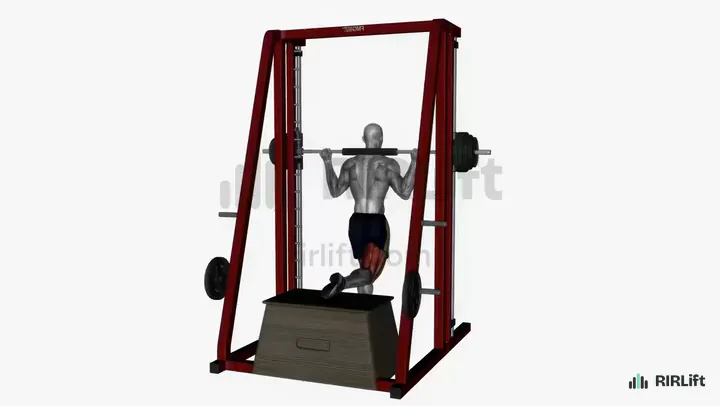
  3. Smith Machine Bulgarian Split Squat Quads, Glutes
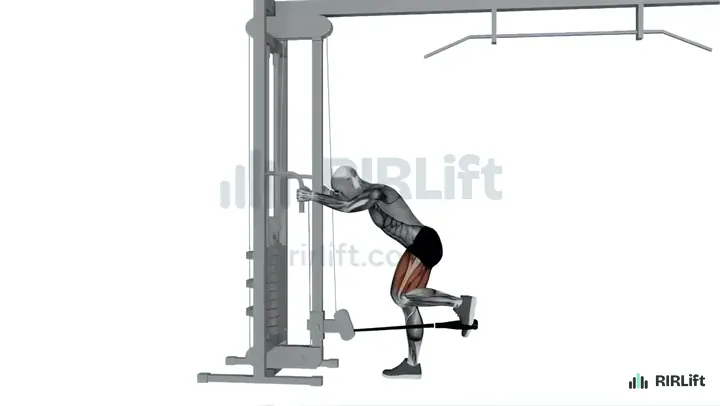
  4. Cable Glute Kickback Glutes
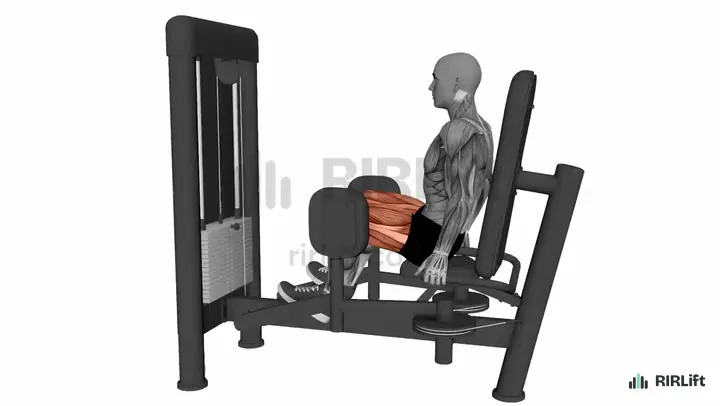
  5. Hip Abduction Machine Abductors
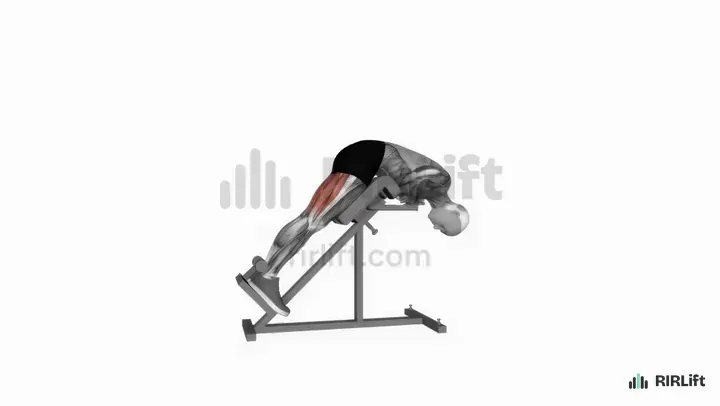
  6. 45-Degree Back Extension Glutes, Hamstrings
  7. Wide-Stance Leg Press Glutes, Quads
  8. Sumo Deadlift Glutes, Hamstrings, Quads
Hip thrusts: barbell and Smith machine

These two are what a gym gives you that a home rarely can: a bar you can load past your bodyweight across your hips. Use the barbell version if a pad and a stable bench are free, and the Smith version when you want a faster setup or the racks are taken.

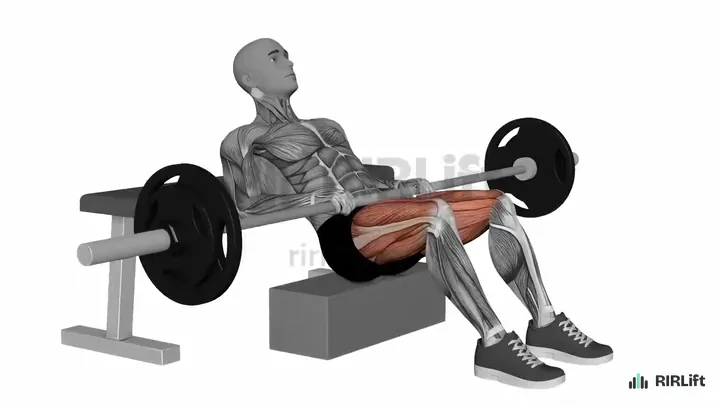
Glute max, barbell hip thrust

Hip Thrust

Glutes

The barbell hip thrust lets you put more load on the glutes than any other exercise in the gym, and the hardest point is at lockout, where the glutes are fully contracted. Most gyms now have a pad for the bar and a bench at the right height, so it is the first lift to claim on glute day.

How to do it

  1. Sit down with the bottom of your shoulder blades against a flat bench and roll a padded barbell over your legs until it rests in your hip crease.
  2. Plant your feet flat, a little wider than hip-width, so your shins will be vertical at the top.
  3. Brace, tuck your chin, and drive through your heels until your hips are level with your knees, the bench acting as a hinge under your upper back.
  4. Hold the lockout for a second, lower until the plates nearly touch the floor, and repeat.

Cues

  • Eyes forward, chin tucked at lockout
  • Ribs stay down
  • Push through the heels

Common mistakes

  • Arching the lower back to finish the rep: the glutes are done when your torso is level, not higher.
  • Letting the bench slide away: brace it against a wall or a rack, or use a thrust station.

Swap for: Smith Machine Hip Thrust, Glute Bridge, Dumbbell Hip Thrust

Glute max, guided hip thrust

Smith Machine Hip Thrust

Glutes

On the Smith machine, the bar runs on a fixed track, so you skip the balancing and the awkward roll-in and just push. It is the easier thrust to set up and the one to use when every barbell is taken or when you are learning the movement.

How to do it

  1. Set a flat bench lengthwise beside the Smith machine and sit with your upper back on it, the bar unracked above your hips.
  2. Lower the bar onto a pad in your hip crease and plant your feet so the shins will be vertical at the top.
  3. Twist the bar to unhook it, then drive your hips up until your torso is level.
  4. Squeeze for a second, lower until your hips almost reach the floor, and re-hook the bar when the set is done.

Cues

  • Set the safeties just below your bottom position
  • Shins vertical at the top
  • Pause every rep

Common mistakes

  • Placing your feet too far forward so the hamstrings cramp: walk them back toward the bench.
  • Forgetting to set the safety stops: set them before the first rep.

Swap for: Hip Thrust, Glute Bridge, Dumbbell Hip Thrust

Barbell hinges

Hinges load the glutes in a deep stretch, and the barbell lets you load them more than anything else. Pick one per session: the Romanian deadlift for glutes and hamstrings, the sumo deadlift when you want the inner thighs and a more upright back.

Glutes and hamstrings, barbell hinge

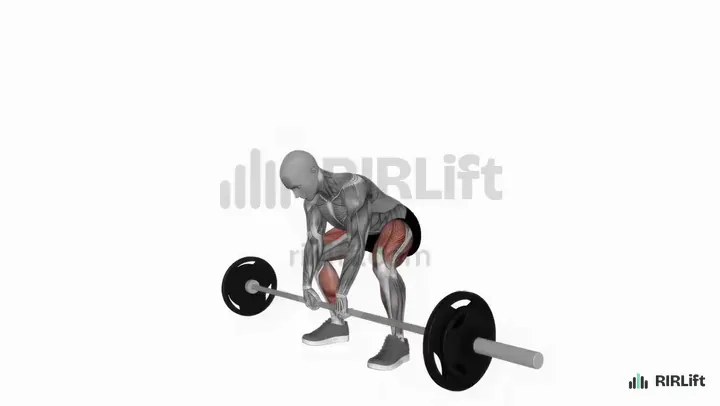
Romanian Deadlift

Hamstrings, Glutes

The barbell Romanian deadlift loads the glutes at long length, which is where the thrust is weakest, so the two lifts complement each other. With a barbell, you can load it far heavier than any dumbbell version.

How to do it

  1. Take the bar from a rack at hip height with an overhand grip just outside your thighs.
  2. Step back, unlock your knees, and push your hips back as the bar slides down your thighs.
  3. Lower until the hamstrings are fully stretched and your back is still flat, usually to mid-shin.
  4. Bring your hips through to stand up, the bar staying close to your legs.

Cues

  • Bar stays in contact with the legs
  • Hips back, knees soft
  • Flat back from start to finish

Common mistakes

  • Letting the bar drift forward away from your legs: keep it brushing your thighs and shins.
  • Going lower than your back can stay flat: depth ends where the spine starts to round.

Swap for: Sumo Romanian Deadlift, Landmine RDL, Dumbbell Romanian Deadlift

Glutes, adductors and hamstrings, wide-stance pull

Sumo Deadlift

Glutes, Hamstrings, Quads
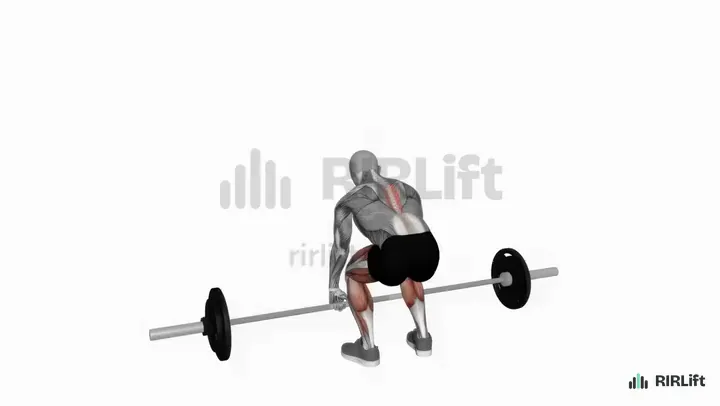
A wide stance with your toes turned out lets you keep your torso more upright and asks more of the glutes and inner thighs than a conventional deadlift. It is the heavy pull to use when glutes, not back, are the goal.

How to do it

  1. Stand with your feet wide, toes turned out about 30 to 45 degrees, and the bar over the middle of your feet.
  2. Reach down between your legs and grip the bar with your arms hanging straight from the shoulders.
  3. Push your knees out over your toes, flatten your back, and push the floor apart with your feet to break the bar off the floor.
  4. Stand tall with your hips locked out, then lower the bar the same way.

Cues

  • Knees out over the toes
  • Chest up, hips close to the bar
  • Push the floor away

Common mistakes

  • Letting the hips shoot up first so it becomes a stiff-leg pull: drive the knees out and the chest up together.
  • Setting the feet so wide that the knees cannot track over the toes: narrow the stance until they can.

Swap for: Trap Bar Deadlift, Kettlebell Sumo Deadlift, Romanian Deadlift

Glute machines

Machines are where a gym pulls clearly ahead of home training for glutes: the multi-hip kickback, the abduction seat, the 45-degree bench and a leg press or hack squat with the feet set high. Each one isolates or supports, so you can push sets closer to failure with less fatigue.

Glutes and hamstrings, angled hip extension

45-Degree Back Extension

Glutes, Hamstrings

On a 45-degree bench, rounding your upper back a little and turning your feet out shifts this from a lower-back move to a glute exercise. It loads the glutes from stretch to lockout and is easy to add weight to by holding a plate.

How to do it

  1. Set the pad so its top edge sits just below your hip bones and hook your heels under the foot rollers, toes turned out slightly.
  2. Cross your arms over your chest, or hold a plate there, and round your upper back slightly.
  3. Hinge down at the hips until you feel a stretch in your glutes and hamstrings.
  4. Push your hips into the pad and squeeze your glutes to raise your torso until your body is in a straight line, without arching past it.

Cues

  • Pad below the hip bones
  • Push the hips into the pad
  • Stop at a straight line

Common mistakes

  • Arching hard at the top, which loads the lower back: finish in a straight line.
  • Setting the pad too high so the hips cannot bend: lower it until your hips fold freely.

Swap for: Back Extension, Cable Pull-Through, Glute Ham Raise

Glute max, machine kickback

Multi-Hip Glute Extension

Glutes

The multi-hip machine lets you push one leg back against a padded lever with a fixed path and a selectorized stack, so it is easier to load and repeat than the cable version. Use it when your gym has one and the cable station is busy.

How to do it

  1. Set the machine for hip extension and adjust the platform so the pivot lines up with your hip.
  2. Stand on the platform, put the back of your working thigh against the pad, and hold the handles.
  3. Drive the leg back until your hip is fully extended, keeping your torso still.
  4. Return under control and finish all reps before switching legs.

Cues

  • Pivot lined up with the hip
  • Torso stays still
  • Slow return

Common mistakes

  • Leaning forward and back to move more weight: fix your torso and lower the stack.
  • Short reps that never bring the leg forward: let the pad come all the way back.

Swap for: Cable Glute Kickback, Landmine Glute Kickback, Donkey Kick

Side glutes, seated abduction

Hip Abduction Machine

Abductors

The seated abduction machine trains the gluteus medius and minimus, the upper side glutes that round out the hip, with a stable seat and a stack you can load precisely. Leaning forward over the pads shifts more of the work onto the glutes.

How to do it

  1. Sit with the outside of your knees against the pads and set the start so your legs are close together.
  2. Lean your torso forward slightly and hold the handles.
  3. Push your knees apart as far as the machine allows.
  4. Pause at the widest point, return slowly without letting the stack touch, and repeat.

Cues

  • Lean forward a little
  • Pause at the widest point
  • Do not let the plates rest

Common mistakes

  • Bouncing the pads out and letting them slam back: count two seconds on the way in.
  • Using so much weight that the range shrinks to a few inches: full range with less load works better.

Swap for: Lateral Band Walk, Band Seated Hip Abduction, Standing Side Leg Raise

Glutes and quads, wide high-foot leg press

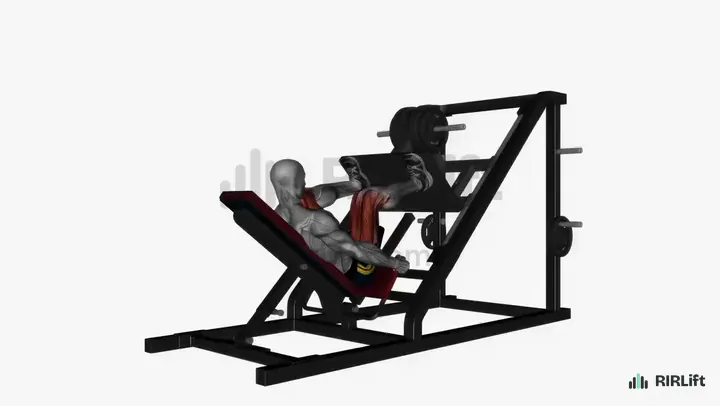
Wide-Stance Leg Press

Glutes, Quads

Placing your feet high and wide on the platform lets your hips bend more and your knees less, which moves the leg press toward the glutes and inner thighs. You can push it hard without balance or back strain limiting you.

How to do it

  1. Sit in the leg press and place your feet high on the platform, wider than shoulder-width, toes turned out slightly.
  2. Release the safeties and lower the sled by bending your hips and knees together.
  3. Go as deep as you can while your lower back stays on the seat.
  4. Drive the platform away through your heels until your legs are straight but not locked.

Cues

  • Feet high and wide
  • Lower back stays down
  • Drive through the heels

Common mistakes

  • Letting your hips lift off the seat at the bottom: stop the rep just before that point.
  • Snapping the knees straight at the top: stop just short of locking out.

Swap for: Leg Press, Hack Squat, 45-Degree Leg Press

Glutes and quads, machine squat

Hack Squat

Quads, Glutes

The hack squat guides you through a deep squat with your back supported, so you can push a squat close to failure without worrying about balance. Setting your feet higher on the platform gives the glutes a bigger share.

How to do it

  1. Stand on the platform with your back and shoulders against the pads, feet set slightly high, about shoulder-width apart.
  2. Release the handles and lower by bending your knees and hips until your thighs are at least parallel to the platform.
  3. Keep your heels flat and your knees tracking over your toes.
  4. Push through your whole foot to stand back up and repeat.

Cues

  • Heels down
  • Deep and controlled
  • Back flat on the pad

Common mistakes

  • Cutting the depth short as the weight climbs: drop the load before you drop the range.
  • Letting the knees cave in on the way up: push them out over the toes.

Swap for: Pendulum Squat, Smith Squat, Leg Press

Glutes and quads, guided split squat

Smith Machine Bulgarian Split Squat

Quads, Glutes

The Smith machine takes the balance out of the Bulgarian split squat, so you can load each leg heavier and focus on depth. Set your front foot further forward than feels natural to keep it glute-biased.

How to do it

  1. Put a bench behind the Smith machine, set the bar on your upper back, and rest one foot on the bench behind you.
  2. Place the front foot far enough forward that your shin stays close to vertical at the bottom.
  3. Unhook the bar and lower straight down until your back knee is close to the floor.
  4. Drive through the front heel to stand up, finish the set, then switch legs.

Cues

  • Front foot well forward
  • Straight down on the track
  • Heel stays heavy

Common mistakes

  • Setting the front foot too close so the knee travels far forward: move it out before you load the bar.
  • Pushing off the back foot: it only rests on the bench.

Swap for: Bulgarian Split Squat, Cable Split Squat, Barbell Bulgarian Split Squat

Cable glute exercises

A cable gives constant tension through the whole rep, which suits the two moves that are hardest to load any other way: a hinge without spinal load, and a standing kickback. Both make good finishers once your heavy lifts are done.

Glutes and hamstrings, cable hinge

Cable Pull-Through

Glutes, Hamstrings

The pull-through lets you train a hinge with almost no load on your spine, because the cable pulls you back rather than down. It is a good glute finisher after heavy pulls, and an easy hinge to learn.

How to do it

  1. Attach a rope to a low cable pulley, face away from the stack and hold the rope between your legs with both hands.
  2. Walk forward two steps so the cable is taut, and stand with your feet a little wider than your hips.
  3. Hinge back, letting the rope travel through your legs, until you feel a stretch in your glutes.
  4. Bring your hips through to stand tall and squeeze at the top.

Cues

  • Arms are just straps
  • Hips back, then hips forward
  • Finish tall, not leaning back

Common mistakes

  • Pulling the rope with your arms: keep them straight and let the hips move it.
  • Squatting down instead of hinging: knees bend only slightly.

Swap for: Band Pull-Through, 45-Degree Back Extension, Kettlebell Swing

Glute max, cable kickback

Cable Glute Kickback

Glutes

Kicking one leg back against a low cable isolates each glute so you can take it close to failure without any other muscle tiring first. It belongs late in a glute session, after the heavy lifts.

How to do it

  1. Clip a cuff onto the bottom pulley and wrap it around one ankle.
  2. Face the machine, hold the frame, and lean your torso forward slightly with the standing knee softly bent.
  3. Kick the strapped leg back and slightly up, keeping the knee nearly straight, until your glute is fully squeezed.
  4. Return slowly until the leg is under your hip, and finish all reps before switching.

Cues

  • Lean forward, kick back
  • Squeeze at the end
  • No arching to get higher

Common mistakes

  • Swinging the leg with momentum: lower the weight and pause at the end of each kick.
  • Arching the lower back so the leg rises higher: the movement ends where the hip stops, not where the back can bend.

Swap for: Multi-Hip Glute Extension, Landmine Glute Kickback, Band Glute Kickback

Put them together: example sessions

Each session below picks from the exercises above for one situation, with the sets, reps, rest and RIR filled in. Open one in the session builder to change a pick, price it from a recent set, and add it to RIRLift.

Session 1

Full gym, two glute-focused days

Open in the session builder
  • Workouts2× a week
  • Working sets29 a week
  • Per workout~45 min
  • EquipmentBarbells, Flat Bench, Smith Machine, Adjustable Cable +3

You have the whole gym, train four or five days a week, and want glutes to be the priority on both of your lower-body days.

Each day opens with one heavy compound for the glutes, the barbell hip thrust on day A and the sumo deadlift on day B, done for 6 to 10 reps with a warm-up set and long rests, stopping 1 to 2 reps short of failure so form holds. A single-leg or machine compound follows, then isolation from the cable or machine stack, which runs to 0 to 1 reps in reserve because those are safe to push. Day A has 15 working sets and day B has 14, which puts weekly glute volume close to 30 hard sets counting the direct work only.

Glute Day A
ExerciseSets × repsRIRRest
Hip Thrust2 warm-up sets first1 s hold at lockout. Chin tucked. 4 × 6–10 1 3 min
Romanian Deadlift1 warm-up set firstBar brushes the legs. 3 × 8–10 2 2:30 min
Smith Machine Bulgarian Split SquatPer leg. Front foot well forward. 3 × 8–12 1 2 min
Cable Glute KickbackPer leg. Pause at the end. 3 × 12–15 0 1 min
Hip Abduction MachineLean forward slightly. 2 × 15–20 0 1 min

Open Glute Day A in the session builder

Glute Day B
ExerciseSets × repsRIRRest
Sumo Deadlift2 warm-up sets firstKnees out. Push the floor apart. 3 × 5–8 2 3 min
Wide-Stance Leg PressFeet high and wide. 3 × 10–15 1 2 min
45-Degree Back ExtensionRound the upper back slightly. Hold a plate. 3 × 12–15 1 90 s
Multi-Hip Glute ExtensionPer leg. 3 × 12–15 0 1 min
Hip Abduction MachineLast set: 10 s hold at the end. 2 × 15–25 0 1 min

Open Glute Day B in the session builder

How to run it
Run Glute Day A and Glute Day B once each per week with at least two days between. Put upper-body sessions on the days in between.
How to progress
Double progression on every lift: once all sets reach the top of the range at the target reps in reserve, add 5 to 10 pounds on the barbell lifts or one plate on the machines, and work back up.

Session 2

Glute block after your usual leg day

Open in the session builder
  • Workouts1× a week
  • Working sets11 a week
  • Per workout~30 min
  • EquipmentBarbells, Flat Bench, Adjustable Cable, Hip Abductor

You already squat or leg press on a lower-body day and want a 25-minute glute block at the end that covers what squats leave out.

Squats and leg presses train the glutes in the stretch but drop off near lockout and barely touch the side glutes. This block fills those gaps: a hip thrust for the lockout, a pull-through for a hinge that spares your already tired back, a cable kickback, and abduction for the side glutes. You arrive fatigued, so the thrust stays at 2 reps in reserve and the isolation work at 0 to 1. It is 11 working sets.

Glute Block
ExerciseSets × repsRIRRest
Hip Thrust1 warm-up set firstAfter squats. 1 s hold. 3 × 8–12 2 2:30 min
Cable Pull-ThroughRope. Hips back, then through. 3 × 12–15 1 90 s
Cable Glute KickbackPer leg. 3 × 12–20 0 1 min
Hip Abduction MachineLean forward. 2 × 15–20 0 1 min
How to run it
Add it straight after your squats or leg press once a week. If you train legs twice a week, do it on the day with less hinge work.
How to progress
Add reps until all sets hit the top of the range at the target reps in reserve, then add load. If your squats start to suffer, cut the thrust to two sets.

Session 3

First month in the gym, machines first

Open in the session builder
  • Workouts2× a week
  • Working sets20 a week
  • Per workout~25 min
  • EquipmentFlat Bench, Smith Machine, Leg Press, Hip Abductor +2

You are new to the gym and want to train glutes without learning barbell lifts on day one.

Every exercise here runs on a guided path or a seat, so you can learn to feel your glutes before you balance a bar. The Smith thrust replaces the barbell thrust, the leg press with feet high replaces the squat, and the 45-degree bench teaches the hinge with your hips supported. Sets stop 2 to 3 reps short of failure for the first weeks while your technique settles, and each session is 10 working sets so you leave with energy left.

Machines A
ExerciseSets × repsRIRRest
Smith Machine Hip Thrust1 warm-up set firstSet the safeties first. 3 × 10–15 2 2 min
Wide-Stance Leg PressFeet high and wide. 3 × 10–15 2 2 min
Multi-Hip Glute ExtensionPer leg. 2 × 12–15 2 1 min
Hip Abduction Machine 2 × 15–20 2 1 min

Open Machines A in the session builder

Machines B
ExerciseSets × repsRIRRest
45-Degree Back ExtensionBodyweight. Pad below the hip bones. 3 × 10–15 2 90 s
Hack SquatFeet slightly high. 3 × 10–15 3 2 min
Smith Machine Hip Thrust 2 × 12–15 2 90 s
Hip Abduction Machine 2 × 15–20 2 1 min

Open Machines B in the session builder

How to run it
Do Machines A and Machines B on two non-consecutive days a week. Write down the seat and pin settings so setup is quick next time.
How to progress
Add reps first and weight second. After four weeks, drop the target to 1 to 2 reps in reserve and try the barbell thrust and Romanian deadlift from the two-day plan.

Make it fit you

Questions

What grows glutes at the gym?

Hard sets of exercises that load the hip through a full range: the barbell hip thrust, Romanian deadlift, split squats and the leg press with your feet set high, plus kickbacks and abduction on machines or cables. Two sessions a week with 10 to 15 hard glute sets each covers it.

What are the best glute machines at the gym?

The hip abduction machine for the side glutes, the multi-hip machine or a cable station for kickbacks, the 45-degree back extension bench, and the leg press or hack squat with your feet set high. A Smith machine counts too, since it makes the hip thrust and split squat easy to set up.

Is the leg press good for glutes?

Yes, with your feet high and wide on the platform and as much depth as your lower back allows. That stance bends the hips more and the knees less, which shifts more of the press to the glutes. It is a good partner for the hip thrust, not a replacement.

What are the gluteal muscles and what do they do?

The gluteus maximus straightens your hip, as in standing up from a squat or thrusting your hips forward. The gluteus medius and minimus sit higher on the side of the hip; they lift your leg out to the side and hold your pelvis level when you stand on one leg. Hip thrusts and hinges train the first; abduction trains the other two.

What are the top 10 glute exercises?

At the gym: the barbell hip thrust, Romanian deadlift, sumo deadlift, Bulgarian split squat, leg press with feet high, hack squat, 45-degree back extension, cable pull-through, cable kickback and hip abduction machine. The list on this page covers all ten, grouped by station.

What are some good dumbbell glute exercises?

The dumbbell hip thrust, dumbbell Romanian deadlift, Bulgarian split squat, step-up and reverse lunge. They work well at the gym when the barbell stations are busy; the dumbbell glute exercises page covers them in detail.

How many glute exercises should I do at the gym?

Three to five per session: one heavy thrust or hinge, one single-leg or leg press move, and one or two isolation moves. More exercises usually means easier sets; it is the number of hard sets that drives growth.