Lat exercises at home: with a bar, dumbbells, a kettlebell or a band

The best lat exercises at home are the pull-up and chin-up if you have a bar, the one-arm dumbbell row and dumbbell pullover if you have dumbbells, and the band row or suspension-trainer row if you have neither. Your lats pull your elbows down and back toward your hips, so every good lat exercise does exactly that. Two exercises are enough per session: one vertical pull or heavy row, and one pullover or second row.

  1. Pull-Up Lats
  2. One-Arm Dumbbell Row Lats, Upper Back
  3. Chin-Up Lats
  4. Dumbbell Lat Pullover Lats
  5. Band-Assisted Pull-Up Lats
  6. Dumbbell Bent-Over Row Upper Back, Lats
  7. TRX Row Upper Back, Lats
  8. Band Bent-Over Row Lats, Upper Back
Lat exercises with a pull-up bar

A doorway or wall bar is the best piece of home equipment for your lats. Pull-ups, chin-ups and neutral-grip pull-ups all move your bodyweight, and the band-assisted version lets you start before you can do a full rep. Pick one grip as your main lift and stay with it long enough to add reps.

Lats, vertical pull on a bar

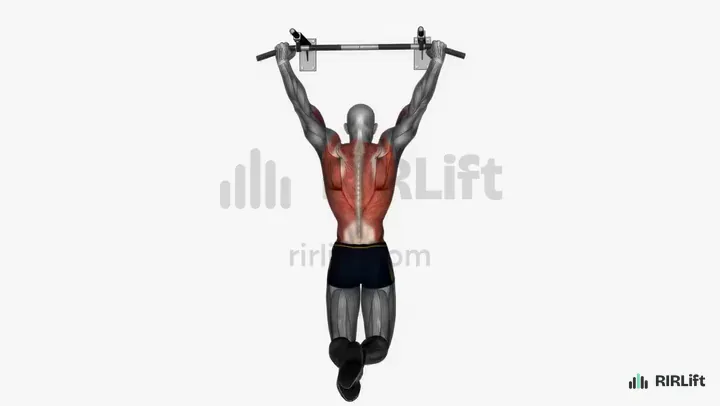
Pull-Up

Lats

Hanging from a bar and pulling your whole body up is the heaviest lat exercise you can do in a house. Your lats are the main muscle that brings your elbows down to your sides, and here they move your full bodyweight through a long range.

How to do it

  1. Hang from a doorway or wall-mounted bar with your palms facing away and hands a little wider than your shoulders.
  2. Pull your shoulders down away from your ears before your elbows bend at all.
  3. Drive your elbows toward your back pockets until your chin clears the bar.
  4. Lower yourself all the way to straight arms in about two seconds before the next rep.

Cues

  • Shoulders down first
  • Elbows to your hips
  • Full hang every rep

Common mistakes

  • Kicking or swinging your legs to get the chin over: cross your ankles, squeeze your glutes and stop the set when the strict rep is gone.
  • Cutting the bottom short: half reps from bent arms leave out the stretched range where the lats work hardest.

Swap for: Neutral-Grip Pull-Up, Chin-Up, Band-Assisted Pull-Up

Build a session with Pull-Up

Lats and biceps, palms-facing pull

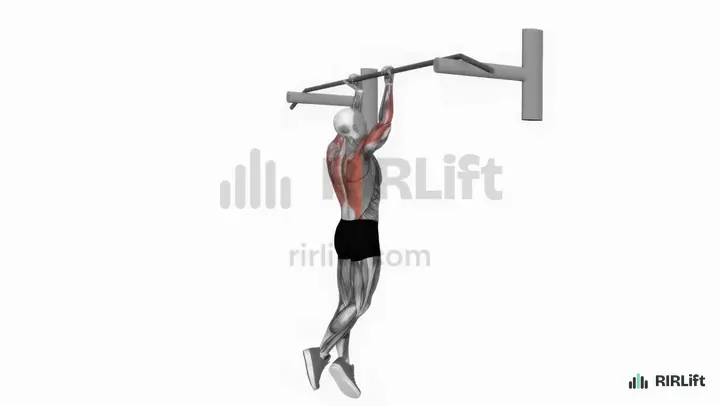
Chin-Up

Lats

Turning your palms toward you lets your biceps help, so most people get a few more reps here than on pull-ups. More reps means more work for the lats from a bar you already own.

How to do it

  1. Grab the bar with your palms facing you and hands about shoulder-width apart.
  2. From a dead hang, set your shoulders down and squeeze the bar hard.
  3. Pull your chest toward the bar, keeping your elbows in front of your body, until your chin passes the bar.
  4. Lower slowly to straight arms.

Cues

  • Chest to the bar
  • Squeeze the bar
  • Slow on the way down

Common mistakes

  • Craning your neck up to reach the bar: keep your chin level and pull your body higher instead.
  • Letting the elbows drift out wide: keep them in front so the lats and biceps share the work.

Swap for: Pull-Up, Neutral-Grip Pull-Up, Band-Assisted Pull-Up

Build a session with Chin-Up

Lats, palms-facing-each-other pull

Neutral-Grip Pull-Up

Lats

If your bar has parallel handles, this grip sits between the pull-up and the chin-up and is the one most lifters find easiest on the elbows and shoulders. Use it as your main bar pull if straight-bar grips bother you.

How to do it

  1. Take the parallel handles, palms in.
  2. Hang with straight arms and your legs slightly in front of you.
  3. Pull your elbows down past your ribs until your chin reaches handle height.
  4. Lower under control to a full hang.

Cues

  • Elbows close to your sides
  • Ribs down, legs quiet
  • Reach the top, then the bottom

Common mistakes

  • Arching your lower back hard to get higher: keep your ribs tucked and finish the rep with your arms.
  • Dropping fast from the top: a quick fall takes the lats out of the lowering half.

Swap for: Pull-Up, Chin-Up, TRX Row

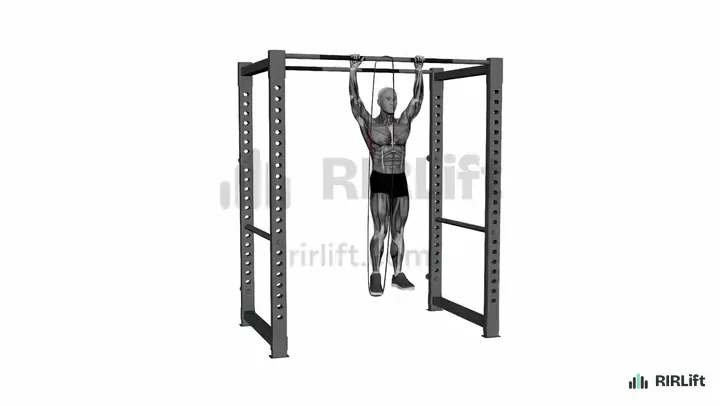
Lats, pull-up with help from a band

Band-Assisted Pull-Up

Lats

A loop band under your foot or knee takes off part of your bodyweight, so you train the real pull-up movement long before you can do one on your own. It is the home version of an assisted pull-up machine.

How to do it

  1. Loop a long band over the bar and pull it through itself so it hangs tight.
  2. Put one foot or one knee in the hanging loop and take an overhand grip.
  3. Pull until your chin passes the bar, keeping the band under you rather than swinging forward.
  4. Lower slowly to a dead hang, letting the band stretch.

Cues

  • Same form as the real thing
  • Control the band at the bottom
  • Thinner band as you get stronger

Common mistakes

  • Bouncing out of the bottom: the band throws you up, so pause a moment in the hang before you pull.
  • Staying on the same band forever: once you get 12 clean reps, move to a lighter band.

Swap for: Pull-Up, Chin-Up, TRX Row

Lat exercises with dumbbells

With dumbbells and a chair you can train lats as hard as any gym row. Pull each dumbbell toward your hip, not your armpit, so the lats move the weight. Add the pullover when you want the stretch overhead that rows cannot give you.

Lats, one-arm row braced on a bench or chair

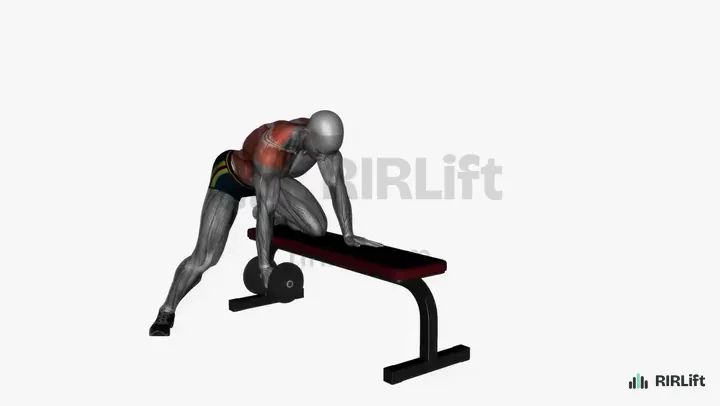
One-Arm Dumbbell Row

Lats, Upper Back

This is the best lat exercise for anyone without a bar. Bracing one hand on a chair lets you row a heavy dumbbell to a full stretch without your lower back tiring first.

How to do it

  1. Put one hand on a chair seat or bench and step your feet back so your torso tilts forward.
  2. Hold the dumbbell in your other hand, arm straight, shoulder blade relaxed toward the floor.
  3. Row by pulling your elbow back and up toward your hip, not straight up to your armpit.
  4. Lower until the arm is straight and you feel the side of your back stretch, then go again.

Cues

  • Pull toward the hip
  • Long arm at the bottom
  • Shoulders square

Common mistakes

  • Rowing the dumbbell up to your chest: that shifts the work to your upper back; aim the elbow at your hip for the lats.
  • Jerking the weight with your torso: if you have to twist, take a lighter dumbbell.

Swap for: Dumbbell Lawnmower Row, Kettlebell Row, Dumbbell Bent-Over Row

Lats and upper back, two-arm bent-over row

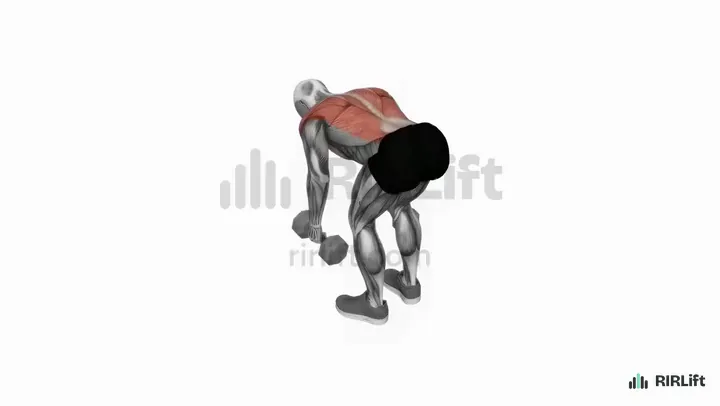
Dumbbell Bent-Over Row

Upper Back, Lats

Rowing both dumbbells at once doubles the work per set and needs no bench. Keep your elbows close to your body and the dumbbells travel to your hips, which keeps the lats in charge.

How to do it

  1. Pick up both dumbbells, soften your knees and hinge forward until your chest is close to parallel with the floor.
  2. Let the dumbbells hang under your shoulders, palms in.
  3. Pull both elbows back past your torso, sliding the dumbbells toward your hips.
  4. Lower until your arms are long again, keeping your back angle the same.

Cues

  • Hold the hinge
  • Elbows skim your sides
  • Dumbbells to the hips

Common mistakes

  • Standing taller with each rep: the row turns into a shrug; pick a weight you can row without your chest rising.
  • Rounding your back to reach lower: keep a flat back and let only the arms move.

Swap for: One-Arm Dumbbell Row, Band Bent-Over Row, Kettlebell Row

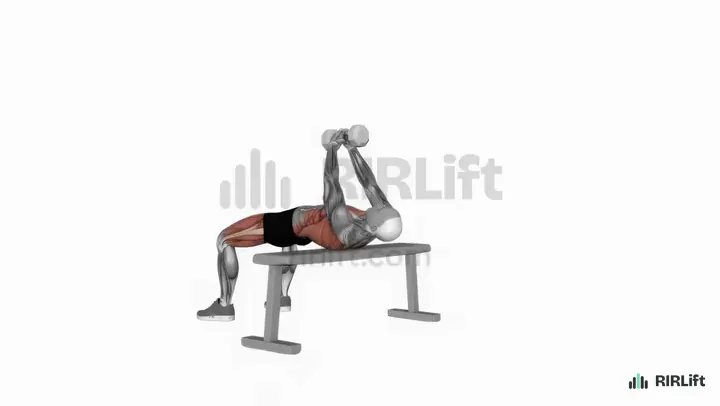
Lats, straight-arm stretch under load

Dumbbell Lat Pullover

Lats

The pullover is the closest thing to a straight-arm pulldown you can do at home. Your arms stay nearly straight, so the lats do the work without your biceps helping, and you load them at full stretch overhead.

How to do it

  1. Lie on a bench or on the floor with knees bent, holding one dumbbell by the inner plate with both hands above your chest.
  2. With elbows softly bent, lower the dumbbell back behind your head in an arc.
  3. Stop once your upper arms reach ear level or when you feel a deep stretch along your sides.
  4. Sweep the weight up to above your chest along the same arc, keeping the elbow angle fixed.

Cues

  • Arms stay the same bend
  • Ribs stay down
  • Pull with your armpits

Common mistakes

  • Bending the elbows as the dumbbell drops: that turns it into a triceps extension; lock the angle in.
  • Arching off the bench to reach further: stop where your ribs start to flare.

Swap for: Kettlebell Pullover, Dumbbell Bent-Over Row, One-Arm Dumbbell Row

Lats, staggered-stance one-arm row with a rotation

Dumbbell Lawnmower Row

Lats

A wide staggered stance with your free hand braced on your front thigh keeps your hips still, and the slight reach across your body at the bottom gives the lat a longer stretch than a standard row.

How to do it

  1. Stand in a wide staggered stance, knees bent, and brace your front-side hand on your front thigh.
  2. Hold the dumbbell low beside your front foot with your torso tilted forward.
  3. Row the dumbbell up and back toward your hip, letting your torso turn slightly open at the top.
  4. Reach the dumbbell back down toward your front foot until the arm is long.

Cues

  • Long reach down
  • Elbow back to the hip
  • Turn a little, not a lot

Common mistakes

  • Spinning your whole torso to lift the weight: a small turn is fine, a full twist means it is too heavy.
  • Shortening the reach: the stretch at the bottom is the reason to choose this row.

Swap for: One-Arm Dumbbell Row, Kettlebell Row, Dumbbell Bent-Over Row

Lat exercises with a kettlebell, band or suspension trainer

No dumbbells? A single kettlebell covers rows and pullovers, a band covers rows, and a suspension trainer over a door gives you a bodyweight row. Every one of these packs away when you are done.

Lats, bent-over kettlebell row

Kettlebell Row

Lats, Upper Back

A kettlebell rows the same way as a dumbbell, and the handle sits a little lower, which lets the bell travel back to your hip easily. If one kettlebell is all you own, this is your main lat exercise.

How to do it

  1. Hinge forward with soft knees and a flat back, a kettlebell in each hand.
  2. Let the bells hang below your shoulders with your arms straight.
  3. Pull one bell back toward your hip, keeping your elbow tight to your side.
  4. Lower until the arm hangs straight again and row the other side. With only one bell, do all your reps on one side, then switch.

Cues

  • Handle to your hip
  • Stay flat
  • Stretch at the bottom

Common mistakes

  • Letting the bell swing away from you: keep it under your shoulder at the bottom.
  • Shrugging the shoulder up at the top: pull it back and down instead.

Swap for: One-Arm Dumbbell Row, Dumbbell Lawnmower Row, Band Bent-Over Row

Lats, pullover with a kettlebell

Kettlebell Pullover

Lats

Holding a kettlebell by the horns works well for pullovers because the weight sits compactly behind your head. It loads the lats in the same stretched position as the dumbbell version.

How to do it

  1. Lie on the floor or a bench holding the kettlebell by the handle sides above your chest.
  2. With a small bend in the elbows, lower the bell behind your head.
  3. Go until your arms are near your ears and your sides feel stretched.
  4. Bring the bell back over your chest without bending your elbows further.

Cues

  • Fixed elbows
  • Low ribs
  • Slow stretch

Common mistakes

  • Letting the kettlebell touch down and rest behind you: keep tension through the whole rep.
  • Pulling past your chest toward your belly: stop over your chest where tension is still on the lats.

Swap for: Dumbbell Lat Pullover, One-Arm Dumbbell Row, Kettlebell Row

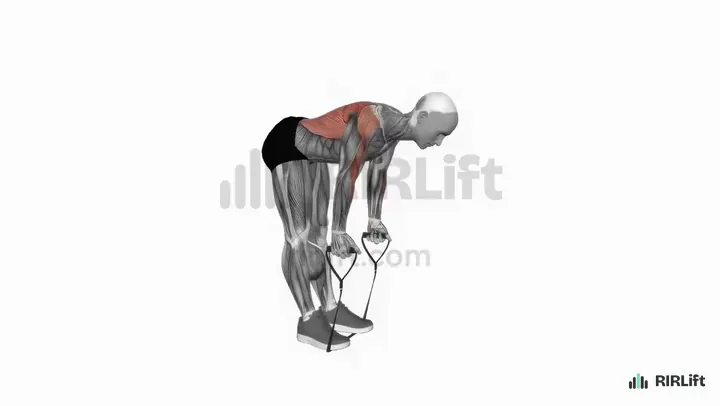
Lats, bent-over row against a band

Band Bent-Over Row

Lats, Upper Back
Standing on a band and rowing it gives the lats a load that gets heavier as you pull, so the squeeze at the top is hard. It is the cheapest way to train lats at home and fits in a drawer.

How to do it

  1. Stand on the middle of a band with your feet hip-width apart and hold an end in each hand.
  2. Hinge forward with a flat back until your torso is tilted well forward.
  3. Row your elbows back past your body until your hands reach your hips.
  4. Let the band pull your arms back to straight under control.

Cues

  • Pull the band to your hips
  • Pause at the top
  • Fight it on the way down

Common mistakes

  • Letting the band snap your arms down: that skips half the work; resist it the whole way.
  • Choosing a band so light the top is easy: shorten the band under your feet or step up to a heavier one.

Swap for: Dumbbell Bent-Over Row, Kettlebell Row, TRX Row

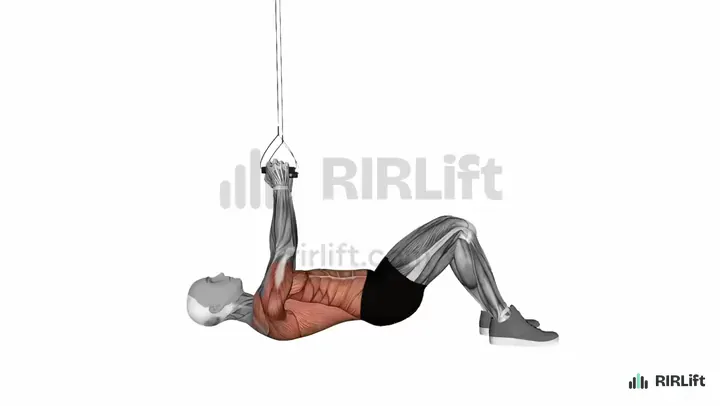
Lats and upper back, bodyweight row on a suspension trainer

TRX Row

Upper Back, Lats

A suspension trainer hooked over a door turns your bodyweight into a row you can make easier or harder by stepping your feet. Bend your knees for an easier set and walk your feet forward to make it heavier.

How to do it

  1. Anchor the straps over a closed door or bar and hold a handle in each hand.
  2. Walk your feet forward and lean back with bent knees until your arms are straight and your body is at an angle.
  3. Pull your chest up to your hands, keeping your elbows close to your sides.
  4. Lower back to straight arms with your body in one line.

Cues

  • Chest to the handles
  • Hips stay up
  • Walk forward for harder

Common mistakes

  • Sagging at the hips: squeeze your glutes so your body moves in one piece.
  • Leaning so little that the set is easy: change the angle until 8 to 15 reps is hard.

Swap for: Band Bent-Over Row, Chin-Up, One-Arm Dumbbell Row

Build a session with TRX Row

Put them together: example sessions

Each session below picks from the exercises above for one situation, with the sets, reps, rest and RIR filled in. Open one in the session builder to change a pick, price it from a recent set, and add it to RIRLift.

Session 1

Pull-up bar and a band, no full pull-up yet

Open in the session builder
  • Workouts2× a week
  • Working sets19 a week
  • Per workout~25 min
  • EquipmentPull-Up Bar, Resistance Bands

You have a doorway bar and a loop band, and you cannot do a strict pull-up yet, or you can do one or two.

The band-assisted pull-up trains the full movement with enough help to reach 6 to 12 reps, and slow chin-up lowerings build the strength to finish reps on your own. Band rows add lat work without the bar. Assisted reps and band rows stop 1 to 2 short of failure; the lowerings stop at 2 because form breaks before your muscles run out. Each session is 9 to 10 working sets.

Lats A
ExerciseSets × repsRIRRest
Band-Assisted Pull-UpPause 1 s in the hang. 4 × 6–12 1 2 min
Chin-UpLowering only: 4-5 s down. 3 × 3–5 2 2 min
Band Bent-Over RowPause at the hips. 3 × 12–20 1 1 min

Open Lats A in the session builder

Lats B
ExerciseSets × repsRIRRest
Chin-UpLowering only: 4-5 s down. 3 × 3–5 2 2 min
Band-Assisted Pull-Up 3 × 6–12 1 2 min
Band Bent-Over RowLast set to failure. 3 × 12–20 0 1 min

Open Lats B in the session builder

How to run it
Do Lats A and Lats B on alternate days, twice each per week if you recover well or once each if not. For the chin-up lowerings, jump or step to the top and lower yourself over 4 to 5 seconds.
How to progress
When you hit 12 assisted reps at 1 RIR, move to a lighter band. When five-second lowerings feel easy for 5 reps, start each set with one full chin-up from the bottom.

Session 2

Dumbbells and a chair, no bar

Open in the session builder
  • Workouts2× a week
  • Working sets20 a week
  • Per workout~25 min
  • EquipmentDumbbells

You train at home with dumbbells, a chair or bench, and nowhere to hang a bar.

Without a bar, rows carry the lats and the pullover replaces the overhead pull you are missing. The one-arm row leads each session because it allows the heaviest load; the lawnmower row and bent-over row change the angle so both sessions do not feel the same. Rows end at 1 RIR, the pullover at 1 to 2 because your shoulders need to stay in control at the stretch. That is 10 sets per session, 20 per week.

Lats A
ExerciseSets × repsRIRRest
One-Arm Dumbbell RowPer arm. Hand on a chair. 4 × 8–15 1 90 s
Dumbbell Lat PulloverOn the floor if no bench. 3 × 10–15 2 1 min
Dumbbell Bent-Over Row 3 × 10–15 1 90 s

Open Lats A in the session builder

Lats B
ExerciseSets × repsRIRRest
Dumbbell Lawnmower RowPer arm. 4 × 8–15 1 90 s
Dumbbell Bent-Over RowPalms facing in. 3 × 10–15 1 90 s
Dumbbell Lat Pullover 3 × 12–20 1 1 min

Open Lats B in the session builder

How to run it
Do Lats A and Lats B once each per week with a day or more between them, or add them to your existing upper body days.
How to progress
Add reps until every set reaches the top of the range at the listed RIR, then go up one dumbbell size and start again at the bottom of the range. Without heavier dumbbells, slow the lowering to three seconds.

Session 3

Bar and dumbbells, already doing 6 or more pull-ups

Open in the session builder
  • Workouts2× a week
  • Working sets21 a week
  • Per workout~30 min
  • EquipmentPull-Up Bar, Dumbbells

You can do at least 6 strict pull-ups and own a bar plus a set of dumbbells.

Once pull-ups are possible, they are the main lift and the dumbbells fill in what bodyweight cannot: a heavy one-arm row and a stretched pullover. Two bar grips spread the work across both sessions. Bar sets end at 1 to 2 RIR so form stays strict, rows and pullovers at 0 to 1. Sessions are 10 to 11 sets.

Lats A
ExerciseSets × repsRIRRest
Pull-UpStrict. Full hang. 4 × 6–12 2 2:30 min
One-Arm Dumbbell RowPer arm. 3 × 8–12 1 90 s
Dumbbell Lat Pullover 3 × 12–15 1 1 min

Open Lats A in the session builder

Lats B
ExerciseSets × repsRIRRest
Neutral-Grip Pull-Up 4 × 6–12 1 2:30 min
Dumbbell Lawnmower RowPer arm. 3 × 8–12 1 90 s
Chin-UpLast set to failure. 2 × 8–15 0 2 min
Dumbbell Lat Pullover 2 × 12–20 0 1 min

Open Lats B in the session builder

How to run it
Do Lats A and Lats B once each per week. If you train back on a push-pull split, use these as your two pull days.
How to progress
Add a rep to every pull-up set until you reach 12, then hold a dumbbell between your feet for added load. On rows, move up a dumbbell when all sets reach the top of the range.

Make it fit you

Questions

What exercise hits lats the most?

The pull-up, because it moves your whole bodyweight through the full range of the lats. Without a bar, the one-arm dumbbell row is the hardest lat exercise you can load at home, and the pullover hits them at their longest stretch.

Is 2 exercises enough for lats?

Yes. Two lat exercises, each done for 3 to 4 sets close to failure, is plenty per session. The sessions on this page use two or three, and the third is there for variety rather than need.

How can I train my lats without equipment?

You need something to pull against. A doorway pull-up bar or a suspension trainer is the cheapest option; a resistance band is the most portable. Floor exercises without any gear train your lats far too lightly to build them.

Are lats hard to grow?

Lats are a large muscle and respond to hard rowing and pulling like any other. Most people who struggle pull with their arms rather than driving the elbows toward the hips. Fix that, train them twice a week, and log your reps in reserve so you know each set is close enough to failure.

Can you build lats with just dumbbells?

Yes. One-arm rows, bent-over rows and pullovers cover both a heavy row and a stretched straight-arm pull. The dumbbells-only plan on this page is built from those three plus the lawnmower row.

How many sets for lats per week at home?

Around 10 to 20 hard sets a week works for most people. Each plan here lands in that range across two sessions.