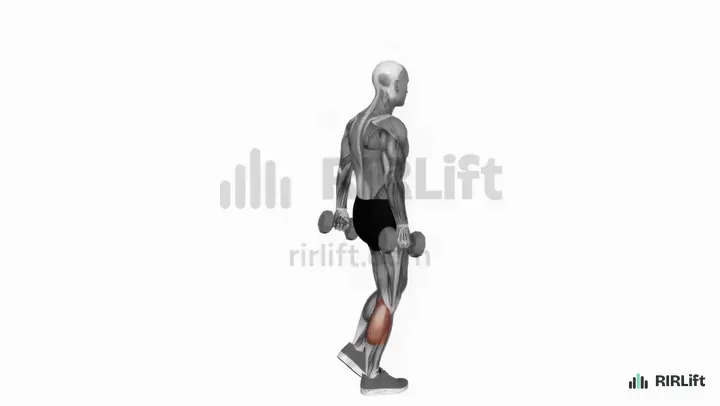
Lower body exercises at home: squats, lunges, hinges and bridges

The best lower body exercises at home are the goblet squat, the Bulgarian split squat, the Romanian deadlift, the hip thrust and the single-leg calf raise. Together they train your quads, hamstrings, glutes and calves with one dumbbell or kettlebell and a bench or couch. With no equipment, swap in slow bodyweight squats, skater squats, single-leg bridges and Nordic curls. Working one leg at a time is what makes light weights or body weight hard enough.

  1. Goblet Squat Quads, Glutes
  2. Bulgarian Split Squat Quads, Glutes
  3. Dumbbell Romanian Deadlift Hamstrings, Glutes
  4. Dumbbell Hip Thrust Glutes
  5. Reverse Lunge Quads, Glutes
  6. Step-Up Quads, Glutes
  7. Skater Squat Quads, Glutes
  8. Nordic Hamstring Curl Hamstrings
  9. Single-Leg Calf Raise Calves

Squats you can do at home

A squat trains your quads and glutes together. Use the goblet squat when you have one dumbbell or kettlebell, and the bodyweight squat, slowed down, when you have nothing.

Quads and glutes, the main home squat

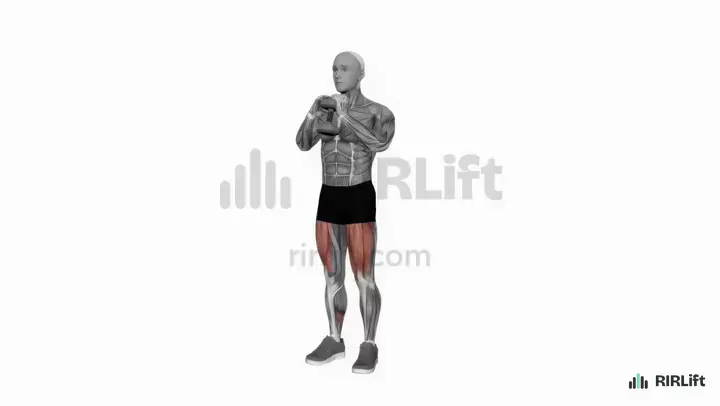
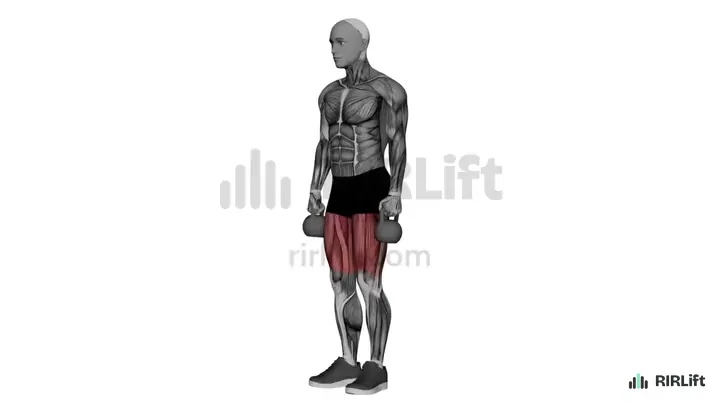
Goblet Squat

Quads, Glutes

Holding one dumbbell or kettlebell at your chest keeps you upright and lets you sit deep, so a single weight gives you a real squat without a rack. It is the first lower body exercise to learn at home.

How to do it

  1. Cup one end of a dumbbell in both palms at your collarbones, elbows pointing down.
  2. Set your feet a little wider than your hips, toes turned out slightly.
  3. Sit down between your heels, keeping your chest tall, until your elbows meet the inside of each knee.
  4. Press the floor away with your whole foot to stand, glutes tight as you finish.

Cues

  • Weight stays on your chest
  • Knees follow the toes
  • Sit between your heels

Common mistakes

  • Heels lifting at the bottom: widen your stance or put a thin book under each heel.
  • Letting the dumbbell drift away from your body: it pulls your chest down.

Swap for: Dumbbell Squat, Heels-Elevated Goblet Squat, Dumbbell Front Squat

Quads and glutes, no equipment

Bodyweight Squat

Quads

With no weight at all, a squat becomes a high-rep exercise. Slow it down and pause at the bottom, and 20 to 30 reps become hard enough to build a beginner's legs.

How to do it

  1. Set your feet about shoulder-width, arms reaching forward for balance.
  2. Bend your hips and knees together and descend until the thighs are at least level with the floor.
  3. Hold the bottom for a second without relaxing.
  4. Stand up by pushing the floor away, and keep the next rep going without rest at the top.

Cues

  • 3 seconds down
  • Pause at the bottom
  • No rest at the top

Common mistakes

  • Rushing reps: fast bodyweight squats turn into cardio and stop building muscle.
  • Stopping short of depth: go as low as your hips and ankles allow with a flat back.

Swap for: Goblet Squat, Wall Sit, Sumo Squat

Lunges, split squats and step-ups

Working one leg at a time is how you make light weights heavy at home. Each of these puts most of your body weight plus the dumbbells on the front leg. Pick one per session, and rotate between them across the week.

Quads and glutes, rear foot on a bench

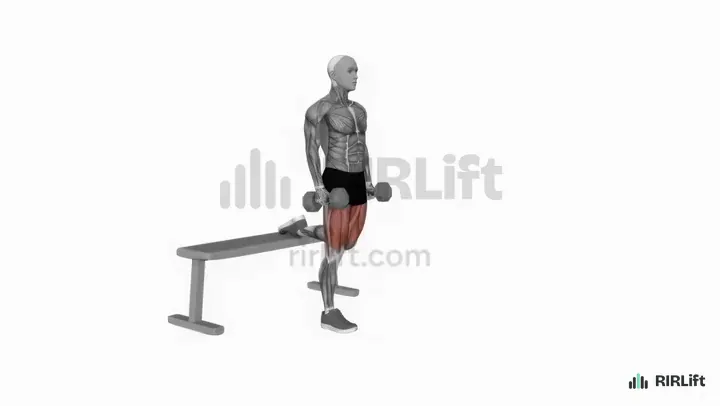
Bulgarian Split Squat

Quads, Glutes

Putting your back foot on a bench or couch shifts nearly all the load to the front leg, so a light pair of dumbbells works like a heavy barbell squat. It is the best leg builder at home for anyone short on weight.

How to do it

  1. Take two steps out from a bench or sturdy chair, holding two dumbbells at your sides.
  2. Reach one foot back and rest the top of it on the seat.
  3. Drop your back knee straight toward the floor until the front thigh is about level.
  4. Push through the front foot to stand, finish the reps on that side, then switch.

Cues

  • Front foot flat
  • Back knee straight down
  • Torso leans slightly forward

Common mistakes

  • Front foot too close to the bench: the front knee shoots forward and the heel lifts. Step out further.
  • Pushing off the back foot: it is there for balance only.

Swap for: Dumbbell Split Squat, Dumbbell Goblet Split Squat, Reverse Lunge

Quads and glutes, stepping back

Reverse Lunge

Quads, Glutes

Stepping backward keeps your front shin more upright than a forward lunge, which is easier on the knees and gives a steadier base. Do it with nothing in your hands or with a kettlebell hanging at each side.

How to do it

  1. Stand tall, either empty-handed or with a kettlebell hanging in each hand.
  2. Take a long step back and lower your back knee until it nearly touches the floor.
  3. Keep most of your weight on the front heel.
  4. Push through that front foot to step back to standing, and alternate legs.

Cues

  • Long step back
  • Front heel heavy
  • Tall chest

Common mistakes

  • Stepping straight behind the front foot like a tightrope: leave a hip-width gap between the feet for balance.
  • Dropping the back knee hard into the floor: lower it under control.

Swap for: Dumbbell Reverse Lunge, Band Reverse Lunge, Bulgarian Split Squat

Quads and glutes, up onto a bench

Step-Up

Quads, Glutes

A step-up trains each leg on its own and is easy to load with dumbbells. The higher the box, the more your glutes work; a knee-height bench or sturdy chair suits most people.

How to do it

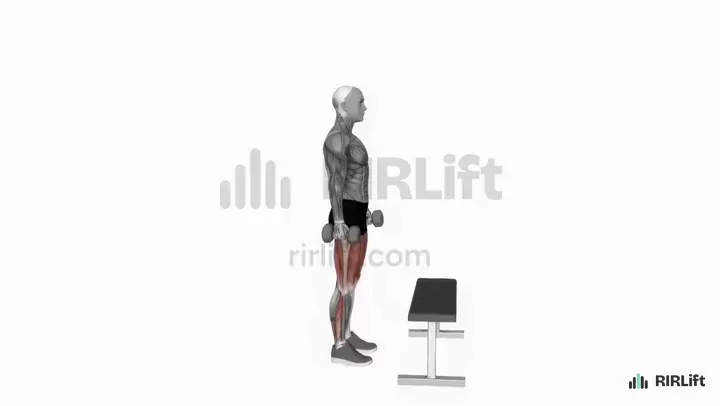
  1. Face a bench, holding two dumbbells at your sides.
  2. Plant one whole foot on the bench.
  3. Lean slightly forward and drive through the top foot until you stand fully on the bench.
  4. Lower the trailing foot back to the floor slowly and repeat on the same leg before switching.

Cues

  • Whole foot on the bench
  • Top leg does the work
  • Slow way down

Common mistakes

  • Pushing off the floor with the back foot: lift your back toes so you cannot.
  • A wobbly chair: use a bench, a step or a stair, never something that can tip.

Swap for: Kettlebell Step-Up, Bulgarian Split Squat, Reverse Lunge

Build a session with Step-Up

Quads and glutes, single-leg squat with no gear

Skater Squat

Quads, Glutes

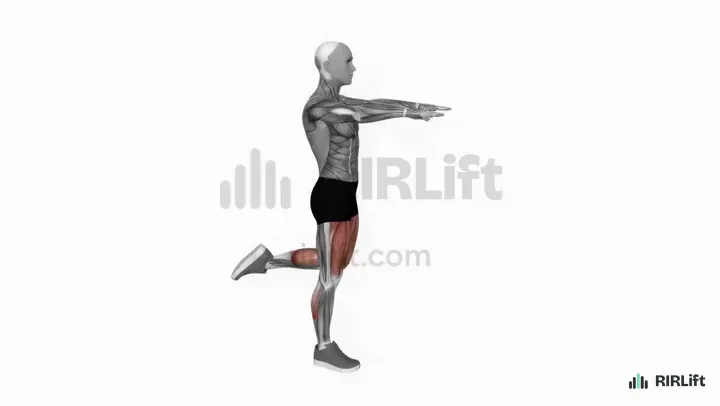
The skater squat is a one-leg squat where the back knee drops behind you, so it is harder than a lunge but easier to learn than a pistol. It makes bodyweight hard again once two-leg squats get easy.

How to do it

  1. Stand on one leg, bend the free knee so that foot is behind you, and reach both arms forward.
  2. Bend the standing knee and lean your chest forward as the back knee sinks toward the floor.
  3. Touch the back knee down lightly, or stop just above a pillow placed there.
  4. Drive up through the standing foot without letting the back foot help.

Cues

  • Arms forward to balance
  • Back knee taps lightly
  • Standing heel stays down

Common mistakes

  • Collapsing the standing knee inward: slow the rep and push it out over your toes.
  • Using the back foot to push off the floor: stack pillows higher to shorten the range instead.

Swap for: Pistol Squat, Bulgarian Split Squat, Reverse Lunge

Hip hinges for hamstrings and glutes

A hinge moves at the hips with the knees nearly fixed, so the back of your legs does the work. Use the Romanian deadlift with a pair of dumbbells, the single-leg version when they feel light, and the swing when you own one kettlebell.

Hamstrings and glutes, two-leg hinge

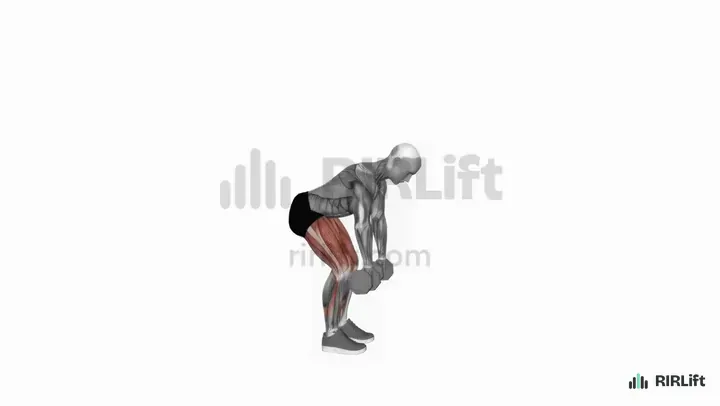
Dumbbell Romanian Deadlift

Hamstrings, Glutes

The Romanian deadlift loads your hamstrings while they are stretched, which squats and lunges never do. With two dumbbells you can go fairly heavy and keep the reps in a muscle-building range.

How to do it

  1. Set your feet under your hips, one dumbbell in front of each thigh.
  2. Soften your knees and push your hips back, letting the dumbbells slide down the front of your legs.
  3. Stop when you feel a strong stretch in the back of your thighs, usually around mid-shin.
  4. Drive your hips forward to stand tall.

Cues

  • Hips back, not down
  • Dumbbells brush your legs
  • Flat back

Common mistakes

  • Squatting the weight down: the knee bend stays small and the hips travel back.
  • Rounding the back to reach lower: depth ends where your hamstrings stop stretching.

Swap for: Single-Leg RDL, Dumbbell B-Stance RDL, Kettlebell Deadlift

Hamstrings and glutes, one-leg hinge

Single-Leg RDL

Hamstrings, Glutes

Hinging on one leg doubles the load on that hamstring, which is useful when your dumbbells are light. It also trains the balance the two-leg version skips.

How to do it

  1. Stand on one foot, holding a dumbbell in the opposite hand.
  2. Send your hips back and let the free leg rise behind you as your torso tips forward.
  3. Keep your hips level and lower until your chest is nearly parallel to the floor.
  4. Squeeze the standing glute to come back up.

Cues

  • Hips square to the floor
  • Back leg reaches long
  • Soft standing knee

Common mistakes

  • Opening the hip so the free leg turns out: point that toe at the floor.
  • Falling over: touch a wall with your free hand until balance improves.

Swap for: Dumbbell B-Stance RDL, Dumbbell Romanian Deadlift, Kettlebell Deadlift

Glutes and hamstrings, explosive hinge

Kettlebell Swing

Glutes, Hamstrings

The swing is a fast hip hinge, so one kettlebell trains the back of your legs hard and raises your heart rate in a short session.

How to do it

  1. Stand with feet a little wider than your hips, a kettlebell about a foot in front of you.
  2. Hinge, grab the handle, and hike it back between your thighs.
  3. Snap your hips forward to stand, letting the bell float up to chest height on its own.
  4. As it drops, hinge again and let it pass between your legs into the next rep.

Cues

  • Hinge, do not squat
  • Hips drive the bell
  • Arms are just ropes

Common mistakes

  • Lifting the bell with your shoulders: if it is not rising, snap the hips harder.
  • Leaning back at the top: finish standing straight, glutes tight.

Swap for: Dumbbell Swing, Kettlebell Deadlift, Dumbbell Romanian Deadlift

Hamstring curls without a machine

The hamstrings also bend the knee, a job hinges barely train. The Nordic curl needs only somewhere to hook your heels; the band curl needs only a loop band.

Hamstrings, lowering against your body weight

Nordic Hamstring Curl

Hamstrings

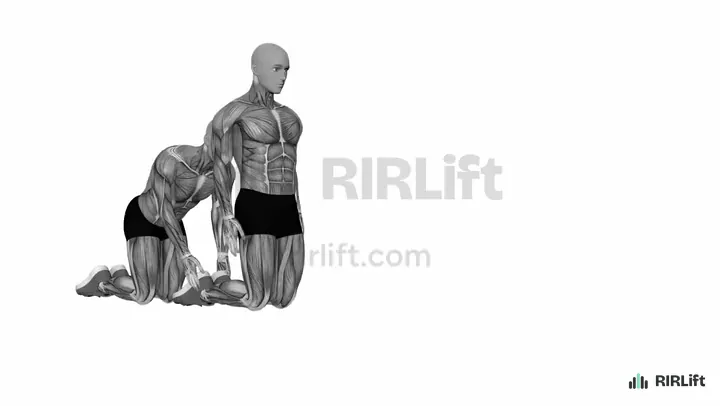
Lowering your whole body forward from your knees is one of the hardest things you can ask of the hamstrings, and it needs only something to anchor your heels. Most people manage only the lowering half at first.

How to do it

  1. Kneel on a pad and anchor your heels under a couch, a low bar or a partner's hands.
  2. With hips straight, lean forward as slowly as you can.
  3. When you can no longer hold it, catch yourself on your hands.
  4. Push off the floor just enough to get back up, and repeat.

Cues

  • Straight line knee to head
  • Fight the fall
  • Hands catch you

Common mistakes

  • Bending at the hips to shorten the lever: keep your hips extended.
  • Doing too many: 3 to 6 slow reps per set is plenty to start.

Swap for: Stability Ball Leg Curl, Band Leg Curl, TRX Leg Curl

Hamstrings, standing curl with a loop band

Band Leg Curl

Hamstrings

A loop band around your ankles turns a standing knee curl into a resistance exercise that needs no anchor at all. It is the easiest way to add direct hamstring work when you have no ball, bar or partner.

How to do it

  1. Loop a band around both ankles and stand tall, holding a wall for balance.
  2. Keep your thigh still and bend one knee to bring that heel toward your glutes.
  3. Hold the top for a second.
  4. Lower the foot slowly, then repeat on that leg before switching.

Cues

  • Thigh stays vertical
  • Squeeze at the top
  • Slow return

Common mistakes

  • Swinging the knee forward to cheat the curl: the thigh does not move.
  • A band too light to feel by rep 15: double it up or use a heavier one.

Swap for: Stability Ball Leg Curl, Nordic Hamstring Curl, TRX Leg Curl

Glute and hip exercises

Bridges and thrusts load the glutes with your hips fully extended, and side steps work the outer hip. Add one of these after your squat or lunge.

Glutes, hip thrust against a bench

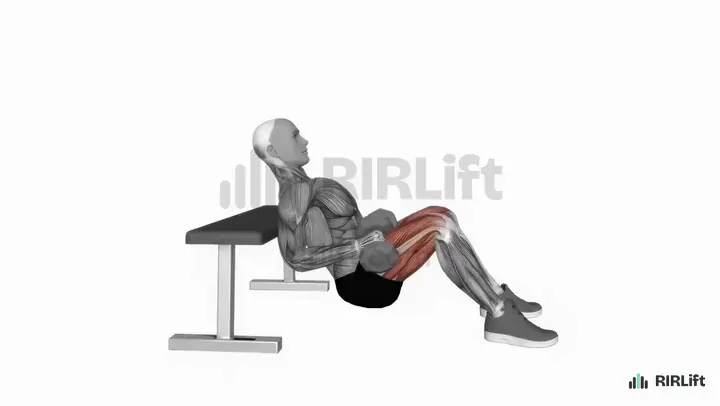
Dumbbell Hip Thrust

Glutes

Leaning your upper back on a bench or couch lets your hips extend fully under load, which is where the glutes work hardest. A heavy dumbbell on your hips is enough for most home gyms.

How to do it

  1. Sit with your shoulder blades against the edge of a bench or couch, knees bent.
  2. Rest a dumbbell across your hip crease and hold it with both hands.
  3. Drive the heels down and raise the hips until your thighs and torso form a flat line.
  4. Hold the top with your glutes tight, then lower slowly.

Cues

  • Chin tucked
  • Shins vertical at the top
  • Squeeze, then lower

Common mistakes

  • Arching the lower back to get higher: tuck the ribs and stop when the hips are level.
  • Feet too far away: the hamstrings take over. Bring them in.

Swap for: Dumbbell Glute Bridge, Single-Leg Hip Thrust, Kettlebell Hip Thrust

Glutes, one-leg bridge on the floor

Single-Leg Glute Bridge

Glutes

Bridging on one leg doubles the load on each glute without any weight. Hold a kettlebell on your hips with both hands when that becomes easy.

How to do it

  1. Lie face up with one foot flat and close to your hips, the other leg lifted.
  2. Press through the heel on the floor and raise your hips.
  3. Stop when your body is straight from shoulders to knee, and hold.
  4. Lower slowly, finish the set, then switch legs.

Cues

  • Heel pushes, toes light
  • Hips stay level
  • One-second hold

Common mistakes

  • Letting the free side hip drop: keep both hip bones at the same height.
  • Feeling it only in the hamstring: move your foot closer to your hips.

Swap for: Single-Leg Hip Thrust, Dumbbell Hip Thrust, Kettlebell Glute Bridge

Side glutes, stepping against a band

Lateral Band Walk

Abductors

Squats and hinges do little for the gluteus medius on the side of your hip. Side steps against a loop band fill that gap and are a common warm-up for knees that cave in on squats.

How to do it

  1. Put a loop band around your legs just above the knees or at the ankles.
  2. Sit into a quarter squat, feet under your hips.
  3. Step sideways with one foot, then bring the other foot after it without letting the band go slack.
  4. Take all your steps one way, then come back the other way.

Cues

  • Stay low
  • Band never slack
  • Toes point forward

Common mistakes

  • Standing up straight between steps: stay in the quarter squat the whole set.
  • Rocking the torso side to side: the hips do the stepping.

Swap for: Band Seated Hip Abduction, Standing Side Leg Raise, Band Standing Hip Abduction

Calves on a stair

Your calves get some work from lunges and step-ups, but not enough to grow. Finish with a few hard sets on a stair.

Calves, one leg on a step

Single-Leg Calf Raise

Calves

At home there is no calf machine, so standing on one leg on a stair is how you get enough load. Hold a dumbbell in the free hand when body weight gets easy.

How to do it

  1. Stand on one foot on the edge of a stair, the ball of the foot on the step and the heel off.
  2. Hold the rail with one hand and, if you have one, a dumbbell in the other.
  3. Sink the heel below the step and pause.
  4. Rise as high as you can, hold a second, and lower.

Cues

  • Pause at the bottom
  • Rise onto the big toe
  • Rail for balance only

Common mistakes

  • Short, bouncy reps: the stretch at the bottom is the part that counts.
  • Pulling up on the rail: the calf lifts you.

Swap for: Dumbbell Standing Calf Raise, Kettlebell Calf Raise, Dumbbell Seated Calf Raise

Put them together: example sessions

Each session below picks from the exercises above for one situation, with the sets, reps, rest and RIR filled in. Open one in the session builder to change a pick, price it from a recent set, and add it to RIRLift.

Session 1

No equipment at all, just a floor, a couch and a stair

Open in the session builder
  • Workouts2× a week
  • Working sets26 a week
  • Per workout~30 min
  • EquipmentDumbbells

You train in a living room or hotel room with nothing but furniture.

Body weight is too light for two legs, so every pick after the first squat loads one leg: the skater squat and reverse lunge for quads, the single-leg bridge for glutes, the Nordic curl with heels under the couch for hamstrings, and a one-leg calf raise on a stair. Bodyweight sets need more reps and closer to failure to count, so most finish at 0 to 1 RIR. Nordics stay at 2 RIR because a failed rep means a hard fall. Each session is 13 sets.

Day A
ExerciseSets × repsRIRRest
Bodyweight Squat3 s down, 1 s pause. 3 × 15–30 1 1 min
Reverse LungePer leg, no weight. 3 × 10–20 1 1 min
Single-Leg Glute BridgePer leg. 3 × 10–20 0 1 min
Single-Leg Calf RaiseOn a stair, per leg. 4 × 10–20 0 45 s

Open Day A in the session builder

Day B
ExerciseSets × repsRIRRest
Skater SquatPillow under the back knee. 3 × 6–12 1 90 s
Nordic Hamstring CurlHeels under the couch. 3 × 3–8 2 2 min
Single-Leg Glute BridgePause 2 s at the top. 3 × 10–20 0 1 min
Single-Leg Calf RaisePer leg. 4 × 10–20 0 45 s

Open Day B in the session builder

How to run it
Do Day A and Day B on non-consecutive days. Rest a full minute or more between sets even though there is no weight; your legs need it.
How to progress
Add reps until sets reach the top of the range, then slow the lowering to 3 seconds. On the skater squat, remove a pillow from under the back knee to lengthen the range.

Session 2

A pair of dumbbells and a bench

Open in the session builder
  • Workouts2× a week
  • Working sets26 a week
  • Per workout~35 min
  • EquipmentDumbbells, Flat Bench

You have adjustable or fixed dumbbells and a flat bench in a garage or spare room.

Dumbbells make the classic split possible: a squat or split squat for quads, a Romanian deadlift for hamstrings and a hip thrust against the bench for glutes. Day A leads with the goblet squat while you are fresh; Day B leads with the Bulgarian split squat, which is the hardest leg exercise here per pound lifted. The compound lifts sit at 1 to 2 RIR and 90 to 120 seconds of rest; the step-up and calf raise go to 0 to 1. Each session is 13 sets.

Day A
ExerciseSets × repsRIRRest
Goblet Squat1 warm-up set firstElbows to knees at the bottom. 4 × 8–15 2 2 min
Dumbbell Romanian DeadliftStop at mid-shin or your stretch. 3 × 8–12 1 2 min
Step-UpPer leg. 3 × 8–12 1 75 s
Single-Leg Calf RaiseDumbbell in the free hand. 3 × 10–15 0 45 s

Open Day A in the session builder

Day B
ExerciseSets × repsRIRRest
Bulgarian Split SquatPer leg, weaker side first. 4 × 8–12 1 90 s
Dumbbell Hip ThrustShoulders on the bench. 3 × 8–15 1 90 s
Single-Leg RDLPer leg. 3 × 8–12 1 75 s
Single-Leg Calf RaisePer leg. 3 × 10–15 0 45 s

Open Day B in the session builder

How to run it
Two lower body days a week, at least two days apart. Pair them with two upper body days if you train four times a week.
How to progress
When all sets of an exercise reach the top of the range at the target RIR, use the next dumbbell up. If you are already on your heaviest pair, switch the Romanian deadlift to the single-leg version.

Session 3

One kettlebell, a loop band and 25 minutes

Open in the session builder
  • Workouts2× a week
  • Working sets28 a week
  • Per workout~30 min
  • EquipmentKettlebells, Dumbbells, Resistance Bands

You own a single kettlebell and a loop band and want one short lower body session you can repeat twice a week.

One kettlebell cannot cover a heavy squat and a heavy hinge for everyone, so the swing does the hinging fast and the goblet squat and reverse lunge share the same bell. The band covers what the bell cannot: knee curls for the hamstrings and side walks for the outer hips. Pairing the band work with the lunge as a superset keeps the session to about 25 minutes. Strength moves stay at 1 to 2 RIR; band work goes to 0. That is 14 sets.

Kettlebell and band
ExerciseSets × repsRIRRest
Kettlebell SwingHips snap, arms relaxed. 4 × 12–20 2 75 s
Goblet SquatHold the bell by the horns. 3 × 10–15 1 90 s
A1 Reverse LungeBell at your chest, per leg. 3 × 8–12 1 45 s
A2 Band Leg CurlPer leg. 3 × 12–20 0 1 min
Lateral Band WalkSteps each way. 1 × 15–25 0 45 s
How to run it
Do the same session twice a week. Pair the reverse lunge with the band leg curl, resting only after both.
How to progress
Add reps until the top of each range is reached, then slow the squat to a 3-second lowering. Buy the next kettlebell size when swings feel easy at 20 reps.

Make it fit you

Questions

What exercises strengthen the lower body?

A squat, a single-leg exercise like the split squat or lunge, a hip hinge like the Romanian deadlift, and a glute bridge or hip thrust. Add a calf raise and you have trained every major lower body muscle.

What are the big 3 leg exercises?

In a gym, the squat, the deadlift and the lunge or leg press. At home the same three patterns become the goblet squat, the dumbbell Romanian deadlift and the Bulgarian split squat.

What are some compound exercises for the lower body?

The goblet squat, Bulgarian split squat, reverse lunge, step-up, Romanian deadlift and kettlebell swing all move more than one joint and train several leg muscles at once.

Is 4 exercises enough for leg day?

Yes. A squat or split squat, a hinge, a glute or hamstring exercise and a calf raise, 3 to 4 sets each taken close to failure, is a full leg session. Every plan on this page uses four or five.

Can you build leg muscle at home without weights?

Yes, if you use single-leg exercises and take sets close to failure. Skater squats, Nordic curls and single-leg bridges are hard enough for most people, and a slow lowering adds difficulty when reps climb past 20.

How many times a week should I train lower body at home?

Twice a week, two or more days apart, works for most people. That gives each muscle 10 to 16 hard sets a week while leaving time to recover.