Single leg exercises: split squats, one-leg squats, hinges and lateral work

The best single leg exercises are the Bulgarian split squat, reverse lunge and step-up for the quads and glutes, the single-leg Romanian deadlift and single-leg hip thrust for the hamstrings and glutes, the skater squat and pistol squat for true one-leg strength, and the Cossack squat and lateral lunge for side-to-side control. Pick one squat pattern and one hinge per session, do 3 sets of 6 to 12 reps per leg, start with your weaker leg, and stop 1 to 3 reps short of failure.

  1. Bulgarian Split Squat Quads, Glutes
  2. Single-Leg RDL Hamstrings, Glutes
  3. Dumbbell Reverse Lunge Quads, Glutes
  4. Step-Up Quads, Glutes
  5. Skater Squat Quads, Glutes
  6. Single-Leg Hip Thrust Glutes
  7. Cossack Squat Quads, Adductors

Split-stance squats and lunges

These are the heavy hitters of single-leg training. The back foot only balances you, so the front leg does most of the work while your balance demand stays low enough to load them with real weight.

Quads and glutes, split squat

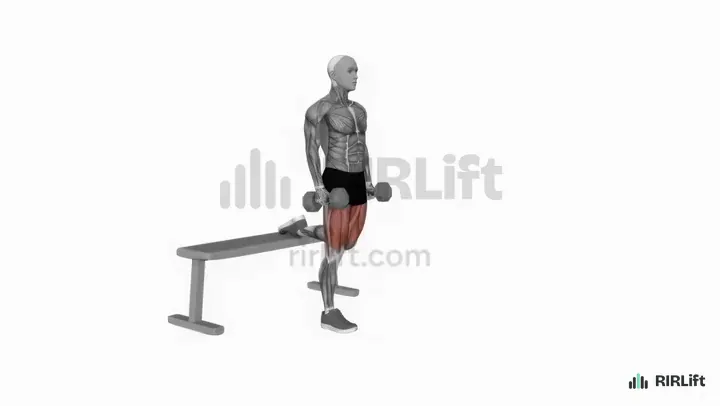
Bulgarian Split Squat

Quads, Glutes

Raising the back foot puts nearly all the load on the front leg, so a pair of moderate dumbbells is enough to take the front leg close to failure in 6 to 10 reps. It is the single leg exercise to start with if you only pick one.

How to do it

  1. Set the top of your back foot on a bench and place your front foot a long stride ahead.
  2. Hold a dumbbell in each hand at your sides, and keep your front foot flat.
  3. Drop your back knee straight toward the floor until the front thigh is close to level.
  4. Press through the front foot to rise, then finish all reps before switching legs.

Cues

  • Go deep for the inner thigh
  • Front foot flat
  • Rear foot is just a kickstand

Common mistakes

  • Pushing up with the back leg: let it relax and make the front leg do the work.
  • Front knee collapsing inward: keep it pointed the same way as your toes.

Swap for: Dumbbell Split Squat, Step-Up, Reverse Lunge

Quads and glutes, lunge

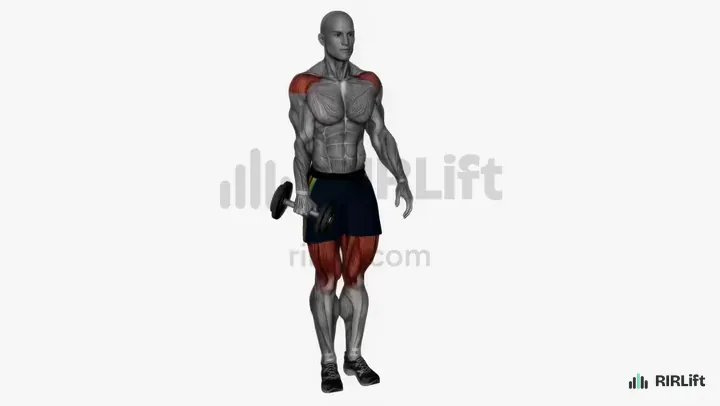
Dumbbell Reverse Lunge

Quads, Glutes

Stepping back instead of forward keeps your weight over the front foot and makes the stop easier to control, so it is the friendliest lunge for anyone new to one-leg work or careful with their knees.

How to do it

  1. Start tall with a dumbbell hanging from each hand and your feet under your hips.
  2. Step one foot back and lower until your back knee is just above the floor and your front thigh is near parallel.
  3. Keep your front heel flat and your chest tall.
  4. Push through your front foot to bring the back foot forward to the start, then alternate or finish all reps on one side.

Cues

  • Front shin stays vertical
  • Back knee kisses the floor
  • Drive through the front heel

Common mistakes

  • Taking a short step so the front knee shoots forward and the heel lifts: step farther back.
  • Letting the torso twist or lean to the side as you tire; keep both dumbbells hanging straight down.

Swap for: Bulgarian Split Squat, Step-Up, Reverse Lunge

Quads and glutes, step-up

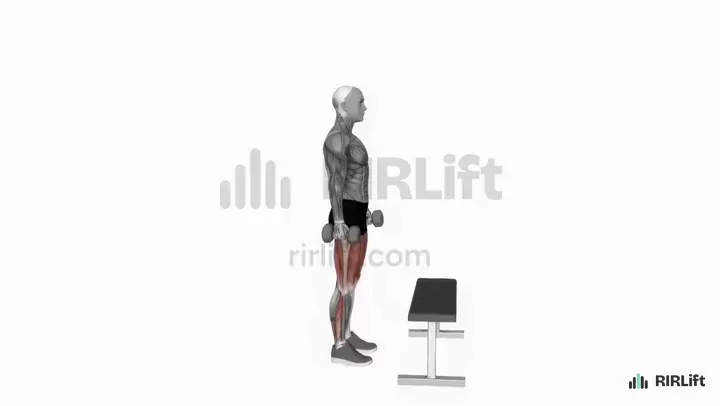
Step-Up

Quads, Glutes

The step-up makes the top leg lift you with no push from the floor leg, and the height of the bench sets how deep the knee bends. It is easy to load with dumbbells and easy to see when the bottom leg is cheating.

How to do it

  1. Stand facing the bench with two dumbbells.
  2. Place one whole foot on the bench.
  3. Lean forward a little and push through the top foot to stand up on the bench.
  4. Bring the other foot up only to touch, then lower it back to the floor.
  5. Finish all reps on one leg before switching.

Cues

  • Whole foot on the bench
  • Push through the top heel
  • Lower slowly, do not drop

Common mistakes

  • Pushing off the floor with the back foot: that halves the work. Keep the trailing foot light.
  • Using a bench so high that your knee is far above your hip: you will rock instead of step.

Swap for: Barbell Step-Up

True one-leg squats

With nothing touching the floor but one foot, the working leg carries all of your body weight and has to control the knee on its own. They need little or no extra load, which makes them the strongest options at home.

Quads and glutes, one-leg squat

Skater Squat

Quads, Glutes

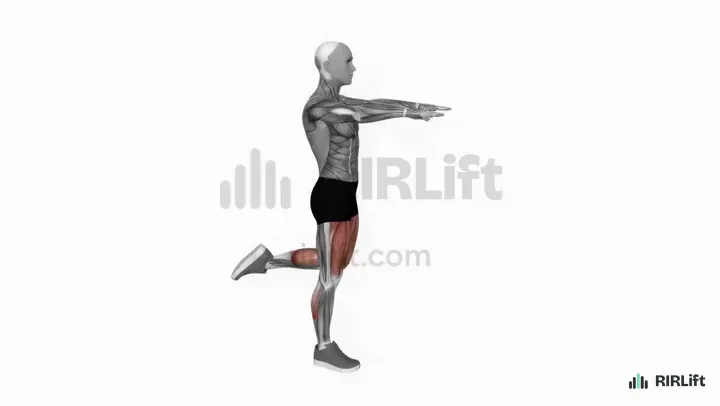
The back knee lowers toward the floor while you hold a light weight forward as a counterbalance, so you get a full one-leg squat without the hip mobility a pistol demands. Add load by holding heavier plates or dumbbells.

How to do it

  1. Stand on one foot and bend the other knee so that foot is behind you, arms straight out in front as a counterweight.
  2. Push your hips back and lean your chest forward as you bend the standing knee.
  3. Lower until the back knee is just above the floor.
  4. Drive through your standing foot to stand tall; sets are per leg.

Cues

  • Arms forward as the counterweight
  • Chest leans, back stays flat
  • Back knee to a folded towel

Common mistakes

  • Only going down a few inches: put a folded towel or cushion where your knee should land and touch it every rep.
  • Letting the standing knee collapse inward: track it over your toes, and slow the lowering if it wobbles.

Swap for: Pistol Squat, Reverse Lunge, Cossack Squat

Quads and glutes, one-leg squat to a box

Pistol Squat

Quads, Glutes

Sitting to a box on one leg is the learnable version of the pistol: the box sets your depth and catches you at the bottom. Lower the box an inch at a time as you get stronger.

How to do it

  1. Stand on one leg in front of a chair or box, the other leg straight out in front and arms reaching forward.
  2. Push your hips back and bend the standing knee, lowering slowly toward the seat.
  3. Touch the chair lightly, without sitting your weight down, and keep the front leg off the floor.
  4. Drive through the standing heel to stand all the way up; sets are per leg.

Cues

  • Touch the chair, don't sit
  • Reach forward to stay balanced
  • Lower the chair as you get stronger

Common mistakes

  • Dropping onto the seat and bouncing back up: control the lowering and barely touch, or raise the seat.
  • Heel popping up at the bottom: shift your weight to mid-foot and use a higher box until it stays down.

Swap for: Skater Squat, Reverse Lunge, Sissy Squat

One-leg hinges and hip work

Lunges train the front of the leg. These train the back: the hamstrings and glutes of one side, with the hips held level so the stronger side cannot take over.

Hamstrings and glutes, one-leg hinge

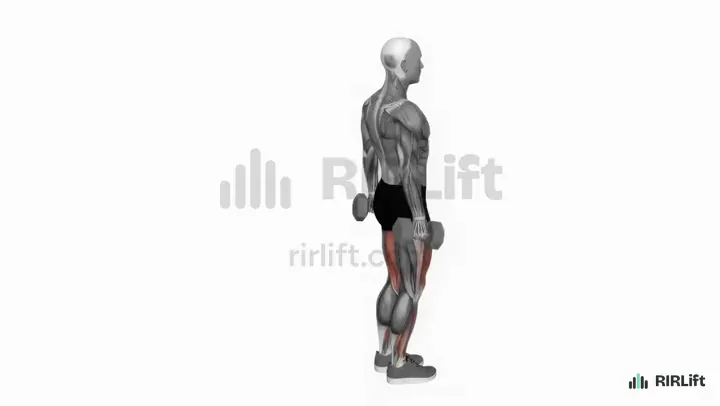
Single-Leg RDL

Hamstrings, Glutes

The single-leg Romanian deadlift loads the hamstring of the standing leg through a long stretch while the hip works to keep the pelvis square. The balance part improves fast; let the weight climb once it does.

How to do it

  1. Stand on your left leg with a dumbbell in your left hand and the standing knee softly bent.
  2. Hinge forward at the left hip while your right leg extends straight behind you, keeping your hips level.
  3. Lower until your torso and back leg are close to parallel to the floor or the standing hamstring stops you.
  4. Drive the left hip forward to come back up, then finish the set before switching sides.

Cues

  • Back leg and torso move as one
  • Hips level, back toes down
  • Slow on the way down

Common mistakes

  • Opening the hip so the back leg rotates out: point the back toes at the floor the whole time.
  • Touching the free foot down between reps to rebalance: slow down and hold a wall with your free hand if needed.

Swap for: Dumbbell B-Stance RDL, Dumbbell Romanian Deadlift

Hamstrings and glutes, staggered hinge

Dumbbell B-Stance RDL

Hamstrings, Glutes

With the back foot's toe on the floor as a kickstand, you get most of the single-leg hinge without the wobble, so you can go heavier. Use it when balance is what stops your single-leg RDL sets.

How to do it

  1. Stand with dumbbells in both hands and slide one foot back so its toes sit level with the heel of the front foot.
  2. Put about four fifths of your weight on the front leg with a soft knee.
  3. Hinge forward by sending your hips back, lowering the dumbbells along the front leg until the back of that thigh is stretched.
  4. Drive the front hip forward to stand up and repeat, then switch legs.

Cues

  • Front leg holds the weight
  • Back foot is only a kickstand
  • Hips square to the floor

Common mistakes

  • Sharing the load evenly between both feet: lift the back heel and keep only the toes down.
  • Twisting the hips open as you lower: keep both hip bones pointing at the floor.

Swap for: Single-Leg RDL, Dumbbell Romanian Deadlift, Dumbbell Good Morning

Glutes, one-leg hip extension

Single-Leg Hip Thrust

Glutes

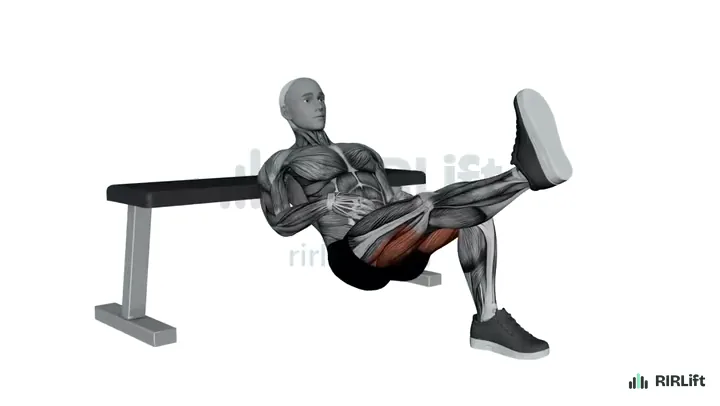
With your upper back on a bench and one foot driving, each glute has to lift the hips alone. It shows a left-right difference in strength quickly because the hips tilt toward the weaker side.

How to do it

  1. Set up with your upper back on a bench edge, one foot flat under your knee and the other foot lifted off the floor.
  2. Rest a dumbbell on the hip of the working leg and hold it in place with that hand.
  3. Push the planted heel into the floor and raise your hips until your torso and working thigh are in one line.
  4. Hold the top for a second, lower with control, and finish all reps before you switch legs.

Cues

  • Hips stay level, not tilted
  • Drive through the planted heel
  • Pause at the top

Common mistakes

  • Letting the hip of the lifted leg drop: if the pelvis tilts, use a lighter dumbbell or none.
  • Kicking the free leg up to help: keep it bent and still.

Swap for: Single-Leg Glute Bridge, Hip Thrust

Side-to-side strength

Most leg training moves forward and back. These shift your weight over one leg sideways and load the inner thigh in a long stretch, the direction you use to cut, step off a curb or change lanes on a trail.

Quads and adductors, lateral squat

Cossack Squat

Quads, Adductors

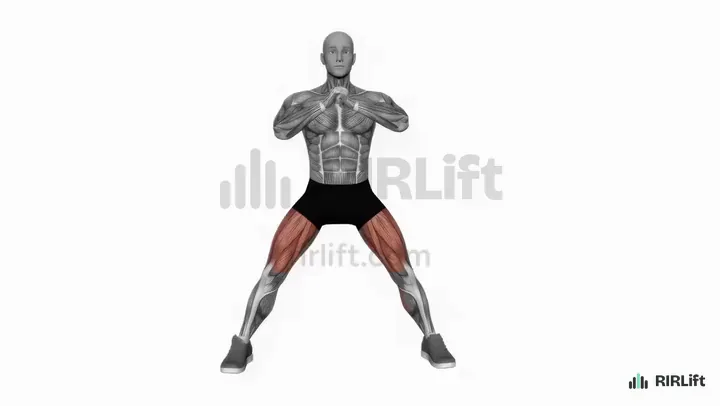
Sitting deep over one leg while the other stays straight trains the working leg and stretches the inner thigh of the other at the same time. It needs no equipment, and the depth you reach is the progression.

How to do it

  1. Take a very wide stance, about twice the width of your shoulders, with the toes turned out a little.
  2. Bend your right knee and sit your hips down toward your right heel, letting the left leg straighten with the toes pointing up.
  3. Sink as deep as you can with the right foot flat and your chest lifted.
  4. Press the floor away with the right foot to return to the middle, then sit to the left.

Cues

  • Sit down, not forward
  • Flat foot on the bent side
  • Long leg stays straight

Common mistakes

  • Folding the chest down to the knee to get lower: hold a light weight out in front as a counterbalance instead.
  • Rushing from side to side: stop in the middle for a breath between reps.

Swap for: Dumbbell Lateral Lunge, Kettlebell Lateral Lunge, Balance Board Lateral Squat

Quads, glutes and adductors, side lunge

Dumbbell Lateral Lunge

Quads, Glutes, Adductors

The lateral lunge loads the same sideways pattern as the Cossack squat with a shallower bottom and dumbbells in hand, so it is the version to load once the bodyweight movement is easy.

How to do it

  1. Stand with your feet together and a dumbbell hanging at each side.
  2. Take a wide step to the right and sit your hips back over the right foot, left leg straight.
  3. Lower until the right thigh is near level with the floor, dumbbells on either side of the bent knee.
  4. Push hard off the right foot to step back to the start, then step out to the left.

Cues

  • Step wide, sit back
  • Trailing leg stays long
  • Both feet point forward

Common mistakes

  • Stepping too short, which turns the lunge into a squat with no stretch on the trailing leg.
  • Letting the bent knee drift inward past your big toe: keep it in line with the foot.

Swap for: Kettlebell Lateral Lunge, Cossack Squat, Goblet Squat

Machines and calves, one side at a time

A machine removes balance from the equation so balance never ends the set before the leg does, and the calf raise loads each ankle with your full body weight.

Quads and glutes, machine

Single-Leg Leg Press

Quads

The single-leg leg press lets you take one leg close to failure with no balance or back fatigue in the way. It is the cleanest way to give a weaker leg extra sets in a gym.

How to do it

  1. Sit in the press and set one foot in the middle of the platform, the other resting on the floor or frame.
  2. Lower the platform with control until your working knee is well bent and your hip stays on the seat.
  3. Push the platform away with that one foot without twisting your pelvis.
  4. Finish all reps on one side, then switch.

Cues

  • Hips square
  • Same depth on both legs
  • Smooth, not jerky

Common mistakes

  • Rotating the hips to cheat the platform up: drop the weight until both hips stay flat.
  • Starting with your stronger leg and doing extra reps: match the weaker side's reps on both.

Swap for: Bulgarian Split Squat, Leg Press

Calves, one-leg raise

Single-Leg Calf Raise

Calves

Standing on one leg puts your whole body weight on one calf before you pick up the dumbbell the demo holds, and the slow lowering trains the ankle that takes your weight in every step of the lunges and step-ups on this page.

How to do it

  1. Stand on one foot with the other lifted just off the floor, arms by your sides; hold a dumbbell in each hand once body weight is easy.
  2. Rise onto the ball of your foot as high as you can and hold for a second.
  3. Lower your heel to the floor over two seconds.
  4. Finish all reps on one leg, then switch; sets are per leg.

Cues

  • Rise as high as you can
  • Pause at the top
  • Two seconds down

Common mistakes

  • Bouncing through the reps: pause for a beat at the top of each one.
  • Rolling onto the outside of the foot: keep your weight over the big toe.

Swap for: Dumbbell Standing Calf Raise, Kettlebell Calf Raise, Standing Calf Raise

Put them together: example sessions

Each session below picks from the exercises above for one situation, with the sets, reps, rest and RIR filled in.

Session 1

Two gym leg days built on single-leg work

  • Workouts2× a week
  • Working sets24 a week
  • Per workout~40 min
  • EquipmentDumbbells, Leg Press, Flat Bench

You lift in a gym, you want bigger and stronger legs, and heavy back squats bother your back or simply stopped progressing.

Each leg gets 12 working sets per day, 24 a week: 9 sets of squats, presses and step-ups, 9 of hinges and hip thrusts, 3 lateral and 3 calf. Machines and split squats let you push close to failure without a heavy bar on your back.

Day 1: Quads
ExerciseSets × repsRIRRest
Bulgarian Split Squat2 warm-up sets firstPer leg. 3 × 6–10 2 2 min
Single-Leg Leg PressPer leg. 3 × 10–15 1 90 s
Single-Leg RDLPer leg. 3 × 8–10 2 90 s
Single-Leg Calf RaisePer leg. 3 × 10–15 1 1 min
Day 2: Hips
ExerciseSets × repsRIRRest
Dumbbell B-Stance RDL2 warm-up sets firstPer leg. 3 × 6–10 2 2 min
Step-UpPer leg. 3 × 8–10 2 90 s
Single-Leg Hip ThrustPer leg. 3 × 10–15 1 75 s
Dumbbell Lateral LungePer leg. 3 × 8–10 2 75 s
How to run it
Run Day 1 and Day 2 once each per week with at least two days between them, for example Monday and Thursday. Pair them with your upper-body days on the other days.
How to progress
Use double progression: once every set of an exercise reaches the top of its rep range at the target reps in reserve, add the smallest dumbbell or plate jump next session and work back up from the bottom of the range.

Session 2

At home with a pair of dumbbells

  • Workouts2× a week
  • Working sets28 a week
  • Per workout~35 min
  • EquipmentDumbbells

You train at home with adjustable or a few fixed dumbbells, and you need your legs to work hard with weights that feel light for two-leg squats.

Standing on one leg puts close to your whole body weight on it, so light dumbbells still make each set hard. The 14-set session, run twice a week, gives each leg 16 squat-pattern sets, 6 hinge sets and 6 calf sets a week.

Home legs
ExerciseSets × repsRIRRest
Dumbbell Reverse Lunge1 warm-up set firstPer leg. 3 × 8–12 2 90 s
Single-Leg RDLPer leg. 3 × 10–12 2 75 s
A1 Skater SquatPer leg. 3 × 6–10 2 1 min
A2 Single-Leg Calf RaisePer leg. 3 × 12–20 1 1 min
Cossack SquatPer side. 2 × 6–8 3 1 min
How to run it
Do the session twice a week on non-consecutive days, such as Tuesday and Saturday. Superset the skater squat and calf raise to keep the session near 40 minutes.
How to progress
When your dumbbells get too light, slow the lowering to three seconds, then add a one-second pause at the bottom before you add reps. For the skater squat, hold a heavier counterweight; for the Cossack squat, sit deeper before adding a dumbbell.

Session 3

One leg is clearly weaker

  • Workouts2× a week
  • Working sets20 a week
  • Per workout~30 min
  • EquipmentDumbbells, Leg Press

One leg gets fewer reps, wobbles more or looks smaller, whether from an old injury, a sport that favors one side or years of shifting your weight in squats.

The weaker leg sets the reps for both sides, so the stronger leg stops getting ahead while the weaker one gets one extra set on the machine. That is 10 working sets for the stronger leg and 11 for the weaker one per session, twice a week.

Weaker leg first
ExerciseSets × repsRIRRest
Bulgarian Split Squat1 warm-up set firstPer leg. Weaker leg first, match its reps. 3 × 8–12 2 2 min
Single-Leg Leg PressPer leg. One extra set on the weaker leg. 3 × 10–15 1 90 s
Single-Leg Hip ThrustPer leg. Weaker leg first. 2 × 10–15 2 75 s
Pistol SquatPer leg. Same box height both sides. 2 × 5–8 2 75 s
How to run it
Run this session on two days with at least two rest days between them, such as Monday and Thursday. Always start each exercise with the weaker leg, note the reps, and stop the stronger leg at the same number.
How to progress
Add weight only when the weaker leg reaches the top of the rep range at the target reps in reserve. Drop the extra set once both legs hit the same reps at the same weight for two sessions in a row.

Make it fit you

Questions

Is it better to do single leg exercises?

Not better, different. Two-leg lifts let you move the most total weight, while single leg exercises load each side on its own, add balance and hip control, and need much lighter weights to work the legs hard. Most lifters do best with both, or with single-leg work alone when the back is the limit.

How do you strengthen a single leg?

Train it with one squat pattern, such as the Bulgarian split squat, and one hinge, such as the single-leg RDL, two or three times a week for 6 to 12 reps per set. Start with that leg, add weight when you reach the top of the rep range, and keep the other leg at the same reps.

What are unilateral exercises?

Unilateral exercises work one arm or one leg at a time. For the legs that means split squats, lunges, step-ups, single-leg deadlifts, single-leg hip thrusts and one-leg squats like the pistol.

Can single leg exercises build big legs?

Yes. A Bulgarian split squat or single-leg leg press taken to 1 or 2 reps short of failure trains the quads and glutes hard enough to grow them. The muscle grows from hard sets, and single-leg exercises give you hard sets with far less weight on your spine.

How many sets of single leg exercises should I do?

Count sets per muscle, per leg: 10 to 20 hard sets a week for the quads and about the same for the glutes and hamstrings covers most goals. In practice that is two or three single leg exercises of 3 sets each, twice a week, plus a hinge.

How do you exercise with only one leg?

Pick exercises where the other foot does nothing: a pistol squat to a box, a single-leg hip thrust, a single-leg leg press and a single-leg calf raise. Hold a rack or wall for balance, start with bodyweight, and add load the same way as any other lift once you reach the top of the rep range.