
The best hybrid training apps
Published November 12, 2026
If you want one app to plan both, Edge is the best hybrid training app: strength, running and HIIT in one coordinated plan, with target paces and suggested weights, for $129.99 a year. If you already have a running plan, RIRLift is the best app for the lifting half: it's free, sets every weight from your last set on the Apple Watch you run with, and saves sessions to Apple Health next to your runs. Runna is the pick if running comes first.
Free on iPhone and Apple Watch · No account · Coming to Android: join the waitlist
The best apps for running and strength training, ranked
Ranked for someone who runs and lifts and wants both to progress: one app that plans both first, then the best way to add lifting to a running plan you already follow.
-
1. Edge
Best for: One plan that schedules runs, lifts and HIIT together
- Price
- $129.99/year or $22.99–$29.99/month; 7-day trial
- Platforms
- iPhone, Android, Apple Watch
Where it wins
- Strength, running and HIIT in one coordinated plan
- Runs with target paces and heart-rate zones; lifts with suggested weights
- Adjusts when you miss a session or travel
- Syncs with Garmin, COROS and Apple Health
Where it falls short
- Paid after the trial
- Fewer ratings than the bigger apps
-
2. RIRLift
Best for: The lifting half, if you already follow a running plan
- Price
- Free; Pro $9.99/month or $79.99/year
- Platforms
- iPhone and Apple Watch
Where it wins
- Sets every weight from your last set, free
- Runs on the Apple Watch you run with
- Saves to Apple Health as strength training, next to your runs
- Runner plans for base, off-season and race builds
Where it falls short
- Doesn't plan your runs
- iPhone and Apple Watch only
- No interval or HIIT timers
-
3. Runna
Best for: Running first, with strength sessions on the side
- Price
- $19.99/month or $119.99/year; 7-day trial
- Platforms
- iPhone, Android; Apple Watch, Garmin, COROS
Where it wins
- Personalized running plans
- Strength and conditioning routines alongside
- Syncs runs to Strava
Where it falls short
- Strength is the side dish
- Subscription after the trial
-
4. Hevy
Best for: Logging lifts that sit next to your runs on Strava
- Price
- Free; Pro $2.99/month, $23.99/year or $74.99 lifetime
- Platforms
- iPhone, Android, Apple Watch, Wear OS, web
Where it wins
- Syncs workouts to Strava automatically
- Free with unlimited workouts
- On almost every device
Where it falls short
- Doesn't plan runs
- Weight suggestions need Pro
- Free tier caps routines at 4
-
5. Go One More
Best for: Nick Bare's hybrid programs and nutrition lessons
- Price
- $14.99/month or $99.99/year; $1 first month
- Platforms
- Inside the Playbook app
Where it wins
- Nick Bare's strength and running programs
- Mobility sessions and 8 nutrition lessons
- Q&As with Nick and direct messages
Where it falls short
- No free version after the $1 first month
- Runs inside the Playbook app
What a runner who lifts needs from an app
-
One plan, or two apps
Edge schedules runs and lifts in one plan. If you already follow Runna, a club plan or your own, you only need the lifting half.
-
Lifting that knows your legs are tired
The day after intervals, log the set as it went. In RIRLift, reps made but closer to failure than planned hold the weight; below the rep range brings the next set down.
-
Both on the same Watch
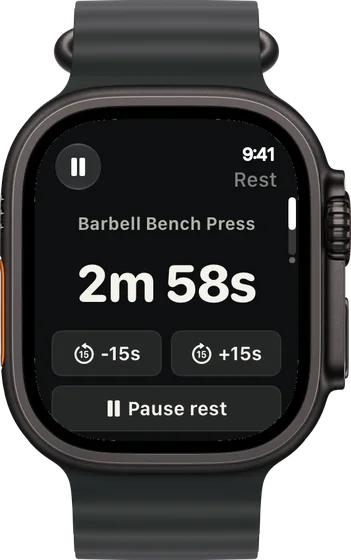
Runna and Edge run on Apple Watch. RIRLift logs every set, runs the rest timer and shows the next weight there, free.
-
One history for both
Hevy syncs lifts to Strava. RIRLift saves each session to Apple Health as Traditional Strength Training, in the same history as your runs.
-
Weights that move without a spreadsheet
Plans that list sets and reps leave the load to you. RIRLift sets it from your last set. How it decides.
Hybrid training, in two real cases
Half-marathon in 12 weeks, two lifting days to add
Runs four days a week on a plan they like, wears an Apple Watch, posts runs to Strava. Wants stronger legs without wrecking the long run.
| App | What it does here | For this lifter |
|---|---|---|
| Edge | Replaces the running plan with one that schedules runs and lifts together, from $129.99 a year. | Good if you'd switch running plans. This runner wouldn't. |
| Runna | Its own running plans, with strength and conditioning routines alongside, for $19.99 a month. | Fits a runner who wants one subscription. |
| Hevy | Logs the two lifting days free and posts them to Strava. Weight suggestions need Pro. | Fits the Strava habit; the jumps stay yours. |
| RIRLift | Runs the two lifting days on the Watch, sets every weight from the last set and saves to Apple Health next to the runs. Free. | The fit: the running plan stays, the lifting progresses itself. |
Keep the running plan you trust. The lifting half is the part to hand to an app.
Leg day the morning after track intervals
The same runner in RIRLift. Reverse lunges planned for 8 reps with 2 left; split squats in an 8–12 range.
| Exercise | You logged | Next session | Why |
|---|---|---|---|
| Dumbbell Reverse Lunge | Set 1: 35 lb pair × 8, nothing left | Set 2: 35 lb pair × 8 | You got the reps, just closer to failure than planned. The weight holds; you don't get cut for pushing. |
| Dumbbell Split Squat | 30 lb pair, 12 / 12 / 12 reps per leg, 2 left | 35 lb pair × 8 | Every set at the top of 8–12: the next pair of dumbbells, reps back to 8. |
Heavy legs from the track held the lunge where it was and didn't cost the split squat its jump.
Runner plans that open in RIRLift
-
The best strength workout for runners, built around your training
Off-season or base phase, full gym
Two heavier sessions a week in the base phase or off-season.
2× a week · 24 sets a week · ~40 min
Add to RIRLiftSee the planAdd to RIRLift
Scan with your iPhone camera to add this plan.
-
The best strength workout for runners, built around your training
Marathon or race build, once a week
One session a week through a race build, to keep the strength.
1× a week · 9 sets a week · ~30 min
Add to RIRLiftSee the planAdd to RIRLift
Scan with your iPhone camera to add this plan.
Make it fit you
-
Put lifting around your key runs
Choose your training days when you set up the plan, and keep the day before a long run or a workout free.
-
Use Ask first in race season
Next session's weights wait on the recap until you confirm them, so nothing climbs in a week you want to hold.
-
Choose Steady on high mileage
Steady takes smaller, surer steps. Switch to Standard in the off-season.
-
Coming from Hevy? Import it
Export a CSV from Hevy and import it in RIRLift, so your first weights come from your history.
When a different app fits better
- You want one plan that schedules both runs and lifts. Edge. RIRLift plans the lifting only.
- Your lifts have to land on Strava. Hevy. RIRLift saves to Apple Health, not Strava.
- You're on Android or train with HIIT intervals. Edge or Runna. RIRLift is iPhone only and has no interval timers.
Questions
What is the best app for running and strength training?
Edge, if you want one plan for both. If you already have a running plan, add RIRLift for the lifting: free, on Apple Watch, with every weight set for you.
Can one app plan running and lifting together?
Yes. Edge schedules strength, running and HIIT in one plan, and Go One More sells Nick Bare's running and strength programs. Runna adds strength routines to its running plans.
How many days a week should a runner lift?
Two in the base phase or off-season, one in a race build. The runner plans show how each fits.
Will my lifting show up with my runs?
In Apple Health, yes: RIRLift saves each session as Traditional Strength Training. On Strava, use Hevy, which syncs there.
Read next
-
The strength training app for runners that fits around your miles
Lifting plans for each phase of your season.
-
Strength training for runners, on the Watch you run with
Lifting on the Watch you run with.
-
The best strength workout for runners, built around your training
The runner plans in full.
-
How RIRLift picks your next weight
Why the lunge held after intervals.
More ways lifters use RIRLift
-
The strength training app for runners that fits around your miles
Short lifting sessions for each phase of your season, with weights that hold when your legs are tired.
-
Strength training for runners, on the Watch you run with
Lift with the Watch you run with: sets logged on the wrist, saved to Apple Health next to your runs.
-
The workout app that puts your lifting in Apple Health
Lifting sessions saved to Apple Health exercise by exercise, next to your runs, with your next weights set.