
The strength training app for runners that fits around your miles
Published October 27, 2026
Runners need strength training that fits around their running: one or two short sessions a week, single-leg and calf work, and weights that don't punish you the day after a long run. RIRLift runs that on iPhone and Apple Watch, free. Pick the plan for your phase, log weight, reps and how many reps you had left, and the next session's weights are set for you. Lifts finished on iPhone save to Apple Health next to your runs.
Free on iPhone and Apple Watch · No account · Coming to Android: join the waitlist
What runners need from a strength training app
-
Short sessions, one or two a week
The runner plans below are two sessions a week of four exercises, or one session in a race build. They fit on an easy day without crowding your key runs.
-
Single-leg and calf work that progresses
Split squats, single-leg RDLs and calf raises go up when every set reaches the top of the rep range. On dumbbells, a 5 lb jump is a big step, so reps come first until the next pair is due.
-
A plan for each phase of your season
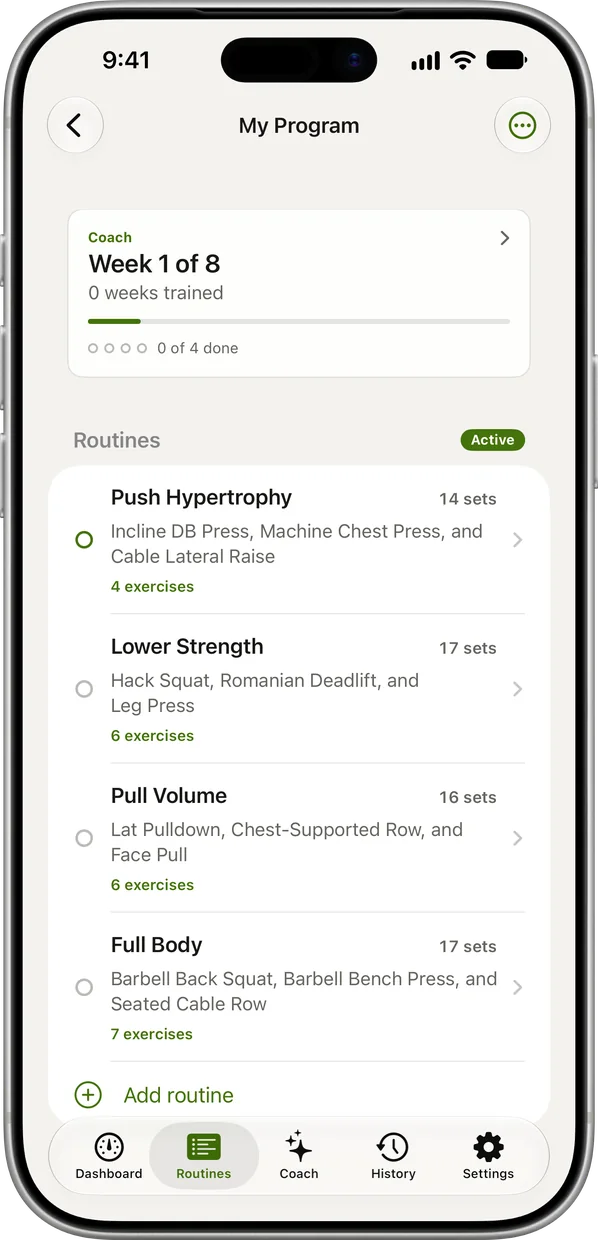
Group routines into programs and switch the active one: a new-to-lifting block, a heavier off-season build, then one session a week through a marathon build. Give a block a finish line and Journey shows where your main lift is headed.
-
Weights that respect tired legs
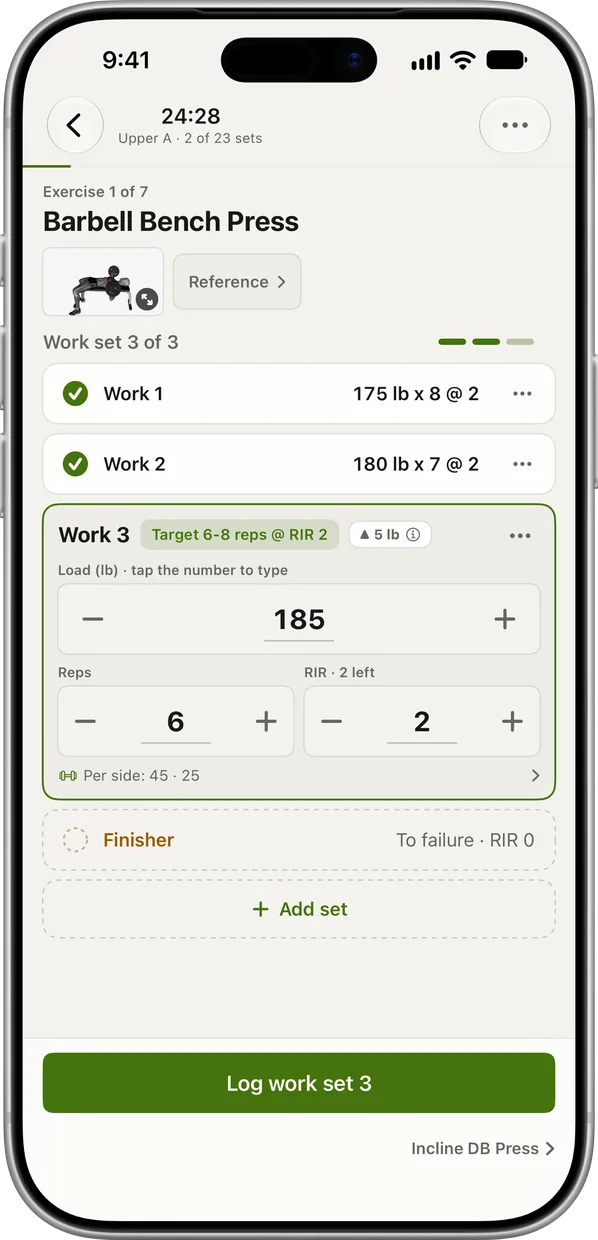
Legs still heavy from yesterday's long run? Log the set as it went. Hit the reps closer to failure than planned and the weight holds. Fall below the rep range and the next set comes down.
-
On your wrist, and in Apple Health
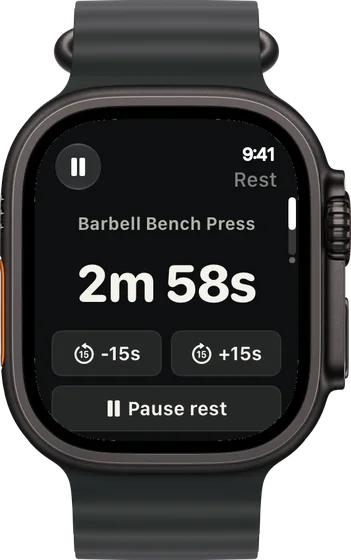
Run the whole session from your Apple Watch, rest timer and plate math included. Workouts finished on iPhone save to Apple Health, each exercise as its own segment, next to your runs.
A runner's strength season, set by set
Base phase, new to lifting, dumbbells at home
Running 25 miles a week, lifting twice. Every set stops 3 reps short of failure while the movements are new.
| Exercise | You logged | Next session | Why |
|---|---|---|---|
| Bulgarian Split Squat | 15 lb pair (Estimate), 16 reps per leg, nothing left | 20 lb × 6–10 | One max-reps set measures you. 16 to failure at 15 lb converts to about 18 lb for 6 reps with 3 left, rounded to your 20s. |
| Single-Leg RDL | 25 lb, 10 / 10 / 10 reps, 3 left | 30 lb × 6–10 | Every set at the top of 6–10 at the planned effort. Next dumbbell, reps back to 6. |
| Dumbbell Seated Calf Raise | 45 lb, 13 / 12 / 12 reps, 2 left (target 12) | 45 lb × 13 | The weakest sets hit 12. Same weight, aim for 13. |
Two short sessions, and every exercise knows its next weight before you lace up for the next run.
Off-season build, the day after a long run
Gym access, lifting heavier between race blocks. Legs are still heavy from yesterday.
| Exercise | You logged | Next session | Why |
|---|---|---|---|
| Trap Bar Deadlift | Set 1: 225 lb, 5 reps, 1 left (target 5, 2 left) | Set 2: 225 lb | You got the reps, just closer to failure. The weight holds; you don't get cut for pushing. |
| Bulgarian Split Squat | Set 1: 40 lb pair, 4 reps, 1 left (target 6, 2 left) | Set 2: 35 lb pair | Four is below the 5–8 range. 40 × 34 ÷ 37 is about 37 lb, rounded to your 35s. |
| Standing Calf Raise | 160 lb, 10 / 10 / 10 reps, 1 left | 170 lb × 6–10 | Calves had a good day anyway. Top of 6–10 on every set: one step up. |
Log what actually happened. A tired day adjusts that session and leaves the rest of your progress alone.
Marathon build, once a week, then three weeks off after the race
Peak mileage, long runs and a weekly workout. The goal is to keep strength, not set records.
| Exercise | You logged | Next session | Why |
|---|---|---|---|
| Trap Bar Deadlift | 245 lb, 5 / 5 / 5 reps, 2 left | 255 lb × 3–5 | Top of 3–5 at the planned effort, so one step is suggested. With Coach on Ask first, you confirm it or keep 245 on the recap. |
| Seated Calf Raise | 90 lb, 12 / 10 reps, 2 left (target 10) | 90 lb × 11 | The weaker set hit 10. Same weight, one more rep. |
| Bulgarian Split Squat | Last session before the race: 45 lb pair × 8 | 40 lb pair × 5–8 | Three weeks off triggers Ease back in: one week about 10% lighter. Or choose Pick up where I left off. |
In a race build you keep the final say on every jump. After the race, the first week back is easier on its own.
Runner plans that open in RIRLift
-
The best strength workout for runners, built around your training
New to lifting, dumbbells at home or gym
Two sessions with dumbbells, at home or in a gym. The plan in the first example.
2× a week · 22 sets a week · ~30 min
Add to RIRLiftSee the planAdd to RIRLift
Scan with your iPhone camera to add this plan.
-
The best strength workout for runners, built around your training
Off-season or base phase, full gym
Heavier trap bar and hip thrust work between race blocks, twice a week.
2× a week · 24 sets a week · ~40 min
Add to RIRLiftSee the planAdd to RIRLift
Scan with your iPhone camera to add this plan.
-
The best strength workout for runners, built around your training
Marathon or race build, once a week
One session a week through a race build, to keep the strength you built.
1× a week · 9 sets a week · ~30 min
Add to RIRLiftSee the planAdd to RIRLift
Scan with your iPhone camera to add this plan.
Make it fit you
-
Set Coach to Ask first for race season
Set Coach to Ask first and next session's weights show on the recap. Confirm the jump or keep the load you had.
-
Choose the Steady pace
Steady takes smaller, surer steps, which suits lifting on top of high mileage. Switch to Standard in the off-season.
-
Put lifting days around your key runs
Choose your training days when you set up the plan, and leave the day before a long run or a workout free.
-
Swap what your gym doesn't have
No trap bar? The swap picker shows replacements with the weight they'd start at, worked out from your strength on the original.
-
Log from your wrist
With an Apple Watch you can log sets, run rest timers and swap exercises without taking out your phone.
When a different app fits better
- You want one calendar that plans your runs and lifts together. RIRLift plans the lifting; your running plan stays in your running app. An app that schedules both fits better.
Questions
Should runners do strength training?
Yes. Heavy, low-rep lifting and single-leg work make your legs stronger for the mileage without adding much bulk. One or two sessions a week is enough, and the runner plans show how they fit each phase.
How many days a week should a runner lift?
Two in the off-season or base phase, one during a race build. The best strength workout for runners has a plan for each.
Will lifting make me slower or bulky?
Not at one or two short sessions a week of low reps with reps left in reserve. Muscle growth takes far more volume and food than runner plans use.
When should I lift in a running week?
Away from your key runs. Lift on an easy-run day or after a workout, and keep the day before a long run or a race free.
Is RIRLift free for runners?
Yes. Unlimited workouts, weight suggestions, the Apple Watch app and up to 4 active routines are free with no account. Pro adds unlimited routines and cycles and all-time analytics.
Read next
-
The best strength workout for runners, built around your training
All three runner plans in full, with every exercise demonstrated.
-
Bulgarian split squat: form, foot position and alternatives
The single-leg lift in every runner plan.
-
Single-leg RDL: how to do it without losing balance
Hamstrings and hip stability on one leg.
-
Trap bar deadlift: how to do it, which handles to use, and how it compares
The heavy lift in the off-season and race plans.
-
Calf raises: how to do them, what they work and what to swap in
Straight-knee and bent-knee calf work for the mileage.
More ways lifters use RIRLift
-
The strength training app that turns heavy sets into your next weight
Heavy sets of 3 to 5, a weight for every one, and a clear answer when a lift stops moving.
-
The Apple Watch weightlifting app that runs the whole session
Log sets, rest, load plates and swap machines from your wrist, with the next weight set on the Watch.
-
The workout app that puts your lifting in Apple Health
Lifting sessions saved to Apple Health exercise by exercise, next to your runs, with your next weights set.