
Blog
Muscle groups to train together: what each pairing costs
Published August 11, 2026 · 15 min read
Ask which muscle groups to train together, or search for muscle groups to workout together, and the internet answers in one voice. Chest and triceps. Back and biceps. Quads and hamstrings. Shoulders with abs if you have room.
The list is not wrong. Those pairings have survived sixty years of gym folklore because they solve a real problem: they keep pushing work on one day and pulling work on another, which keeps your rest days clean and your sessions short.
But notice what the answer is optimising for. Time. Logistics. Not one of the pages returning that list tells you what the pairing does to the amount of growth stimulus each muscle actually receives, and that is the only thing the pairing changes that you should care about.
Because pairings are not neutral. When you put triceps after chest, the triceps show up to their direct work having already pressed for forty minutes. The four sets your log records are four sets. They are not four fresh sets. Choose your pairings badly and you can run a full year of correct-looking weekly volume while one muscle in every pairing quietly eats the leftovers.
What muscle groups should you train together?
Train together the muscle groups that share the movement patterns you have already decided to do that day. The default pairings are chest with triceps and shoulders (pushing), back with biceps (pulling), and quads with hamstrings and glutes (legs). The pairing is not a growth strategy. It is a decision about which muscle in the pair gets its work while fresh and which one gets it pre-fatigued.
That second half is the part missing from every list. A pairing decides sequence, and sequence decides dose. Two lifters can run identical weekly set counts for triceps and end the year in different places because one of them always trained triceps after chest and the other gave triceps a day where they went first.
So the useful version of the question is not "which muscles go together". It is "which muscle am I willing to pay the tax on". That is a question about what your training week delivers rather than how it is arranged, which is also why it is easier to answer from a log than from a template. Seeing how a session runs from your wrist is a decent way to picture the difference: the pairing you chose on paper is a plan, and what each muscle actually received is data.
The three ways to pair muscle groups
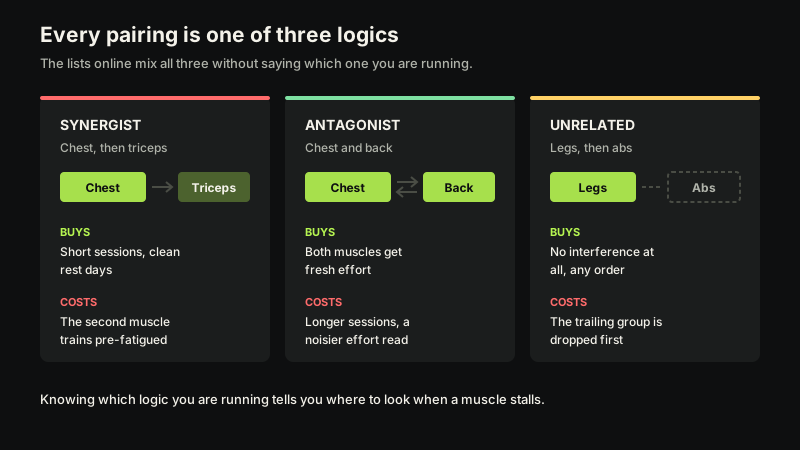
Every pairing you have ever seen is one of three logics. They have different costs and the popular lists rarely distinguish them.
Synergist pairing. Muscles that already assist each other in the same movement. Chest and triceps, back and biceps, shoulders and triceps. The pairing is efficient because the second muscle is already warm and already partly worked. That is also exactly why it is discounted.
Antagonist pairing. Muscles on opposite sides of a joint. Chest and back, biceps and triceps, quads and hamstrings. Neither muscle fatigues the other, so both arrive at their work fresh. The cost is session length and a longer list of exercises to fit into one day.
Unrelated pairing. Muscles with no shared workload at all. Legs and abs, back and calves, shoulders and forearms. The cost is not physiological, it is attentional: the second group is almost always the one that gets cut when the session runs long.
| Pairing logic | Example | What it buys you | What it costs |
|---|---|---|---|
| Synergist | Chest, then triceps | Short sessions, clean rest days, one movement pattern per day | The second muscle trains pre-fatigued for all of its direct sets |
| Antagonist | Chest and back alternating | Both muscles get fresh effort, more total work in the same time | Longer sessions, more exercises to organise |
| Unrelated | Legs, then abs | Total freedom of order, no interference | The trailing group is the first thing dropped when time runs out |
Most published splits mix all three without saying so. A push day is a synergist pairing. An upper day is an antagonist pairing with a synergist pairing hidden inside it. Knowing which one you are running tells you where to look when a muscle stalls.
The best muscle groups to train together, and what each pairing actually costs
Here are the pairings any search will hand you, with the column nobody prints.
| Classic pairing | Why it is recommended | Who pays the tax |
|---|---|---|
| Chest, then triceps | Triceps assist every press | Triceps. They have done pressing volume before their first extension |
| Back, then biceps | Biceps assist every row and pull-up | Biceps. Same mechanism, often worse because grip fatigue arrives too |
| Shoulders, then triceps | Overhead pressing hits both | Triceps again, and on a push day they take it twice |
| Quads, then hamstrings | One leg day, one recovery window | Usually neither, if you squat before you curl. Hamstrings if you deadlift first |
| Chest and back (antagonist) | Neither interferes, more work per hour | Nobody. This is the cheapest pairing available |
| Legs, then abs | Nothing conflicts | Abs, by attrition, because they are last and optional |
Read the right-hand column and a pattern jumps out. In three of the six, the muscle paying is a small muscle that only ever gets trained in the tail of a session. Arms are the classic casualty, and this is a large part of why so many lifters with respectable pressing numbers have arms that refuse to move.
That is not an argument against synergist pairings. It is an argument for knowing which muscle you have quietly put on a discount, and for making sure it is not the same muscle in every session of the week.
Why the second muscle gets less than your log says
This is the mechanism, and it has two halves.
Half one: the second muscle already did work you did not count. When you bench press, your triceps are not spectating. They contribute to every rep and accumulate real fatigue. Whether that should count as triceps volume is one of the genuinely unsettled questions in the field. The systematic review of set-counting methods by Baz-Valle and colleagues found that studies quantify volume inconsistently, some counting only direct sets for a muscle and others counting indirect contributions too, and that the choice materially changes what a study appears to show about a dose. If researchers cannot agree how to count a press for your triceps, your spreadsheet is not going to settle it either.
The practical consequence is that your weekly triceps number is soft in a direction you cannot see. Six direct sets after twelve sets of pressing is not the same stimulus as six direct sets on a fresh day, and no set count distinguishes them.
Half two: pre-fatigue changes the exercise itself. When Brennecke and colleagues measured muscle activity during a bench press performed after pre-exhausting the chest, the triceps worked harder during the press while the chest did not, which is the opposite of the intended effect. The body routes work toward whatever is still fresh. Fatigue a muscle and then ask it to lead a movement, and it contributes less, not more, while its helpers pick up the slack.
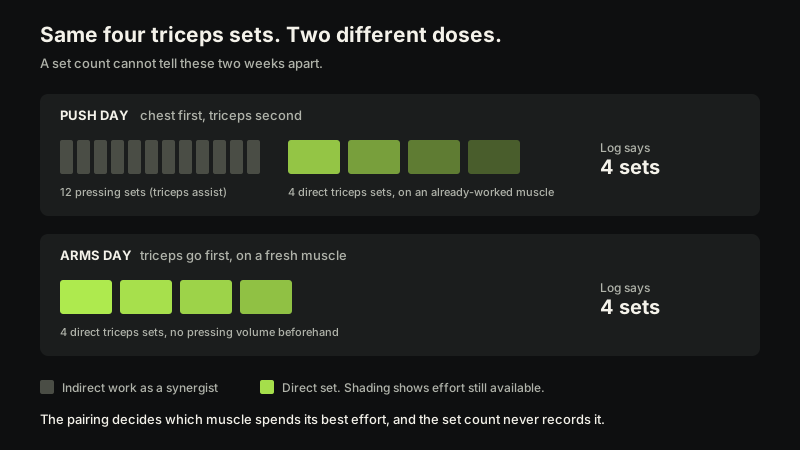
Put those together. In a synergist pairing the second muscle arrives partly fatigued, contributes proportionally less to its own direct work, and logs exactly the same number of sets as if none of that had happened. The discount is real and completely invisible in a set count.
Which muscle group should not be trained together?
Almost nothing on this topic answers this, so here is the honest version: there is no forbidden combination. There are only combinations that cost more than they return.
Four worth avoiding, with the reason rather than the rule.
Two muscles you are both trying to prioritise. If chest and shoulders are your two lagging muscles, putting them in the same session guarantees one of them always trains second and tired. Split them across days. Priority is a per-session resource and it does not divide.
A small muscle behind two large ones that recruit it. Triceps after chest is fine. Triceps after chest and shoulders, on a six-day rotation, means they never once train fresh. That is the pattern that produces arms which stop responding while the presses keep going up.
Anything demanding after heavy hinging. Deadlifts and heavy Romanian deadlifts tax your whole system, not just your hamstrings. Whatever you pair after them gets a version of you that is not fully present. If you deadlift, treat the rest of that session as low-priority accessory work by design rather than by accident.
Two groups that together exceed what a session can hold. This is the real constraint, and it is arithmetic rather than physiology. A session is a fixed budget of quality effort spent in sequence, which is why the order you write your exercises in moves individual lifts so much while barely moving the session total. Pair two large muscle groups that each want twelve sets and the second one is getting eight tired sets whatever your plan says.
The rule underneath all four: do not pair two things that both need to go first.
How many muscle groups can one session serve?
Most pairing advice assumes the answer is "as many as you list". It is not. Adding a third muscle group to a day does not add capacity, it divides the same capacity three ways.
A practical ceiling for most lifters: two muscle groups get real, prioritised work in a session, and a third can be served with two or three sets of tail-end work if it is small and tolerant (calves, abs, rear delts, forearms). Beyond that you are writing a list, not a session.
Which means the pairing decision and the weekly volume decision are the same decision made twice. Decide how many hard sets each muscle needs per week, divide by the days you can train, and the pairings mostly fall out of the arithmetic. Choosing pairings first and hoping the volume works out is how muscles end up on permanent discount.
Muscle groups to train together, by how many days you train
The muscle group combinations that make sense depend almost entirely on your training days, because days decide frequency and frequency decides how much room each muscle gets per session.
| Days per week | Sensible combination | Pairing logic | The muscle to watch |
|---|---|---|---|
| 3 | Full body each day: one push, one pull, one lower, plus one small group | Antagonist and unrelated | Whatever always lands in the fourth slot |
| 4 | Upper (chest, back, shoulders, arms) / Lower (quads, hams, glutes, calves) | Antagonist inside each day | Arms, always last on the upper day |
| 5 | Upper / Lower / Push / Pull / Legs, or four-day upper-lower plus an arms and weak-points day | Mixed | The group you added the fifth day for |
| 6 | Push (chest, shoulders, triceps) / Pull (back, biceps) / Legs, twice through | Synergist | Triceps, worked indirectly on both push days |
Two notes that matter more than the table.
The four-day upper/lower is where crowding shows up fastest, because a single upper day is asked to serve chest, back, shoulders and both arms. Something is always going to be sixth in line. Choose who, deliberately, rather than letting the order you happened to type decide it.
And a six-day push pull legs rotation is pure synergist pairing by construction, which is efficient and also puts triceps in the discounted seat four times a week. If your arms are the priority, that structure is working against you no matter how many sets you write for them. The split you choose is a container for the pairings, not a substitute for thinking about them.
The antagonist option most lifters skip
If a synergist pairing has a hidden cost, the obvious question is why not pair antagonists instead, alternating chest and back, or biceps and triceps, through the session.
The evidence is reasonably friendly to this. Robbins and colleagues reviewed agonist-antagonist paired set training and found it generally maintains or increases the work performed in a given amount of time compared with traditional straight sets, because the rest a muscle gets while its opposite number works is genuine rest for it. More total work per hour, with neither muscle interfering with the other.
The catch is what it does to your effort read. Alternating two exercises means your breathing and general fatigue never fully settle, so the local sensations you use to judge how close a set was to failure get noisier. This is the same problem supersets create: the technique saves time honestly, and it distorts what the second exercise is measuring.
That is a fair trade when you know you are making it. It is a bad trade when you paired antagonists to save time, kept recording your usual effort estimates, and quietly started training two reps further from failure than you believe you are.
How to choose which muscle groups to train together
Four decisions, in order.
- Start from weekly sets per muscle, not from the day. Decide the target first. The pairings exist to deliver that number across your available days, and a pairing that cannot deliver it is the wrong pairing regardless of how classic it looks.
- Give your priority muscle a session where it goes first. Not more sets. A better seat. One day a week where the lagging muscle is the opening exercise, on a fresh nervous system, is worth more than two extra tired sets appended to an existing day.
- Never let the same muscle be second in every pairing. If triceps follow chest on Monday and shoulders on Thursday, they get no fresh exposure at all. Rotate which member of the pair leads, at block boundaries, so you can still compare like with like.
- Cap the session at two groups that matter plus one that tolerates the tail. If a third group genuinely needs prioritised work, it needs a day, not a slot.
For beginners this collapses into something simpler: run full body three times a week, put a different movement pattern first each session, and do not worry about pairings until your weekly set target stops fitting into three days. Pairing problems are a consequence of having enough volume to run out of room, which is not a beginner's problem yet.
How to tell whether a pairing is working
The honest answer is that you cannot tell from a set count, which is what makes this topic so persistent. Both versions of the week look identical on paper.
You can tell from effort. If your triceps extensions sit at the same weight and reps as last month but the sets now finish one point closer to failure, the pairing is charging you more than it used to and the load is not the thing that changed. If a muscle's first set of the day reads 3 reps in reserve and its last reads 0 at a lighter weight, you are watching the discount arrive in real time.
That only works if effort is recorded per set, at the time, next to weight and reps. Reconstructed two hours after the session it is a guess, and the drift you are trying to see is exactly what memory smooths over. Getting an honest RIR on every set is the whole measurement here, and it is why the number belongs in the log rather than in your head.
Once it is there, the pairing question stops being a matter of opinion. A muscle that trains second and still gets a real dose will show flat or improving RIR at the same loads. A muscle on a permanent discount will show effort creeping up while the weights stand still, and it will show it months before the mirror does. That comparison is what a session review is for, because the pattern lives across weeks rather than inside any single workout.
Pairing is an accounting decision
Chest and triceps is a fine answer to a question about logistics. It is an incomplete answer to a question about growth.
Every pairing you write down decides two things at once: which muscles share a day, and which muscle in the pair receives its work already tired. The first is what the lists talk about. The second determines whether the sets you counted are the sets you got.
So pick your pairings from your weekly set targets rather than from a list. Give the muscle you actually care about a seat at the front of a session. Rotate who leads, so the tax circulates instead of landing on the same muscle fifty times a year. And write down how hard each set was, because that is the only place the discount ever shows up.
The lifters whose arms grow are usually not the ones doing more arm sets. They are the ones whose arm sets are not always the last thing that happens.