
Blog
How to Log Workouts: What to Record and How
Published October 23, 2026 · 13 min read
Log every working set the moment you finish it, with four numbers: the exercise, the weight, the reps, and how many reps you had left in reserve (RIR). Add the date and a short note when something affects the session, and you have a log that can tell you what to lift next time.
Most people who quit logging do so because the system is too heavy, not because logging is hard. This guide shows what to record, how to record it fast, which format fits you, and how to read the log back so it changes your training.
TL;DR
- Record exercise, load, reps and RIR for every working set, straight after the set, not from memory at the end of the session.
- Keep names, units and set order identical from week to week, so you can compare like with like.
- Log what happened, not what you intended. Self-reported logs drift toward the plan.
- Use a notebook, a spreadsheet or an app, but pick the one you will open with chalk on your hands.
- Review the log once a week and decide the next load before you walk into the gym.
Table of Contents
- Why logging is worth the effort
- What to record for every set
- A step-by-step way to log a session
- Choose your logging format
- Keep your data clean
- Logging cardio and other activity
- What to do when your log shows you are stuck, or off
- Our perspective
- Let the log do the thinking
- FAQ
- Sources
Why logging is worth the effort
A workout you do not record is a workout you cannot learn from. Memory is good at the feeling of a session and poor at the numbers: you remember that bench felt heavy, not whether you got 8 or 9 reps at 185 pounds two weeks ago. Progressive training depends on exactly that comparison.
There is also a research reason to be strict about what goes into the log. A study of self-report exercise logbooks compared written records with objective measures of performance and looked at the patterns of misreporting. It was done in people with Parkinson's disease doing home exercise, so we treat it as a caution rather than a rule for lifters, but the practical lesson holds: people tend to write down what they meant to do. Logging set by set, at the time, narrows that gap.
Consistency is the other payoff. A review of methods for regulating and monitoring resistance training frames monitoring as the way to individualize training, adjusting variables to performance, readiness and recovery. A log is the cheapest monitoring tool there is.
What to record for every set
Start with the minimum that makes a set comparable to the next one. Everything else is optional.
| Field | What to write | Why it matters |
|---|---|---|
| Exercise | One consistent name, such as "Barbell bench press" | Lets you chart the same lift across months |
| Load | Weight in pounds (or kilograms), with the unit fixed | A change in unit silently breaks your history |
| Reps | Full, controlled reps only | Keeps the number honest |
| RIR | Reps you could still have done with good form | Shows how hard the set really was |
| Set type | Warm-up or working | Keeps warm-ups out of your volume count |
The first three fields are the classic log. The fourth is what turns a list of numbers into something you can act on, and it is the one most beginners skip.
Why RIR belongs in the log
Two sets of 8 reps at 135 pounds can be very different events. In one you could have done 3 more reps. In the other the last rep was a grind. Without effort recorded, both look identical, and you cannot tell whether to add weight.
RIR fixes this. After each set, ask yourself how many clean reps you had left, and write the number. If you want to learn the scale, our guide on how to use reps in reserve in your workouts walks through it, and if you already use RPE, RPE vs RIR explains which to log.
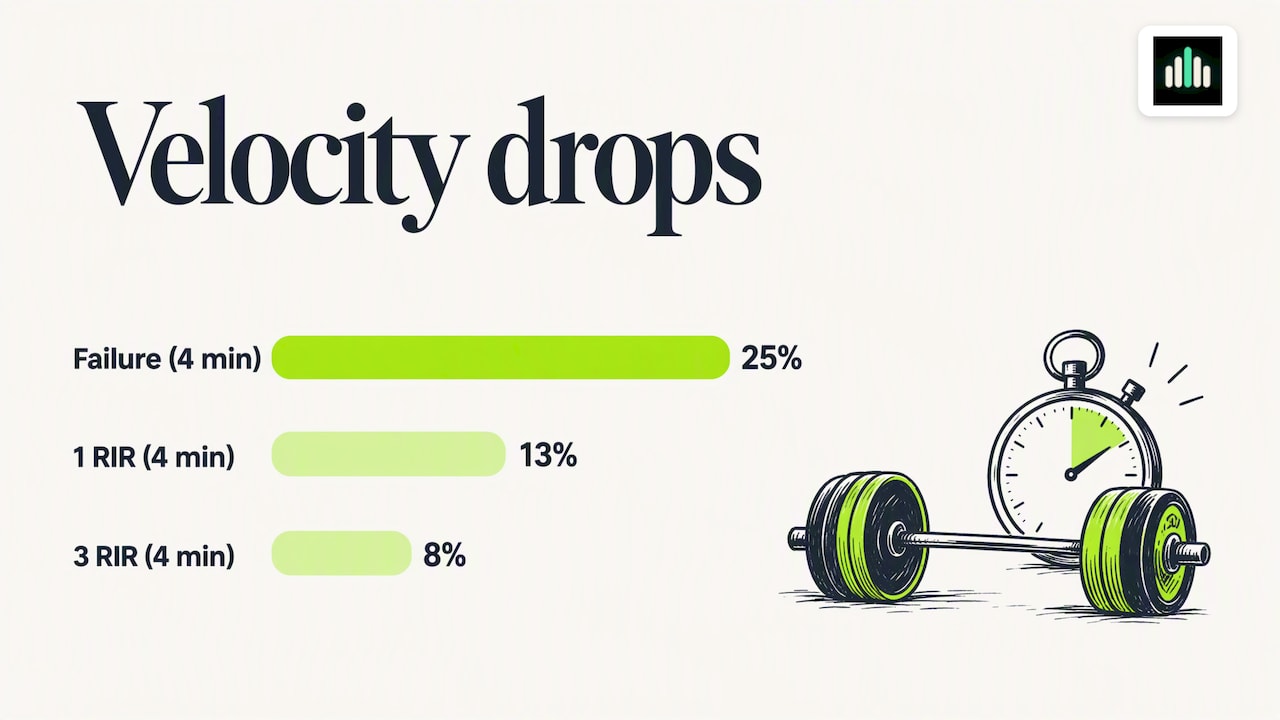
The research supports using it as a target, too. A controlled eight-week study in resistance-trained people found that ending sets with a close proximity to failure, around 1 to 2 RIR, can be enough to produce similar hypertrophy to training to momentary failure. Separately, a 2023 study of proximity to failure measured larger drops in lifting velocity four minutes after sets taken to failure (25%) than after sets stopped at 1 RIR (13%) or 3 RIR (8%). Failure costs more recovery, and your log is where you notice that cost.
Be honest about RIR early on
Beginners usually underestimate how many reps they have left. That is normal and it improves with practice. Two habits help:
- Log your best guess without second-guessing it, and do not change it afterward.
- Treat your RIR on heavy compound lifts as less reliable than on machines or isolation work, where stopping near failure is easier to judge.
If you want an objective check, bar speed is one. A study on movement velocity as a measure of effort examined how velocity loss relates to how close a set is to failure. You do not need a sensor to log well, but it shows why your rating should improve against real data over time.
A step-by-step way to log a session
The aim is to spend under ten seconds per set. Here is a routine that works with any tool.
- Prepare the session before you arrive. Have the exercise list and last week's numbers in front of you, so each set has a target.
- Log warm-ups only if they matter. Mark them as warm-ups so they do not inflate your working volume. Our post on how long to rest between sets covers timing between them.
- Record each working set right after you rack the weight. Weight, reps, RIR. Do it during your rest, not after the session.
- Write the deviation, not the plan. If you planned 8 reps and got 6, enter 6.
- Add a one-line note only when it explains the numbers. Poor sleep, a sore shoulder, a different gym, a pause rep tempo.
- Close the session. Glance at the totals and note one thing to change next time.
An example log
Here is a bench press entry for two weeks, to show what a useful record looks like.
| Week | Set | Load | Reps | RIR | Note |
|---|---|---|---|---|---|
| 1 | 1 | 175 lb | 8 | 3 | Smooth |
| 1 | 2 | 175 lb | 8 | 2 | |
| 1 | 3 | 175 lb | 7 | 1 | Slowed on last 2 reps |
| 2 | 1 | 180 lb | 8 | 3 | Slept 5 hours |
| 2 | 2 | 180 lb | 8 | 2 | |
| 2 | 3 | 180 lb | 8 | 1 | Same bar speed as week 1 |
You can read the story at a glance. Week 2 added 5 pounds and the last set matched week 1 in effort while gaining a rep. That is progress, and the sleep note explains why the first set felt harder than you would expect. For a deeper look at turning that pattern into a plan, see our piece on the progressive overload workout plan.
Choose your logging format
There is no single correct tool. There are three types, and each has a real trade-off.
| Format | Strengths | Weak points | Best for |
|---|---|---|---|
| Paper notebook | No distractions, no battery, easy to sketch notes | Hard to chart, hard to search, easy to lose | Lifters who like a ritual and train with a fixed routine |
| Spreadsheet | Fully customizable, formulas for volume and estimated maxes | Typing on a phone between sets is slow | People who enjoy building their own system |
| Workout app | Pre-fills last session, charts automatically, timers | Some bundle social feeds and clutter | Anyone who wants speed and automatic history |
If you go with paper, set up one page per session with columns already ruled for load, reps and RIR. If you choose a spreadsheet, keep one row per set and one column per field, so you can filter by exercise later. Do not merge cells or use free text for numbers, because both will break your charts.
Whatever you choose, test it for two weeks. The right tool is the one where you do not skip sets because the entry took too long.
Keep your data clean
A log is only as good as its consistency. Small habits protect it.
- Name exercises once. "Incline DB press" and "Incline dumbbell bench" are two different lines in most tools.
- Pick one unit. Pounds or kilograms, never both.
- Define a rep. Decide your standard for depth and pause, and apply it every time. A half rep logged as a full rep inflates progress.
- Log the equipment variant. Smith machine, barbell and dumbbell versions of a press are not interchangeable.
- Record failures too. A missed target is useful information. It tells you the load was too high or recovery was poor.
If you want a quick estimate of your top-end strength from logged sets, our one-rep max calculator adjusts for the reps you had left.
Logging cardio and other activity
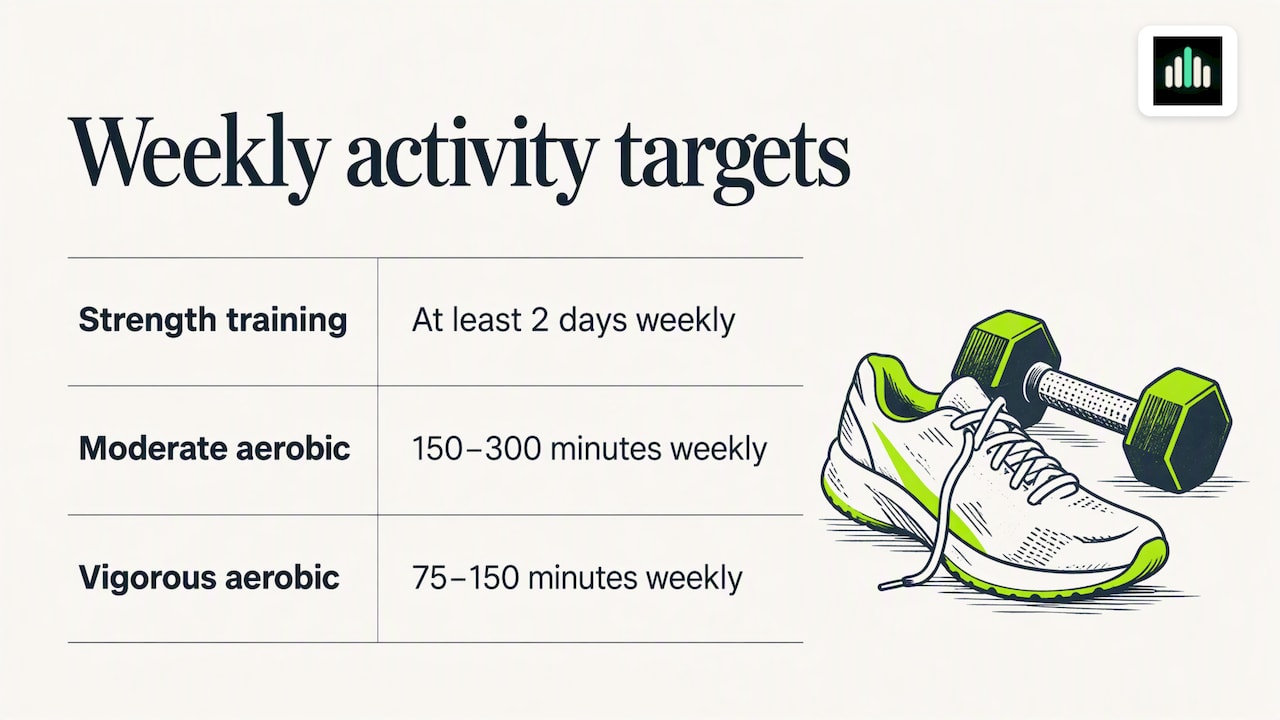
If you also run, bike or walk, keep that in the same place so you can see total weekly load. The Physical Activity Guidelines for Americans recommend muscle-strengthening activity involving all major muscle groups on at least 2 days per week, plus 150 to 300 minutes of moderate-intensity aerobic activity weekly (or 75 to 150 minutes of vigorous activity). A log that shows both lets you check yourself against those numbers.
For cardio, three entries are enough: duration, distance or intensity, and how it felt. If you are training for longer events, it is worth understanding lactate threshold versus VO2 max before you decide what to track.
If you forget to start a workout on your Apple Watch, you can add it afterward. Apple's instructions for adding a workout manually in the Health app take you through Activity, then Workouts, then the add button. That entry captures time and calories for your rings, but it does not hold sets, reps or RIR, so keep your lifting detail in a dedicated log.
What to do when your log shows you are stuck, or off
Review weekly, not daily. Daily numbers are noisy, and you will overreact to one bad session.
Use this short checklist on your review day:
- Did each lift's load or reps go up, or hold at lower effort?
- Which sets finished at 0 RIR, and was that intended?
- Which notes repeat (sleep, joint pain, a tight schedule)?
- What is the one change for next week: add weight, add a rep, or repeat?
If your reps stay flat at an unchanged load for three or four weeks and your RIR keeps shrinking, you are likely under-recovered or under-fed, so look at sleep and food before you change the program. If your RIR stays high at the same load, you have room to add weight. A rep range matters here too: our post on the best rep range for muscle growth and the comparison of high reps versus low reps help you decide which numbers to chase.
On days when training is harder than usual, for example during a painful period, note it in your log rather than skipping the entry. A guide to exercising with period cramps can help you scale a session, and your note makes that scaling visible when you look back across a cycle.
Our perspective
We built our approach around one belief: a log should answer a question, not just store data. The question is always "what should I lift next?" That is why we ask for RIR on every set. Load and reps tell you what happened. RIR tells you how much was left, which is what decides the next jump.
We also think the log should be quiet. Lifters do not need a feed, badges or a crowd in the middle of a set. They need last week's number, a fast way to enter this week's, and a sensible suggestion. When recommendations come from your own data rather than a generic template, they fit the way you actually respond to training, and that is the standard we hold ourselves to.
One caution from our side: no tool fixes dishonest entries. If you round up your reps or shade your RIR to feel better, any system, ours included, will give you worse advice.
— Guilherme
Let the log do the thinking
If you train with an iPhone and Apple Watch and want your logged sets to turn into a recommended next load, RIRLift does this. You enter weight, reps and RIR for each set, and the AI Coach analyzes your sessions, suggests the next load and lets you talk through adjustments. Core logging is free, and Pro is $9.99 per month or $79.99 per year. If you only want a clean place to record sets, the free plan covers that, and you can add Pro later if coaching is useful to you.
FAQ
Should I log my workouts?
Yes, if you want to measure progress rather than guess at it. A log lets you compare sets across weeks, spot stalls and decide when to add weight. If logging feels like a burden, start with just your main lifts and add detail later.
How detailed should my workout log be?
For strength training, exercise, load, reps and RIR per working set is enough. Add notes only when something changes the interpretation, such as poor sleep or pain. More fields than that tend to reduce how consistently you log.
Is it better to log during or after the workout?
During, in the rest period after each set. Logging at the end of the session relies on memory, and recalled numbers tend to drift toward your plan. Entering a set takes only seconds if your tool pre-fills last session's numbers.
Can I use Apple Health to log my lifting?
Apple Health can store a workout with its duration and calories, and you can add one manually if you forgot to start it. It will not hold per-set weight, reps and RIR, so pair it with a log designed for sets.
Sources
- Influence of Resistance Training Proximity-to-Failure, Determined by Repetitions-in-Reserve, on Neuromuscular Fatigue
- Similar muscle hypertrophy following eight weeks of resistance training to momentary muscular failure or with repetitions-in-reserve
- Movement Velocity as a Measure of Level of Effort During Resistance Exercise
- Methods for Regulating and Monitoring Resistance Training
- The accuracy of self-report logbooks of adherence to prescribed home-based exercise in Parkinson's disease
- Top 10 Things to Know About the Physical Activity Guidelines for Americans
- How to manually add a workout in the Health app, Apple Support