
Blog
RDL vs Deadlift: Which One Should You Be Doing?
Published October 19, 2026 · 16 min read
The conventional deadlift is the better lift for building total-body strength, and the Romanian deadlift (RDL) is the better lift for loading the hamstrings and glutes through a long, controlled stretch. They are not interchangeable, so most lifters who want both strength and size should run both, with the deadlift as the primary pull and the RDL as a second, volume-oriented movement.
The rest of this guide covers what separates the two lifts mechanically, what the EMG research says, how the RDL differs from the stiff-leg deadlift, how to learn the hip hinge, and how to place each lift in a week of training.
TL;DR
- The conventional deadlift starts from the floor, bends the knees more, and recruits the quads and glutes harder. The RDL starts from standing, keeps the knees softly bent, and stops around mid-shin.
- A 2019 EMG and kinetic comparison found greater rectus femoris and gluteus maximus activation in the conventional deadlift, tied to larger knee and ankle torques.
- The RDL is an accessory, not a substitute: use it for hamstring and glute volume, and the deadlift for maximal strength.
- The stiff-leg deadlift is a close cousin of the RDL with straighter knees, and the two are distinguished mostly by knee angle and how far the hips travel back.
- Learn the hinge first with a dowel or a wall, then add load. Keep a rep or two in reserve on RDLs, since the hamstrings and lower back fatigue before the grip does.
Table of Contents
- What each lift actually is
- RDL vs deadlift: the differences that matter
- RDL vs stiff-leg deadlift
- How to hip hinge properly
- Common mistakes on each lift
- Is the RDL a substitute for the deadlift?
- Are RDLs good for glute growth?
- How to program both lifts
- Our perspective
- Tracking both lifts in RIRLift
- FAQ
- Sources
What each lift actually is
The conventional deadlift
In a conventional deadlift, the bar starts on the floor over midfoot. You bend your knees and hips to reach it, brace, and stand up by pushing the floor away while the bar travels in a near-vertical line. Every rep begins from a dead stop, which means there is no stretch reflex to help you out of the bottom. That dead stop is the reason the lift is such a clean test of raw strength.
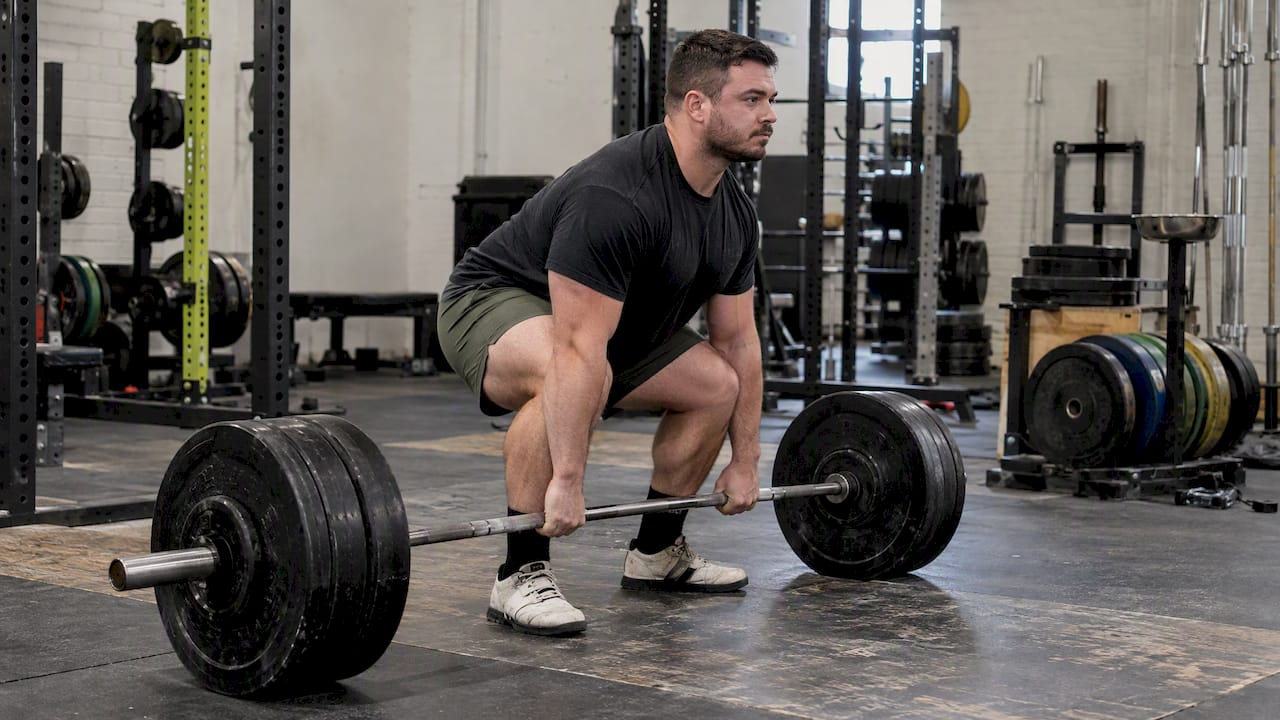
Because the knees bend significantly, the quads contribute to the first part of the pull, and the glutes and hamstrings take over as the bar passes the knees. The upper back, lats, and grip work isometrically to keep the bar close and the spine stable.
The Romanian deadlift
The RDL begins from the top. You stand holding the bar at the hips, push your hips back with the knees only slightly bent, lower the bar along your thighs until you feel a strong hamstring stretch (usually somewhere between the knee and mid-shin), and then drive the hips forward to stand. The bar does not need to touch the floor, and in most sets it does not.
The movement is defined by the hip hinge, a pattern where the hips travel backward and the shins stay close to vertical, rather than the knees and hips bending together as in a squat or a floor pull. The shared hinge pattern is why people confuse the two lifts. The difference is how much the knees contribute and where the load is hardest.
RDL vs deadlift: the differences that matter
| Feature | Conventional deadlift | Romanian deadlift |
|---|---|---|
| Starting position | Bar on the floor | Standing, bar at the hips |
| Knee bend | Substantial, changes through the lift | Slight and roughly fixed |
| Where reps start | Concentric (a dead stop) | Eccentric (a lowering first) |
| Main emphasis | Whole body, quads, glutes, back | Hamstrings, glutes, spinal erectors |
| Typical load | Heaviest | Noticeably lighter |
| Best role | Primary strength lift | Accessory for posterior chain volume |
| Fatigue cost | High, systemic | Moderate, localized |
Muscle activation: what the research shows
The most direct comparison comes from an electromyographic and kinetic study of conventional and Romanian deadlifts. It reported that the conventional deadlift produced significantly greater rectus femoris and gluteus maximus activation than the RDL, which fits the larger knee and ankle joint torques in the floor pull. In plain terms, the quads and glutes do more work when the knees have to bend and the bar has to leave the ground.
That result surprises people who assume the RDL is the better glute exercise. It can still be an excellent glute and hamstring exercise, because the long eccentric and the stretch under load are a different stimulus. But EMG amplitude is not a measure of muscle growth, and a single small study cannot settle which lift builds more tissue over months. A systematic review of EMG activity in deadlift variants pulled together the available studies, and its value is mostly in showing that muscle recruitment shifts with the variation you choose. Treat these numbers as a map of where the work lands, not a ranking of which lift is best.
Strength versus muscle-building roles
The practical split follows from the mechanics. The conventional deadlift lets you move the most weight, so it is the lift that drives maximal strength and the neural skills that go with it: bracing, tension, and staying tight off the floor. The RDL cannot be loaded as heavily because the limited knee bend takes the quads out of the equation, and the lower back and hamstrings become the limiting muscles instead.
That is why we describe the RDL as a volume lift. It lets you accumulate hard sets for the hamstrings and glutes with less total-body fatigue than another heavy floor pull. If you want a deeper look at how strength-focused and size-focused training differ in sets, reps, and loads, see our guide to hypertrophy versus strength training.
RDL vs stiff-leg deadlift
People search for the RDL and the stiff-leg deadlift (SLDL) as if one were a mistake. They are two points on a spectrum of knee bend. In the SLDL, the knees are kept nearly straight, the hips go back less, and the stretch on the hamstrings comes earlier and harder. In the RDL, the knees are slightly bent, the hips travel farther back, and the shins stay close to vertical.
A 2022 EMG analysis of Romanian, step-Romanian, and stiff-leg deadlifts tested ten competitive bodybuilders on all three variations to see how posterior chain muscle excitation differed. The takeaway for training is that small changes in knee angle and setup change which muscles take the load, so the variations are not identical, even though gym talk often treats them that way.
Here is how we would choose between them:
- Pick the RDL if you want a movement you can load heavily and repeat for sets of 6 to 12 with a stable setup. The soft knee bend lets you push the hips back without the spine rounding to find range.
- Pick the SLDL if you have the hamstring flexibility for it and want a more stretch-focused version. Keep the load lighter than your RDL until the pattern is clean.
- Do not mix cues within a set. Choose a knee angle, lock it in, and keep it constant across reps so your logs are comparable week to week.
If you are curious about the common label, "stiff-leg" does not mean locked knees. Locking the knees hard shifts stress to the lower back and the back of the knee for no benefit.
How to hip hinge properly
The hinge is the skill underneath both lifts. If you cannot hinge, the RDL will feel like a back exercise, and the deadlift will round out of the floor. Here is a progression that works for most people.
Step 1: Wall hinge
Stand about a foot in front of a wall with your back to it. Soften your knees and push your hips straight back until your glutes touch the wall, keeping your chest tall. Return by driving the hips forward. If you tip forward from the waist instead of sliding the hips back, you will not touch the wall.
Step 2: Dowel hinge
Hold a dowel or broomstick along your spine so it touches the back of your head, upper back, and tailbone. Hinge back while keeping all three contact points. If the dowel leaves your tailbone, you have rounded the lower back. If it leaves your head, you are craning your neck.
Step 3: Load it
Move to a light barbell or a pair of dumbbells. Our dumbbell leg exercise guide and dumbbell back exercises cover several hinge-friendly options if you do not have a barbell at home.
Hinge cues that tend to work
- Hips back, not down. Think about closing a car door with your glutes.
- Shins stay vertical. If your knees drift forward, you are squatting the movement.
- Lats tight. Pull the bar into the legs as if you were squeezing oranges in your armpits.
- Neutral neck. Look at the floor about six feet ahead rather than craning up.
- Stop when the hamstrings run out of stretch. The bottom of an RDL is the point where your back would have to round to go lower, not a fixed spot on the shin.
These are coaching conventions from practice, not findings from a specific study, so adjust them to your limb lengths. A tall lifter with long femurs will hinge deeper than a short lifter with long arms, and both can be correct.
Common mistakes on each lift
Deadlift mistakes
- Yanking the bar off the floor. Take the slack out first by pulling the bar into your shins and creating tension before the plates move.
- Hips shooting up first. If the hips rise faster than the shoulders, the lift becomes a stiff-leg pull and the lower back takes over.
- Letting the bar drift forward. The bar should brush your legs the whole way.
- Bouncing reps. Resetting each rep keeps it a true deadlift and keeps your log honest.
RDL mistakes
- Turning it into a squat. Too much knee bend loses the hamstring stretch.
- Going too low. Chasing the floor with a rounded back is the quickest way to turn a good accessory into a bad one.
- Using straps and heavy weight as a test. An RDL set should be limited by the hamstrings, so use a load you can control on the way down.
- Rushing the lowering phase. The eccentric is the point. A two to three second descent is a reasonable practice default.
One thing we see in logs again and again is lifters treating RDL numbers as a miniature deadlift. They are different measures. An RDL that is 60 to 70 percent of your deadlift is not a sign of weakness, since the lifts load the body differently. Judge progress on each lift against its own history.
Is the RDL a substitute for the deadlift?
No, not if your goal includes maximal strength. The deadlift trains the whole chain from the floor, including quad drive and the position-specific strength that only a dead start provides. The RDL is a very good hamstring and glute builder, and it carries over partly to the deadlift lockout, but the carryover is not the same as practicing the lift itself.
There are a few situations where it makes sense to swap:
- Lower back or recovery limits. If heavy floor pulls beat you up, reduce deadlift frequency and keep RDL volume moderate.
- Hypertrophy-only goals. If you do not compete in powerlifting, you can run the RDL as your main hinge and treat the deadlift as optional.
- Home training. With dumbbells only, the RDL is easier to load and perform than a floor pull.
If you have back pain, numbness, or pain that travels down a leg, talk to a physician or physical therapist before you add hinge volume, and do not push through it in the gym.
Are RDLs good for glute growth?
Yes, in the right context. The RDL gives the glutes a heavy stretch through a long range, and many lifters report a strong glute and hamstring effect. The 2019 EMG comparison above suggests the conventional deadlift recruits the gluteus maximus harder, so the strongest approach is to use both lifts and add a hip extension or lunge pattern for the glutes if they are a priority. Our glute workout plans show how to combine them, and the hamstring workout pairs hinges with curls so the knee-flexion function of the hamstrings gets trained too.
That second point matters. The RDL trains the hamstrings as hip extensors. A leg curl trains them as knee flexors. The hamstrings do both jobs, so a program that relies on RDLs alone leaves half the muscle's function under-trained.
How to program both lifts
The American College of Sports Medicine's 2026 resistance training prescription overview is a useful reference for how loads, volume, and frequency relate to strength and hypertrophy outcomes. What it does not do is tell you to choose between lifts. A sensible structure uses both for different jobs.
A simple weekly layout
| Day | Lift | Sets x reps | Effort |
|---|---|---|---|
| Day 1 | Conventional deadlift | 3 x 3 to 5 | 1 to 3 RIR |
| Day 2 | Squat or leg press, leg curl | per your plan | 1 to 3 RIR |
| Day 3 | Romanian deadlift | 3 x 6 to 10 | 1 to 2 RIR |
These ranges are common practice, not a prescription. Many lifters work toward roughly ten hard sets per muscle group per week as a starting point for hypertrophy, and the deadlift and RDL both count toward hamstring and glute volume. If your weekly volume feels like too much, drop RDL sets before you drop the deadlift, because the deadlift is the more skill-dependent lift.
Using reps in reserve on hinges
Reps in reserve (RIR) is how many more clean reps you could have done when you stop a set. On the deadlift, stopping at 2 to 3 RIR keeps bar speed and form crisp, since grinding a failed rep at the floor is risky. On RDLs, 1 to 2 RIR is typically fine because the movement is more forgiving, though form should never degrade to hit a number. Because both lifts accumulate fatigue in the lower back, be honest about your RIR on the last rep, not the first.
Progressing the loads
A straightforward way to progress is to add reps within a range until you hit the top, then increase the weight. We explain how that works, and where it breaks, in our guide to double progression. For the barbell options beyond these two lifts, our barbell exercises by movement pattern lists the other hinges, squats, and presses worth knowing.
One published trial is worth a mention for context. A randomized trial on Romanian deadlift training and lumbar extension strength examined how ten weeks of RDL work related to lower-back extension strength, which is a reminder that the RDL loads the spinal erectors as well as the hamstrings. That is also why jumping to heavy RDLs without a base is a poor idea.
Our perspective
After looking at how people log hinge work, we think the most common mistake is not choosing the wrong lift. It is failing to track the two lifts separately and honestly. Lifters bury a heavy deadlift and a lighter RDL in the same note, then wonder why neither moves.
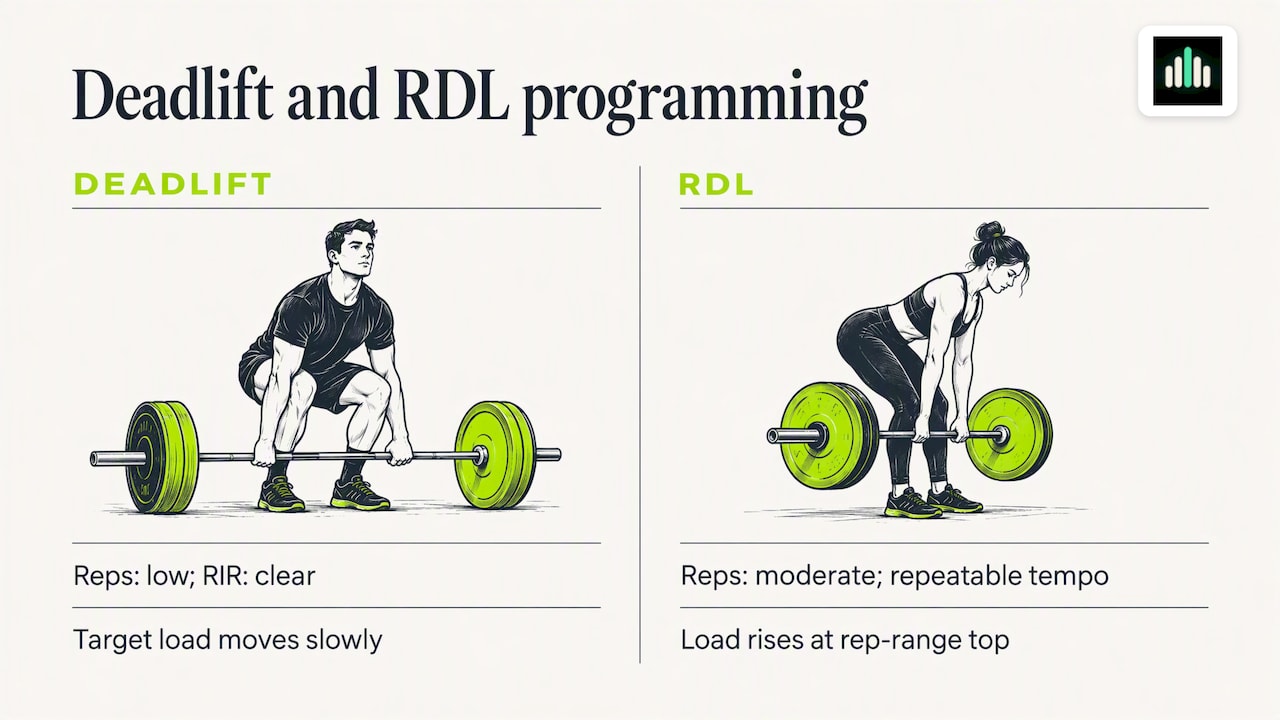
So we log them as different jobs. The deadlift gets low reps, a clear RIR, and a target load that moves slowly. The RDL gets moderate reps, a tempo you can repeat, and a load that rises when you hit the top of your rep range with reps left in the tank. That is the logic behind RIRLift: it records the weight, reps, and RIR of every set, and the AI Coach reads that history to suggest the next load, rather than handing you a generic template. When your RDL reps are crisp at 2 RIR, the next load follows from your data, and when a deadlift set grinds at 0 RIR, the suggestion backs off.
We do not think any app replaces careful coaching of the hinge itself. A video review, or a session with a qualified coach, will catch a rounded back faster than a log will. What logs do well is show you the pattern across weeks: whether the RDL is actually getting stronger, whether the deadlift is stalling because of hamstring fatigue, and whether you are doing enough hard sets to move either.
— Guilherme
Tracking both lifts in RIRLift
If you want a place to record deadlift and RDL sets with load, reps, and RIR, the free plan covers set logging on iPhone and Apple Watch. Pro, at $9.99 per month or $79.99 per year, adds advanced coaching, analytics, and unlimited routines. You can also build a session around your equipment before you start.
FAQ
Is an RDL a substitute for the deadlift?
Not for maximal strength. The conventional deadlift trains the dead-start pull and heavier loading, and the EMG research shows greater quad and glute recruitment than the RDL. The RDL works best as a second hinge for hamstring and glute volume, and a good swap only when recovery or equipment limits the floor pull.
Is a 100 lb dumbbell RDL good?
It can be, depending on your size, experience, and rep range. A 100 lb dumbbell in each hand is a serious load for most lifters, and a single 100 lb dumbbell is a moderate load for a stronger one. Judge it by the set: if you can control the descent, feel the hamstrings, and finish with 1 to 2 reps in reserve, the weight is doing its job.
What is the difference between an RDL and a stiff-leg deadlift?
Knee angle and hip travel. The RDL uses a slight knee bend and sends the hips far back, keeping the shins near vertical. The stiff-leg deadlift keeps the knees straighter and moves the hips less, which pushes more stretch onto the hamstrings. Pick one and keep it consistent so your logs stay comparable.
Which muscles does the deadlift work?
The conventional deadlift works the glutes, hamstrings, quads, spinal erectors, lats, upper back, and grip. The 2019 EMG comparison found the quads and gluteus maximus work harder in the conventional pull than in the RDL.
Sources
- An electromyographic and kinetic comparison of conventional and Romanian deadlifts
- Electromyographic activity in deadlift exercise and its variants: a systematic review
- An electromyographic analysis of Romanian, step-Romanian, and stiff-leg deadlift
- A randomized trial on Romanian deadlift exercise and lumbar extension strength
- ACSM: Resistance training prescription for muscle function, hypertrophy, and physical performance