
Blog
PPL vs Upper/Lower: Which Split Fits Your Week
Published November 5, 2026 · 15 min read
Choose upper/lower if you can train four days a week, and push/pull/legs (PPL) if you can reliably train six. When weekly hard sets per muscle are equal, the research does not show one split beating the other, so the better split is the one you will actually run for months.
The rest of this guide shows how each split lays out the week, where they differ in practice (session length, sets per muscle, recovery), and how to decide based on your schedule, your goal and how you recover.
TL;DR
- Four days a week fits upper/lower. Six days a week fits PPL. Five days is awkward for PPL and fine for a hybrid.
- Both splits usually train each muscle about twice a week, so frequency alone does not separate them.
- Studies that equate weekly volume find similar strength and muscle outcomes across split styles. Total hard sets per muscle matter more than the label.
- Upper/lower makes long sessions shorter per muscle group and easier to recover from. PPL gives each session a narrower focus and room for more exercises per muscle.
- Whichever you pick, log weight, reps and reps in reserve (RIR) so you can see whether the split is working.
Table of Contents
- How each split lays out the week
- What the research says about frequency and splits
- Where the two splits really differ: weekly sets and session design
- Recovery and the real-life schedule
- PPL vs full body, briefly
- How to choose: days, goal and experience
- Our perspective
- Tracking the split and adjusting it over time
- Putting your numbers to work
- FAQ
- Sources
How each split lays out the week
PPL organizes training by movement pattern. Healthline's split guide describes a push day (chest, shoulders, triceps), a pull day (back, biceps, forearms) and a legs day (quads, glutes, hamstrings, calves), with a common six-day rotation of push, pull, legs, push, pull, legs, then rest.
Upper/lower alternates upper-body and lower-body days. The same Healthline guide lists a four-day cycle and a six-day cycle that runs upper, lower, upper, lower, upper, lower before a rest day. NASM's trainer guide describes the classic four-day version, two upper and two lower sessions, built to leave recovery days between sessions.
| PPL | Upper/lower | |
|---|---|---|
| Typical days per week | 6 (3 for a once-weekly version) | 4 (6 is possible) |
| Session focus | One movement pattern | Half the body |
| Typical weekly frequency per muscle | Twice on the 6-day version | Twice on the 4-day version |
| Sessions per week | More, shorter and more focused | Fewer, broader |
| Rest days | One per week on the 6-day plan | Three per week on the 4-day plan |
| Best fit | Lifters with time and recovery for six sessions | Lifters with three to four available days |
A sample four-day upper/lower week looks like this: Monday upper, Tuesday lower, Thursday upper, Friday lower. A sample six-day PPL week is push, pull, legs on Monday to Wednesday, then the same three on Thursday to Saturday, with Sunday off.
If you want a deeper walkthrough of one option, we have written up how to run the four-day upper/lower version and what PPL leaves out. This article stays on the choice between them.
What the research says about frequency and splits
Both of these splits land on the same frequency, about twice per muscle per week, which is why the argument between them is mostly about something else. NASM states that the design goal of upper/lower is to train each muscle group roughly twice weekly, usually with one higher-volume and one lower-volume day per region, and calls twice-weekly frequency a well-supported driver of progress for most clients.
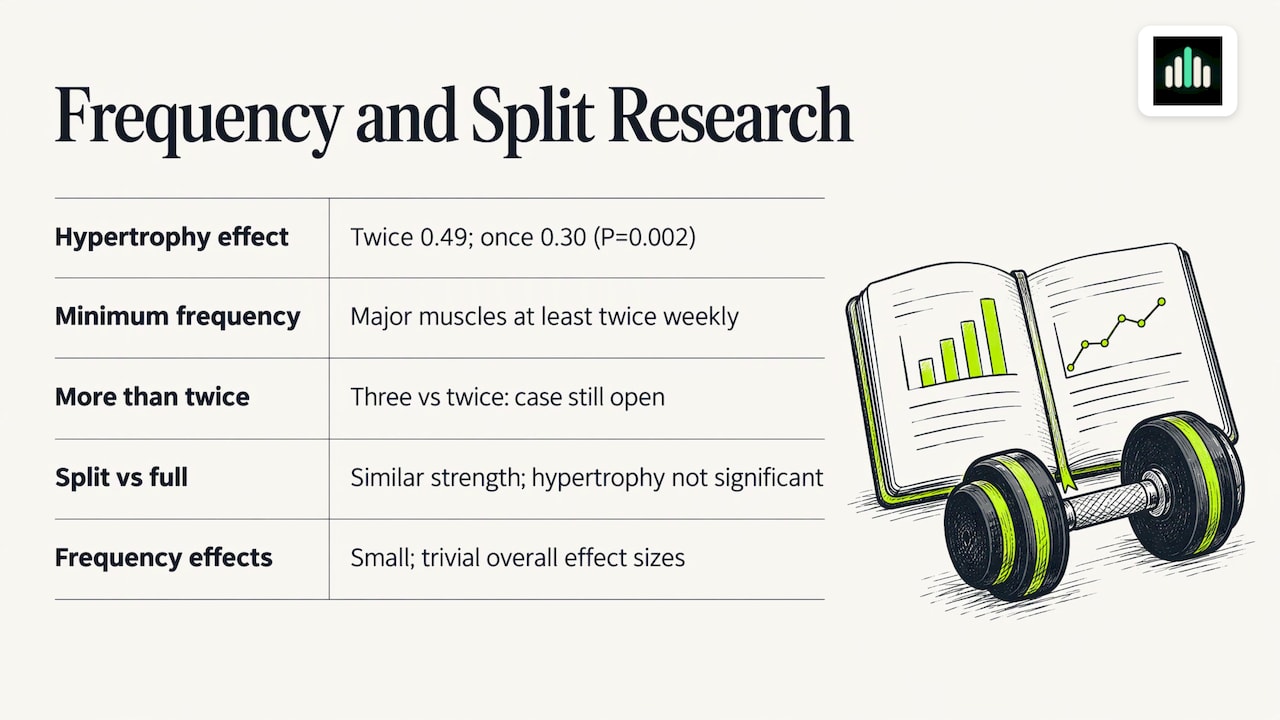
The frequency evidence itself points the same way. A systematic review and meta-analysis by Schoenfeld and colleagues (2016) found that, in studies directly comparing training a muscle one to three days per week with volume equated, training twice a week produced larger hypertrophy effects than once a week (0.49 vs 0.30, P=0.002). The authors concluded that major muscle groups should be trained at least twice per week, while the case for three times over twice was still open.
The effect of going beyond that is small. Greg Nuckols at Stronger by Science summarized that frequency effects on hypertrophy are statistically significant but small, with trivial effect sizes overall when higher and lower frequencies were compared.
What about the split style itself? A 2024 meta-analysis by Ramos-Campo and colleagues compared split routines with full-body routines and found similar strength gains (for example, bench press mean difference 1.19, p=0.34) and no significant differences in several hypertrophy measures, including lean body mass, when weekly volume was equated. A randomized trial published in PMC (Evangelista et al., 2021) compared a split in which muscles were trained twice per week with a full-body routine that trained them four times per week. After eight weeks, the selected variables did not differ significantly between groups, and the authors concluded that frequency is not the only determinant when weekly set volume is the same.
Note what these studies compared: split versus full body, not PPL versus upper/lower directly. We are not aware of strong evidence that crowns one of these two over the other, so treat any forum post that claims a winner as opinion. The sound reading of the evidence is that both give you the twice-weekly exposure that works, and the rest comes down to volume, effort and consistency.
Where the two splits really differ: weekly sets and session design
The difference you will feel is how weekly sets get distributed. This part is practice rather than research, but it follows from simple arithmetic.
Suppose you want about 12 hard sets for chest per week, split over two sessions. On PPL, each push day carries 6 chest sets, along with shoulders and triceps work. On upper/lower, each upper day carries the same 6 chest sets, but also all of your back, biceps and overall upper-body work, so something has to give. You trim exercises per muscle, or the session runs long.
That is the real tradeoff:
- PPL spreads the same weekly work across six sessions. Each session is shorter or can hold more exercise variety per muscle. You also get three or four exercises per muscle in one sitting without the session dragging past 75 minutes.
- Upper/lower packs it into four sessions. You get fewer, denser sessions. Each muscle receives fewer exercises per session, but you need fewer gym trips and get three full rest days.
A worked comparison for the upper body, using a target of about 10 to 12 hard sets per muscle group per week:
| Muscle | PPL (2 sessions) | Upper/lower (2 sessions) |
|---|---|---|
| Chest | 5 to 6 sets per push day | 5 to 6 sets per upper day |
| Back | 5 to 6 sets per pull day | 5 to 6 sets per upper day |
| Shoulders and arms | Plenty of room on push and pull days | Often trimmed to 2 to 4 sets per session |
| Legs | One long session, twice a week | Lower day, twice a week |
| Total session time | Shorter | Longer per upper day |
The weekly totals can be identical. The question is whether you would rather spend them across six shorter sessions or four longer ones. If a bigger weekly volume per muscle is your goal, six days gives it more room. If you are happy at around 10 to 12 hard sets per muscle, four days covers it.
A hard set here means a set taken close to failure, which is why tracking reps in reserve matters. If you end sets with four or five reps left, adding sessions will not rescue your volume. Our RIR calculator is a quick way to estimate it for a given lift, and our guide on training frequency for hypertrophy goes deeper on how often to hit a muscle.
Recovery and the real-life schedule
Both splits put a gap between sessions that hit the same muscle, but they handle it differently. A well-designed week keeps hard sessions for the same muscle separated by a day or two. One commonly repeated rule of thumb says muscles need roughly 48 to 72 hours between hard sessions, though it is a guideline, not a law, and your sleep, food and stress shift it.
In a six-day PPL week, push and pull days overlap muscles indirectly: heavy rows tax biceps and forearms, and overhead pressing on push day carries into the next pull day's rear delts and upper back. With one rest day, you rarely get a full break from training, so fatigue accumulates quietly over a few weeks. In four-day upper/lower, the three rest days buy extra recovery, which is often why lifters with busy jobs, kids or physical work stick with it for years.
Recovery is a field of its own, covering sleep, nutrition and load management, and this overview of performance recovery science is a decent place to start if you want to look at it more broadly.
The practical rule: pick the number of days you can hold through a rough month, not your best month. Ripped Body's program-building guide suggests that for most lifters, three to five training days per week with a frequency of two to four times per muscle balances stimulus and recovery, and that your schedule should not stress the rest of your life. Six PPL days sit just outside that range, which is fine if you recover well and have the time, and a poor idea if you miss sessions every second week.
PPL vs full body, briefly
If you are also weighing full body, the logic is the same. Full body trains every muscle each session, usually three days a week, so frequency is three times per muscle. The 2024 meta-analysis above found similar strength and hypertrophy outcomes for split and full-body routines with matched volume, so full body is a legitimate choice when you only have three days.
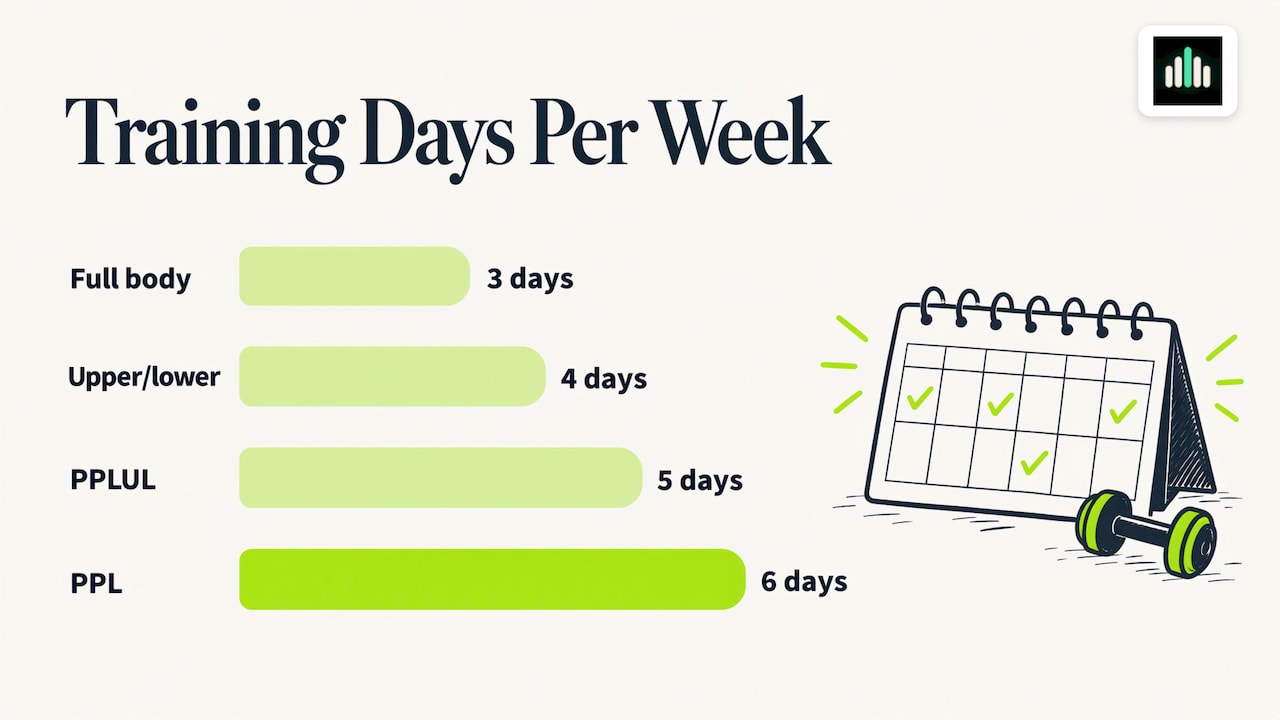
The ACE-certified article on split routines describes splits as the step a client takes after full-body training two to three days weekly, when adding a fourth day. For a four-day split by region, it describes dividing the full-body routine into two parts, such as upper and lower, each performed twice per week. That is the natural bridge: full body at three days, upper/lower at four, PPL at six. Five days sits in between, and a hybrid such as PPLUL fills it, with a detailed look at how to spend four sessions well if four is your number.
How to choose: days, goal and experience
Start with days, then goal, then experience.
- Count your reliable days. Three days: full body. Four days: upper/lower. Six days: PPL. Five days: a hybrid or a four-day plan with an optional fifth session.
- Check your goal. For strength, upper/lower is easy to organize around the big lifts. You can place a heavy squat, bench, deadlift or overhead press in the first slot of each session, and a lighter, higher-rep variation in the second. This is common practice among coaches rather than a research finding. For size, either works. PPL gives extra room for exercise variety and for isolation work, and upper/lower gives enough if you keep your weekly sets honest.
- Consider your experience. Beginners progress on almost any sensible plan, so choose the one with the fewest gym trips that still gets each muscle twice. Intermediate and advanced lifters who want more weekly volume per muscle have a reason to move toward six days.
- Match recovery. If you wake up tired and your lifts stall, add rest before you add sessions.
A quick summary of who tends to fit where:
| Situation | Likely best fit |
|---|---|
| Four days available, balanced goals | Upper/lower |
| Six days available, lots of recovery | PPL |
| Strength priority, limited time | Upper/lower |
| Want more exercise variety per muscle | PPL |
| Inconsistent schedule | Upper/lower, or full body |
If your goal is general muscle growth and you want the bigger picture, our piece on picking the container for muscle growth covers the broader decision.
Our perspective
We think the split is the container, and the numbers inside it decide your results. PPL and upper/lower both deliver the twice-weekly exposure the evidence supports, so arguing about the label misses what moves your training forward: how many hard sets each muscle gets, how close to failure they are taken, and whether the load goes up when it should.
That is why we built RIRLift around logging every set with weight, reps and reps in reserve. Once those three numbers are recorded, the question "which split is better" turns into a question your own data can answer: did your bench, squat or row climb over the last six weeks, and at what effort?
We also think training should run on your own numbers rather than a generic template. Coach reads what you logged and recommends the next load, so a four-day upper/lower lifter and a six-day PPL lifter each get a recommendation grounded in their own sessions, not in a plan written for someone else.
Guilherme
Tracking the split and adjusting it over time
No split is permanent, and the only way to know if yours works is to measure it. The method below is practice-based, not a research protocol.
- Run it for six to eight weeks before judging. Shorter windows are dominated by noise: a bad night's sleep, a hard week at work.
- Log weight, reps and RIR on every working set. Progress shows up as the same load for more reps, or more load at the same reps and effort.
- Watch the trend per muscle, not per session. If chest climbs but back stalls, the problem is that muscle's weekly sets or effort, not the split.
- Change one thing at a time. Add two sets to the lagging muscle, or move a day, before swapping the whole structure.
- Switch splits for a reason. Good reasons: your schedule changed, you keep skipping the sixth day, or you have plateaued despite adequate sets and recovery. Boredom alone is not one.
For strength-focused lifters, the same logic applies to the main lifts: if your top set at RIR 2 moves up in weight across several weeks, the split is doing its job. If it stalls while fatigue climbs, you probably need a lighter week or more rest, not more volume.
Putting your numbers to work
We built RIRLift for lifters who want the set log and the next-load recommendation in one place, on iPhone and Apple Watch, so you can run either split without carrying a notebook. The free plan covers core set logging, and RIRLift Pro unlocks the advanced coaching, including AI Coach, plus analytics and unlimited routines, at $9.99 per month or $79.99 per year through the App Store.
You can see the plans and download the app on the RIRLift home page, and read how analysis of your training data works before you decide.
FAQ
Is PPL or upper/lower better for building muscle?
Neither wins on the evidence we found. Studies that match weekly volume show similar hypertrophy across split styles, and both PPL and upper/lower usually train each muscle twice weekly. Choose by the days you can train consistently and by how you recover.
Is PPL or upper/lower better for strength?
Upper/lower is the easier fit for most strength lifters, because four days leave room to place the main lifts first in each session, with recovery days in between. PPL works too if you can train six days and manage the fatigue. This is common coaching practice, not a head-to-head research result.
Can I run PPL on five days?
Yes, but the rotation shifts each week, so some muscles get hit twice and others once. A hybrid, such as upper, lower, push, pull, legs, keeps twice-weekly frequency for most muscles on five days. If you want to keep a strict PPL rhythm, six days is the cleaner fit.
Should beginners start with PPL, upper/lower or full body?
Three days of full body or four days of upper/lower suit most beginners, since progress comes quickly on simple plans and fewer sessions are easier to keep. The ACE-certified article describes splits as a step after two to three days of full-body work. Move to more days when your recovery and schedule allow it.
How long should I stay on a split before switching?
Give it six to eight weeks of logged training. If your loads, reps and effort are trending up, stay. If you are stalling despite enough sets and rest, or you keep missing sessions, adjust the split to fit your schedule.
Sources
- Split Workout Schedule: What To Know and Examples (Healthline)
- Upper/Lower Splits: A Trainer's Guide (NASM)
- Effects of resistance training frequency on measures of muscle hypertrophy (Schoenfeld et al., 2016)
- Training Frequency for Muscle Growth: What the Data Say (Stronger by Science)
- Efficacy of Split Versus Full-Body Resistance Training (Ramos-Campo et al., 2024, PubMed)
- Split or full-body workout routine: which is best (Evangelista et al., 2021, PMC)
- Guide To Program Building For Bodybuilding and Powerlifting (Ripped Body)
- Mastering the Art of the Split Routine (ACE)
- Performance Recovery Science for Athletes and Active Adults