Blog
Session RPE: How to Rate and Use Your Whole Workout
Published November 24, 2026 · 11 min read

Scan with your phone camera
Session RPE is a single 0 to 10 rating of how hard your entire workout was, given shortly after you finish, and multiplying it by the session's length in minutes gives you a training load number you can track week to week. It differs from the RPE you assign to one set, which describes how close that set came to failure, and lifters who log both get a much clearer picture of fatigue and progress. If you want an app that records set effort and uses it to suggest your next weight, RIRLift was built for that job.
TL;DR
- RPE stands for rating of perceived exertion. Session RPE is one number for the whole workout, taken from a modified Borg CR-10 scale.
- Training load = session RPE × session minutes, in arbitrary units (AU). A 60-minute session rated 7 scores 420 AU.
- Set RPE (tied to reps in reserve) and session RPE are different measures. Label which one you are logging.
- Research supports session RPE as a valid, practical tool, but it works best with consistent timing and a scale you have practiced.
- Use it to spot weekly spikes and monotonous weeks, and pair it with set-level data to guide load decisions.
Table of Contents
- What session RPE actually is
- Session RPE vs set RPE vs reps in reserve
- The session RPE scale
- How to rate a session and calculate load
- Turning daily numbers into weekly insight
- What the evidence says
- Making session RPE useful when you lift
- Where RIRLift fits
- Applying it to different lifters
- FAQ
- Sources
What session RPE actually is
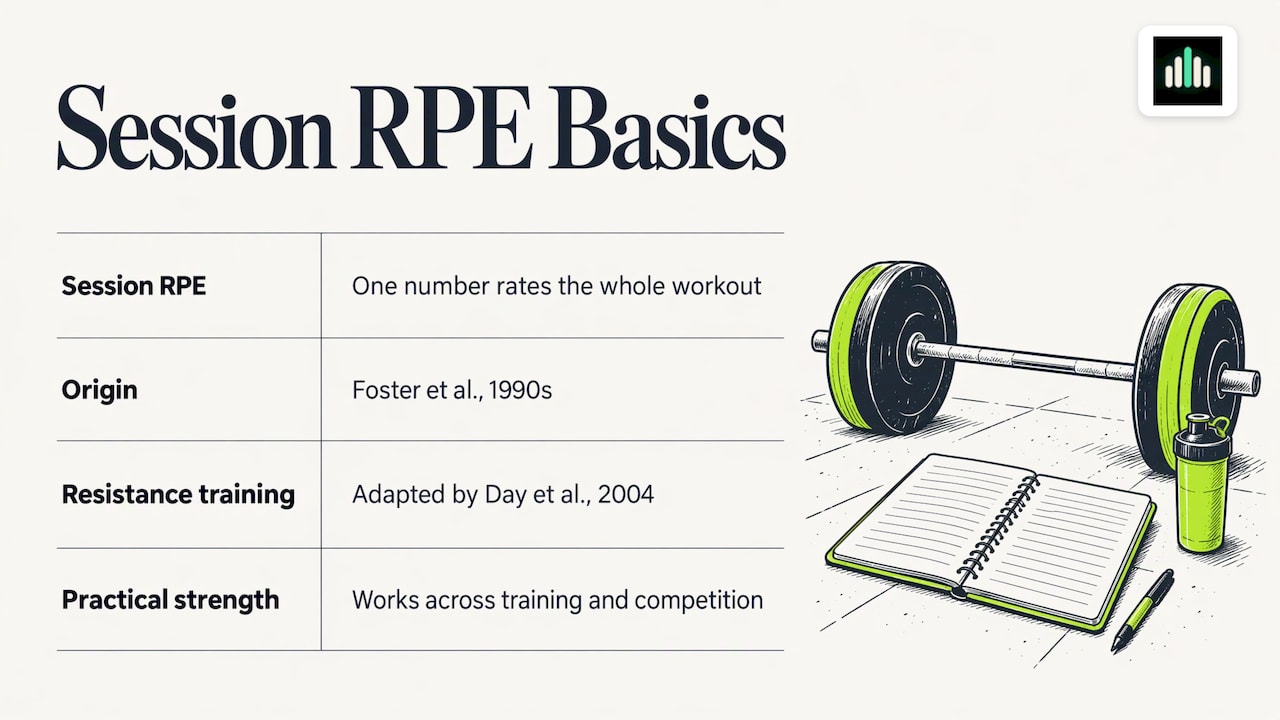
RPE stands for rating of perceived exertion. The session version was introduced by Foster and colleagues in the 1990s and later adapted to resistance training by Day and colleagues in 2004. The idea is simple: instead of recording heart rate or tallying every set, you answer one question about the whole workout, "How was your workout?", with one number. The 2017 Haddad review describes that single question as the method's main practical strength, since it works across training and competition alike.
Because the rating folds in everything you did, it reflects what researchers call internal load: how the session felt to your body given the weights, reps, rest periods and bar speed combined. Helms and colleagues (2020) make this point in their review of methods for regulating and monitoring resistance training.
Session RPE vs set RPE vs reps in reserve
This is where many lifters get tangled, because the same three letters mean two different things.
| Measure | What it rates | Typical scale | Question it answers |
|---|---|---|---|
| Session RPE | The whole workout | 0 to 10 (modified CR-10) | How hard was today overall? |
| Set RPE | One set, relative to your rep capacity | 1 to 10 | How close was this set to failure? |
| Reps in reserve (RIR) | Reps you could still have done | 0, 1, 2, 3... | How many reps were left? |
On the lifting scale, set RPE equals 10 minus RIR, so RPE 8 means about 2 reps in reserve and RPE 7 about 3. Session RPE has no such conversion. A session rated 7 does not mean you stopped 3 reps short on every set. It means the workout as a whole felt "very hard" on the Foster scale. The calculator pages at RPE Training make the same distinction: the 0 to 10 session rating is not the same as the reps-in-reserve rating for a single set.
If you want the set-level side in depth, our guides on what RPE means in lifting and how RPE and RIR differ cover it, and the RIR chart maps the two scales side by side.
The session RPE scale
The scale most studies use is Foster's modified CR-10. According to the Haddad review, the labeled anchors are:
| Rating | Label |
|---|---|
| 0 | Rest |
| 1 | Very, very easy |
| 2 | Easy |
| 3 | Moderate |
| 4 | Somewhat hard |
| 5 | Hard |
| 6 | (unlabeled) |
| 7 | Very hard |
| 8 | (unlabeled) |
| 9 | (unlabeled) |
| 10 | Maximal |
So a 7 on this scale is "very hard" for the session as a whole. In practice, think of a 7 as a workout where you finished tired, the last sets were demanding, and you would not want to repeat it an hour later. A 4 or 5 is a productive but comfortable day. A 10 is the hardest session you could imagine.
The authors also note that athletes need to be familiarized with the scale before the numbers become reliable. Give yourself a few weeks of consistent rating before you trust trends.
How to rate a session and calculate load
- Wait before you rate. The standard is about 30 minutes after the session. A VU University review of resistance training monitoring reports that ratings at 15 minutes are also reliable, while ratings at 5 or 10 minutes run higher because the final hard set dominates your memory.
- Rate the whole session. Include warm-up, working sets, rest periods and any conditioning. Do not average your set RPEs in your head.
- Use the same scale every time. Pick the CR-10 labels above and stick to them.
- Record the duration in minutes. Count from first warm-up set to last set.
- Multiply. Session load (AU) = session RPE × minutes. The Haddad review gives a worked example: 87 minutes at RPE 4 equals 348 AU.
A lifting example: Monday, 70 minutes at RPE 6 is 420 AU. Wednesday, 55 minutes at RPE 8 is 440 AU. Friday, 80 minutes at RPE 7 is 560 AU. Your week totals 1,420 AU. Rest days count as zero.
Turning daily numbers into weekly insight
Once you have a week of loads, the monitoring literature adds two more metrics. The VU review defines monotony as the mean daily load divided by its standard deviation over the prior week, and strain as load multiplied by monotony. In the Helms review, higher monotony and strain were associated with overtraining in earlier work by Foster.
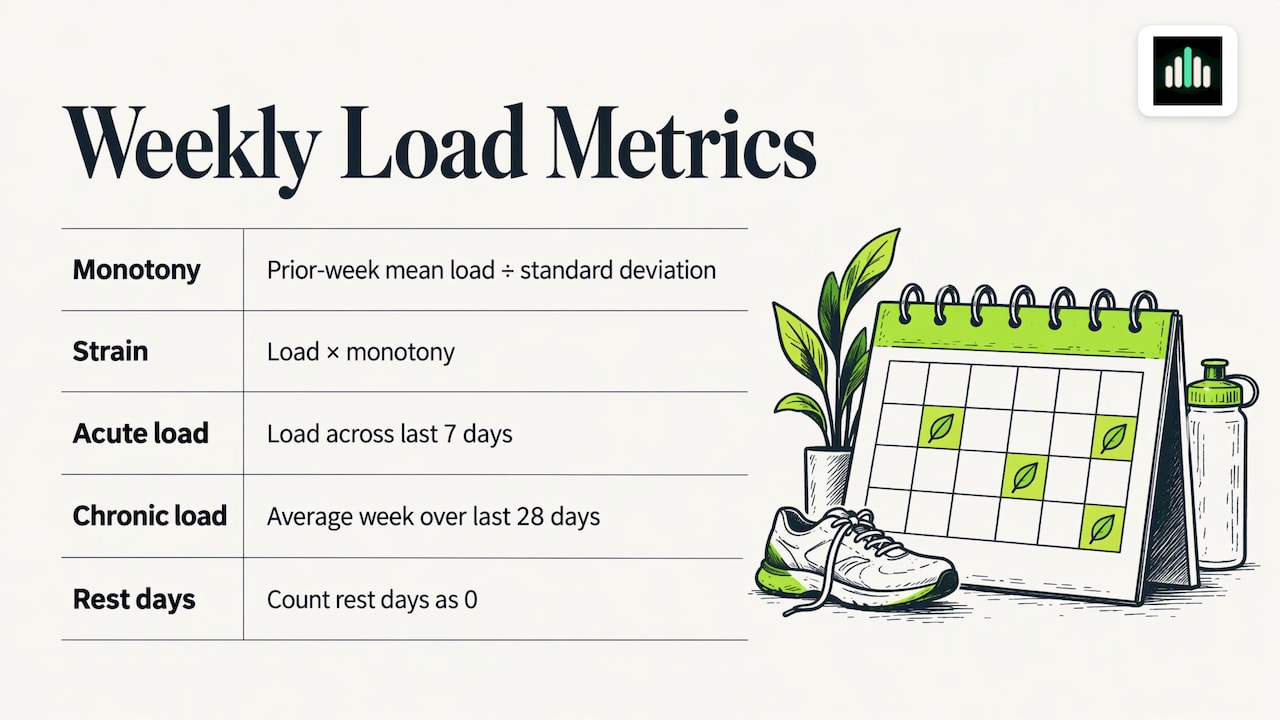
What this means for you: a week where every session scores about the same, with no easy days, has high monotony. Varying hard, moderate and easy days lowers it. Some tools also compare the last 7 days of load (acute) with the average week over the last 28 days (chronic), counting rest days as 0. A sudden jump of acute load over chronic load is your signal to look at sleep, stress and recovery before adding more.
The Helms review also notes that a rating used alone does not capture volume. Sweet and colleagues (2004) suggested multiplying by repetitions, and optionally dividing by session time, to capture volume, intensity and density together. If you lift heavy for few reps one day and light for many the next, that variant can separate days that minutes-based load treats as equal.
What the evidence says
The case for session RPE is strong, with some caveats worth knowing.
- Resistance training validity. In Day and colleagues' 2004 study of 19 men and women, session RPE was higher for heavy (90% of 1RM, 4 to 5 reps) than for moderate or light work, with an intraclass correlation of 0.88, supporting it as a reliable intensity measure.
- Breadth. The Haddad review reports that 950 studies had cited the Foster method and concludes it is valid with good reliability across several sports and activities.
- Reliability varies. In a six-week study of 25 people doing high-intensity functional training, session RPE tracked heart-rate-based load at group level (r = 0.889) but individual reliability was poor to moderate, improving over time. Consistent practice matters.
- Popularity. A 2023 systematic review of 59 studies found session RPE was the most commonly reported load-monitoring tool and found moderate evidence that more resistance training volume load goes with more strength. Evidence for most other load and outcome links was limited, and the authors recommend looking at several factors, including sleep and stress, rather than one number.
The practical reading: treat session RPE as a trend line, not a verdict. It tells you how hard training felt, which is exactly the thing heart rate and tonnage miss, and it works best next to set-level data.
Making session RPE useful when you lift
Session RPE answers "how much did this cost me?" Set RPE answers "how heavy should the next set be?" You need both.
Set-level effort is also something lifters learn to judge. Reviews note that lifters tend to underestimate reps left when far from failure and get more accurate near failure, so many newer lifters start by logging RIR, then move to RPE as their ratings match tested sets. A 2022 meta-analysis found lifters under-predicted reps to failure by about one rep on average, which is why your set ratings improve with practice.
A workable routine:
- Log every working set with weight, reps and RIR.
- After the session, give one session RPE on the 0 to 10 scale and note the minutes.
- Each week, add up loads and look for spikes or flat, identical days.
- If a week's load jumps, hold your weights steady instead of pushing progression.
You can also reverse-check with a tool: the RPE calculator estimates a max and next-set load from a single logged set.
Where RIRLift fits
Set logging is the part most lifters skip when they are tired, which is why it helps to have it built into the workout. RIRLift lets you log weight, reps and RIR for every set on iPhone or Apple Watch, and its Coach analyzes your session logs to recommend the next load. It also includes workout analytics and Apple Health integration. The core features are free, and Pro is $9.99 per month or $79.99 per year for advanced coaching, analytics, unlimited routines and customization. You can see the plans on the RIRLift site or read how the Apple Watch workout tracker handles sets on your wrist.
If you are comparing options, the workout apps overview shows what each lifter type tends to need.
Applying it to different lifters
Beginners. Start with only the session rating and minutes. Rating one number after each workout builds the habit, and the scale gets more reliable as you practice.
Strength-focused lifters. Pair session RPE with set RIR. If your heavy days feel like 8 and your volume days like 6, you have a clear rhythm. If every day lands at 8 or 9, monotony is probably high and a lighter day is worth planning.
Athletes with other training. The VU review points out that session RPE gives one metric across resistance, technical and conditioning sessions, so lifting and sport practice can be summed into a single weekly load.
FAQ
What is a session RPE?
It is one rating from 0 to 10 for how hard your whole workout felt, usually given about 30 minutes after you finish. Multiply it by the session length in minutes to get training load in arbitrary units.
What does 7 RPE feel like?
On the session scale, 7 means a very hard workout overall. On the set scale used in lifting, RPE 7 means roughly 3 reps in reserve, a heavy set that still had clear room left.
Is session RPE the same as RIR?
No. RIR counts the reps you could still do on one set, while session RPE rates the entire workout. Log them separately and label each so the numbers never get mixed.
How often should I use it?
Rate every session. The value comes from the weekly pattern, so consistency matters more than precision on any single day.
Sources
- Session-RPE Method for Training Load Monitoring (Haddad et al., PMC)
- Methods for Regulating and Monitoring Resistance Training (Helms et al., PMC)
- Monitoring Exercise Intensity During Resistance Training (Day et al., PubMed)
- Validity, Reliability, and Application of the Session-RPE Method (Crawford et al., PMC)
- Methods of Monitoring Internal and External Loads (PMC)
- Training Monitoring for Resistance Exercise (VU University)
- Training Load Calculator: sRPE, ACWR and Monotony
- RPE 7 Meaning: 3 Reps in Reserve
- The 1-10 Scale Explained