
The RPE and RIR app where effort sets the weight
Published October 27, 2026
An effort number is only worth logging if it changes something. RIRLift asks one effort question per set, how many reps you had left (RIR), and uses the answer: the next set goes up, holds or comes down, and between sessions it decides how big the jump is. RIR and RPE are the same scale read from opposite ends, so RPE 8 is 2 reps in reserve.
Free on iPhone and Apple Watch · No account · Coming to Android: join the waitlist
What an RPE or RIR app should do with your effort
-
Effort on every set, in one tap
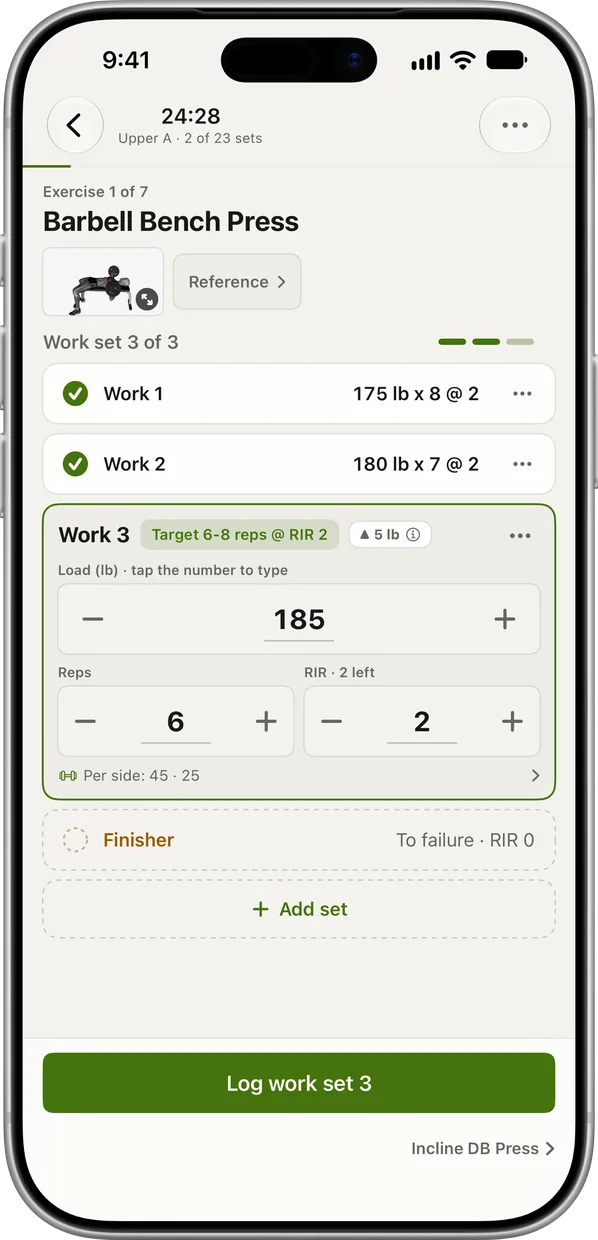
After each working set, tap how many more reps you had: 0, 1, 2, 3 or 4+. Weight and reps are prefilled, so logging effort is the only new input.
-
Your RPE program, translated
RPE 10 is 0 reps left, RPE 9 is 1, RPE 8 is 2, RPE 7 is 3. Set each exercise's target RIR to match and run the program as written. RPE vs RIR explains the conversion.
-
Effort that changes the next set
Reps and RIR combine into reps to failure, and the next set is converted from it: next = load × (29 + logged) ÷ (29 + target). More left than planned goes up; reps below the range come down.
-
Effort that sizes the next jump
Between sessions, reps decide whether the weight goes up and RIR decides by how much. Clearly easier than your target, and the jump can be two steps instead of one.
-
Consistency over precision
Your RIR is compared with targets you judge the same way, so a habit of calling sets easy cancels out. The app shows how your logged RIR tracks against your targets, and reps always count first.
-
Strength you can see without testing a max
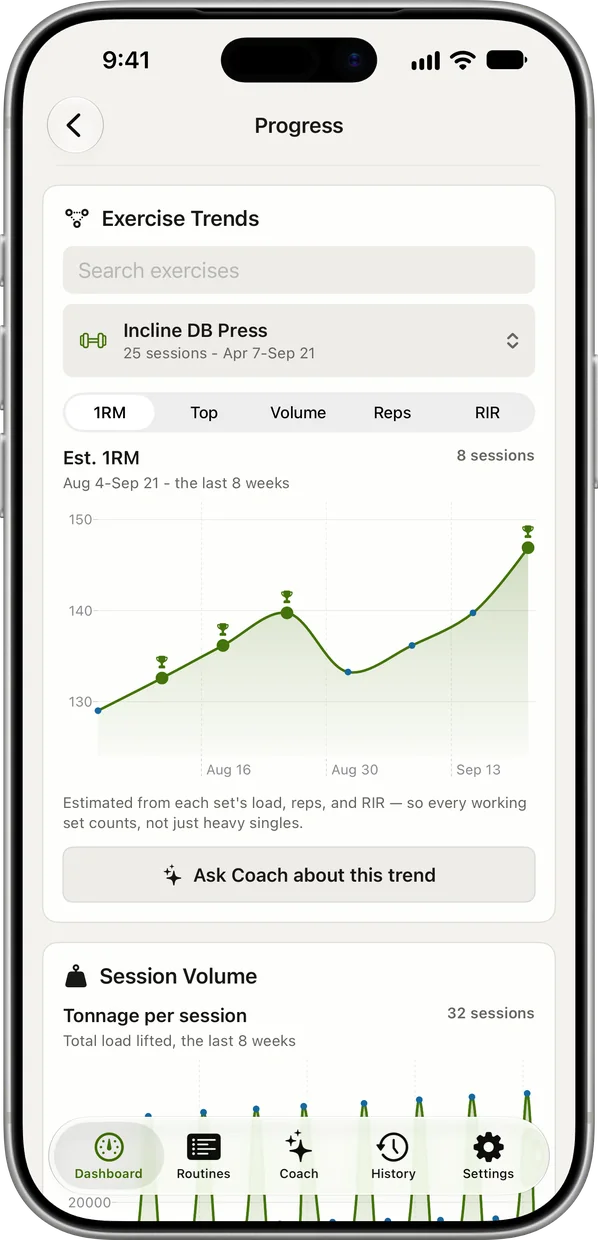
Progress charts each lift's estimated 1RM from your logged sets over time. You never test or enter a max.
Effort-based sessions, with the arithmetic
Your program says bench 3 × 5 @ RPE 8
A three-day squat, bench and deadlift plan. RPE 8 is entered as 2 reps in reserve, so the target is 5 reps with 2 left: 7 reps to failure.
| Exercise | You logged | Next session | Why |
|---|---|---|---|
| Barbell Bench Press | Set 1: 215 lb × 5 @ RPE 7 (3 left) | Set 2: 220 lb × 5 | 8 reps to failure against 7: 215 × 37 ÷ 36 ≈ 221 lb, rounded to 220 lb. |
| Barbell Bench Press | Set 2: 220 lb × 5 @ RPE 8 (2 left) | Set 3: 220 lb × 5 | Exactly on target, so it holds. |
| Barbell Bench Press | Set 3: 220 lb × 5 @ RPE 9 (1 left) | Holds at 220 lb | Harder than planned but you got the reps. Pushing never costs you weight. |
The first set told the app what RPE 8 weighs today. The program stayed the same; the load matched it.
Push day: everything felt light
Six days of push, pull and legs. Most sets are meant to end with 1 left (RPE 9).
| Exercise | You logged | Next session | Why |
|---|---|---|---|
| Barbell Bench Press | Set 1: 185 lb × 10 @ RPE 7 (3 left) | Set 2: 195 lb × 10 | 3 left instead of 1: 185 × 42 ÷ 40 ≈ 194, rounded to 195 lb. |
| Incline Dumbbell Press | 55 lb, 12 / 12 / 12 reps @ RPE 9 | 60 lb × 8 | Top of the range at the target effort: one dumbbell step. |
| Dumbbell Shoulder Press | 50 lb, 10 / 9 / 9 reps @ RPE 9 | 50 lb × 10 | The weakest set hit its target of 9 but not the top of 8–12. Same weight, one more rep. |
Same rep rule for every lift between sessions. Effort moved the bench before set 2.
Sets taken to failure: RPE 10, 0 left
On the same plan, lateral raises, pressdowns and hammer curls go to failure on purpose.
| Exercise | You logged | Next session | Why |
|---|---|---|---|
| Dumbbell Lateral Raise | 20 lb, 20 / 20 / 20 reps, 0 left | 25 lb × 12 | Every set at the top of 12–20 at the target effort: one dumbbell step, reps back to 12. |
| Cable Triceps Pressdown | 60 lb, 15 / 13 / 12 reps, 0 left | 60 lb × 13 | The weakest set hit its target of 12. Same weight, one more rep. |
| Hammer Curl | 35 lb, 13 / 12 / 11 reps, 0 left | 35 lb × 12 | The weakest set missed its target of 12, so weight and target both stay. |
At 0 left there is no easier to read, so reps alone decide. That's why reps always come first.
Plans with an effort target on every exercise
-
The best workout routine for men, for your week
Stronger squat, bench press and deadlift
The RPE 8 example's plan: heavy sets of 3 to 5 that stop 2 reps short.
3× a week · 49 sets a week · ~55 min
Add to RIRLiftSee the planAdd to RIRLift
Scan with your iPhone camera to add this plan.
-
The best workout routine for the days you can train
6 days a week: push/pull/legs
The push day and to-failure examples: most sets at 1 left, a few taken to 0.
6× a week · 102 sets a week · ~45 min
Add to RIRLiftSee the planAdd to RIRLift
Scan with your iPhone camera to add this plan.
-
The best workout plan for muscle gain, for where you are now
Past a year of lifting, gains have stalled
Heavy days at 2 left, volume days at 1 and some arm work to failure.
4× a week · 76 sets a week · ~50 min
Add to RIRLiftSee the planAdd to RIRLift
Scan with your iPhone camera to add this plan.
Make it fit you
-
Set a target RIR per exercise
Heavy compounds at 2 left, isolation work at 1 or 0. Use the RPE conversion if your program is written that way.
-
Calibrate on safe lifts
Take a lateral raise or a machine curl to true failure now and then. It shows you what 0 left feels like, so your 2s mean 2. The RIR guide walks through 0 to 4.
-
Log on your wrist
The Apple Watch app asks the same RIR question after each set, and the next set adjusts there.
-
Choose how hard it pushes
Pace (Steady, Standard or Push) sets how quickly weights climb. Set Coach to Ask first and next session's weights wait on the recap until you confirm them.
When a different app fits better
- You're running a percentage-based meet prep with @ notation and a taper. A powerlifting app fits that block better.
Questions
What's the difference between RPE and RIR?
RPE rates how hard a set was out of 10; RIR counts the reps you had left. For lifting they map directly: RPE 8 is 2 RIR, RPE 10 is 0. RPE vs RIR has the full table.
Can I log RPE in RIRLift?
You log RIR, which is the same information. Convert your program's RPE targets once (RPE 8 = 2 RIR) and log each set by reps left.
What if I'm bad at judging effort?
Be consistent rather than perfect. Your answers are compared with targets you judge the same way, and reps come first: going closer to failure than planned never cuts your weight, and falling below your range brings the next set down.
Does it use my effort to change weights?
Yes. Within a session, effort and reps convert the next set's load. Between sessions, effort decides whether a jump you earned with reps is one step or two.
Is it free?
Yes. RIR logging, the weight suggestions, progression and the Apple Watch app are free with no account. Pro adds Fine-tune for step sizes, more Coach conversations and all-time analytics.
Read next
-
RPE vs RIR: what's the difference, and which should you log?
The two scales side by side, with a conversion table.
-
What is RIR (reps in reserve)?
What 0 to 4 reps left feel like, and how to judge them.
-
RPE calculator
Work out a weight for any reps at any RPE.
-
RIR calculator (reps in reserve)
The same math from the RIR side.
-
RIR vs going to failure
How hard each set should be, and when failure is worth it.
More ways lifters use RIRLift
-
The progressive overload app that decides your next weight
Next weight and rep target set from your weakest set, corrected between sets, with stalls caught early.
-
The powerlifting app for building your squat, bench and deadlift
Heavy triples adjusted set by set, plate math on your wrist, and no max test to get started.
-
The hypertrophy app that sets your load from reps in reserve
RIR on every set, weekly sets per muscle, and deloads when a lift stalls instead of on a calendar.