Blog
Velocity based training: how to train by bar speed
Published November 17, 2026 · 15 min read

Scan with your phone camera
You put 100 kg on the bar for squats, the same weight your program called for last Monday. Last Monday you slept well; this week you did not, and the bar feels heavier than the plates say. A percentage program gives you the same sets either way. Velocity based training does not, because it reads the answer off the first rep: the faster the bar moves at maximal intent, the lighter that load is for you today.
That is the whole idea of velocity based training (VBT). You measure how fast the bar moves, use that speed to estimate how heavy a load really is on the day, and use how much that speed drops within a set to decide when the set is over. It sounds like a coaching gadget, and the room selling it is mostly device makers and strength and conditioning coaches. The research underneath it is solid, though, and it says something useful even if you never buy a sensor: the reason velocity loss works is the same reason reps in reserve works.
This post covers what VBT is, the two numbers it runs on, which velocity loss thresholds suit which goal, the devices, and how to get most of the benefit with no device at all.
What is velocity based training?
Velocity based training is a method of programming resistance training from the measured speed of the bar (or your body) during each rep, instead of only from fixed percentages of a one-rep max. A sensor records the concentric velocity of every rep, usually in metres per second, and two decisions follow from it:
- Load selection. How fast your first rep moves tells you roughly what percentage of today's max that weight is, so you can adjust the load up or down before the set goes wrong.
- Set termination. How much the bar slows down from your fastest rep tells you how much fatigue the set has built up, so you can stop the set at a planned velocity loss rather than at a fixed rep count.
Everything else in VBT (zones, feedback screens, load-velocity profiles, readiness checks) is built on those two uses. Both rest on one requirement that is easy to skip: every rep has to be lifted with maximal intended velocity. A rep you deliberately slow down tells the sensor nothing about how heavy the weight is. Tempo work and VBT do not mix.
How bar speed tells you how heavy a load is
The foundation of VBT is the load-velocity relationship: as the load goes up, the fastest speed you can move it goes down, and that relationship is tight and stable.
In the bench press, González-Badillo and Sánchez-Medina (2010) tested 120 strength-trained men and found an almost perfect relationship between mean propulsive velocity and relative load (R² = 0.98). The bar moved at about 0.16 m/s on a true 1RM. The striking part came six weeks later: in the 56 lifters retested, maxes had gone up by 9.3% on average, but the velocity attached to each percentage of their max had not changed. 70% of your max moves at roughly the same speed whether your max is 100 kg or 110 kg.
The squat behaves the same way. Sánchez-Medina and colleagues (2017) found mean velocity tracked percentage of 1RM with R² = 0.96 in 80 strength-trained men, with a 1RM moving at about 0.32 m/s, and concluded that relative load can be estimated from the very first rep of a set.
Two practical consequences:
- You can estimate your max without testing it. Record the speed of a few submaximal loads, draw the line, and read off where it meets your 1RM velocity. Coaches call this your load-velocity profile.
- Velocities are lift-specific. A squat 1RM moves about twice as fast as a bench 1RM in these studies. Never use one lift's numbers for another, and expect a deadlift or an overhead press to have its own profile.
The velocity "zones" you see in VBT marketing (absolute strength, strength-speed, speed-strength and so on) are coaching conventions layered on this relationship. They are useful shorthand for power-focused athletes; for a lifter training for muscle and strength, the two research-backed uses above matter far more.
How velocity loss tells you how hard a set is
The second number is velocity loss: the drop from your fastest rep to the current rep, as a percentage. If your first rep moves at 0.60 m/s and a later rep at 0.48 m/s, you are at a 20% velocity loss.
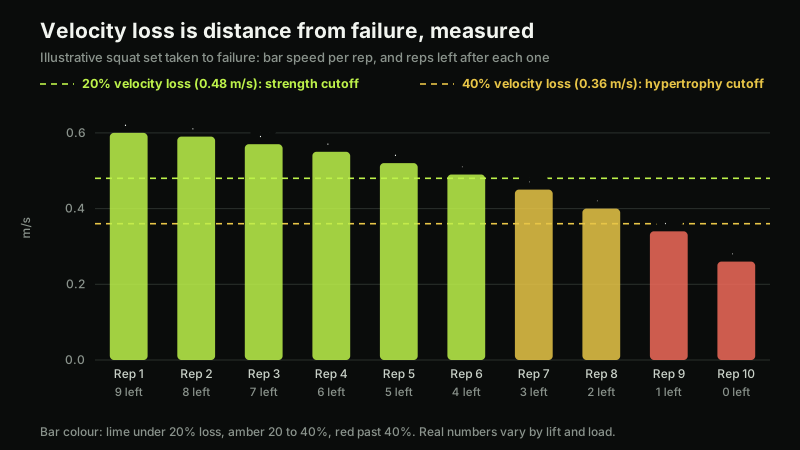
Sánchez-Medina and González-Badillo (2011) put strength-trained men through 15 different set and rep schemes in the bench press and squat and measured the fatigue each one caused. Velocity loss tracked blood lactate very closely (r = 0.93 to 0.97) and tracked the drop in jump height after squatting, which is why it is treated as an objective measure of neuromuscular fatigue during a set.
More useful still for anyone who trains by effort: velocity loss tells you how far you are from failure. González-Badillo and colleagues (2017) had lifters bench press to failure at loads from 50% to 85% of their max and found a very close relationship between the velocity lost in a set and the percentage of possible reps already completed, reliable enough that the authors wrote you can "estimate, with considerable precision, how many repetitions are left in reserve." In other words, velocity loss is an instrument reading of reps in reserve.
That is why the chart above pairs the two. A small velocity loss means many reps left; a large one means you are close to failure. The exact mapping depends on the lift and the load, so treat any number you see as specific to the exercise it was measured on.
Velocity loss thresholds: which one for which goal
Training with velocity loss means picking a cutoff in advance and ending each set when the bar slows past it. The research gives a clear pattern.
The best-known trial is Pareja-Blanco and colleagues (2017). Twenty-two young men squatted for eight weeks with identical loads and sets, and only one difference: one group stopped each set at 20% velocity loss, the other at 40%. The 20% group did 40% fewer reps and got similar squat strength gains, plus a bigger improvement in jump height (9.5% vs 3.5%). The 40% group gained more muscle in two of the quadriceps (vastus lateralis and intermedius) and lost some of its fastest (type IIX) fibres, which the 20% group kept.
Two meta-analyses since then say the same thing at larger scale:
- Hickmott and colleagues (2022) found velocity loss thresholds of 25% or less produced greater 1RM strength, while thresholds above 25% produced greater hypertrophy.
- Jukic and colleagues (2023) pooled 19 longitudinal studies and found the threshold did not change strength gains, higher thresholds favoured hypertrophy, and lower thresholds favoured jumping, sprinting and speed against submaximal loads.
Put together, with the exact bands best read as coaching conventions built on those findings:
| Goal | Velocity loss threshold | What the set feels like | Distance from failure |
|---|---|---|---|
| Speed, power, jump and sprint | Low (20% or less) | Fast, crisp, nowhere near hard | Far |
| Maximal strength with low fatigue | Up to about 25% | Hard to start, smooth to finish | Moderate |
| Hypertrophy | Above about 25% (30 to 40% is a common choice) | Last reps visibly slow | Close |
| Testing or occasional failure work | Until the bar stops | Grinding | At failure |
The last column is deliberately qualitative. The same velocity loss means a different number of reps left on a bench press than on a squat, and at 50% of your max than at 85%, so there is no single conversion from a percentage to a rep count. The pattern is the reliable part. The further you take a set toward failure, the more muscle it builds per set and the more fatigue it costs, and strength responds over a much wider range of effort. That matches the proximity-to-failure meta-regressions by Robinson and colleagues (2024), which found hypertrophy improved as sets ended closer to failure while strength gains were similar across a wide range of reps in reserve. It is also why training to failure is rarely necessary for strength and only sometimes worth it for size.
Velocity based training for hypertrophy
Most VBT content is written for athletes chasing power, where low thresholds are the point. If your goal is muscle, the research above flips the default: low velocity loss thresholds leave too much stimulus on the table. The 20% group in the Pareja-Blanco study did 40% fewer reps and grew less in two of the vastus muscles.
So hypertrophy-focused VBT looks like this:
- Use velocity for load, not to cut sets short. The load-velocity relationship is just as useful for a bodybuilder: if your first rep at your planned working weight is noticeably slower than usual, the weight is heavier for you today and you can drop it before the set turns into a grind.
- Set thresholds above about 25% (30 to 40% is a common choice) on the sets meant to build muscle. That keeps the last reps hard without making failure the default.
- Watch the ceiling, not just the floor. Hickmott's meta-analysis found no significant hypertrophy difference between thresholds above 25% and those at 20 to 25%, so the extra growth from grinding every set out is small at best, while the fatigue keeps climbing. Sets that slow to a crawl, repeated across a session, are where junk volume comes from.
- Mind the exercise. Sensors work best on barbell and machine lifts with a clear vertical path. Isolation work like lateral raises or cable flyes is a poor fit for velocity tracking, and that is a lot of hypertrophy training.
VBT devices: what measures bar speed
You need something that measures the speed of each rep. The main types:
| Device type | How it works | Strengths | Trade-offs |
|---|---|---|---|
| Linear position transducer | A tether clips to the bar and measures how fast it is pulled out | The type used in the 2011 fatigue study above; well suited to barbell lifts | Costs more; tethered to the floor next to you |
| Wearable or bar-mounted sensor | An accelerometer and gyroscope on the bar or your wrist | Portable, no tether | Estimates speed from acceleration, so accuracy varies by product and lift |
| Camera or phone app | Tracks the bar end or a marker on video | Cheap or free | Sensitive to camera angle and lighting; slower to use set by set |
Whichever you use, the rules are the same: measure the same lift the same way every time, compare a lift only to its own history, and lift every rep as fast as you can. A cheaper device used consistently beats an expensive one used carelessly, because what you care about is the change from your own baseline.
How to start velocity based training
If you have a device, a simple four-week trial:
- Pick one or two barbell lifts, for example the squat and bench press. Leave everything else as it is.
- Build a rough load-velocity profile. In your warm-up, record the fastest rep at three or four loads (for example 40%, 60% and 80% of your estimated max). Note the speeds. Repeat it weekly so you learn what a normal day looks like.
- Choose a threshold that matches the goal from the table above: up to about 25% for a strength block, above that (30 to 40% is common) for a hypertrophy block.
- End each set when a rep falls below the threshold, even if the program said one more. Write down how many reps that took.
- Use the first rep to adjust load. If it is much slower than your usual speed at that weight, take some weight off for the day. If it is much faster, add a little.
After four weeks, look at two things: whether your speed at a fixed load went up (you got stronger) and how many reps you got before hitting the threshold at each weight (your capacity at that load).
Velocity based training without a device: reps in reserve
Most lifters will never clip a tether to their bar, and they do not need to. The reason velocity loss works is that it measures distance from failure. Reps in reserve measures the same thing by feel, and the two are linked: Zourdos and colleagues (2016) found a strong inverse relationship between bar speed and an RIR-based effort rating in experienced squatters (r = -0.88): heavier, slower reps were rated with fewer reps left.
So you can run the same logic with no sensor:
- Velocity loss threshold becomes a target RIR. As a rule of thumb, a low-fatigue strength set ends with a few reps in reserve, and a hypertrophy set ends close to failure, around 1 to 3. If you are new to rating effort, the RPE vs RIR post explains how the two scales line up.
- First-rep speed becomes how the first working set feels. If a weight that is normally 3 RIR for eight reps lands at 1 RIR, it is heavier today, so take a little off. If it lands at 5, you are ready for more, which is the same call when to increase weight walks through.
- The load-velocity profile becomes your log. A device builds a profile from speeds; you build one from load, reps and RIR across sessions. 100 kg for 8 at 2 RIR this month and 100 kg for 8 at 4 RIR next month is the same signal as the bar moving faster at 100 kg.
The honest trade-off: an RIR rating is a judgement rather than a measurement, and it takes practice. They are also free, work on every exercise including the isolation work a sensor handles poorly, and get more accurate as you log and check them against sets you take to failure now and then. This is the approach behind RIRLift, which records load, reps and RIR for every set and uses the last set's load, reps and RIR to suggest your next weight, so the load adjustment VBT makes from a sensor comes from your own effort ratings instead, on the iPhone or the Apple Watch.
Speed work still has a place without a device. On a power or conjugate dynamic effort day, lift light loads as fast as you can and stop the set when a rep looks or feels clearly slower than the first. That is a coarse velocity loss threshold, judged by eye, and it captures most of the intent.
Common velocity based training mistakes
- Lifting submaximally. Any rep you do not try to move fast gives a false speed and a false threshold. Intent is non-negotiable.
- Comparing lifts or people. Your squat speed at 80% means nothing next to your bench speed at 80%, or next to someone else's squat.
- Chasing speed on hypertrophy sets. A 15% threshold on a muscle-building block is a strength or power program with extra steps.
- Changing devices mid-block. Different sensors read the same rep differently. Pick one and keep it.
- Treating the numbers as more precise than they are. Day-to-day variation is real. Look for trends across weeks, not a single slow rep.
FAQ
Is velocity based training good for hypertrophy?
Yes, if the thresholds are set for it. Studies comparing thresholds show more muscle growth with higher velocity loss (above roughly 25%), because those sets end closer to failure. Low thresholds are better for power and speed.
What velocity loss should I use?
For strength with minimal fatigue, up to about 25%. For hypertrophy, above about 25%, with 30 to 40% a common choice. For power, jump and sprint performance, 20% or less. Pick by goal, not by what feels comfortable.
Do I need a device for velocity based training?
To measure velocity, yes. To use its main idea, no. Reps in reserve is the device-free equivalent: both measure how close a set is to failure, and bar speed and RIR ratings move together.
What is a good velocity for a 1RM?
It depends on the lift. In the studies above, a bench press 1RM moved at about 0.16 m/s and a squat 1RM at about 0.32 m/s (mean velocity). Your own numbers will vary, so build your profile from your own lifts.
The takeaway
Velocity based training gives you two numbers: first-rep speed, which tells you how heavy a load is for you today, and velocity loss, which tells you how close a set is to failure. The evidence says lower thresholds suit strength and power, higher ones suit hypertrophy, and strength responds across a wide range. If you own a sensor, it is a precise way to apply that. If you do not, rate and log your reps in reserve on every set and you are running the same system by feel. Let that effort record set the next session's weights and the bar speed takes care of itself.