
Blog
Smolov Jr and Smolov: the percentages are fixed, so read what you log
Published November 4, 2026 · 13 min read
Smolov is the program people reach for when they want one number to move fast. Bench stuck for a year, a squat that will not budge past a plateau, three weeks before a meet: someone always says run Smolov Jr. The appeal is that it removes every decision. You put your one-rep max into a calculator, it hands back a table of weights, and your only job for three or four weeks is to show up and hit the prescribed loads. No reading, no autoregulation, no judgement calls. That is also the problem. A program that prescribes every weight in advance has no way of knowing whether those weights are still the right ones halfway through, and Smolov asks more of your recovery than almost anything else a general lifter will run. The percentages are fixed. Whether they are working is something only your log can tell you. Here is how each version runs, what it actually does, and the one thing the calculator leaves out.
What is Smolov Jr?
Smolov Jr is an abbreviated, high-frequency peaking cycle for a single lift, run over three weeks of training plus a fourth week to test and recover. It is the condensed version of the base block of the full Smolov squat routine, and most people run it for the bench press rather than the squat because three weeks of brutal squat volume is a harder sell than three weeks of brutal benching. You pick one lift, train it four times a week at fixed percentages of your current one-rep max, add a little weight each week, and test a new max at the end. You do not run it for two lifts at once, and you cut almost everything else back while you do, because the whole cycle is built around hammering one movement and recovering enough to hit it again two days later.
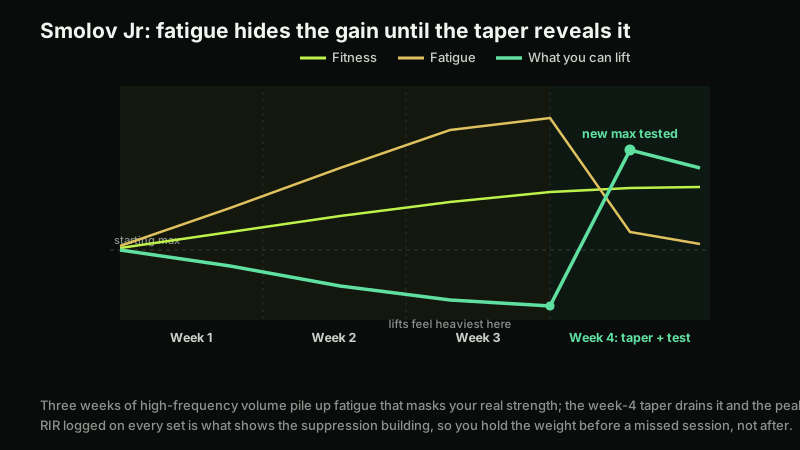
The defining feature is frequency and volume at a submaximal load. You are not grinding singles at 95 percent. You are doing a lot of hard sets in the 70 to 85 percent range, four days a week, which accumulates enormous fatigue and, if you recover from it, a short-term strength spike. That last clause is doing a lot of work, and it is where the log earns its place. First, the schedule itself.
The Smolov Jr schedule
The three training weeks repeat the same four sessions, with the weight climbing week to week. The base percentages are off your current one-rep max for the lift you chose.
| Day | Sets x reps | Percentage of 1RM |
|---|---|---|
| Day 1 (Monday) | 6 x 6 | 70% |
| Day 2 (Wednesday) | 7 x 5 | 75% |
| Day 3 (Friday) | 8 x 4 | 80% |
| Day 4 (Saturday) | 10 x 3 | 85% |
Week 1 runs those percentages off your true current max. Week 2 adds roughly 5 to 10 lb (about 2.5 to 5 kg) to every working weight from week 1. Week 3 adds another 10 to 20 lb on top of that. Week 4 is a test and deload week: light movement, real rest, and a new one-rep-max attempt once you feel recovered. Thirty sets a week on one lift at those intensities is the entire stimulus, and the single most common way to ruin the cycle is to also keep training that lift's helpers hard on the other days. If you are benching Smolov Jr, your overhead pressing and heavy triceps work come down, not up.
The weekly jumps are the part the calculator cannot actually decide for you. "Add 5 to 10 lb" is a range, and which end of it you pick, or whether you should add anything at all, depends entirely on how week 1 went. That is the first place a prescribed number meets a lifter it knows nothing about.
What is the full Smolov squat program?
The full Smolov routine is a 13-week Russian cycle built for one job: a large, short-term squat increase. It was popularised in the English-speaking world through translations of Sergey Smolov's programming, and PowerliftingToWin's review of the full cycle is the most-cited English breakdown. It runs in phases: a two-week introductory microcycle to prepare, a four-week base mesocycle that is the grinding high-volume heart of the program (four squat sessions a week, rising from sets of nine down to sets of three as the load climbs), a one-week switching phase, a four-week intense mesocycle built around heavier near-maximal work, and a taper into a new max.
Smolov Jr is, essentially, that base mesocycle pulled out and shortened to three weeks so you can apply it to any lift. The full program is far more demanding and far more specific to the squat; almost nobody should run the complete 13 weeks unless squatting is the only thing they care about for three months. For most lifters the useful version of Smolov is the junior cycle on one lift, which is why it carries most of the search traffic and why the rest of this guide stays with it.
Smolov Jr vs Smolov
The two are the same idea at different scales, and choosing between them is mostly a question of how much of your training life you are willing to hand over to one lift.
| Smolov Jr | Full Smolov | |
|---|---|---|
| Length | 3 weeks + test week | 13 weeks |
| Lift | Any one lift (usually bench) | Built for the squat |
| Days per week on the lift | 4 | 4 (base), variable later |
| Demand | High, survivable for most intermediates | Extreme; near your whole training focus |
| Best for | A short, focused push on one lift | A dedicated squat specialisation block |
| Risk if run wrong | Overreaching, stalled lift, joint strain | The same, scaled up and over three months |
For a lifter who is not a competitive powerlifter squatting as their single priority, Smolov Jr is the honest answer. It delivers most of what people actually want from "Smolov", a sharp short-term bump on a chosen lift, in three weeks rather than three months, and it is recoverable alongside a trimmed-down version of the rest of your training. The full cycle is a specialisation commitment, not a program you bolt onto normal training.
Does Smolov actually build strength, or just borrow it?
Smolov Jr usually does add weight to the bar by the end. The more useful question is whether that weight stays. A big share of the end-of-cycle number is peak-specific: three weeks of high-frequency overreaching followed by a week of rest produces a short supercompensation spike, part of which is neural and part of which is temporary. Lifters who do not transition into balanced training afterward often watch the new max drift back down. That is why the standard advice, echoed in every serious write-up, is to never run it back-to-back and to feed it into a normal block afterward.
For muscle size specifically, Smolov is not the lever. Hypertrophy is driven by total weekly hard sets per muscle taken close to failure and progressed over time, and the dose-response relationship Schoenfeld and colleagues found between weekly hard sets and growth does not care whether those sets came from Smolov or anything else. The broader periodization evidence lands in the same place: Stronger by Science's review of what the periodization data actually say finds that structured training beats genuinely random training, but no peaking model reliably out-grows another at matched volume. Smolov Jr is a short-term strength peaking tool. Treat it as one. It is a close relative of other percentage-driven peaking approaches like wave loading and the waves inside the 5/3/1 program, and like those it is about expressing and testing strength on a schedule, not about adding muscle a simpler plan would have missed.
The percentages are blind: Smolov is a tracking problem
Here is the gap every calculator and every schedule skirts. Smolov Jr prescribes the load for all 30 sets a week in advance, but it prescribes nothing about effort, and effort is the only thing that tells you whether the prescription is still correct. A top set of three at 85 percent in week 1 might sit at two or three reps in reserve; by week 3, after you have added weight twice and absorbed two weeks of accumulated fatigue, the same slot can be a genuine grind with nothing left. The program treats those as the same set. They are not. One is productive overload and the other is the first sign you are about to miss a session and stall the whole cycle. The published week-3 instruction is literally to add weight "depending on how you feel", and nothing in the program gives you a way to measure how you feel beyond a vague memory of yesterday.
The instrument for that is reps in reserve recorded on every set. Logged across the twelve sessions, your RIR is the readout the percentages cannot provide: it shows the prescribed loads getting harder at exactly the rate hard training should, or it shows them falling off a cliff mid-week-two, which is your signal to hold the weight instead of adding to it. This is the job RIRLift is built for, and it is worth being precise about what it does and does not do. It does not write Smolov for you, it does not change the percentages, and it does not autoregulate the loads. It makes a blind program legible. You set the rep target and a target reps in reserve per exercise when you build the cycle, and you keep that target on the screen for the set you are about to do rather than in your head between sessions. Because RIR is recorded as a first-class value on every set instead of guessed afterward, the week-1 sets and the week-3 sets become comparable, the estimated one-rep max surfaced during rest shows whether your strength is actually climbing, and the end-of-cycle test has a logged trend behind it instead of a single hopeful attempt. That trend is also how you answer the question the program will not: whether the final number is real strength you kept or a spike you are about to lose.
Who should run Smolov Jr, and who should not
Smolov Jr is not a beginner program. If you can still add weight to a lift most weeks on a straightforward linear progression or something like the Texas Method, you have no reason to spend three weeks of hard overreaching to force a peak you can get for free. The cycle is built for the intermediate lifter whose chosen lift has genuinely stalled and who wants a short, focused push to break it open, and it is the right tool far more often for a stalled bench press than for a squat a general lifter is still progressing. It is also a real demand on your joints, particularly the shoulders, elbows and wrists on the bench version, so it rewards lifters with a few years of training behind them and punishes those without.
Whatever you run it for, plan the exit before you start. Smolov Jr is a short peaking block, and like any peaking block it needs something structured to come down into. Block periodization describes the general shape: a hard concentrated phase has to hand off to a lower-stress phase that consolidates the gain, or the gain leaks away. In practice that means a deload week after the test and then a return to normal volume-driven training, not a second Smolov cycle. Smolov Jr is one short, aggressive block among many, not a way to train year-round.
The verdict
Smolov Jr is a sharp tool for a narrow job: a short-term strength peak on one stalled lift for an intermediate who can recover from a lot of volume on a tight schedule. It is not a hypertrophy program, not a beginner program, and not something to run on repeat. The full 13-week Smolov is a squat-specialisation commitment most lifters should never make; the junior cycle gets most of the benefit in a quarter of the time. And whichever you run, the calculator's weights are the easy half. The hard half is reading whether they are still the right weights as fatigue piles up, and whether the number you test at the end is strength you will keep. The program gives you nothing for that. Set your rep and RIR targets, log the load, reps and RIR for every set as you rack it, and watch the effort and the estimated max trend across the three weeks. Do that and Smolov Jr becomes a cycle you can steer and judge. Run it off a calculator and a vague memory, and you are trusting a program that stopped knowing anything true about you the moment week 1 ended.
Frequently asked questions
Does Smolov Jr work for bench? Yes, for most intermediate lifters it produces a short-term bench increase over the three weeks, which is why bench is the most common lift people run it for. How much of that increase you keep depends on transitioning into normal training afterward rather than running it back-to-back, and on whether you actually recovered from the volume, which your logged effort per set tells you and a calculator cannot.
How much weight does Smolov Jr add? Anecdotal reports commonly cite 10 to 25 lb on the bench over the cycle, but a meaningful part of any peaking spike is temporary. Judge the result by what you can still lift a month later, after you have returned to balanced training, not by the single attempt at the end of test week.
Smolov Jr vs full Smolov: which should I run? Run Smolov Jr unless squatting is your single training priority for three months. Smolov Jr is the base block of the full routine, shortened to three weeks and applicable to any lift; the full 13-week cycle is a squat-specialisation program that demands almost all of your recovery.
Can I run Smolov Jr for two lifts at once? No. The cycle is built around hammering one lift four times a week and recovering enough to repeat it. Running two at once doubles the fatigue with no extra recovery and is the fastest way to stall both. Pick one lift, cut its helpers back, and run it alone.
Is Smolov Jr safe for beginners? No. A beginner can still add weight most weeks with far less fatigue, so there is nothing to gain from the overreaching, and the high-frequency volume is hard on the joints. Spend your early training on a simple linear progression first; Smolov Jr solves a plateau you do not have yet.