Apple Watch for teens: three lifting sessions you log on your wrist

A teen can track lifting on an Apple Watch paired to their own iPhone: a lifting app on the Watch logs the weight, reps and reps in reserve of every set, and the session is saved to Apple Health as Traditional Strength Training. Apple Watch For Your Kids, Apple's setup for a child without an iPhone, needs a GPS + Cellular Watch and a parent's iPhone; RIRLift's Watch app takes its routines from RIRLift on the teen's own iPhone. Below are three sessions: a first gym program, two short in-season days for a sport, and a home routine with one pair of dumbbells.

  1. Goblet Squat Quads, Glutes
  2. Dumbbell Romanian Deadlift Hamstrings, Glutes
  3. Flat Dumbbell Press Chest
  4. One-Arm Dumbbell Row Lats, Upper Back
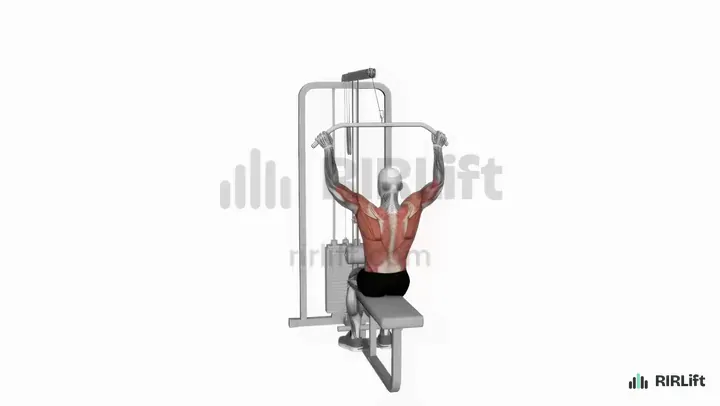
  5. Lat Pulldown Lats
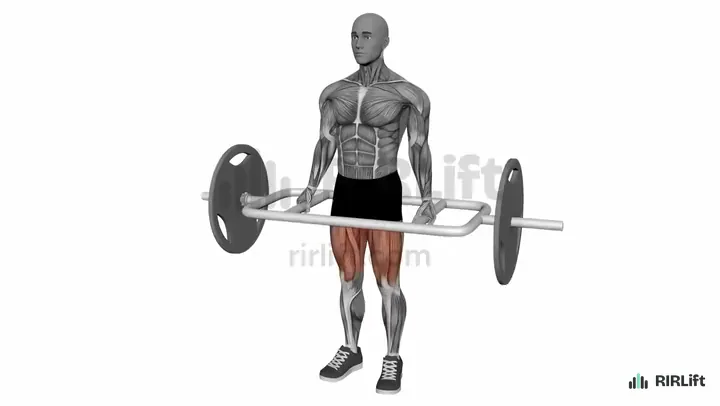
  6. Trap Bar Deadlift Quads, Glutes
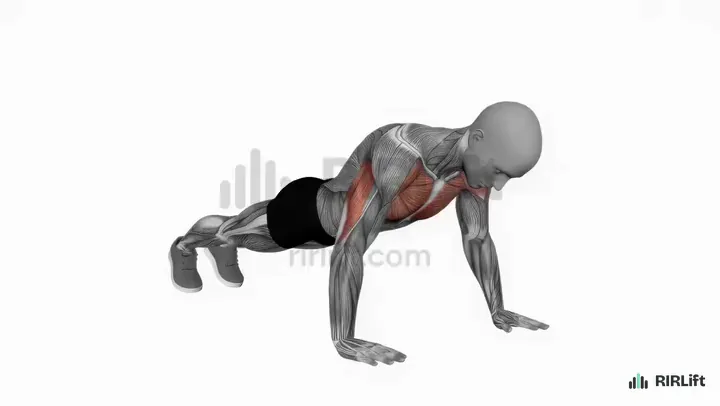
  7. Push-Up Chest

Legs and hips

One squat, one hinge and one single-leg lift a week cover the legs. Log each set on the Watch as you set the weight down.

Quads and glutes, dumbbell squat

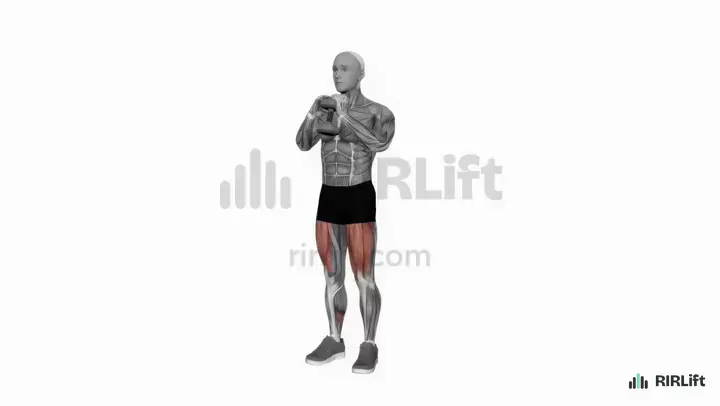
Goblet Squat

Quads, Glutes

The first squat to learn: the weight at your chest keeps you upright, and one dumbbell is easy to find in any gym.

How to do it

  1. Hold a dumbbell or kettlebell vertically against your chest.
  2. Sit down between your knees, elbows inside them at the bottom.
  3. Stand up tall.

Cues

  • Elbows nudge the knees out at the bottom.
  • Chest stays up behind the weight.

Common mistakes

  • Letting the weight pull you forward.

Swap for: Bodyweight Squat, Barbell Back Squat

Quads and glutes, one leg at a time

Dumbbell Reverse Lunge

Quads, Glutes

Stepping back is easier on the knees than stepping forward and shows which leg is weaker. Log the reps of one leg.

How to do it

  1. Start tall with a dumbbell hanging from each hand and your feet under your hips.
  2. Step one foot back and lower until your back knee is just above the floor and your front thigh is near parallel.
  3. Keep your front heel flat and your chest tall.
  4. Push through your front foot to bring the back foot forward to the start, then alternate or finish all reps on one side.

Cues

  • Front shin stays vertical
  • Back knee kisses the floor
  • Drive through the front heel

Common mistakes

  • Taking a short step so the front knee shoots forward and the heel lifts: step farther back.
  • Letting the torso twist or lean to the side as you tire; keep both dumbbells hanging straight down.

Swap for: Reverse Lunge, Step-Up, Dumbbell Split Squat

Quads and glutes, rear foot raised

Bulgarian Split Squat

Quads, Glutes

With the back foot on a bench, light dumbbells feel heavy, which suits a home set that tops out at 25 lb.

How to do it

  1. Set the top of your back foot on a bench and place your front foot a long stride ahead.
  2. Hold a dumbbell in each hand at your sides, and keep your front foot flat.
  3. Drop your back knee straight toward the floor until the front thigh is close to level.
  4. Press through the front foot to rise, then finish all reps before switching legs.

Cues

  • Go deep for the inner thigh
  • Front foot flat
  • Rear foot is just a kickstand

Common mistakes

  • Pushing up with the back leg: let it relax and make the front leg do the work.
  • Front knee collapsing inward: keep it pointed the same way as your toes.

Swap for: Dumbbell Split Squat, Step-Up, Reverse Lunge

Hamstrings and glutes, hip hinge

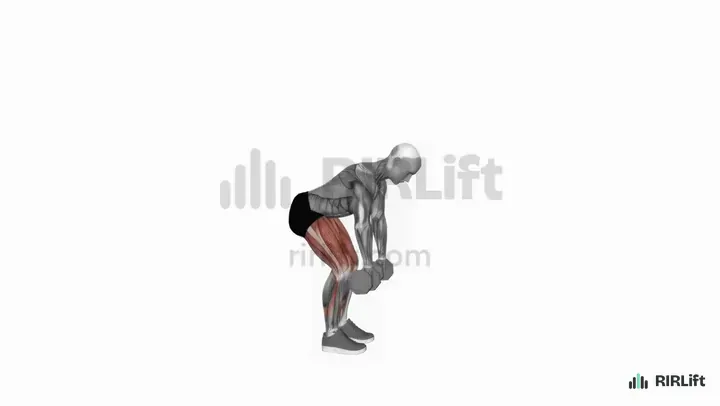
Dumbbell Romanian Deadlift

Hamstrings, Glutes

Teaches the hinge every jump, sprint and deadlift uses, with weights light enough to learn it on.

How to do it

  1. Stand hip-width apart with a dumbbell in each hand resting against the front of your thighs, palms facing you.
  2. Push your hips straight back and let your torso fold forward, knees softly bent, the dumbbells brushing your legs.
  3. Lower until the dumbbells pass your knees and you feel a strong stretch in your hamstrings, with your back still flat.
  4. Drive your hips forward to stand back up, squeezing your glutes at the top, and repeat.

Cues

  • Hips back, not down
  • Dumbbells slide down your legs
  • Flat back, chin tucked

Common mistakes

  • Bending the knees into a squat so the dumbbells go lower: the depth comes from the hips, and most people stop just past the knees.
  • Rounding the lower back at the bottom: end the rep where your back stays flat, and lighten the load if that is high.

Swap for: Single-Leg RDL, Dumbbell Good Morning, Kettlebell Deadlift

Whole lower body, heavy pull

Trap Bar Deadlift

Quads, Glutes

The heaviest lift in the in-season session. The handles sit at your sides, so the back stays more upright than with a straight bar.

How to do it

  1. Step inside the trap bar with the handles beside your feet.
  2. Push your hips back, bend your knees, and grip the handles.
  3. Flatten your back, take the slack out, and stand up by pushing the floor away.
  4. Lower under control. Each warm-up set adds weight toward your working sets.

Cues

  • Push the floor away
  • Flat back
  • Slack out before you pull

Common mistakes

  • Yanking the bar off the floor: pull the slack out first.
  • Rounding the back as the weight climbs: hold the ramp until the setup is solid.

Swap for: Barbell Deadlift, Romanian Deadlift, Kettlebell Deadlift

Pushing

A dumbbell press, a push-up and an overhead press. Push-ups need nothing but the floor, so they travel to a team gym or a bedroom.

Chest, shoulders and triceps, dumbbell press

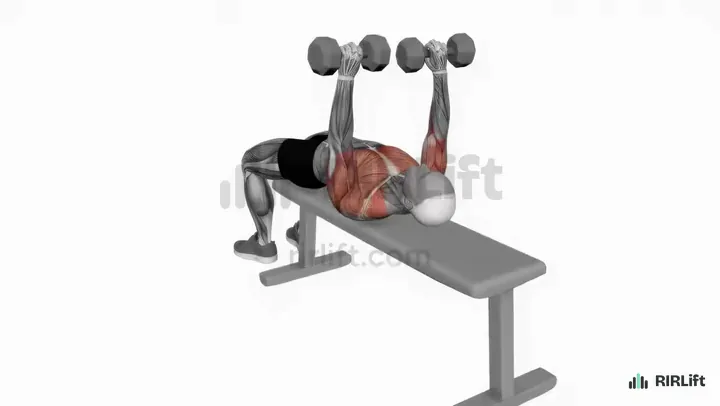
Flat Dumbbell Press

Chest

Each arm moves on its own, so a stronger side cannot cover for the weaker one.

How to do it

  1. Lying on a flat bench, hold two dumbbells above your chest.
  2. Lower the bells to the sides of your chest with elbows at about 45 degrees.
  3. Press them back up over your shoulders.

Cues

  • Shoulder blades pinched.
  • Control the lowering.

Common mistakes

  • Flaring the elbows straight out.

Swap for: Push-Up, Barbell Bench Press

Chest, shoulders and triceps, bodyweight

Push-Up

Chest

Works anywhere. Log the reps; once 15 is easy, raise your feet or add a backpack and log the added weight.

How to do it

  1. Set your hands slightly wider than your shoulders with your body straight from head to heels.
  2. Lower until your chest nearly touches the floor, elbows at about 45 degrees.
  3. Press back up to straight arms.

Cues

  • One straight line
  • Elbows angled back

Common mistakes

  • Flaring the elbows straight out: tuck them toward your ribs.

Swap for: Kneeling Push-Up, Incline Push-Up, Push-Up Plus

Shoulders and triceps, seated press

Dumbbell Shoulder Press

Shoulders

The overhead press of the beginner program, seated so the legs and lower back stay out of it.

How to do it

  1. Set a bench upright or one notch back from vertical, sit with your feet flat, and rest a dumbbell on each thigh.
  2. Kick one knee up at a time to bring the dumbbells to shoulder height, then set your back against the pad.
  3. Turn your elbows slightly forward so they sit a little in front of your torso, palms facing forward or angled in.
  4. Drive both weights overhead on a slight inward arc until your elbows are straight, keeping your ribs down and your back on the pad.
  5. Lower slowly until the dumbbells are around ear height or a bit below, then press again.

Cues

  • Ribs down, back on the pad
  • Elbows a little forward
  • Press up and slightly in

Common mistakes

  • Arching your lower back off the pad to finish reps: that turns it into an incline press, so lighten the weight and keep your ribs stacked over your hips.
  • Flaring the elbows straight out at shoulder height: bring them a little forward so the shoulder joint stays comfortable at the bottom.
  • Stopping each rep well above your ears: lower to around ear height so the delts work through a full range.

Swap for: Machine Shoulder Press, Arnold Press, Landmine Press

Pulling

At least as many sets of rows and pulldowns as presses, so the shoulders get both sides of the work.

Upper back and lats, one arm

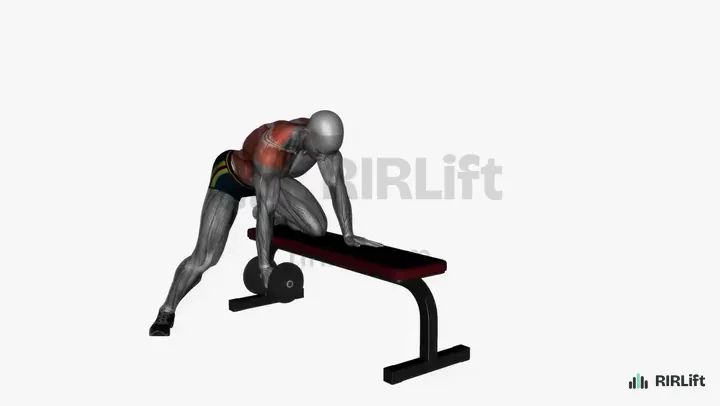
One-Arm Dumbbell Row

Lats, Upper Back

A bench or a chair is all it needs, so it works in the gym and at home. Log the reps of one arm.

How to do it

  1. Put one hand and the same-side knee on a bench, or your hand on a chair seat with both feet on the floor, so your back is flat.
  2. Hold a dumbbell in the other hand with your arm hanging straight.
  3. Pull your elbow back toward your hip until the dumbbell reaches your ribs.
  4. Lower it until your arm is straight again, finish all reps, then switch sides.

Cues

  • Elbow to your hip
  • Back flat as a table
  • Full stretch at the bottom

Common mistakes

  • Twisting your chest open to lift the dumbbell higher: keep both shoulders level.
  • Shrugging the shoulder up toward your ear: pull the elbow back, not the shoulder up.

Swap for: Band Bent-Over Row, Dumbbell Bent-Over Row, Seated Cable Row

Lats and upper back, cable pulldown

Lat Pulldown

Lats

Builds toward a first pull-up, with a pin that sets the load in seconds.

How to do it

  1. Set the thigh pad so your legs are locked under it, then stand up and take the bar a little wider than your shoulders, palms forward.
  2. Sit down with your arms fully stretched overhead and lean back only slightly.
  3. Pull the bar to your upper chest by driving your elbows down toward your hips.
  4. Let the bar rise until your arms are straight and your shoulders lift toward your ears, then pull again.

Cues

  • Elbows to your back pockets
  • Bar to the top of the chest
  • Let the stack lift you at the top

Common mistakes

  • Leaning far back and rowing the bar to your stomach: stay nearly upright so it remains a vertical pull.
  • Stopping with the arms still bent at the top: the stretch overhead is half of what makes the pulldown work.

Swap for: Pull-Up, Neutral-Grip Lat Pulldown, Single-Arm Lat Pulldown

Upper back and lats, cable row

Seated Cable Row

Upper Back, Lats

A steady row on the stack for the second gym day, easy to load and easy to log.

How to do it

  1. Sit at the cable row with your feet on the platform and knees slightly bent, holding a close-grip handle with your arms straight.
  2. Sit tall with your chest up and let the cable pull your shoulder blades forward a little.
  3. Row the handle to your lower ribs, driving your elbows back past your torso.
  4. Return it under control until your arms are straight and your shoulders reach forward, then repeat.

Cues

  • Sit tall, no rocking
  • Handle to the belly button
  • Shoulders reach at the front

Common mistakes

  • Rocking back and forth to move the stack: your torso should stay close to upright throughout.
  • Shrugging the handle up toward your neck: pull your shoulders down before the elbows bend.

Swap for: Chest-Supported Row, Single-Arm Cable Row, Barbell Row

Trunk holds

Timed holds. Tap Start hold on the Watch and it counts the seconds for you.

Trunk, front hold

Plank

Abs

Holds teach bracing for every other lift. The Watch times the set.

How to do it

  1. Set your forearms under your shoulders and your feet behind you, body in a straight line.
  2. Squeeze your glutes and pull your ribs down toward your hips.
  3. Hold, breathing normally, without letting your hips sag or rise.
  4. For the harder version, reach one arm forward and lift the opposite foot, hold, then switch sides.

Cues

  • Ribs down
  • Glutes tight
  • Straight line

Common mistakes

  • Hips sagging toward the floor: that hangs on your lower back.
  • Holding for minutes at an easy level: make it harder instead.

Swap for: Long Lever Plank, Plank Shoulder Tap

Trunk, side hold

Side Plank

Abs

Trains the sides of the trunk that cutting and changing direction lean on. Log each side as its own set.

How to do it

  1. Lie on one side with your elbow under your shoulder and your legs stacked.
  2. Lift your hips until your body is straight from head to feet.
  3. Hold, then switch sides.

Cues

  • Hips high
  • Stacked feet
  • Elbow under shoulder

Common mistakes

  • Letting the hips drop toward the floor as the hold goes on.
  • Rolling the chest forward or back.

Swap for: Dumbbell Side Plank, Copenhagen Plank

Put them together: example sessions

Each session below picks from the exercises above for one situation, with the sets, reps, rest and RIR filled in.

Session 1

First program, school weight room or gym, 2 days

  • Workouts2× a week
  • Working sets22 a week
  • Per workout~25 min
  • EquipmentDumbbells, Flat Bench, Lat Pulldown, Cable Row

You are new to lifting and train twice a week after school, with dumbbells, a cable stack and a bench.

Two full-body days alternate: a squat and press day, and a hinge and row day. Every lift stops with three reps left, which leaves room to learn the movement before the weight climbs.

Day A: Squat and press
ExerciseSets × repsRIRRest
Goblet Squat 3 × 8–12 3 90 s
Flat Dumbbell Press 3 × 8–12 3 90 s
Lat Pulldown 3 × 10–12 3 75 s
Plank 2 × 20–40 s 2 1 min
Day B: Hinge and row
ExerciseSets × repsRIRRest
Dumbbell Romanian Deadlift 3 × 8–12 3 90 s
Dumbbell Shoulder Press 3 × 8–12 3 90 s
Seated Cable Row 3 × 10–12 3 75 s
Dumbbell Reverse LungePer leg. 2 × 8–10 3 75 s
How to run it
Import it, save it, and switch to it in My Programs; only the active program's routines reach the Watch. Alternate A and B with at least a day between. The first time you do a lift it opens at a light estimate and the first set is as many reps as you can do with good form; every weight after that is set from what you logged.
How to progress
Double progression, judged on your weakest set. Goblet squat with a 30 lb dumbbell, target 10: you log 12, 11, 10, the weakest set hit 10, so next time it stays at 30 lb and the target is 11. Log 12, 12, 12 and every set is at the top of 8 to 12, so the next session opens at 35 lb for 8.

Session 2

In season for a sport, two 30-minute days

  • Workouts2× a week
  • Working sets20 a week
  • Per workout~25 min
  • EquipmentTrap Bar, Dumbbells

You play a sport with practice most days and want to keep your strength through the season without being sore for games.

One short session, twice a week, away from game days: a heavy trap bar pull for low reps, a push-up, a row and a side plank. Ten working sets keep the strength you built without adding fatigue.

In-season day
ExerciseSets × repsRIRRest
Trap Bar Deadlift2 warm-up sets first 3 × 4–6 3 2:30 min
Push-Up 3 × 8–15 2 75 s
One-Arm Dumbbell RowPer arm. 2 × 8–12 2 1 min
Side PlankPer side. 2 × 20–30 s 2 45 s
How to run it
Run it twice a week with at least two days before a game. If practice ran long, do the trap bar pull and the row and log only those; a skipped lift changes nothing, and the next session picks up at the weight you earned.
How to progress
Trap bar at 135 lb for 6, 6, 6 is the top of 4 to 6 on every set, so the next session opens one step heavier on your plates, 140 lb with a pair of 2.5 lb plates, for 4. If a lift goes three sessions without a new rep, the recap offers a lighter week; you choose.

Session 3

Home, one pair of 25 lb dumbbells, 3 days

  • Workouts3× a week
  • Working sets42 a week
  • Per workout~30 min
  • EquipmentDumbbells

You train in your room or garage with a single pair of dumbbells and a chair or bench.

One session repeated three times a week. With the weight fixed at 25 lb, the single-leg squat and the higher rep ranges keep the work hard enough to count.

Home day
ExerciseSets × repsRIRRest
Bulgarian Split SquatPer leg. 3 × 8–12 2 90 s
Push-Up 3 × 8–15 2 75 s
One-Arm Dumbbell RowPer arm. 3 × 10–15 2 1 min
Dumbbell Romanian Deadlift 3 × 10–15 2 90 s
Plank 2 × 30–45 s 2 45 s
How to run it
Monday, Wednesday and Friday, or any three days with a day between. Leave the phone in another room: the session runs on the Watch and each set is saved there as you log it.
How to progress
One-arm row with the 25 lb dumbbell, target 12: you log 15, 14, 12, the weakest set hit 12, so the weight stays and the next target is 13. When every set reaches 15 and there is no heavier dumbbell, keep logging what you do; the next weight is always worked out from what you logged.

Make it fit you

Questions

What does a teen need to lift with RIRLift on Apple Watch?

An Apple Watch on watchOS 10 or later, paired with the teen's own iPhone running RIRLift. The Watch app takes its routines from the iPhone app and syncs each session back to it.

Can a teen use an Apple Watch without an iPhone?

Yes, through Apple Watch For Your Kids: Apple says it needs an Apple Watch with GPS + Cellular, a cellular plan, and an iPhone for the first setup, and apps come through Ask to Buy. RIRLift's Watch app gets its routines from the RIRLift iPhone app, so a teen needs their own iPhone to use it.

What workout does Apple Watch record for lifting?

When the session runs in RIRLift, any session with a lift in it is saved to Apple Health as Traditional Strength Training, with heart rate recorded while it runs.

How heavy should a teen start?

Light enough to stop with about three reps left. On a lift you have never logged, RIRLift opens at a deliberately light estimate and asks for as many reps as you can do with good form on the first set, then sets every weight after that from what you logged.

Sources