
Blog
Beginner Strength Program: 8 Weeks, 3 Days a Week
Published October 21, 2026 · 14 min read
The best beginner strength program trains every major muscle group at least twice a week, uses a handful of basic lifts, and adds load slowly and only when you have earned it. Below is an eight-week plan built on that idea: three short full-body sessions, starting weights you can find in one visit, and clear rules for when to go heavier.
The plan leans on the current evidence, not on a famous template. Where the research is silent, we say so and describe what is simply common practice.
TL;DR
- Train all major muscle groups at least 2 days per week. ACSM's 2026 position stand puts consistency ahead of complexity.
- Start each lift with a load you can move for 8 to 12 reps, and stop 2 to 3 reps before you would fail.
- Add weight only after you beat the top of your rep target in two sessions in a row, then raise it by a small step.
- Skip drop sets, myo-reps and training to failure for now. They are not what drives your first months of progress.
- Log every set so that week 8 is compared with week 1, not with how you remember feeling.
Table of Contents
- What a beginner program actually has to do
- The 8-week plan at a glance
- How to find your starting weights
- The progression rule: when to add weight
- Weeks 1 to 8: what changes and what does not
- Do you need heavier loads for strength?
- What beginners can safely ignore
- Our view on beginner programs
- Tracking the program on your phone
- FAQ
- Sources
What a beginner program actually has to do
A beginner program has three jobs: teach you a few movement patterns, give your body enough work to adapt to, and be simple enough that you show up. Everything else is optional.
The ACSM position stand makes the point bluntly. Its authors report that the largest gain comes from moving from no resistance training to any resistance training, and its summary is that the best program is the one you will actually do. Stuart Phillips of McMaster University, quoted in the same release, says much the same: hitting all major muscle groups twice a week matters far more than chasing a perfect plan.
That is good news for you. It means the choice between two reasonable programs matters less than the choice to run either one for two months without gaps.
Why your first weeks feel so fast
In the first 6 to 12 weeks, much of your improvement comes from your nervous system getting better at the lift, not from new muscle. A narrative review on minimalist training covers how lower-dosage training can still improve fitness. In practice this means your scale weight and mirror are poor early indicators. Your logbook is a better one: the weight on the bar, the reps you completed, and how hard they felt.
Some lifters also like a body-based check alongside the numbers, such as movement quality or how a joint feels under load. A practitioner who works with somatic tracking and personalized adjustments is one example of in-person help for people who want to understand how their body responds to new training. If a movement hurts rather than simply burns, that is a question for a clinician, not something to push through.
The 8-week plan at a glance
You will train three days a week on non-consecutive days, for example Monday, Wednesday and Friday. You alternate two sessions, A and B, so that every muscle group is trained at least twice a week and usually three times in some weeks.
| Week | Mon | Wed | Fri |
|---|---|---|---|
| 1 | A | B | A |
| 2 | B | A | B |
| 3 | A | B | A |
| 4 | B | A | B |
| 5 to 8 | Repeat weeks 1 to 4 with heavier loads |
Two sessions three times a week gives you 12 workouts in four weeks, and each lift gets practiced about six times in that block. That repetition is what makes the movements feel automatic.
Session A
| Exercise | Sets | Reps | Reps in reserve |
|---|---|---|---|
| Goblet squat or barbell back squat | 3 | 8 to 10 | 2 to 3 |
| Dumbbell or barbell bench press | 3 | 8 to 10 | 2 to 3 |
| Seated cable row or one-arm dumbbell row | 3 | 10 to 12 | 2 to 3 |
| Plank | 2 | 20 to 40 seconds | Stop with good form |
Session B
| Exercise | Sets | Reps | Reps in reserve |
|---|---|---|---|
| Romanian deadlift (dumbbells or barbell) | 3 | 8 to 10 | 2 to 3 |
| Overhead dumbbell press | 3 | 8 to 10 | 2 to 3 |
| Lat pulldown or assisted pull-up | 3 | 10 to 12 | 2 to 3 |
| Leg press or split squat | 2 | 10 to 12 | 2 to 3 |
Each session has four exercises and takes roughly 45 to 60 minutes including your first lighter sets. That is a choice of practice rather than a research finding: a session you can finish when you are tired or busy beats an ambitious one you skip.
Swapping exercises
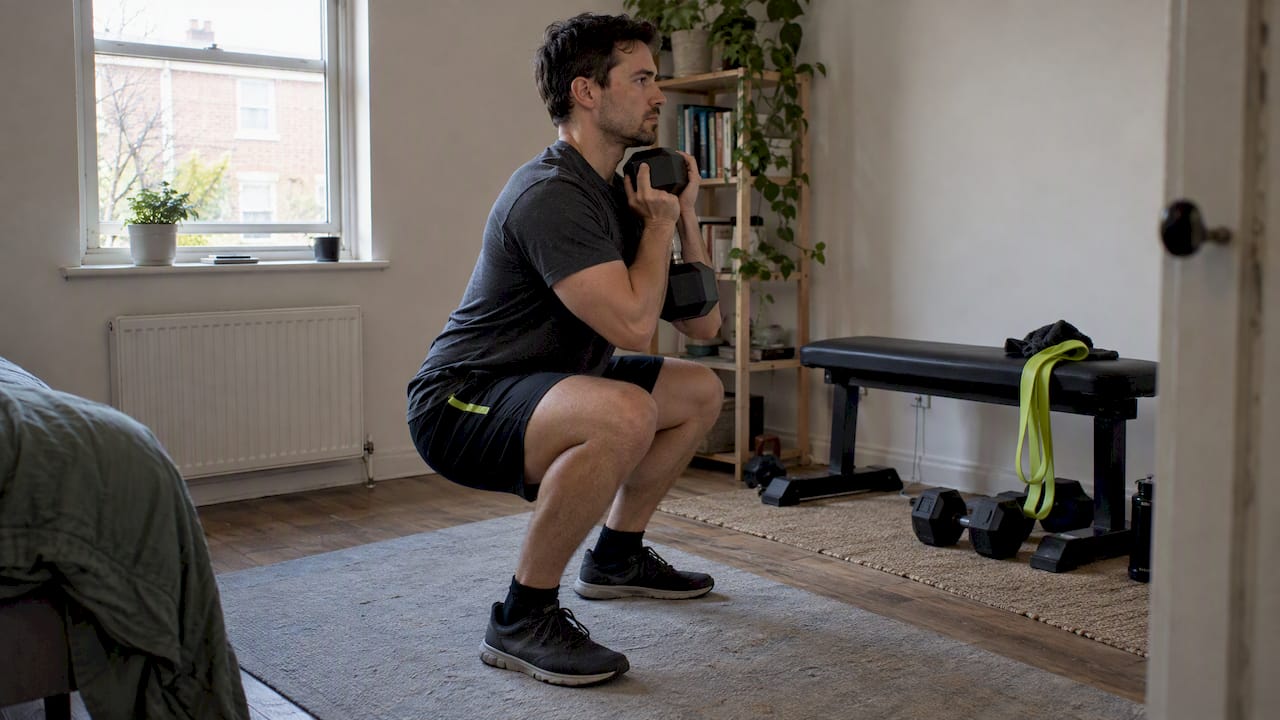
No gym membership? You can run the same pattern with a pair of dumbbells, a bench and a band. Our guides to bodyweight exercises by muscle group, resistance band exercises and gym machine exercises list substitutions for each pattern: a squat, a hip hinge, a push, a pull and a trunk exercise. If your schedule only allows two days, see how twice-weekly training with limited equipment works. Two days still meets the ACSM minimum.
How to find your starting weights
Most beginners either start too light and drift, or start too heavy and grind. A simple method fixes both.
- Warm up with the empty bar or a light dumbbell for a few easy reps so the movement feels smooth.
- Pick a weight you think you could lift about 12 times. Do 8 to 10 reps.
- Count what is left. If you could have done 2 to 3 more clean reps, the load is right. If you could have done 5 or more, add weight next set. If the last rep was a struggle, drop weight.
- Write it down. That number is your starting weight for that exercise.
A load in the range of 8 to 12 repetition maximum is the evidence-based starting point for novices in the ACSM progression models, so your first sets should feel moderate rather than heroic.
What reps in reserve means
Reps in reserve, or RIR, is the number of clean reps you could still have done when you stopped a set. An RIR of 2 means two more reps were possible. It is a judgment call, and beginners usually underestimate how many reps they have left, so your first two weeks are partly about calibrating that sense. Do not worry if you are off by one or two.
Why not simply train to failure? A meta-regression of proximity to failure found only modest model fit, and for strength the confidence intervals for estimated RIR contained zero, so the data do not show that grinding every set to failure is required. Stopping short of failure also lets you do your next session in better shape. That is a reasonable default for your first two months, not a universal law.
The progression rule: when to add weight
Add load on an exercise when you can perform one to two repetitions over your target in two consecutive sessions. ACSM's progression models suggest a 2 to 10 percent increase at that point.
Here is how it looks on the goblet squat with a target of 8 to 10 reps:
| Session | Weight | Reps in set 1 to 3 | What you do |
|---|---|---|---|
| 1 | 30 lb | 8, 8, 8 | Stay at 30 lb |
| 2 | 30 lb | 10, 9, 9 | Stay at 30 lb, close |
| 3 | 30 lb | 10, 10, 10 | Hit the top of the range once |
| 4 | 30 lb | 10, 10, 10 | Second time: go up next session |
| 5 | 35 lb | 8, 8, 7 | Start the climb again |
With dumbbells, the smallest jump may be 5 pounds, which is more than 10 percent on a light weight. That is fine on a 30 pound squat but too big for a 10 pound overhead press. In that case, add reps first, or use smaller plates or a lighter pair.
Reps count as progress too
Progress does not always mean a heavier bar. A trial comparing load progression with repetition progression looked at whether adding reps at a fixed load can produce adaptations, and the idea is a useful one for small-increment lifts like presses and lateral movements. If you did 8, 8, 7 last week and 9, 8, 8 this week, you progressed. For a wider look at the principle, our piece on the part every progressive overload plan skips goes deeper.
Weeks 1 to 8: what changes and what does not
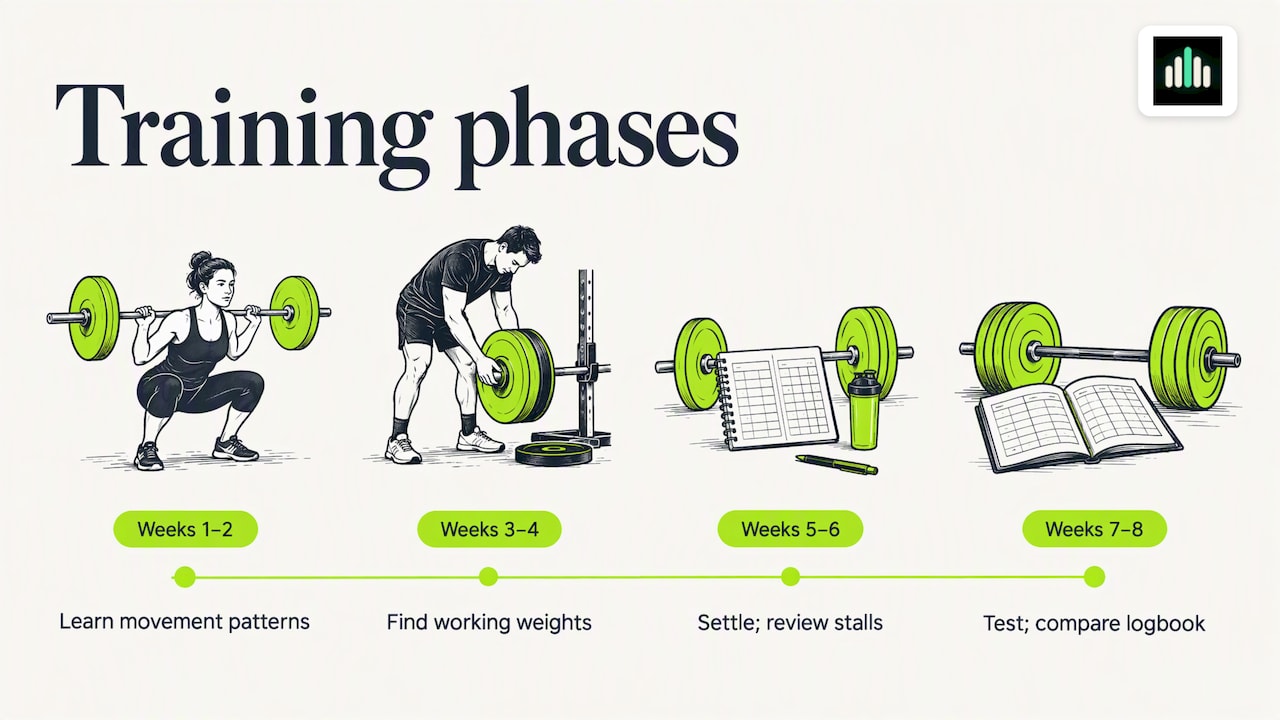
Weeks 1 and 2: learn the patterns. Use lighter loads than you think you need and aim for 3 reps in reserve. Film one set of each lift from the side if you can. Your only goal is smooth, repeatable reps.
Weeks 3 and 4: find the working weights. By now you know the movements. Apply the progression rule and expect to add load on most lifts within two weeks.
Weeks 5 and 6: settle into the range. Progress slows on some lifts, and that is normal. Lifts that stall for two sessions should be checked for sleep, food and technique before you change anything.
Weeks 7 and 8: test and review. Do your regular sessions, then compare your logbook to week 1. Note the weight and reps on every lift. Next, choose what to run for the following block: the same plan with heavier loads, or a move to something with more variety. Our newbie gains article helps you judge whether your beginner progress has actually ended, which is rarer at eight weeks than most people assume.
What does not change: the exercises, the days of the week and the rep ranges. Keeping them stable is what makes the numbers in your log comparable.
Do you need heavier loads for strength?
It depends on your goal. The 2026 ACSM summary says that for strength specifically, loads around 80 percent of one-rep max for 2 to 3 sets per exercise are the most effective approach, while muscle size is better served by roughly 10 sets per muscle group per week. A true beginner rarely needs to test a one-rep max, so use the 8 to 12 rep starting point and let the loads climb naturally. After a couple of months, you can shift one or two lifts to lower reps, such as 5 to 6, if strength is your priority. Our note on rep ranges for muscle growth explains why a range matters more than any single number.
What beginners can safely ignore
- Drop sets and myo-reps. These are advanced tools. They add fatigue without adding much for someone whose first six months of gains come from simply practicing basic lifts.
- Complex periodization. The ACSM message is that periodized schemes and training to absolute failure do not consistently add benefit over plain, sustainable progression for the average healthy adult.
- Many exercises per session. Four is plenty. Extra movements dilute your attention and push the session past an hour.
- Perfect nutrition before you start. Eat enough protein and enough food overall, but do not delay your first workout until a meal plan is ready.
If you have a history of low bone density, joint injury or a medical condition, talk to your physician or a physical therapist before you add load. Some people with osteopenia or osteoporosis look for supervised loading programs, and facilities that specialize in bone-density loading sessions are one option to ask about alongside your doctor.
Our view on beginner programs
We see the same pattern in beginner training over and over: the plan is fine, but nobody can tell whether it is working. The lifter remembers feeling strong on Tuesday and weak on Friday, and with no record there is nothing to correct.
That is why we built RIRLift around set-by-set logging of weight, reps and reps in reserve, with no social feed. Our AI Coach reads that log and recommends the next load. For a beginner, the value is not novelty. It is that the progression rule above gets applied the same way every session, including the sessions where you feel tired and would otherwise guess.
We also think beginners are over-served with options. A good first program is dull on purpose: the same few lifts, the same days, small weekly increments. Excitement can wait until your logbook shows you have outgrown it.
— Guilherme
Tracking the program on your phone
A paper notebook works. If you prefer to have the logging and next-load suggestions handled for you, RIRLift is a free iPhone and Apple Watch app for logging every set, and the Pro plan, at 9.99 USD per month or 79.99 USD per year, unlocks advanced coaching, analytics and unlimited routines. Coach can then suggest the next load from what you actually lifted. If you want to pick sets, reps and loads for the gear you own first, try the Session Builder.
If you want more starter options after this plan, see our three simple beginner workouts and three full-body plans.
FAQ
How many days a week should a beginner lift?
Two to three days. The ACSM position stand sets a floor of at least two days per week for all major muscle groups. Three full-body days gives you more practice with each lift, while two days is enough to make real progress if that is what your schedule allows.
Is a novice linear progression the same as this plan?
Not quite. A classic novice linear progression adds a fixed amount of weight every session for as long as you can, usually on low-rep sets. This plan uses moderate reps and adds load only after you hit the top of your rep range twice, which is gentler on joints and easier to sustain for lifters who are new to training. Both rest on the same idea of small, regular increases.
How long until I see results?
You will likely notice that the same weights feel easier within a few weeks, because much of the early change in the first 6 to 12 weeks is neurological. Visible muscle changes take longer. Track your lifts rather than the mirror in the first two months.
Do I need to train to failure to get stronger?
No. Research on proximity to failure does not show that failure is required for strength gains, and stopping with 2 to 3 reps in reserve leaves you fresher for the next session. Failure can be used occasionally later, once your technique is solid.
What should I do after eight weeks?
Review your log. If you are still adding weight or reps on most lifts, keep running the plan. If most lifts have stalled for several weeks despite good sleep and food, it is time to add variety or another training day.
Sources
- ACSM publishes updated resistance training guidelines
- ACSM Position Stand: Progression models in resistance training for healthy adults (PubMed)
- Progressive overload without progressing load? (PubMed)
- Proximity to failure, strength gain and hypertrophy: meta-regressions (PubMed)
- Minimalist training: lower dosage or intensity resistance training (PubMed)
- Somatic tracking, Mercy Chiropractic Palm Bay
- Osteogenic loading at home, Bone Health Sacramento