Back exercises for strength: deadlifts, rows and pull-ups that build a strong back

The best back exercises for strength are the deadlift, rack pull, barbell and Pendlay rows, pull-ups and chin-ups, with one-arm dumbbell rows, chest-supported rows, lat pulldowns and back extensions filling in. A strong back needs three things each week: one heavy pull from the floor, one row and one vertical pull. Do the deadlift or rack pull for 3 to 5 reps, rows and pull-ups for 5 to 10, and back extensions for 10 to 15, stopping 1 to 3 reps short of failure, across two sessions a week.

  1. Barbell Deadlift Glutes, Lower Back
  2. Pull-Up Lats
  3. Barbell Row Upper Back, Lats
  4. Pendlay Row Upper Back, Lats
  5. One-Arm Dumbbell Row Lats, Upper Back
  6. Lat Pulldown Lats
  7. Rack Pull Glutes, Lower Back, Traps
Heavy pulls from the floor

Deadlifts train the spinal erectors, traps and lats to hold your back rigid under the heaviest loads you will ever lift. One full deadlift a week is enough; on a second day, the rack pull trains the top half of the lift without the strain of another pull from the floor.

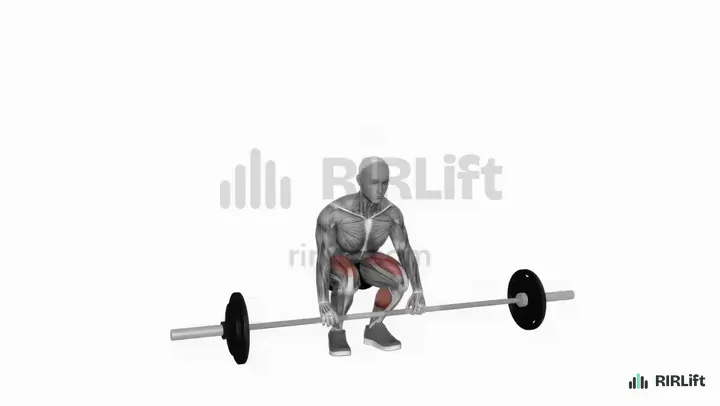
Whole back and hips, deadlift

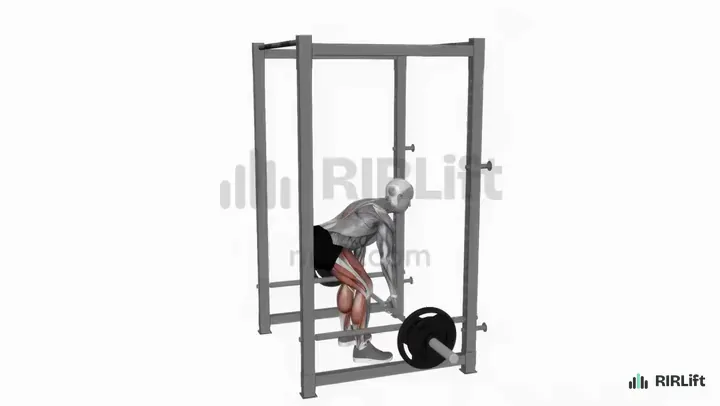
Barbell Deadlift

Glutes, Lower Back

The deadlift makes every muscle along your spine hold position under a load that can reach two or three times your body weight. It is the best single measure of back strength and the lift to build the rest of a back program around.

How to do it

  1. Stand with the bar over your mid-foot and grip it just outside your legs.
  2. Drop your hips until your shins touch the bar, flatten your back, and pull the slack out.
  3. Push the floor away and stand up tall, then lower the bar the same way.

Cues

  • Bar against the legs
  • Push the floor away

Common mistakes

  • Jerking the bar off the floor: take the slack out first on every set.

Swap for: Trap Bar Deadlift, Romanian Deadlift, Rack Pull

Upper back and traps, partial deadlift

Rack Pull

Glutes, Lower Back, Traps
Pulling from knee height lets you hold more than your full deadlift, so the traps and upper back get trained harder than they ever are from the floor. Use it on a second pulling day so the full deadlift stays fresh.

How to do it

  1. Set the bar on rack pins or blocks just below your knees.
  2. Stand close with your feet under your hips and grip the bar overhand just outside your thighs.
  3. Hinge until your back is flat and your shoulders are slightly in front of the bar.
  4. Drive your hips forward and stand up, pulling your shoulders back at the top, then lower the bar to the pins under control.

Cues

  • Shoulders ahead of the bar
  • Finish tall, shoulders back
  • Set it down, do not drop it

Common mistakes

  • Turning the top of each rep into a lean back: stand straight and let your traps hold the weight.
  • Loading so heavy the bar bends off the pins every rep: keep it to weights you can pull smoothly for the full set.

Swap for: Barbell Deadlift, Snatch-Grip Deadlift, Barbell Shrug

Rows for upper and mid-back

Rows build the thickness of the upper back and the strength to hold your shoulder blades in place under a bar. Use a barbell row for heavy sets and a supported row when your lower back is already tired.

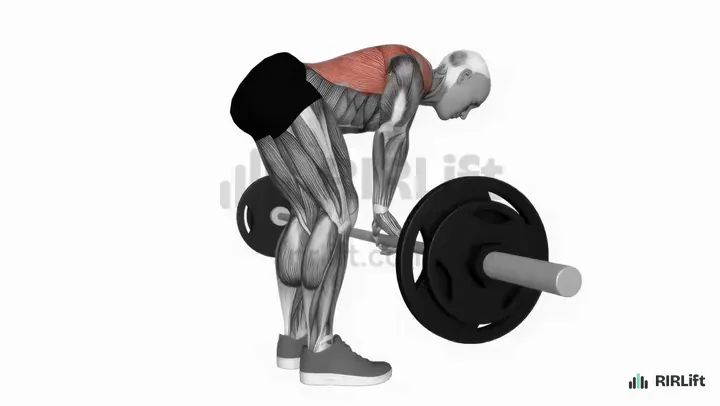
Upper back and lats, row

Barbell Row

Upper Back, Lats

The bent-over row is the heaviest row most people can do, and holding the hinge position makes your lower back work too. Sets of 5 to 8 build the mid-back strength that keeps your bench and deadlift solid.

How to do it

  1. Hold the bar at your thighs, hinge forward until your torso is near 45 degrees, back flat.
  2. Row the bar to your lower ribs with the elbows tucked near your sides.
  3. Lower to straight arms and keep the torso angle.

Cues

  • Brace before every rep
  • Bar to the belly button

Common mistakes

  • Standing taller each rep as it gets heavier: if the hinge goes, the set is over.

Swap for: Pendlay Row, Dumbbell Bent-Over Row, T-Bar Row

Upper back, row from the floor

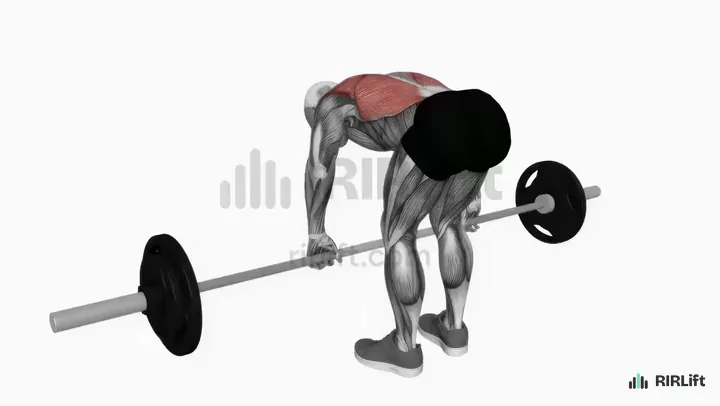
Pendlay Row

Upper Back, Lats

Every rep starts from a dead stop on the floor, so you cannot use momentum from the last one. It builds explosive pulling strength and a flat-backed hinge, and the strict start makes progress easy to compare week to week.

How to do it

  1. Set the bar on the floor over your mid foot and hinge down until your torso is nearly flat, knees bent enough to reach the bar.
  2. Grip a little outside shoulder width with your arms straight and shoulders above the bar.
  3. Pull the bar fast from the floor to your upper belly without lifting your chest.
  4. Lower it back to the floor, let it settle for a moment, reset your brace and pull again.

Cues

  • Torso stays flat
  • Explode off the floor
  • Dead stop every rep

Common mistakes

  • Raising your chest to meet the bar: your torso should stay put while only the bar moves.
  • Letting the bar crash down: lower it under control so it lands where it started and the next rep starts from the same spot.

Swap for: Barbell Row, Seal Row, Meadows Row

Lats and upper back, one-arm row

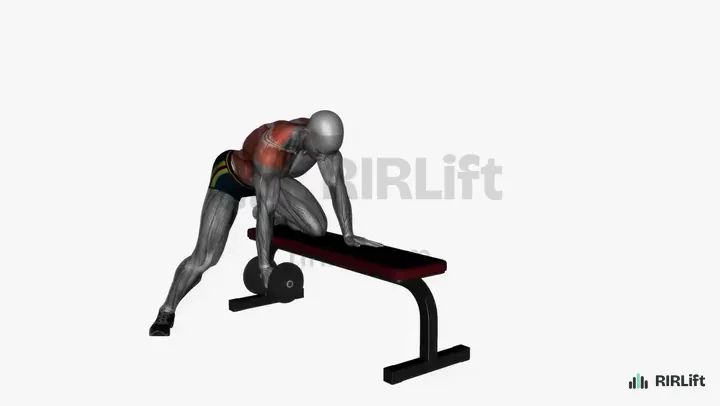
One-Arm Dumbbell Row

Lats, Upper Back

With one hand on a bench, your lower back gets a rest while the working side pulls heavy through a long range. It is the best row with just dumbbells, and it shows if one side of your back is weaker.

How to do it

  1. Put one hand and the same-side knee on a bench, or your hand on a chair seat with both feet on the floor, so your back is flat.
  2. Hold a dumbbell in the other hand with your arm hanging straight.
  3. Pull your elbow back toward your hip until the dumbbell reaches your ribs.
  4. Lower it until your arm is straight again, finish all reps, then switch sides.

Cues

  • Elbow to your hip
  • Back flat as a table
  • Full stretch at the bottom

Common mistakes

  • Twisting your chest open to lift the dumbbell higher: keep both shoulders level.
  • Shrugging the shoulder up toward your ear: pull the elbow back, not the shoulder up.

Swap for: Band Bent-Over Row, Dumbbell Bent-Over Row, Seated Cable Row

Upper back, machine row

Chest-Supported Row

Upper Back, Lats

With your chest on the pad, there is no hinge to hold, so all the effort goes into the upper back. It is the row to choose on the day after deadlifts or when your lower back limits barbell rows.

How to do it

  1. Set the seat so the handles are at chest height and rest your chest on the pad.
  2. Pull the handles back until your elbows pass your torso.
  3. Let the handles return until your arms are straight and your shoulders reach forward.

Cues

  • Chest stays on the pad
  • Squeeze, then reach

Common mistakes

  • Lifting your chest off the pad to move more weight: the pad is there so your back can rest.

Swap for: Machine Row, Seated Cable Row, Incline Dumbbell Row

Mid-back and lats, cable row

Seated Cable Row

Upper Back, Lats

The cable keeps tension on the back through the whole pull and lets you change the weight in seconds. Use it for sets of 8 to 12 after your heavy rows.

How to do it

  1. Sit at the cable row with your feet on the platform and knees slightly bent, holding a close-grip handle with your arms straight.
  2. Sit tall with your chest up and let the cable pull your shoulder blades forward a little.
  3. Row the handle to your lower ribs, driving your elbows back past your torso.
  4. Return it under control until your arms are straight and your shoulders reach forward, then repeat.

Cues

  • Sit tall, no rocking
  • Handle to the belly button
  • Shoulders reach at the front

Common mistakes

  • Rocking back and forth to move the stack: your torso should stay close to upright throughout.
  • Shrugging the handle up toward your neck: pull your shoulders down before the elbows bend.

Swap for: Chest-Supported Row, Single-Arm Cable Row, Barbell Row

Pull-ups and pulldowns

Pulling from overhead trains the lats, the widest muscles of the back. Add weight to pull-ups once you get 10 clean reps; until then, the pulldown lets you train the same pattern with a load you can choose.

Lats, vertical pull

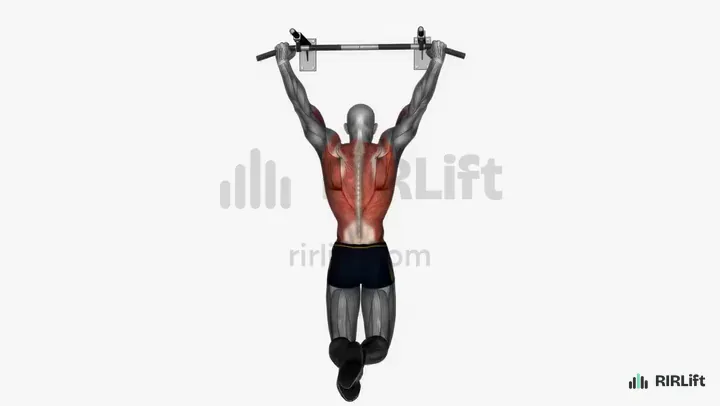
Pull-Up

Lats

The pull-up moves your whole body, which makes it a strength test in itself. Once you get 10 clean reps, hang weight from a belt and train it in the 4 to 8 range like any other heavy lift.

How to do it

  1. Grab the bar overhand, hands a little wider than your shoulders, and hang from fully straight arms.
  2. Pull your shoulders down away from your ears before your elbows start to bend.
  3. Drive the elbows toward your ribs until your chin passes over the bar.
  4. Lower slowly to a dead hang and pull again.

Cues

  • Shoulders down, then pull
  • Legs still and together
  • Two seconds on the way down

Common mistakes

  • Swinging the legs to cheat reps: cross your ankles and brace the abs.
  • Half reps from a bent-arm start: finish each rep at a full hang.

Swap for: Chin-Up, Neutral-Grip Pull-Up, Lat Pulldown

Lats and biceps, underhand pull-up

Chin-Up

Lats

The underhand grip brings the biceps in, so most people get a few more reps than on pull-ups. It is a good second vertical pull in the week, and often the first one beginners can do.

How to do it

  1. Hang from the bar with your palms toward you and hands shoulder-width.
  2. Pull your elbows down and back until your chin is over the bar.
  3. Lower to a full hang with straight arms.
  4. Keep your legs quiet and your body still between reps.

Cues

  • Palms toward you
  • Chin over the bar
  • Dead hang at the bottom

Common mistakes

  • Kipping or kicking to finish: stop the set when you cannot pull cleanly.
  • Half reps at the top: straighten your arms fully every time.

Swap for: Close-Grip Chin-Up, Assisted Pull-Up

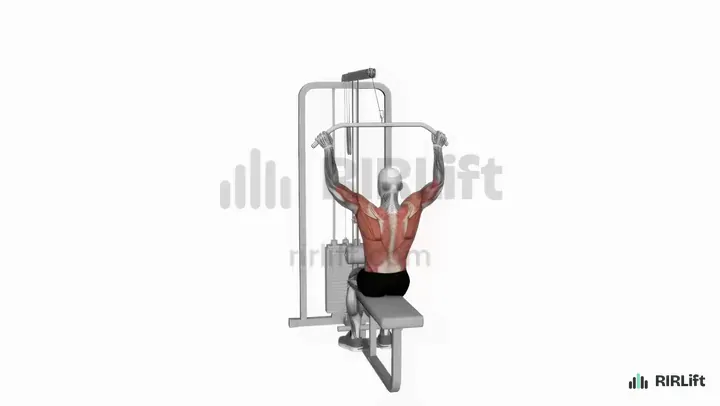
Lats, cable pulldown

Lat Pulldown

Lats

The pulldown trains the pull-up pattern with any load from very light to heavier than body weight. It is the main vertical pull until you can do pull-ups, and a volume lift after them.

How to do it

  1. Set the thigh pad so your legs are locked under it, then stand up and take the bar a little wider than your shoulders, palms forward.
  2. Sit down with your arms fully stretched overhead and lean back only slightly.
  3. Pull the bar to your upper chest by driving your elbows down toward your hips.
  4. Let the bar rise until your arms are straight and your shoulders lift toward your ears, then pull again.

Cues

  • Elbows to your back pockets
  • Bar to the top of the chest
  • Let the stack lift you at the top

Common mistakes

  • Leaning far back and rowing the bar to your stomach: stay nearly upright so it remains a vertical pull.
  • Stopping with the arms still bent at the top: the stretch overhead is half of what makes the pulldown work.

Swap for: Neutral-Grip Lat Pulldown, Single-Arm Lat Pulldown, Assisted Pull-Up

Lower back extensions

Back extensions load the spinal erectors directly with light weight and higher reps, building the endurance to hold position through long sets of squats and rows.

Lower back, floor extension

Back Extension

Lower Back

Lifting your chest off the floor works the spinal erectors with nothing but body weight. It is a simple lower-back exercise for home, and a light finisher on heavy deadlift days.

How to do it

  1. Lie face down with your hands behind your head and elbows out.
  2. Squeeze your glutes and lift your chest off the floor while your legs stay down.
  3. Lower slowly back to the floor.

Cues

  • Lift the chest, not the chin
  • Legs stay heavy

Common mistakes

  • Jerking up fast: lift and lower at the same steady speed.

Swap for: Superman, 45-Degree Back Extension, Band Good Morning

Lower back and glutes, bench extension

45-Degree Back Extension

Glutes, Hamstrings

On the 45-degree bench you move through a much longer range than on the floor, and you can hold a plate to your chest to add load. It builds lower-back endurance without the fatigue of another heavy hinge.

How to do it

  1. Set the pad so it sits just below your hip bones, then hook your heels under the foot rollers.
  2. Fold your arms over your chest and stand straight in line with the bench.
  3. Bend forward at the hips until you feel a stretch in your hamstrings.
  4. Lift your torso back to a straight line with your legs, squeezing your glutes, and stop there.

Cues

  • Hinge at the hips
  • Stop at a straight line
  • Squeeze your glutes at the top

Common mistakes

  • Arching back past a straight line at the top: the rep ends when your body is straight.
  • Setting the pad too high so it blocks your hips: you should be able to fold freely over it.

Swap for: Back Extension, Superman, Weighted Back Extension

Put them together: example sessions

Each session below picks from the exercises above for one situation, with the sets, reps, rest and RIR filled in.

Session 1

Barbell gym, deadlift and row heavy

  • Workouts2× a week
  • Working sets27 a week
  • Per workout~45 min
  • EquipmentBarbells, Pull-Up Bar, Dumbbells, Hyperextension +1

You have a barbell, rack, pull-up bar and cable station, and want your deadlift and rows to keep climbing.

Each day has one heavy hinge, one row and one vertical pull, so every part of the back is trained hard twice a week. Day 1 has 13 sets and Day 2 has 14, 27 back sets for the week, with the deadlift kept to one heavy session.

Day 1: Deadlift
ExerciseSets × repsRIRRest
Barbell Deadlift3 warm-up sets first 4 × 3–5 2 3:30 min
Pull-UpAdd weight once you reach 8 reps. 4 × 4–8 2 2:30 min
One-Arm Dumbbell RowPer arm. 3 × 8–10 1 90 s
45-Degree Back Extension 2 × 10–15 2 90 s
Day 2: Rows
ExerciseSets × repsRIRRest
Pendlay Row2 warm-up sets first 4 × 5–6 2 2:30 min
Rack Pull1 warm-up set first 3 × 3–5 2 3 min
Chin-Up 4 × 5–8 2 2 min
Seated Cable Row 3 × 8–12 1 90 s
How to run it
Put Day 1 early in the week and Day 2 at least three days later. Squat on a separate day, or before Day 2's rows, not before Day 1's deadlift.
How to progress
When every set of the deadlift, rack pull or Pendlay row reaches the top of the range at the target reps in reserve, add 5 to 10 pounds. For pull-ups and chin-ups, add reps until you hit the top, then add 5 pounds on a belt.

Session 2

Gym, cannot do a pull-up yet

  • Workouts2× a week
  • Working sets22 a week
  • Per workout~25 min
  • EquipmentLat Pulldown, Seated Row Machine, Hyperextension, Cable Row +1

You train in a gym with machines and cables and want a stronger back, but pull-ups are not there yet.

Machines and cables let you load the back hard while you build up to your body weight. Each day has 11 sets, 22 for the week, and the pulldown appears in both sessions so the pull-up pattern gets practice twice.

Day A
ExerciseSets × repsRIRRest
Lat Pulldown 4 × 6–10 2 2 min
Chest-Supported Row 4 × 8–12 2 90 s
45-Degree Back Extension 3 × 10–15 2 90 s
Day B
ExerciseSets × repsRIRRest
Seated Cable Row 4 × 6–10 2 2 min
Lat Pulldown 3 × 8–12 1 90 s
One-Arm Dumbbell RowPer arm. 2 × 8–12 1 90 s
Back Extension 2 × 12–15 2 1 min
How to run it
Two days a week with at least two days between. Every few weeks, test how many pull-ups you can do at the start of a session; once you can do 3, replace the first pulldown with 3 sets of pull-ups.
How to progress
Add reps until every set reaches the top of its range at 2 reps in reserve, then go up one plate on the stack. A pulldown of about your body weight for 8 reps usually means a pull-up is close.

Session 3

Home with a pull-up bar and dumbbells

  • Workouts2× a week
  • Working sets22 a week
  • Per workout~30 min
  • EquipmentPull-Up Bar, Dumbbells, Hyperextension

You train at home with a doorway or wall-mounted bar, a set of dumbbells and a bench or sturdy chair.

With no barbell, the pull-up and heavy one-arm rows carry the strength work, and floor back extensions train the lower back. Each day has 11 sets, 22 for the week.

Day 1: Pull-ups
ExerciseSets × repsRIRRest
Pull-Up 4 × 3–8 2 2:30 min
One-Arm Dumbbell RowPer arm. 4 × 6–10 2 90 s
Back Extension 3 × 10–15 2 1 min
Day 2: Chin-ups
ExerciseSets × repsRIRRest
Chin-Up 4 × 3–8 2 2:30 min
One-Arm Dumbbell RowPer arm. 4 × 10–12 1 90 s
Back Extension 3 × 12–20 2 1 min
How to run it
Two days a week, three days apart. If you cannot do the minimum reps on pull-ups yet, do slow 5-second lowering reps from the top for the same number of sets.
How to progress
Add a rep a week until every set reaches the top of the range, then add load: a backpack with books for pull-ups and chin-ups, the next dumbbell for rows, and a 2-second pause at the top of each back extension.

Make it fit you

Questions

How do I train my back for strength?

Twice a week, do one heavy hinge like the deadlift for 3 to 5 reps, one heavy row for 5 to 8, and one vertical pull for 4 to 10. Stop each set 1 to 3 reps short of failure and add weight when you reach the top of the rep range.

What are the big 3 exercises for back?

The deadlift, the barbell row and the pull-up. Between them they train the lower back, the upper and mid-back, and the lats, the three areas a back program has to cover.

What is the #1 back exercise?

For strength, the deadlift, because it loads the whole back with more weight than any other lift. If you only have a bar at home, the pull-up is the best single back exercise.

How many sets per week do I need for back strength?

Most lifters progress on 12 to 25 hard sets a week for the back, split over two sessions. Beginners can start at the low end; if you are stalling and recovering well, add a few sets.

Should I do lower back exercises if I deadlift?

Heavy deadlifts already load the lower back a lot. One or two light sets of back extensions are enough on top, mostly for endurance.