Compound back exercises: deadlifts, rows and pull-ups

The best compound back exercises are the deadlift and rack pull for the whole back, the barbell row, Pendlay row, T-bar row and one-arm dumbbell row for thickness, and pull-ups, chin-ups and the lat pulldown for width. A complete back workout uses one vertical pull, two rows and, once a week, a deadlift, for 12 to 16 hard sets. Heavy rows and deadlifts go first at 4 to 8 reps; cable and machine rows take 8 to 15, ending each set with 1 or 2 good reps left.

  1. Barbell Deadlift Glutes, Lower Back
  2. Pull-Up Lats
  3. Barbell Row Upper Back, Lats
  4. T-Bar Row Upper Back, Lats
  5. One-Arm Dumbbell Row Lats, Upper Back
  6. Lat Pulldown Lats
  7. Chest-Supported Row Upper Back, Lats
  8. Chin-Up Lats

Deadlifts for the whole back

Deadlifts load the spinal erectors, traps and lats isometrically while the hips move a heavy weight. Once a week is enough; they cost a lot to recover from.

Erectors, traps and lats, full-body pull

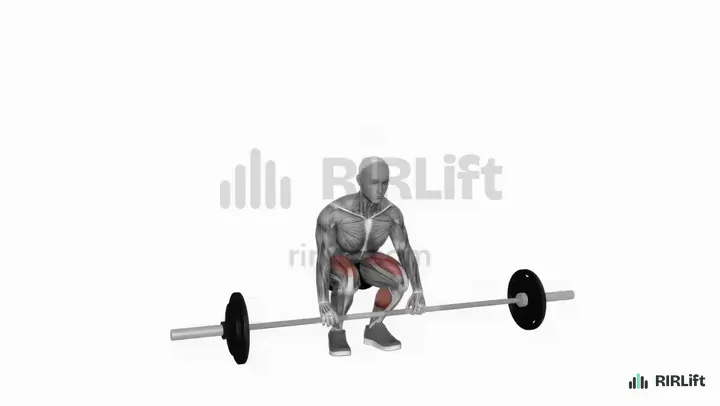
Barbell Deadlift

Glutes, Lower Back

No other lift loads the back muscles with as much weight. Holding a flat back against a heavy bar builds the erectors and traps, and the lats keep the bar close.

How to do it

  1. Stand with the bar over your mid-foot and grip it just outside your legs.
  2. Drop your hips until your shins touch the bar, flatten your back, and pull the slack out.
  3. Push the floor away and stand up tall, then lower the bar the same way.

Cues

  • Bar against the legs
  • Push the floor away

Common mistakes

  • Jerking the bar off the floor: take the slack out first on every set.

Swap for: Trap Bar Deadlift, Romanian Deadlift, Rack Pull

Upper back and traps, partial deadlift

Rack Pull

Glutes, Lower Back, Traps

Starting the pull from knee height lets you hold more weight than a full deadlift, so the traps and upper back work hard with less leg drive. Use it for back thickness, not as a deadlift test.

How to do it

  1. Set the bar on rack pins or blocks just below your knees.
  2. Stand close with your feet under your hips and grip the bar overhand just outside your thighs.
  3. Hinge until your back is flat and your shoulders are slightly in front of the bar.
  4. Drive your hips forward and stand up, pulling your shoulders back at the top, then lower the bar to the pins under control.

Cues

  • Shoulders ahead of the bar
  • Finish tall, shoulders back
  • Set it down, do not drop it

Common mistakes

  • Turning the top of each rep into a lean back: stand straight and let your traps hold the weight.
  • Loading so heavy the bar bends off the pins every rep: keep it to weights you can pull smoothly for the full set.

Swap for: Barbell Deadlift, Snatch-Grip Deadlift, Barbell Shrug

Heavy free-weight rows for thickness

Bent-over rows pull toward the torso and build the mid and upper back. Pick one barbell row as your heavy back lift, and use the one-arm row to train each side alone.

Mid back and lats, bent-over barbell row

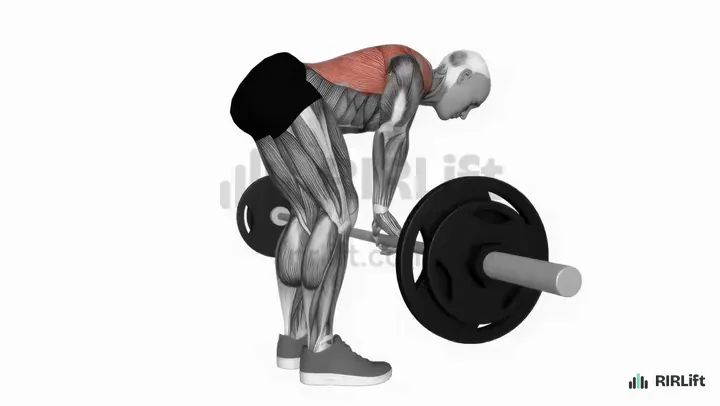
Barbell Row

Upper Back, Lats

The bent-over row is the main thickness builder: heavy, two-handed, with the torso held still. It should be your heaviest row of the week.

How to do it

  1. Hold the bar at your thighs, hinge forward until your torso is near 45 degrees, back flat.
  2. Row the bar to your lower ribs with the elbows tucked near your sides.
  3. Lower to straight arms and keep the torso angle.

Cues

  • Brace before every rep
  • Bar to the belly button

Common mistakes

  • Standing taller each rep as it gets heavier: if the hinge goes, the set is over.

Swap for: Pendlay Row, Dumbbell Bent-Over Row, T-Bar Row

Upper back, row from the floor

Pendlay Row

Upper Back, Lats

Each rep starts dead on the floor, so there is no momentum and the upper back has to produce force from a stop. It suits strength-focused back days.

How to do it

  1. Set the bar on the floor over your mid foot and hinge down until your torso is nearly flat, knees bent enough to reach the bar.
  2. Grip a little outside shoulder width with your arms straight and shoulders above the bar.
  3. Pull the bar fast from the floor to your upper belly without lifting your chest.
  4. Lower it back to the floor, let it settle for a moment, reset your brace and pull again.

Cues

  • Torso stays flat
  • Explode off the floor
  • Dead stop every rep

Common mistakes

  • Raising your chest to meet the bar: your torso should stay put while only the bar moves.
  • Letting the bar crash down: lower it under control so it lands where it started and the next rep starts from the same spot.

Swap for: Barbell Row, Seal Row, Meadows Row

Mid back, landmine row

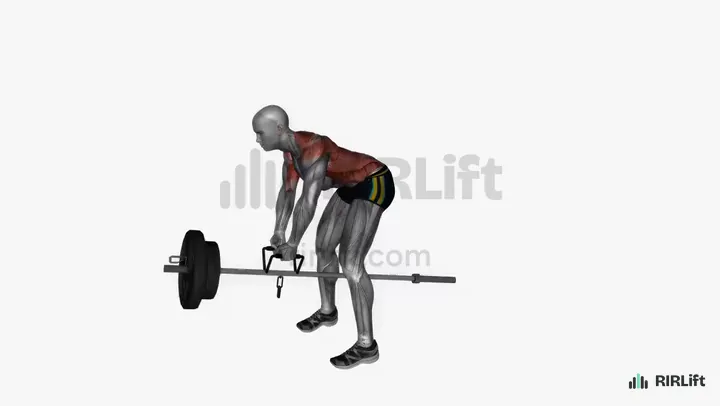
T-Bar Row

Upper Back, Lats

The landmine angle lets you row heavy with a neutral grip and your chest over the bar. Many lifters find it easier on the lower back than a barbell row.

How to do it

  1. Load the free end of a barbell sitting in a landmine and stand over the bar with your feet on either side of it.
  2. Hinge forward, put a close-grip handle under the bar near the plates and grip it with both hands, arms straight.
  3. Row the plates toward your chest, elbows tight to your torso, until they nearly touch.
  4. Lower until your arms are straight while holding your hinge, then repeat.

Cues

  • Chest up, back flat
  • Pull to the chest
  • Small plates for a longer pull

Common mistakes

  • Shrugging the weight up with your legs and back: the elbows do the pulling.
  • Big plates that hit your chest early: use 25-pound plates to get more range.

Swap for: Barbell Row, Meadows Row, Chest-Supported Row

Lats, one-arm dumbbell row

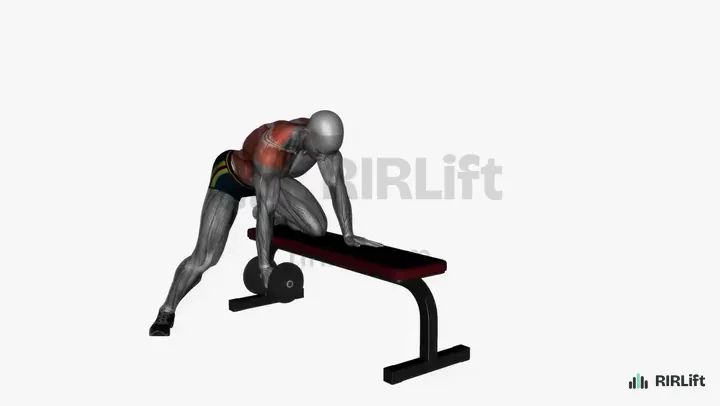
One-Arm Dumbbell Row

Lats, Upper Back

One hand on the bench supports the trunk, so you can pull a heavy dumbbell far back and even out the two sides.

How to do it

  1. Put one hand and the same-side knee on a bench, or your hand on a chair seat with both feet on the floor, so your back is flat.
  2. Hold a dumbbell in the other hand with your arm hanging straight.
  3. Pull your elbow back toward your hip until the dumbbell reaches your ribs.
  4. Lower it until your arm is straight again, finish all reps, then switch sides.

Cues

  • Elbow to your hip
  • Back flat as a table
  • Full stretch at the bottom

Common mistakes

  • Twisting your chest open to lift the dumbbell higher: keep both shoulders level.
  • Shrugging the shoulder up toward your ear: pull the elbow back, not the shoulder up.

Swap for: Band Bent-Over Row, Dumbbell Bent-Over Row, Seated Cable Row

Supported and cable rows

When the chest is on a pad or you sit braced at a cable, the lower back stops being the limit, so the upper back can be taken close to failure. These make up the volume after the heavy row.

Upper back, machine row

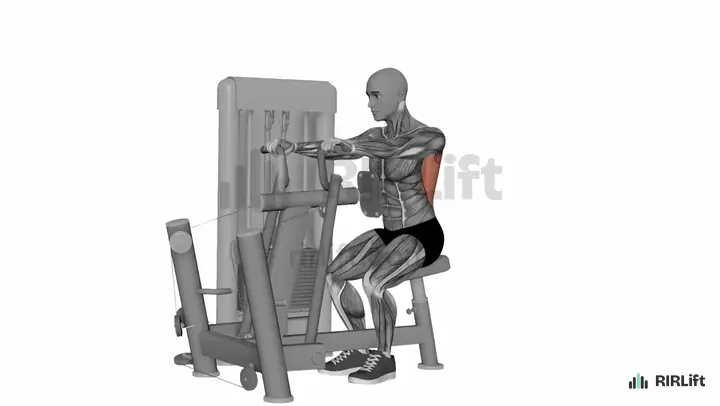
Chest-Supported Row

Upper Back, Lats

The pad takes the lower back out, so this is the row to push close to failure for back size without adding fatigue to deadlifts and squats.

How to do it

  1. Set the seat so the handles are at chest height and rest your chest on the pad.
  2. Pull the handles back until your elbows pass your torso.
  3. Let the handles return until your arms are straight and your shoulders reach forward.

Cues

  • Chest stays on the pad
  • Squeeze, then reach

Common mistakes

  • Lifting your chest off the pad to move more weight: the pad is there so your back can rest.

Swap for: Machine Row, Seated Cable Row, Incline Dumbbell Row

Mid back, cable row

Seated Cable Row

Upper Back, Lats

Constant cable tension and a long reach forward make this a good volume row for 10 to 15 reps after the heavy work.

How to do it

  1. Sit at the cable row with your feet on the platform and knees slightly bent, holding a close-grip handle with your arms straight.
  2. Sit tall with your chest up and let the cable pull your shoulder blades forward a little.
  3. Row the handle to your lower ribs, driving your elbows back past your torso.
  4. Return it under control until your arms are straight and your shoulders reach forward, then repeat.

Cues

  • Sit tall, no rocking
  • Handle to the belly button
  • Shoulders reach at the front

Common mistakes

  • Rocking back and forth to move the stack: your torso should stay close to upright throughout.
  • Shrugging the handle up toward your neck: pull your shoulders down before the elbows bend.

Swap for: Chest-Supported Row, Single-Arm Cable Row, Barbell Row

Upper back, bodyweight row

Inverted Row

Upper Back, Lats

Rowing your body up to a bar is the compound row for home or for warming up the back. Lower the bar or raise your feet to make it harder.

How to do it

  1. Set a bar at about hip height, lie under it, and grip it with your hands a little wider than your shoulders.
  2. Straighten your body from heels to head, or bend your knees with feet flat for an easier version.
  3. Pull your chest up to the bar, leading with your elbows, and keep your hips in line.
  4. Lower until your arms are straight, then pull again.

Cues

  • Body stays a straight plank
  • Chest touches the bar
  • Bend your knees to make it easier

Common mistakes

  • Letting your hips sag so only your chest rises: squeeze your glutes and move as one piece.
  • Pulling the bar to your neck: aim for the bottom of your chest.

Swap for: TRX Row, Seated Cable Row, One-Arm Dumbbell Row

Vertical pulls for width

Pulling from overhead trains the lats through their full length, which is what makes the back look wider from the front. Do at least one every back session.

Lats, overhand bodyweight pull

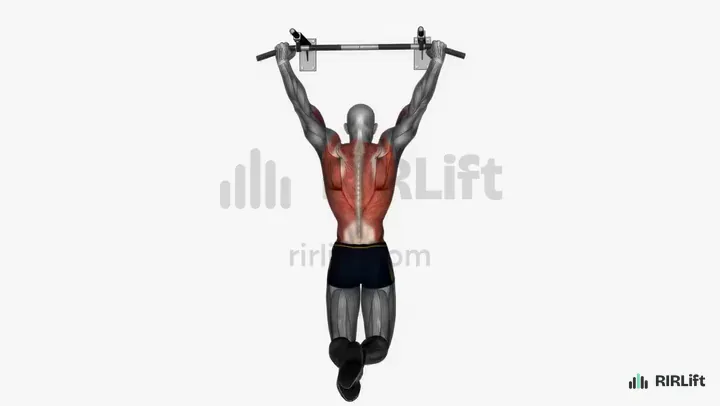
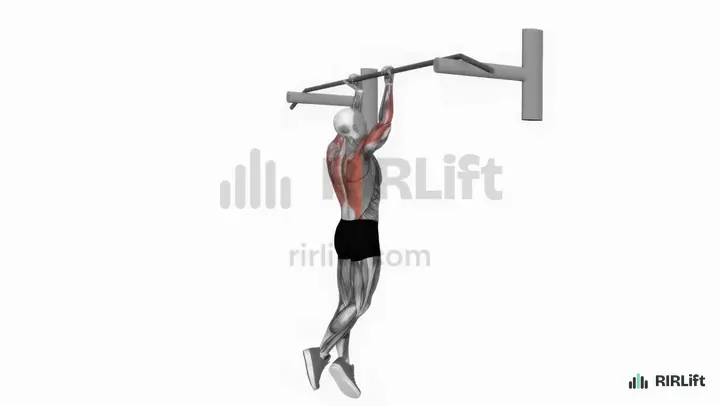
Pull-Up

Lats

The pull-up is the hardest vertical pull and builds width, grip and the biceps at once. When you reach 10 strict reps, add a weight belt.

How to do it

  1. Grab the bar overhand, hands a little wider than your shoulders, and hang from fully straight arms.
  2. Pull your shoulders down away from your ears before your elbows start to bend.
  3. Drive the elbows toward your ribs until your chin passes over the bar.
  4. Lower slowly to a dead hang and pull again.

Cues

  • Shoulders down, then pull
  • Legs still and together
  • Two seconds on the way down

Common mistakes

  • Swinging the legs to cheat reps: cross your ankles and brace the abs.
  • Half reps from a bent-arm start: finish each rep at a full hang.

Swap for: Chin-Up, Lat Pulldown, Assisted Pull-Up

Lats and biceps, underhand pull

Chin-Up

Lats

The underhand grip lets the biceps help, so you get more reps and can load it heavier than a pull-up. A good second vertical pull in the week.

How to do it

  1. Hang from the bar with your palms toward you and hands shoulder-width.
  2. Pull your elbows down and back until your chin is over the bar.
  3. Lower to a full hang with straight arms.
  4. Keep your legs quiet and your body still between reps.

Cues

  • Palms toward you
  • Chin over the bar
  • Dead hang at the bottom

Common mistakes

  • Kipping or kicking to finish: stop the set when you cannot pull cleanly.
  • Half reps at the top: straighten your arms fully every time.

Swap for: Close-Grip Chin-Up, Assisted Pull-Up

Lats, cable pulldown

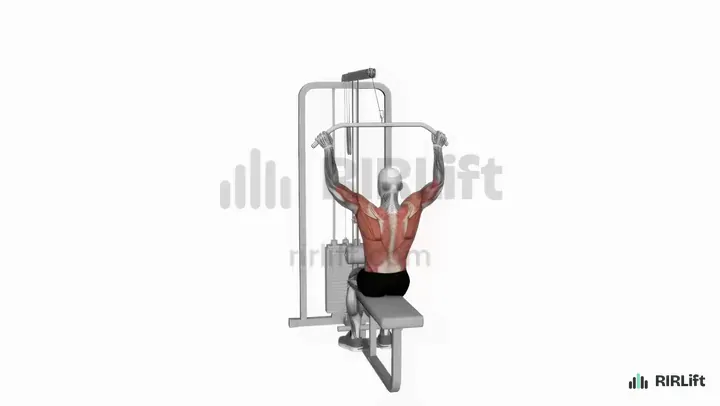
Lat Pulldown

Lats

The pulldown lets you pick the exact load for 8 to 15 reps, a range where the lats can be pushed close to failure without your grip or lower back giving out first. It is also the way to build up to pull-ups.

How to do it

  1. Set the thigh pad so your legs are locked under it, then stand up and take the bar a little wider than your shoulders, palms forward.
  2. Sit down with your arms fully stretched overhead and lean back only slightly.
  3. Pull the bar to your upper chest by driving your elbows down toward your hips.
  4. Let the bar rise until your arms are straight and your shoulders lift toward your ears, then pull again.

Cues

  • Elbows to your back pockets
  • Bar to the top of the chest
  • Let the stack lift you at the top

Common mistakes

  • Leaning far back and rowing the bar to your stomach: stay nearly upright so it remains a vertical pull.
  • Stopping with the arms still bent at the top: the stretch overhead is half of what makes the pulldown work.

Swap for: Pull-Up, Neutral-Grip Lat Pulldown, Single-Arm Lat Pulldown

Put them together: example sessions

Each session below picks from the exercises above for one situation, with the sets, reps, rest and RIR filled in.

Session 1

Back day for mass, once a week

  • Workouts1× a week
  • Working sets16 a week
  • Per workout~55 min
  • EquipmentBarbells, Pull-Up Bar, Seated Row Machine, Lat Pulldown

You train each muscle once a week on a body-part or push-pull-legs split and want a wider and thicker back.

About 16 working sets: 3 deadlift sets, 6 row sets and 7 vertical pull sets. Width and thickness each get enough to grow, and the deadlift stays short so the rest of the session stays heavy.

Back day
ExerciseSets × repsRIRRest
Barbell Deadlift3 warm-up sets first 3 × 3–5 2 3:30 min
Pull-Up 4 × 6–10 2 2:30 min
Barbell Row 3 × 6–10 2 2:30 min
Chest-Supported Row 3 × 10–12 1 90 s
Lat Pulldown 3 × 10–12 1 90 s
How to run it
Put back day at least two days before or after leg day so the lower back is fresh for the deadlift. About 70 minutes.
How to progress
Double progression: when all sets reach the top of the rep range at the target reps in reserve, add the smallest jump. For pull-ups, work to 10 reps, then add 5 lb.

Session 2

Upper-lower split: heavy and volume back work

  • Workouts2× a week
  • Working sets21 a week
  • Per workout~35 min
  • EquipmentBarbells, Pull-Up Bar, Landmine, Dumbbells +2

You train four days a week on an upper-lower split and want your back strength to keep up with your bench and overhead press.

Two upper days give about 10 back sets each, 20 a week. The first day is heavy and low-rep, the second is moderate and higher-rep, so the back sees both stimuli without repeating a session.

Upper A: Heavy back
ExerciseSets × repsRIRRest
Rack Pull2 warm-up sets first 3 × 3–5 2 3 min
Pendlay Row1 warm-up set first 4 × 4–6 2 2:30 min
Chin-Up 3 × 5–8 2 2:30 min
Upper B: Volume back
ExerciseSets × repsRIRRest
T-Bar Row 3 × 8–10 2 2 min
One-Arm Dumbbell RowPer arm. 3 × 8–12 1 90 s
Lat Pulldown 3 × 8–12 1 90 s
Seated Cable Row 2 × 12–15 1 75 s
How to run it
Upper A early in the week, Upper B three or four days later. Add your presses to each day.
How to progress
On Upper A, add weight to the rack pull and Pendlay row when every set hits the top of the range at 2 reps in reserve. On Upper B, fill the rep ranges first.

Session 3

At home with a pull-up bar and dumbbells

  • Workouts2× a week
  • Working sets20 a week
  • Per workout~25 min
  • EquipmentPull-Up Bar, Dumbbells, Barbells

You train at home with a doorway or rack pull-up bar and a pair of dumbbells, no barbell.

Ten sets per session, twice a week, gives 20 back sets with just three compound exercises. Pull-ups give width, and the inverted and dumbbell rows give thickness.

Home back
ExerciseSets × repsRIRRest
Pull-Up 4 × 5–10 2 2 min
One-Arm Dumbbell RowPer arm. 3 × 8–12 1 90 s
Inverted Row 3 × 8–15 2 90 s
How to run it
Twice a week on non-consecutive days, at the start of an upper-body session.
How to progress
Add reps to pull-ups and inverted rows until every set reaches the top of the range, then make them harder: a backpack with weight, or feet raised on the inverted row. Add dumbbell weight when the rows reach 12 reps.

Make it fit you

Questions

What are the best compound back exercises?

The deadlift, barbell row, pull-up, T-bar row, one-arm dumbbell row and lat pulldown. Those cover thickness, width and the lower back.

Are 3 exercises enough for back?

Yes, if they are a vertical pull, a heavy row and a second row, done for 3 or 4 hard sets each. Twice a week, that is plenty for most people.

Is a lat pulldown a compound exercise?

Yes. The shoulder and elbow both move, and the lats, upper back and biceps all work. It is the machine version of the pull-up.

How do I sculpt my back?

Build width with a pull-up or pulldown and thickness with two rows, 12 to 20 hard sets a week over two sessions, and add weight whenever every set reaches the top of its rep range. The detail shows once your overall body fat is low enough to see it.

Which compound back exercise builds the most mass?

Heavy rows, such as the barbell or T-bar row, add the most thickness, and pull-ups and pulldowns add width. Using both is what builds a big back.

How do I build my back at home?

Pull-ups, inverted rows and one-arm dumbbell rows cover it. Add reps first, then add weight with a backpack or heavier dumbbells.

Should I do deadlifts on back day?

Do it if your leg day doesn't already have a heavy hinge. Keep it to 3 sets of low reps first in the session, so it doesn't eat into your rows.