Barbell leg exercises: squats, hinges, thrusts and split squats

The best barbell leg exercises are the back squat and front squat for your quads, the Romanian deadlift and sumo deadlift for your hamstrings and glutes, the hip thrust for your glutes, the Bulgarian split squat and step-up for one leg at a time, and the standing calf raise. A complete barbell leg day is one squat, one hinge and one single-leg lift, plus a hip thrust or calf raise if you have time. Without a rack, the Zercher squat, Romanian deadlift, sumo deadlift and hip thrust all start from the floor.

  1. Barbell Back Squat Quads, Glutes, Adductors
  2. Romanian Deadlift Hamstrings, Glutes
  3. Front Squat Quads, Glutes, Adductors
  4. Hip Thrust Glutes
  5. Barbell Bulgarian Split Squat Quads, Glutes
  6. Sumo Deadlift Glutes, Hamstrings, Quads
  7. Zercher Squat Quads, Glutes
  8. Barbell Standing Calf Raise Calves
Barbell squats

Where the bar sits changes which muscles do most of the work. On your upper back it lets you lift the most weight for your whole leg; in front, on your shoulders or in your elbows, it keeps you more upright and shifts the load to your quads. The box squat sits you down on a box at the same depth every rep.

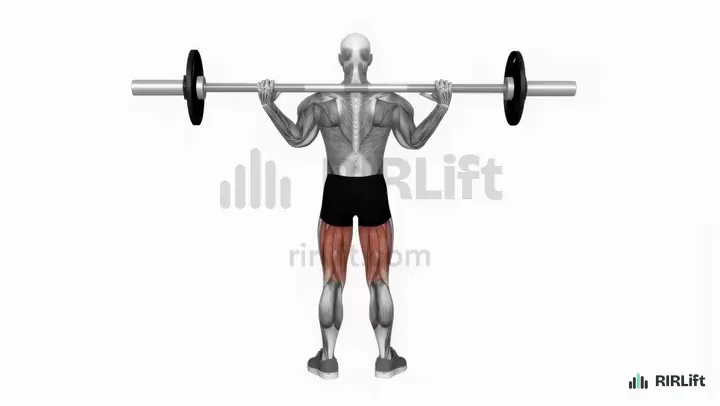
Quads, glutes and adductors, heavy squat

Barbell Back Squat

Quads, Glutes, Adductors

The back squat lets you put more weight on your legs than any other free-weight lift, and it trains your quads, glutes and inner thighs together. If you only had one barbell leg exercise, this would be it, though it still needs a hinge alongside it for your hamstrings.

How to do it

  1. Set the bar at upper-chest height in a rack, duck under, and settle it across your upper traps hands set a bit outside your shoulders.
  2. Stand up to unrack it, step back twice, and set your feet about shoulder-width with your toes turned out slightly.
  3. Take a big breath, brace your trunk, and bend your hips and knees together until your hip crease drops to knee level or lower.
  4. Drive up out of the bottom, pushing your upper back into the bar so your chest and hips rise together, and breathe out at the top.

Cues

  • Breathe and brace, then descend
  • Spread the floor with your feet
  • Upper back leads the way up

Common mistakes

  • Hips rising faster than the bar out of the bottom: lighten the load and push your back into the bar.
  • Knees caving in on the way up: drive them out over your toes and stop the set if they keep collapsing.

Swap for: Barbell Low-Bar Squat, Front Squat, Smith Squat

Quads and upper back, front-loaded squat

Front Squat

Quads, Glutes, Adductors

Holding the bar on the front of your shoulders keeps your torso nearly vertical, so your knees travel further forward and your quads take more of the load. It also uses less weight than the back squat for the same effort, which is kind to your lower back on a second squat day.

How to do it

  1. Set the bar at upper-chest height, step in close, and rest it on the front of your shoulders against your throat, fingertips under the bar and elbows pointing forward.
  2. Unrack it, step back, and set your feet about shoulder-width.
  3. Keep your elbows high and sit straight down until your thighs pass parallel.
  4. Stand up by driving your elbows up and your feet down, keeping your chest tall the whole way.

Cues

  • Elbows high
  • Sit straight down
  • Chest up out of the hole

Common mistakes

  • Elbows dropping so the bar rolls forward: raise them before each rep and loosen the grip to fingertips if your wrists complain.
  • Leaning forward to get out of the bottom: this is a quad lift, so stay upright and use less weight.

Swap for: Zercher Squat, Barbell Back Squat, Dumbbell Front Squat

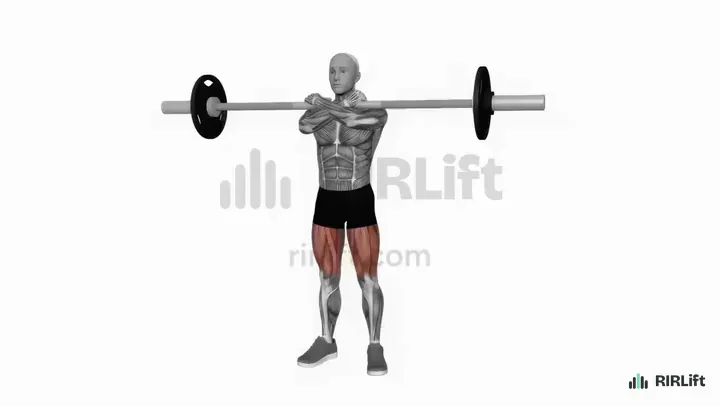
Quads, glutes and upper back, elbow-held squat

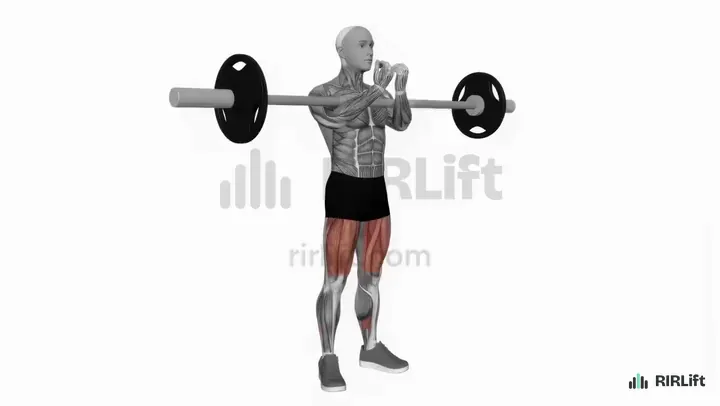
Zercher Squat

Quads, Glutes

Cradling the bar in your elbow creases keeps you upright like a front squat, and you can get it into position from the floor by deadlifting it to your hips first. That makes it the squat for a bar and plates with no rack.

How to do it

  1. Without a rack, deadlift the bar to your thighs, squat down a few inches, and rest it on your thighs while you hook your elbows under it. With a rack, set it at waist height and step in.
  2. Clasp your hands together and keep the bar locked in your elbow creases against your body.
  3. Take a stance a little wider than your shoulders and squat down until your elbows reach the inside of your knees.
  4. Stand back up with your chest high and the bar pinned to your body.

Cues

  • Bar tight in the elbows
  • Hands clasped, chest high
  • Elbows to the inside of the knees

Common mistakes

  • Letting the bar sag down your forearms: squeeze your biceps and pull it into your body.
  • Skipping a pad or towel when the bar digs in: wrap it so the pain stops before your legs do.

Swap for: Front Squat, Goblet Squat, Barbell Back Squat

Glutes and hamstrings, squat to a box

Box Squat

Quads, Glutes, Adductors

Sitting back onto a box gives you the same depth every rep and lets you reach further back with your hips than a free squat, so your glutes and hamstrings do more. It is useful when your depth drifts on heavy sets or when you want a squat that is easier on the knees.

How to do it

  1. Set a box or bench behind you at a height where your thighs are about parallel when you sit, and set the bar on your back as for a back squat.
  2. Take a slightly wider stance than usual, toes turned out.
  3. Push your hips back and sit down on the box under control, keeping your shins close to vertical and your trunk braced.
  4. Pause briefly without relaxing, then drive your feet into the floor to stand straight up.

Cues

  • Hips back to the box
  • Sit, do not crash
  • Stay tight on the box

Common mistakes

  • Dropping onto the box and rocking forward to stand: sit softly and stand up without momentum.
  • Relaxing your trunk while seated: keep your breath and brace for the whole pause.

Swap for: Barbell Back Squat, Barbell Low-Bar Squat, Goblet Squat

Build a session with Box Squat

Hinges and hip thrusts for hamstrings and glutes

Squats leave most of your hamstrings untouched, so a barbell leg day needs a hinge. The Romanian deadlift loads the hamstrings at a stretch, the sumo deadlift moves the most weight with your glutes and inner thighs, and the good morning puts the bar on your back to train the same hinge with less load. The hip thrust trains the glutes where hinges go light, at full hip extension.

Hamstrings and glutes, hip hinge

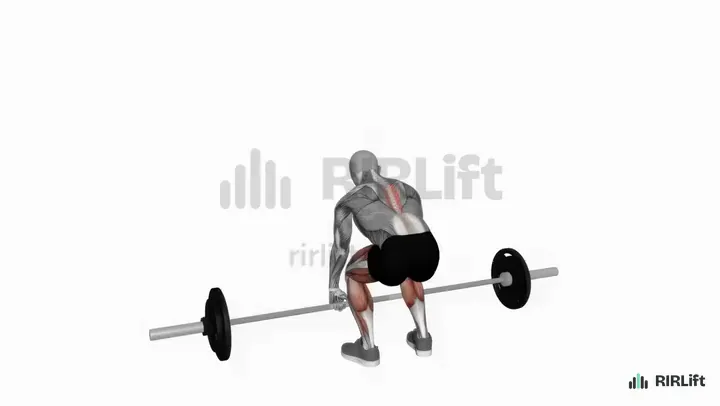
Romanian Deadlift

Hamstrings, Glutes

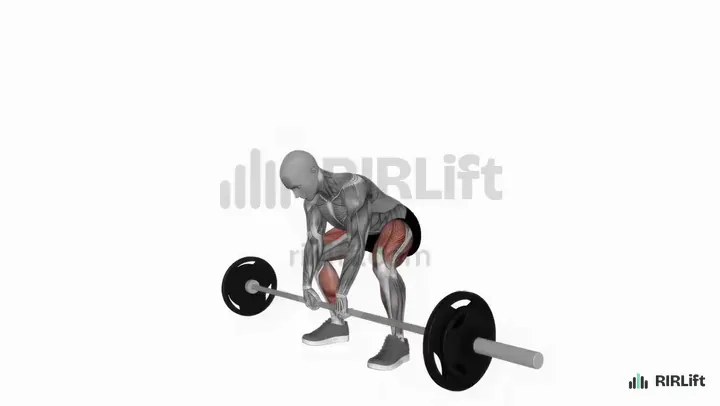
The Romanian deadlift loads your hamstrings at their longest, which is where they grow best, and the barbell lets you add weight in small steps for months. It is the hinge that belongs next to a squat in almost every barbell leg day.

How to do it

  1. Pick the bar up from the floor or a rack, grip it overhand just outside your thighs, and stand tall with a hip-width stance.
  2. Unlock your knees, then push your hips back while the bar travels down your thighs.
  3. Lower until your hamstrings are fully stretched with a flat back, typically somewhere between the knees and mid-shin.
  4. Snap your hips through to stand tall, finishing with your glutes tight.

Cues

  • Bar on the legs
  • Hips go back, knees stay put
  • Flat back sets the depth

Common mistakes

  • Turning it into a stiff-legged toe touch with a rounded back: stop where your back stays flat.
  • Bending the knees as the bar drops: keep the same slight bend you started with.

Swap for: Stiff-Leg Deadlift, Landmine RDL, Dumbbell Romanian Deadlift

Glutes, adductors and hamstrings, wide-stance pull

Sumo Deadlift

Glutes, Hamstrings, Quads

A wide stance with your hands inside your knees shortens the distance the bar travels and keeps your torso more upright, so your glutes and inner thighs take more of the work than in a regular deadlift. It starts from the floor, so it needs no rack.

How to do it

  1. Stand with your feet wide, toes pointed out, and the bar over your midfoot.
  2. Reach down and take the bar about shoulder-width apart, inside your knees, arms straight.
  3. Push your knees out over your toes, bring your hips down until your chest is up and your back is flat, and pull the slack out of the bar.
  4. Push the floor apart with your feet and stand up, keeping the bar close, then lower it the same way.

Cues

  • Knees out over the toes
  • Chest up before the pull
  • Push the floor apart

Common mistakes

  • Hips shooting up first so it becomes a stiff-leg pull: set your hips lower and push your knees out.
  • Yanking the bar off the floor: take the slack out first, then push.

Swap for: Trap Bar Deadlift, Sumo Romanian Deadlift, Barbell Deadlift

Hamstrings and lower back, bar-on-back hinge

Good Morning

Hamstrings, Glutes

With the bar on your upper back instead of in your hands, the same hip hinge as a Romanian deadlift becomes much harder at a lighter weight, and your grip never limits it. It works your hamstrings and spinal erectors and suits a second hinge slot on a lighter day.

How to do it

  1. Set the bar on your upper back as for a back squat and stand with stance hip-width, knees softly bent.
  2. Brace your trunk and push your hips back, letting your torso tip forward with a flat back.
  3. Lower until your hamstrings are stretched and your torso is close to parallel with the floor, or higher if your back starts to round.
  4. Bring your hips through to stand back up.

Cues

  • Hips back, chest forward
  • Knees softly bent and still
  • Light bar, long stretch

Common mistakes

  • Going heavy too soon: the lever is long, so start with a weight well under your Romanian deadlift.
  • Bending forward at the upper back instead of the hips: keep your chest proud and fold at the hip crease.

Swap for: Romanian Deadlift, Seated Good Morning, Stiff-Leg Deadlift

Glutes, loaded hip extension

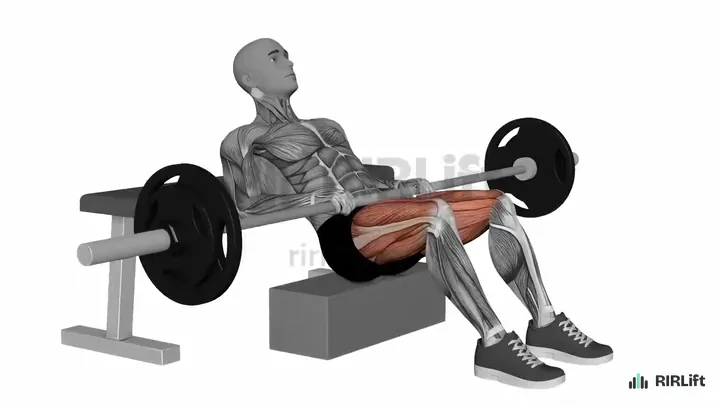
Hip Thrust

Glutes

Squats and hinges are hardest at the bottom, but the hip thrust is hardest at the top, where your glutes are fully shortened. A barbell across your hips lets you load that position heavily, and you can set it up from the floor without a rack.

How to do it

  1. Sit with your shoulder blades against the long side of a bench and roll a padded bar over your hip crease.
  2. Set your feet flat and about hip-width so your shins will be vertical at lockout.
  3. Brace, tuck your chin, and push through your feet to raise your hips until your torso is level with the floor.
  4. Squeeze for a second, then lower your hips most of the way to the floor and go again.

Cues

  • Chin tucked, ribs down
  • Shins vertical at lockout
  • Squeeze before you lower

Common mistakes

  • Overarching your lower back at the top: the rep is done when your hips are level, not higher.
  • Using no pad so the bar hurts your hips: a pad or a folded mat lets you load it properly.

Swap for: Glute Bridge, Smith Machine Hip Thrust, Dumbbell Hip Thrust

Single-leg barbell lifts

With a bar on your back, split squats and step-ups load each leg heavier than dumbbells can, because your grip is no longer the limit. Both legs take the same weight, so a weaker side shows up right away. Use a lighter bar than you would think at first; balance is the hard part.

Quads and glutes, rear-foot-elevated split squat

Barbell Bulgarian Split Squat

Quads, Glutes

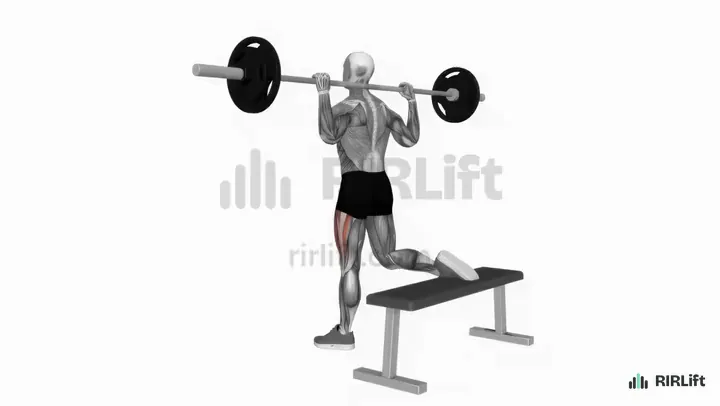
With your back foot on a bench, nearly all the load lands on your front leg, and a bar on your back lets you load it far beyond the dumbbells your grip could hold. It is the hardest single-leg barbell lift here and builds the quads and glutes of each leg separately.

How to do it

  1. Set the bar on your upper back from a rack, then stand about two feet in front of a bench and rest the laces of one foot on it.
  2. Brace and lower straight down until the back knee hovers just off the floor.
  3. Lean your torso a touch forward, front heel planted.
  4. Drive through your front foot to rise, finish the set on that leg, and switch.

Cues

  • Back knee straight down
  • Front heel planted
  • Bar stays level

Common mistakes

  • Wobbling and twisting under the bar: start with the empty bar and add weight only when the reps are steady.
  • Standing too close to the bench so the front heel rises: move your front foot forward.

Swap for: Bulgarian Split Squat, Smith Machine Bulgarian Split Squat, Barbell Split Squat

Quads and glutes, split-stance squat

Barbell Split Squat

Quads, Glutes

Both feet stay on the floor, so the split squat is more stable than the Bulgarian version and takes more weight. It is the single-leg lift for heavier, lower-rep sets.

How to do it

  1. Set the bar on your upper back and step into a long split stance, front foot flat, back heel up.
  2. Brace and lower your back knee straight toward the floor.
  3. Stop with the back knee an inch above the floor and the front thigh about level.
  4. Stand up through the front foot without stepping, and finish one side before switching.

Cues

  • Long stance
  • Straight down and up
  • Weight over the front foot

Common mistakes

  • A short stance that pushes the front knee far forward and lifts the heel: lengthen it.
  • Rocking forward and back instead of moving vertically: picture an elevator.

Swap for: Barbell Bulgarian Split Squat, Dumbbell Split Squat, Jefferson Split Squat

Glutes and quads, single-leg step

Barbell Step-Up

Quads, Glutes

Stepping onto a bench with a bar on your back trains each leg through a long range, and a higher step shifts the work toward your glutes. The bar lets you load it beyond what you could hold in your hands.

How to do it

  1. Set the bar on your upper back and face a sturdy bench or box at about knee height.
  2. Place one whole foot on the box.
  3. Drive through that foot to stand up on the box, keeping your torso steady, and bring the other foot up.
  4. Step down slowly with the trailing leg, keep the working foot on the box, and repeat for the set.

Cues

  • Whole foot on the box
  • Top leg lifts you
  • Slow on the way down

Common mistakes

  • Bouncing off the floor with the trailing leg: keep its toes light.
  • A box so high that you have to lunge forward to get up: start at knee height.

Swap for: Step-Up, Kettlebell Step-Up, Barbell Split Squat

Barbell calf raise

One calf exercise is enough, and the barbell version takes the load off your hands so the calves are the only thing that can fail.

Calves, standing raise

Barbell Standing Calf Raise

Calves
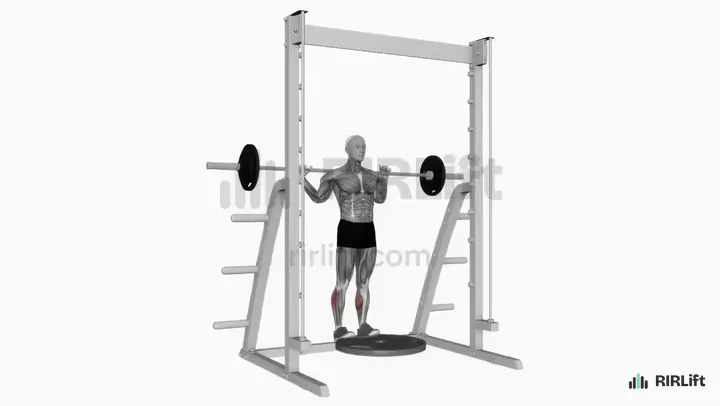
With a bar on your back and your forefoot on a plate or step, you can load your calves heavily through a full range with no grip limit. It finishes a rack-based barbell leg day in a few sets.

How to do it

  1. Set the bar on your upper back from a rack and stand with the balls of your feet on a plate or low step, heels off the edge.
  2. Lower your heels slowly until your calves are fully stretched, and hold for a second.
  3. Rise onto your toes as high as you can.
  4. Pause at the top, then lower slowly and repeat.

Cues

  • Pause in the stretch
  • Straight legs
  • Full rise

Common mistakes

  • Bouncing out of the bottom: hold the stretch, then rise.
  • Using a step so high you lose balance: a single plate is enough height.

Swap for: Smith Machine Calf Raise, Standing Calf Raise, Barbell Seated Calf Raise

Put them together: example sessions

Each session below picks from the exercises above for one situation, with the sets, reps, rest and RIR filled in. Open one in the session builder to change a pick, price it from a recent set, and add it to RIRLift.

Session 1

A bar and plates, no rack

Open in the session builder
  • Workouts2× a week
  • Working sets20 a week
  • Per workout~35 min
  • EquipmentBarbells, Flat Bench

You have a barbell and plates at home or in a garage, but no squat rack, and you want to train your legs fully.

Without a rack you cannot get the bar onto your back safely, so every lift here starts from the floor: the Zercher squat for your quads, the Romanian and sumo deadlifts for your hamstrings and glutes, and the hip thrust with the bar rolled over your hips. The squat and the pulls stop at 2 reps in reserve because a failed rep with no safety arms is a real problem, and only the hip thrust goes to 1. Day A is 10 sets and day B is 10, done twice a week each if you can, or once each to start.

Day A
ExerciseSets × repsRIRRest
Zercher Squat2 warm-up sets firstDeadlift the bar up first. Towel on the bar. 4 × 6–10 2 3 min
Romanian DeadliftBar on the legs. Flat back. 3 × 8–12 2 2:30 min
Hip ThrustPad the bar. Pause 1 s at lockout. 3 × 8–12 1 2 min

Open Day A in the session builder

Day B
ExerciseSets × repsRIRRest
Sumo Deadlift2 warm-up sets firstKnees out. Slack out before the pull. 4 × 5–8 2 3 min
Zercher SquatLighter than Day A. Pause 1 s at the bottom. 3 × 8–12 2 2:30 min
Hip ThrustLighter, higher reps. 3 × 12–20 1 90 s

Open Day B in the session builder

How to run it
Alternate Day A and Day B, two to four sessions a week in total, with a day between them. Pad the bar with a towel for the Zercher squat and the hip thrust.
How to progress
Double progression: reach the top of the rep range on every set at the target reps in reserve, then add 5 pounds. When the Zercher squat is limited by your arms rather than your legs, add a pause at the bottom instead of more weight.

Session 2

A squat rack and a bench

Open in the session builder
  • Workouts2× a week
  • Working sets25 a week
  • Per workout~40 min
  • EquipmentBarbells, Flat Bench

You train with a barbell, a squat rack with safety arms, and a flat bench, and you want two muscle-building leg days a week.

The rack opens up the back squat, front squat, Bulgarian split squat and calf raise, so each day starts with a different squat and adds a hinge or thrust, a single-leg lift and a finisher. The squats sit at 2 reps in reserve with warm-up sets, the single-leg lifts and the hip thrust at 1, and the calf raise goes to 0, since a failed calf rep costs nothing. Day A is 13 sets and day B is 12, which gives your quads, glutes and hamstrings roughly 10 to 15 hard sets each per week.

Day A
ExerciseSets × repsRIRRest
Barbell Back Squat2 warm-up sets firstSafeties set. Brace every rep. 4 × 6–10 2 3 min
Romanian DeadliftStretch, then drive the hips. 3 × 8–12 2 2:30 min
Barbell Bulgarian Split SquatPer leg. Start with the empty bar. 3 × 8–12 1 2 min
Barbell Standing Calf RaiseForefoot on a plate. Pause in the stretch. 3 × 10–15 0 1 min

Open Day A in the session builder

Day B
ExerciseSets × repsRIRRest
Front Squat2 warm-up sets firstElbows high. Stay upright. 3 × 6–10 2 3 min
Hip ThrustPause 1 s at lockout. 4 × 8–12 1 2 min
Barbell Step-UpPer leg. Knee-height bench. 3 × 8–12 1 2 min
Good MorningLight bar. Hips back. 2 × 8–12 2 2 min

Open Day B in the session builder

How to run it
Do Day A and Day B once each per week, three or four days apart. Set the safety arms just below your bottom position for every squat.
How to progress
Double progression on every lift. On the squats, when all sets reach the top of the range at 2 reps in reserve, add 5 to 10 pounds; on the single-leg lifts, add 5 pounds at a time.

Session 3

Getting stronger: heavy squats and pulls

Open in the session builder
  • Workouts2× a week
  • Working sets22 a week
  • Per workout~45 min
  • EquipmentBarbells

You already squat and deadlift with good form and want an eight-week block that raises your top weights while keeping muscle work in the week.

Strength grows fastest from heavy sets of 3 to 5 reps, so each day opens with one heavy lift, the back squat on the first and the sumo deadlift on the second, kept at 2 reps in reserve so technique holds and you recover by the next session. Each heavy lift is followed by a variation at moderate reps, the Romanian deadlift and the box squat, which adds muscle and drills the positions that matter for the main lift. The split squat, good morning and calf raise round out each day at lower volume. Day 1 is 10 sets and day 2 is 12.

Heavy Squat
ExerciseSets × repsRIRRest
Barbell Back Squat3 warm-up sets firstSame weight all sets. 5 × 3–5 2 4 min
Romanian DeadliftControlled 3 s lowering. 3 × 6–8 2 3 min
Barbell Split SquatPer leg. 2 × 6–10 2 2 min

Open Heavy Squat in the session builder

Heavy Pull
ExerciseSets × repsRIRRest
Sumo Deadlift3 warm-up sets firstReset each rep on the floor. 4 × 3–5 2 4 min
Box Squat1 warm-up set firstBox at parallel. Pause, then drive. 3 × 5–8 2 3 min
Good MorningLight. Full hamstring stretch. 2 × 6–10 2 2:30 min
Barbell Standing Calf RaisePause at both ends. 3 × 8–12 0 1 min

Open Heavy Pull in the session builder

How to run it
Do Heavy Squat and Heavy Pull once each per week, three or four days apart. Rest the full time on the first lift of each day; heavy triples need it.
How to progress
Add 5 pounds to the squat and 5 to 10 to the sumo deadlift each week while every set reaches at least 3 reps at 2 reps in reserve. When a week falls short, repeat that weight the next week before adding more.

Make it fit you

Questions

What are the big 3 leg exercises?

The squat, the deadlift (or Romanian deadlift) and a single-leg lift such as the Bulgarian split squat. The squat covers your quads and glutes, the hinge covers your hamstrings, and the single-leg lift balances the two sides. All three can be done with a barbell.

Is a barbell squat enough for leg day?

No. The back squat trains your quads, glutes and inner thighs well, but it barely works your hamstrings and calves. Add a Romanian deadlift or good morning for the hamstrings and a calf raise, and you have a full leg day.

Can you build legs with only a barbell?

Yes. Squats, hinges, hip thrusts, split squats and calf raises cover every leg muscle, and a barbell lets you add weight in small steps for years. The one gap is a direct leg curl, so the plans here use the Romanian deadlift and good morning to train the hamstrings through a long stretch.

What barbell leg exercises can I do without a squat rack?

The Zercher squat, Romanian deadlift, sumo deadlift and hip thrust all start from the floor. For the Zercher squat, deadlift the bar to your thighs, then hook your elbows under it. The no-rack plan on this page uses those four.

How heavy should barbell leg exercises be?

Heavy enough to finish each set with 1 to 2 reps left inside the rep range. For muscle, that is usually 6 to 12 reps on squats and hinges and 8 to 15 on single-leg lifts. For strength, sets of 3 to 5 at 2 reps in reserve.