Chest exercises at the gym: barbells, machines, cables and dips

The best chest exercises at the gym are the barbell bench press and the incline dumbbell press for heavy pressing, the chest press and incline press machines for pressing to failure without a spotter, the pec deck and cable crossovers for flies, and dips for the lower chest. A complete gym chest day is a heavy press, a press from a second angle, and a fly. The gym's real advantage over home is the machines and cables, which let you push the last sets hard without risk.

  1. Barbell Bench Press Chest
  2. Incline Dumbbell Press Chest
  3. Machine Chest Press Chest
  4. Pec Deck Fly Chest
  5. High-to-Low Cable Fly Chest
  6. Incline Barbell Bench Press Chest
  7. Chest Dip Chest, Triceps
  8. Smith Machine Incline Press Chest
Barbell chest exercises

The bench press in its three angles is where you load the chest heaviest. Flat for the whole chest, low incline for the upper chest, decline for the lower chest. Do one as the first lift of a chest day, while you are fresh, and set the safeties if you train alone.

Whole chest, heaviest press

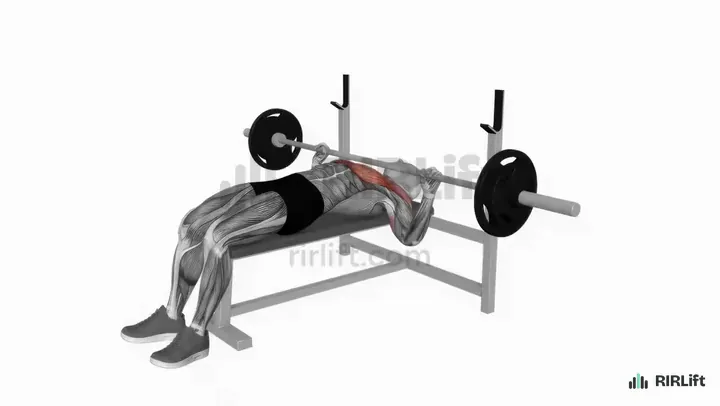
Barbell Bench Press

Chest

The barbell bench press lets you load your chest heavier than anything else in the gym, and adding weight to it is the clearest sign your chest is getting stronger. It is the anchor of most gym chest days, with a rack and safeties to make heavy sets safe alone.

How to do it

  1. Lie on the flat bench with your eyes under the bar, set the rack safeties just below chest height, and grip the bar a little wider than shoulder width.
  2. Squeeze your shoulder blades together, plant your feet, and lift the bar out over your shoulders.
  3. Lower it to your lower chest with your elbows tucked roughly 45 to 70 degrees from your sides.
  4. Touch lightly, then drive it back up and slightly toward your face until your arms are straight.

Cues

  • Shoulder blades pinched into the bench
  • Bar to the lower chest
  • Feet push the floor

Common mistakes

  • Bouncing the bar off your chest: touch and press, with no rebound.
  • Elbows flared straight out to the sides at the bottom: tuck them a bit toward your ribs.

Swap for: Flat Dumbbell Press, Smith Machine Bench Press, Machine Chest Press

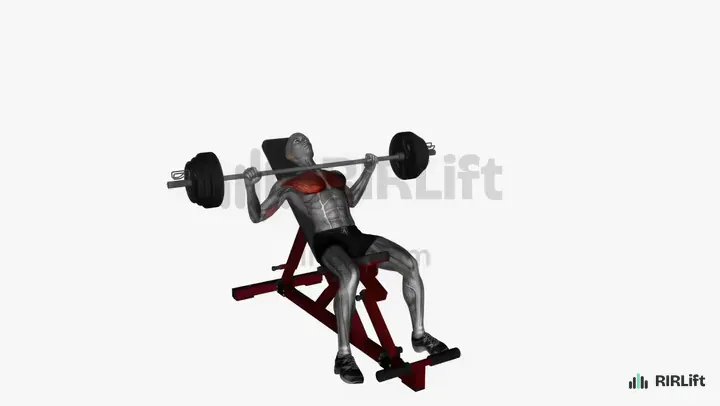
Upper chest, heavy barbell press

Incline Barbell Bench Press

Chest

Setting the bench to a low incline aims the barbell press at the upper chest, which the flat bench works less. It is the heaviest upper-chest exercise in the gym and a good first lift on days you want the top of your chest to lead.

How to do it

  1. Set an adjustable bench to about 30 degrees in a rack or incline bench station, and grip the bar just outside shoulder width.
  2. Pull your shoulder blades back and lift the bar out over your upper chest.
  3. Lower it to just below your collarbones, elbows angled under the bar.
  4. Press it back up in a straight line over your shoulders.

Cues

  • Low angle, about 30 degrees
  • Bar to the top of the chest
  • Wrists stacked over elbows

Common mistakes

  • A steep bench that turns the lift into a shoulder press: keep the incline low.
  • Lifting your hips off the seat to finish reps: keep your glutes down and end the set there.

Swap for: Incline Dumbbell Press, Smith Machine Incline Press, Machine Incline Press

Lower chest, barbell press

Decline Barbell Bench Press

Chest

A decline bench shortens the distance the bar travels and points the press toward the lower chest, so most people move their heaviest weight here with little shoulder strain. Use it as a second press when the lower chest lags or your shoulders dislike the flat bench.

How to do it

  1. Hook your legs under the pads of a decline bench and lie back with your eyes under the bar.
  2. Take a grip slightly wider than your shoulders and lift the bar out with straight arms.
  3. Lower it to the bottom of your chest under control.
  4. Press it back up over your chest until your arms are straight. Have a spotter or use a station with safeties.

Cues

  • Bar to the bottom of the chest
  • Short, strong path
  • Legs locked under the pads

Common mistakes

  • Lowering the bar to your neck because the angle feels strange: aim for the lowest part of your chest.
  • Training heavy without a spotter or safeties on a decline: racking the bar from that angle is hard when you fail.

Swap for: Decline Dumbbell Press, Machine Decline Press, Chest Dip

Dumbbell chest exercises at the gym

The gym's dumbbell rack goes up in small steps and much heavier than home pairs, so dumbbell presses can be your main lift, not just an accessory. They also give your chest a longer range than a bar.

Upper chest, dumbbell press

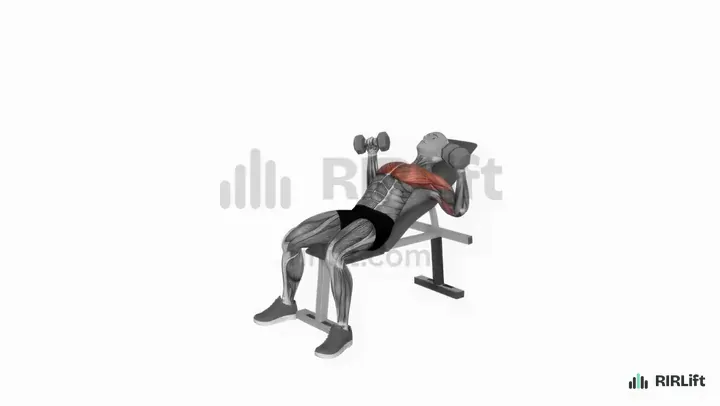
Incline Dumbbell Press

Chest

Dumbbells move freely, so your hands can travel lower and finish closer together than with a bar, which gives the upper chest a deeper stretch and a fuller squeeze. Gyms stock dumbbells in small jumps, so this one is easy to keep progressing.

How to do it

  1. Set an adjustable bench to a low incline, sit back and kick the dumbbells up to your shoulders one at a time.
  2. Press them up over your upper chest until your arms are straight.
  3. Lower them to the sides of your upper chest until you feel a strong stretch, elbows angled back.
  4. Drive them back up, bringing them close together at the top without clanking.

Cues

  • Deep stretch at the bottom
  • Low incline
  • Press up and slightly in

Common mistakes

  • Dropping the dumbbells to the floor from the top of a heavy set: bring them to your thighs and sit up.
  • Shortening the range as the set gets hard: stop the set instead.

Swap for: Incline Barbell Bench Press, Incline Dumbbell Squeeze Press, Machine Incline Press

Whole chest, dumbbell press

Flat Dumbbell Press

Chest

The flat dumbbell press trains the same muscles as the barbell bench with a longer range and each arm working on its own, which evens out a stronger side. Choose it as your main press if you train without a spotter.

How to do it

  1. Sit on the end of a flat bench, dumbbells resting on your knees, lie back, and use your thighs to help bring them over your chest.
  2. Plant your feet and set your shoulder blades back into the bench.
  3. Lower the dumbbells beside your chest, elbows angled toward your hips.
  4. Press them back up until your arms are straight above your chest.

Cues

  • Shoulder blades back
  • Forearms vertical under the dumbbells
  • Full stretch each rep

Common mistakes

  • Letting the dumbbells drift out wide at the bottom: keep your forearms stacked under them.
  • Arching hard to move heavier dumbbells: lower the weight until your back stays settled.

Swap for: Barbell Bench Press, Machine Chest Press, Dumbbell Hex Press

Chest machines and the Smith machine

Machines guide the path, so you can take presses to failure with no spotter and no balance to manage. Use them as a second press after free weights, or as your main press on days when every bench is taken.

Whole chest, guided press

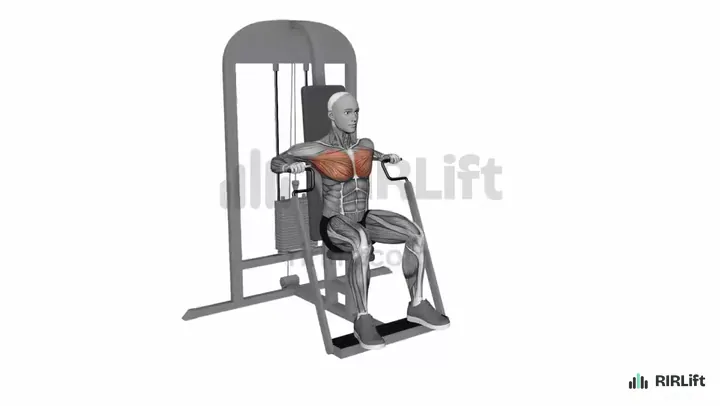
Machine Chest Press

Chest

The chest press machine lets you push to failure on a fixed path with no spotter, which makes it ideal late in a session or when the benches are all taken. It is also the easiest press to learn in your first weeks at the gym.

How to do it

  1. Raise or lower the seat until the handles line up with the middle of your chest, then sit with your back on the pad.
  2. Take the handles with your wrists straight and shoulder blades pressed back.
  3. Push forward until your arms are nearly straight.
  4. Return slowly until your hands are level with your chest, then press again.

Cues

  • Handles at mid-chest
  • Back stays on the pad
  • Slow return

Common mistakes

  • Seat too high, which makes the shoulders do the work: drop it until the handles are at mid-chest.
  • Cutting reps short at the chest: let the handles come all the way back.

Swap for: Barbell Bench Press, Machine Incline Press, Smith Machine Bench Press

Upper chest, guided incline press

Machine Incline Press

Chest

The incline press machine gives you an upper-chest press you can take to failure without balancing anything. It works well as the second upper-chest exercise after an incline barbell or dumbbell press.

How to do it

  1. Set the seat so the handles start a bit above the middle of your chest, and sit with your back flat on the pad.
  2. Take the handles with your elbows pointing down and slightly out.
  3. Press up and away until your arms are nearly straight.
  4. Lower the handles slowly back toward your upper chest and repeat.

Cues

  • Press up and away
  • Chest high
  • Elbows under the handles

Common mistakes

  • Arching off the pad: end the set when your back has to help.
  • Letting the stack crash between reps: control every return.

Swap for: Incline Dumbbell Press, Smith Machine Incline Press, Machine Chest Press

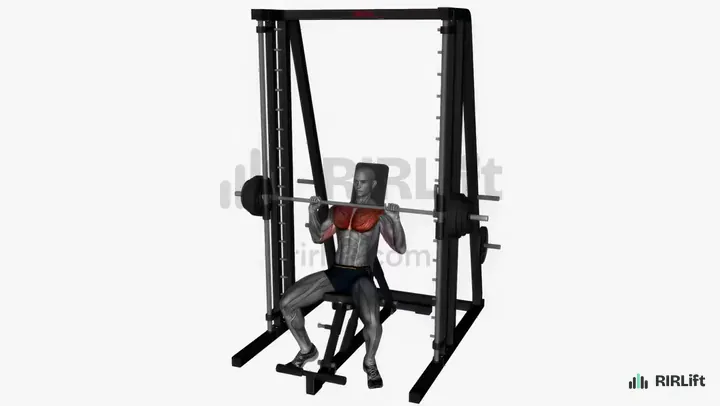
Upper chest, guided barbell press

Smith Machine Incline Press

Chest
The Smith machine fixes the bar in a track, so you can load an incline press heavy and rack it at any point by twisting your wrists. It is the safest way to push an incline barbell press hard when you train alone.

How to do it

  1. Place an incline bench at about 30 degrees under the Smith bar so the bar lines up with your upper chest.
  2. Grip the bar just outside shoulder width, twist it off the hooks, and hold it over your chest.
  3. Lower it to your upper chest under control.
  4. Press back up to straight arms, and rotate the bar back onto the hooks when the set is done.

Cues

  • Bench set so the bar meets the upper chest
  • Elbows under the bar
  • Rack it with a wrist turn

Common mistakes

  • Bench too far forward or back, so the bar lands on your neck or stomach: check the path with an empty bar first.
  • Forgetting to set the safety stops: set them just below chest height.

Swap for: Incline Barbell Bench Press, Machine Incline Press, Incline Dumbbell Press

Cable and pec deck chest exercises

Flies cover the movement presses miss: pulling your arms together across your body. The pec deck is the simplest; the crossover lets you pick the angle, high pulleys for the lower chest and low pulleys for the upper chest. Save them for last.

Whole chest, machine fly

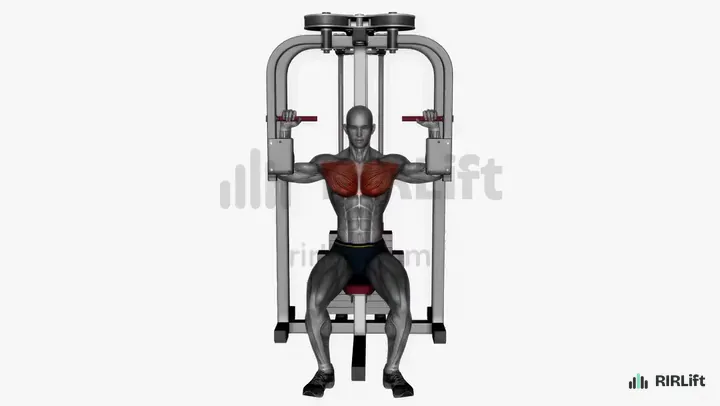
Pec Deck Fly

Chest

The pec deck isolates the chest's job of bringing your arms together, with no triceps involved. The pads hold your arms in place, so you can take every set to failure safely at the end of a session.

How to do it

  1. Set the seat so your arms are level with your shoulders when you hold the handles.
  2. Sit tall with your back on the pad and your arms open to the sides, elbows slightly bent.
  3. Bring the handles together across your body until they almost meet.
  4. Open back out slowly until your hands are in line with your shoulders, then repeat.

Cues

  • Squeeze for a second
  • Arms move as one piece
  • Chest up, shoulders down

Common mistakes

  • Letting the weight drag your arms behind your shoulders: control the stretch.
  • Hunching forward to close the handles: sit tall and use less weight.

Swap for: High-to-Low Cable Fly, Dumbbell Chest Fly, Machine Chest Press

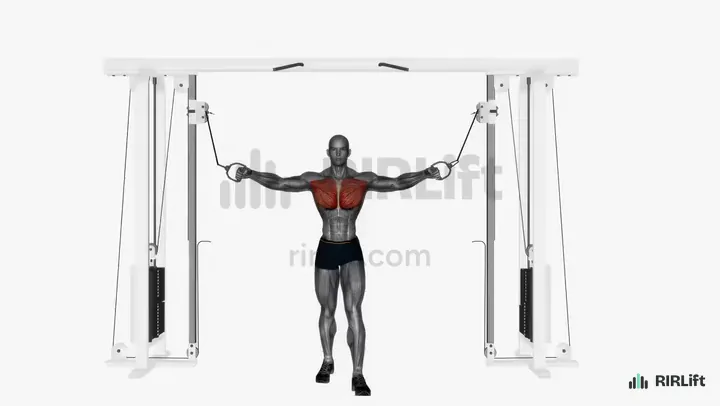
Lower chest, cable crossover

High-to-Low Cable Fly

Chest

At the cable crossover with the pulleys set high, your hands sweep down and together toward your hips, which lines up with the lower chest fibers. Cables keep the pull on your chest through the whole arc, including the squeeze at the end.

How to do it

  1. Set both pulleys high, take a handle in each hand, and step to the middle with a staggered stance.
  2. Lean slightly forward and let your arms open wide and up with soft elbows.
  3. Sweep both handles down and inward in a big arc until they meet near your hips.
  4. Let them travel back up along the same arc, slowly, then repeat.

Cues

  • Hands meet at belt height
  • Elbow angle stays fixed
  • Lean, don't bend at the waist

Common mistakes

  • Pressing the handles down by bending the elbows: keep the angle fixed and go lighter.
  • Standing too close to the towers, so the cables go slack: step forward until they pull at the start.

Swap for: Cable Fly, Pec Deck Fly, Decline Dumbbell Fly

Upper chest, low-to-high crossover

Cable Fly

Chest

With the pulleys at the bottom, the handles rise from your sides to meet at chin height, aiming the fly at the upper chest. It pairs well with incline presses on an upper-chest day.

How to do it

  1. Set both pulleys at the lowest notch, take the handles, and stand in the middle of the crossover.
  2. Start with your arms down and slightly behind you, elbows a little bent.
  3. Raise the handles forward and up until they meet in front of your upper chest.
  4. Lower them back down and out along the same arc.

Cues

  • Scoop up and in
  • Ribs down
  • Stop at chin height

Common mistakes

  • Shrugging as the hands rise: keep your shoulders down and stop at upper-chest height.
  • Leaning back to swing the handles: stand tall and lighten the stack.

Swap for: Incline Cable Fly, Low-to-High Cable Fly, Incline Dumbbell Fly

Build a session with Cable Fly

Dips for the lower chest

Parallel bar dips load the lower chest and triceps with your bodyweight, and a dip belt adds more. Lean forward to keep the chest in charge.

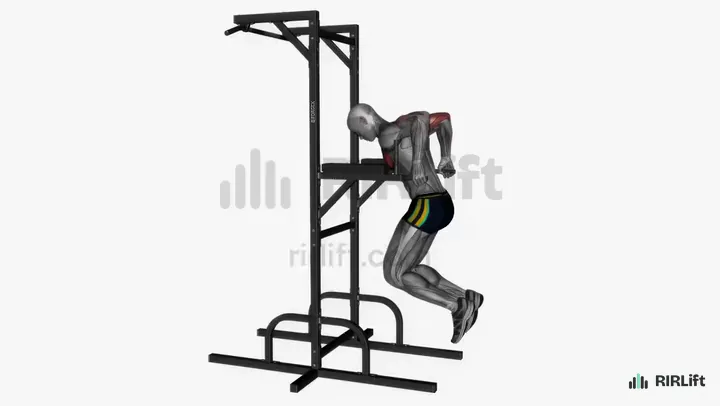
Lower chest and triceps, bodyweight dip

Chest Dip

Chest, Triceps

Dips on parallel bars load the lower chest and triceps with your whole bodyweight, and you can add a belt with plates once bodyweight gets easy. Lean forward and let your elbows drift out a little to keep the chest doing the work.

How to do it

  1. Grip the dip bars, jump or step up, and hold yourself with straight arms.
  2. Lean your torso forward and bend your knees, ankles crossed.
  3. Bend your elbows to sink until your shoulders are just below your elbows and your chest feels stretched.
  4. Push back up to straight arms, keeping the forward lean.

Cues

  • Chest over the hands
  • Sink until the stretch
  • Control the bottom

Common mistakes

  • Staying bolt upright, which makes it a triceps exercise: lean forward.
  • Dropping too deep with shoulders rolling forward: stop where your shoulders still feel solid.

Swap for: Machine Chest Dip, Decline Barbell Bench Press, Machine Decline Press

Build a session with Chest Dip

Put them together: example sessions

Each session below picks from the exercises above for one situation, with the sets, reps, rest and RIR filled in. Open one in the session builder to change a pick, price it from a recent set, and add it to RIRLift.

Session 1

Full access to racks, dumbbells and cables

Open in the session builder
  • Workouts2× a week
  • Working sets20 a week
  • Per workout~30 min
  • EquipmentBarbells, Flat Bench, Dumbbells, Incline Bench +3

You train at a well-equipped gym at a quiet hour, on an upper/lower or push/pull/legs split, and want chest twice a week.

Day A is built around the flat barbell bench for strength, with incline dumbbells for the upper chest and the high-to-low crossover to finish. Day B leads with the incline barbell press, adds dips for the lower chest, and ends on the pec deck. The heavy barbell work stops 2 reps short of failure after warm-ups so you can add weight safely week to week; the second press stops at 1, and the fly finishes at 0. Each day has 10 hard sets, 20 a week.

Chest A
ExerciseSets × repsRIRRest
Barbell Bench Press3 warm-up sets firstSafeties just below chest height. 4 × 5–8 2 3 min
Incline Dumbbell Press 3 × 8–12 1 2 min
High-to-Low Cable FlyPause 1 s at the bottom. 3 × 12–15 0 75 s

Open Chest A in the session builder

Chest B
ExerciseSets × repsRIRRest
Incline Barbell Bench Press2 warm-up sets first30 degree bench. 4 × 6–10 2 3 min
Chest DipLean forward. Add a belt past 12 reps. 3 × 6–12 1 2 min
Pec Deck Fly 3 × 12–20 0 75 s

Open Chest B in the session builder

How to run it
Do A and B on separate days with two or three days between them. Set the rack safeties on both barbell lifts.
How to progress
On the barbell lifts, add 5 pounds once every set reaches the top of the range at 2 RIR. On the dumbbells, dips and flies, add reps until you reach the top of the range, then go up one step.

Session 2

Busy gym: benches taken, machines and cables free

Open in the session builder
  • Workouts2× a week
  • Working sets19 a week
  • Per workout~30 min
  • EquipmentIncline Bench, Smith Machine, Chest Press, Cable Crossover +2

You train after work when every bench and rack has a queue, and you want a chest day you can do without waiting.

Machines and the Smith are the stations that free up fastest, so this plan uses them exclusively. The Smith incline press is the heavy lift, the chest press machine gets taken close to failure because it needs no spotter, and the crossover and pec deck finish. Every station is next to the others in most gyms, so the session moves fast. 10 sets in A, 9 in B.

Machine Chest A
ExerciseSets × repsRIRRest
Smith Machine Incline Press2 warm-up sets firstSafeties set. 4 × 6–10 2 2:30 min
Machine Chest Press 3 × 8–12 1 2 min
Cable FlyPulleys at the bottom. 3 × 12–15 0 75 s

Open Machine Chest A in the session builder

Machine Chest B
ExerciseSets × repsRIRRest
Machine Chest Press2 warm-up sets first 3 × 6–10 2 2:30 min
Machine Incline Press 3 × 8–12 1 2 min
Pec Deck Fly 3 × 12–20 0 1 min

Open Machine Chest B in the session builder

How to run it
Run A and B once each per week. If the Smith is busy, start B and come back to it.
How to progress
On the Smith and the chest press, add one plate once all sets reach the top of their range at the target RIR. On the flies, add reps first, then weight.

Session 3

One chest block in a 45-minute push day

Open in the session builder
  • Workouts1× a week
  • Working sets11 a week
  • Per workout~30 min
  • EquipmentDumbbells, Flat Bench, Incline Chest Press, Fly Machine +1

You hit the gym three or four days a week for the whole body, and chest gets one short block per week inside a push day.

With one session, the chest gets the two most productive gym exercises plus a fly: the flat dumbbell press for the whole chest, the incline machine press for the upper chest, and the pec deck and crossover paired as a superset to save time. Dumbbells and machines need less warm-up than a barbell, which keeps the block under 25 minutes. Sets end 1 rep short of failure, and the superset goes to 0. 11 sets in one go.

Push Day Chest
ExerciseSets × repsRIRRest
Flat Dumbbell Press2 warm-up sets first 4 × 6–12 1 2:30 min
Machine Incline Press 3 × 8–12 1 2 min
A1 Pec Deck Fly 2 × 12–15 0 45 s
A2 High-to-Low Cable Fly 2 × 12–15 0 90 s
How to run it
Do it once a week at the start of your push day, before shoulders and triceps.
How to progress
Add one rep per set each week; when the press hits 12 at 1 RIR, take the next dumbbell. Alternate the superset order every week.

Make it fit you

Questions

What gym workout is best for chest?

A heavy press, a second press from another angle, and a fly. For example: the barbell bench press, the incline dumbbell press, and the cable crossover or pec deck, for three or four sets each, twice a week. That covers the whole chest from the heaviest loading to the full squeeze.

Are 4 exercises enough for chest day?

Yes. Three or four exercises cover the chest completely and give you 10 to 12 hard sets, which is about right for one session. Adding more exercises usually means easier sets, not more growth.

What are the 5 best chest exercises?

The barbell bench press, the incline dumbbell press, the chest dip, the pec deck and the high-to-low cable fly. That list covers heavy pressing, the upper chest, the lower chest and two kinds of fly, and every gym has the equipment for it.

What is the best chest exercise at the gym?

The barbell bench press for strength and the incline dumbbell press for muscle growth are the two most common answers. If you can only pick one, the incline dumbbell press trains the upper and middle chest with a long range and progresses easily.

Should you do barbell or dumbbell presses?

Both work. The barbell lets you load heavier and track strength; dumbbells give more range and let each side work alone. Many people bench with a barbell on one day and use dumbbells on the other.

How many sets of chest per week at the gym?

Ten to twenty hard sets a week grows most people's chest, split over two sessions. Count only sets that end within 0 to 3 reps of failure; warm-ups do not count.

What order should you do chest exercises in?

Heaviest first: a barbell or dumbbell press while you are fresh, then a machine or second press from another angle, then flies. Flies go last because they are safe to push to failure when you are already tired.