Back exercises at home: with a bar, weights, bands or no equipment

The best back exercises at home are the pull-up and chin-up if you can hang a bar, the one-arm dumbbell row and bent-over row if you have weights, the suspension row and band row if you have neither, and the superman or kettlebell swing for your lower back. Pick one vertical pull or pullover, one row and one lower-back move, and take each set within 1 or 2 reps of failure. A $30 doorframe bar does more for a home back workout than any other piece of gear.

  1. Pull-Up Lats
  2. Chin-Up Lats
  3. One-Arm Dumbbell Row Lats, Upper Back
  4. Dumbbell Bent-Over Row Upper Back, Lats
  5. TRX Row Upper Back, Lats
  6. Band Bent-Over Row Lats, Upper Back
  7. Band Pull-Apart Shoulders, Upper Back
  8. Superman Lower Back

Back exercises with a pull-up bar

A doorframe or wall bar is the one piece of home gear that gives your lats a vertical pull, the movement every home row misses. Start with the grip you can do the most reps on, use a band until you can do sets of 5 or more on your own, and treat the pull-up as the exercise you measure progress by.

Lats and upper back, vertical pull

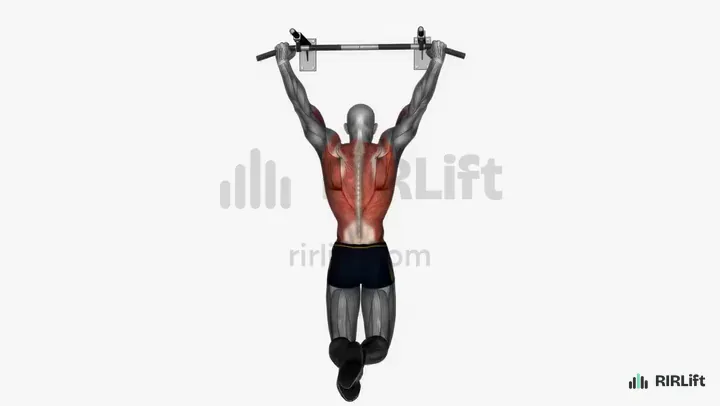
Pull-Up

Lats

Hanging from a bar and pulling your chin over it trains your lats through a range no row reaches, and your bodyweight is a load most people need months to outgrow. A doorframe bar is the single best back purchase for a home setup, which is why both bar plans open with it.

How to do it

  1. Hang from the bar with an overhand grip slightly wider than your shoulders, arms fully straight, feet off the floor.
  2. Set your shoulder blades low first, then bend your elbows and drive them toward your back pockets.
  3. Keep pulling until your chin clears the bar, with your chest rising toward it.
  4. Lower yourself all the way to straight arms over two seconds before the next rep.

Cues

  • Shoulders down before elbows bend
  • Chest to the bar
  • Dead hang between reps

Common mistakes

  • Kicking or swinging to reach the bar: cross your ankles, squeeze your glutes and stop the set when you can no longer pull cleanly.
  • Cutting the bottom short: a rep starts from straight arms, or the lats miss their stretch.

Swap for: Chin-Up, Band-Assisted Pull-Up, Neutral-Grip Pull-Up

Build a session with Pull-Up

Lats and biceps, underhand vertical pull

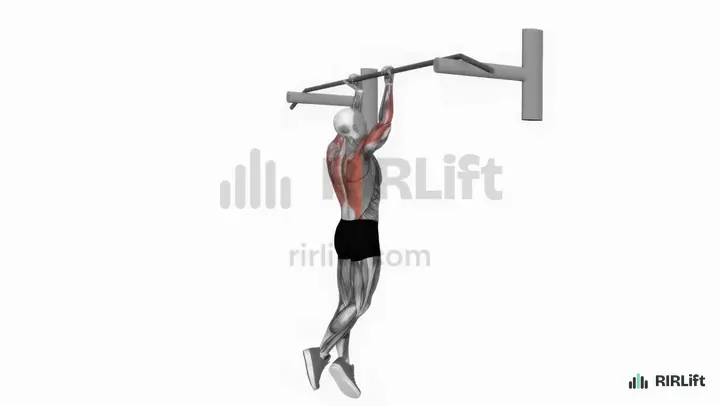
Chin-Up

Lats

Turning your palms toward you lets your biceps help, so most people get two or three more reps than on a pull-up. That makes it the first bar exercise to build reps on, and a second vertical pull that feels different on the days you already do pull-ups.

How to do it

  1. Grip the bar with palms facing you, hands about shoulder-width apart, and hang with straight arms.
  2. Set your shoulders low and back, then pull your elbows down past your ribs.
  3. Finish with your chin over the bar and your upper chest close to it.
  4. Lower slowly until your elbows are straight again, then repeat.

Cues

  • Elbows drive down to your sides
  • Ribs stay down
  • Slow on the way down

Common mistakes

  • Craning your neck to get the chin over: pull your chest up instead, and count the rep only when the bar is under your chin with your head neutral.
  • Half reps late in the set: once you cannot reach full range, finish with slow lowerings from the top instead.

Swap for: Pull-Up, Band-Assisted Pull-Up, TRX Chin-Up

Build a session with Chin-Up

Lats, parallel-grip vertical pull

Neutral-Grip Pull-Up

Lats

Most doorframe bars and many wall-mounted bars have parallel handles, and pulling palms turned in is the easiest grip on the wrists and elbows. It sits between the chin-up and the pull-up in difficulty and lets you keep your elbows close for a strong lat contraction.

How to do it

  1. Take the parallel handles, palms turned in, and hang with your arms straight.
  2. Draw your shoulder blades down, then pull your elbows straight down beside your body.
  3. Rise until your chin passes the handles and your upper chest nearly touches them.
  4. Lower slowly to a full hang and repeat.

Cues

  • Elbows close to your ribs
  • Lead with the chest
  • Full hang at the bottom

Common mistakes

  • Pulling your knees up toward your chest to help: keep the legs still and slightly in front of you.
  • Rushing the lowering: take two seconds down so the lats work on every inch of the rep.

Swap for: Chin-Up, Pull-Up, Band-Assisted Pull-Up

Lats, assisted vertical pull

Band-Assisted Pull-Up

Lats

A loop band from the bar under your knee or foot takes part of your weight off at the bottom, where the pull-up is hardest, so you can do full sets of real pull-ups before you can do one on your own. Swap to a thinner band as you get stronger until you need none.

How to do it

  1. Loop a strong resistance band over the bar and pull it through itself so it hangs down tight.
  2. Grip the bar a little wider than your shoulders and step one knee or foot into the loop at the bottom.
  3. Pull your elbows down toward your hips until your chin clears the bar.
  4. Lower under control to straight arms, letting the band stretch back out, and repeat.

Cues

  • Thinnest band you can do 8 reps with
  • Full range every rep
  • Stay vertical, no swing

Common mistakes

  • Using a band so thick that the set never gets hard: move down a band once you pass 12 reps at the target reps in reserve.
  • Bouncing out of the bottom off the band: pause for a moment at the hang before each pull.

Swap for: Pull-Up, Chin-Up, Neutral-Grip Pull-Up

Back exercises with dumbbells or kettlebells

Free weights give your back the rows: one-arm with a chair for support, both arms in a hinge, or alternating from the floor with kettlebells. Add the pullover when you have no cable, because it trains the lats with straight arms, the way a pulldown machine would.

Lats, braced one-arm row

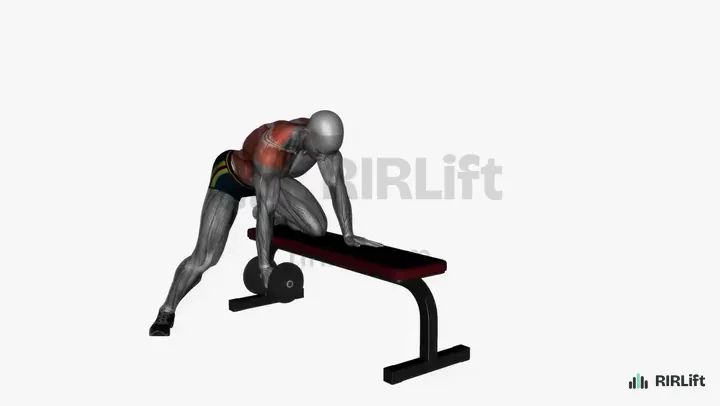
One-Arm Dumbbell Row

Lats, Upper Back

If you own one dumbbell, this is the row to use: your free hand on a chair or couch arm takes the strain off your lower back, and working one side at a time makes a single dumbbell twice as useful. It is the main row in the no-bar plan.

How to do it

  1. Plant your left hand on a sturdy chair seat, step your right foot back, and tilt your torso forward until it is close to flat.
  2. Let your right arm hang with the dumbbell, the arm hanging straight below your shoulder.
  3. Row the dumbbell toward your hip by pulling the elbow back along your side.
  4. Lower until the arm is long and the shoulder drops toward the floor, finish the set, then switch sides.

Cues

  • Elbow sweeps toward the hip
  • Long arm at the bottom
  • Shoulders level

Common mistakes

  • Turning your chest toward the ceiling to finish the rep: the torso stays square, and the elbow stops at your side.
  • Using a wobbly chair or a rolling stool: brace on something that will not move, or the set ends because of balance, not your back.

Swap for: Kettlebell Gorilla Row, Dumbbell Bent-Over Row, Band Bent-Over Row

Lats and mid-back, two-arm bent-over row

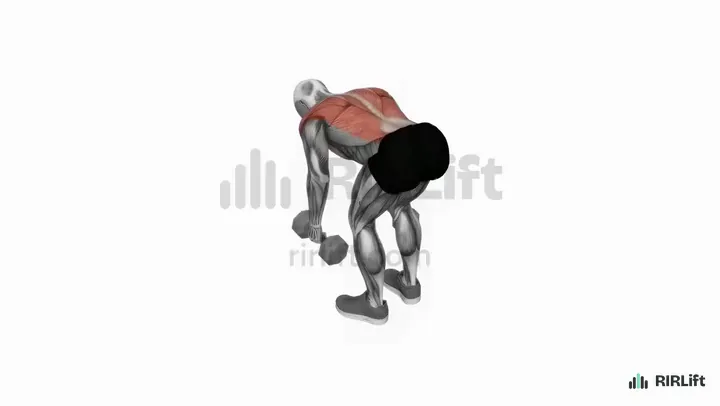
Dumbbell Bent-Over Row

Upper Back, Lats

With a pair of dumbbells and two square feet of floor, the bent-over row trains your whole back at once, and it scales with adjustable dumbbells better than any other home row. Your lower back has to hold the hinge, which is the trade for not needing a bench.

How to do it

  1. Take one dumbbell per hand, feet about hip-width apart, and hinge forward from the hips with soft knees until your torso is nearly level with the floor.
  2. Let the dumbbells hang straight down under your shoulders, palms turned in.
  3. Pull both dumbbells up to your lower ribs, keeping the elbows close, and hold the top for a beat.
  4. Lower to straight arms without letting your torso rise and repeat.

Cues

  • Torso angle stays locked
  • Pull to the ribs
  • Squeeze, then lower

Common mistakes

  • Letting the hinge rise until you are rowing upright: keep a mirror or phone camera to the side and stop the set when your chest climbs.
  • Yanking the dumbbells with your hips: the legs stay still and the elbows do the work.

Swap for: One-Arm Dumbbell Row, Kettlebell Gorilla Row, Band Bent-Over Row

Lats and mid-back, alternating floor row

Kettlebell Gorilla Row

Lats, Upper Back

Two kettlebells on the floor between wide feet let you row one while you push into the other, so your trunk stays braced and each side gets a full stretch at the bottom. If your home gym is kettlebells instead of dumbbells, this replaces the bent-over row.

How to do it

  1. Stand with your feet wider than shoulder-width, two kettlebells on the floor between them, and hinge down to grip both handles with a flat back.
  2. Press one kettlebell into the floor to brace your trunk.
  3. Row the other kettlebell up to your hip, elbow close to your side, without twisting.
  4. Set it back down with control and row the other side. Alternate until the set is done.

Cues

  • Wide stance, low hips
  • Push down with the planted hand
  • Square shoulders

Common mistakes

  • Rotating your torso to lift the bell higher: the row ends at your hip with both shoulders level.
  • Standing up between reps: stay in the hinge from the first rep to the last.

Swap for: Dumbbell Bent-Over Row, One-Arm Dumbbell Row, TRX Row

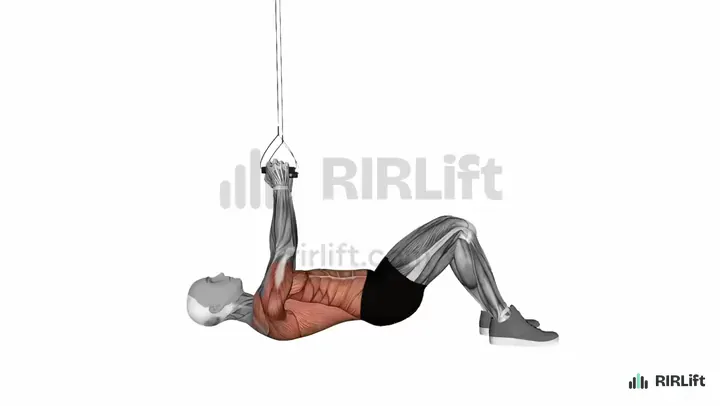
Lats, straight-arm pullover

Dumbbell Lat Pullover

Lats

At home you rarely have a cable for straight-arm work, and the pullover fills that gap: the lats lower one dumbbell behind your head and pull it back over your chest, with the biceps out of the way. Done on the floor, the floor itself stops the range at a safe point.

How to do it

  1. Lie face up on the floor, knees up and feet down, or across a bench if you have one, holding one dumbbell with both hands over your chest.
  2. Soften your elbows a little and hold that exact angle for the whole set.
  3. Lower the weight behind your head in an arc until it nearly touches the floor behind you, or until your upper arms line up with your torso on a bench.
  4. Return it above your chest by driving your upper arms down toward your hips.

Cues

  • Same elbow bend all set
  • Ribs pinned down
  • Arms sweep, they do not bend

Common mistakes

  • Turning it into a skull crusher by bending and straightening the elbows: fix the angle and choose a lighter dumbbell.
  • Arching your back to reach further: brace your abs and let the range end where your ribs stay down.

Swap for: Kettlebell Pullover, Band Bent-Over Row, TRX Row

Back exercises with bands or a suspension trainer

Bands and straps are what make a home back workout possible without weights. Straps over a door give you a row with your bodyweight, a long band gives you a bent-over row, and a light band covers the rear delts and upper back with pull-aparts and face pulls.

Lats and upper back, suspension row

TRX Row

Upper Back, Lats

Straps hung over a door or a beam turn your bodyweight into a row you can make easier or harder by walking your feet. Start sitting low with bent legs, which suits almost everyone, and moving your feet forward makes it harder.

How to do it

  1. Anchor the suspension straps above a closed door or a beam, take a handle in each hand, and sit back, knees bent, both soles planted.
  2. Lean back until your arms are straight and your body forms a line from knees to shoulders.
  3. Pull your chest up to the handles by driving your elbows back past your ribs.
  4. Lower back to straight arms under control and repeat.

Cues

  • Hips stay up in line
  • Elbows past the ribs
  • Walk the feet forward to make it harder

Common mistakes

  • Letting your hips sag as you tire: squeeze your glutes and end the set when the line breaks.
  • Pulling only with the arms and stopping short: the handles should finish beside your chest every rep.

Swap for: Band Bent-Over Row, One-Arm Dumbbell Row, Kettlebell Gorilla Row

Build a session with TRX Row

Lats and mid-back, band row

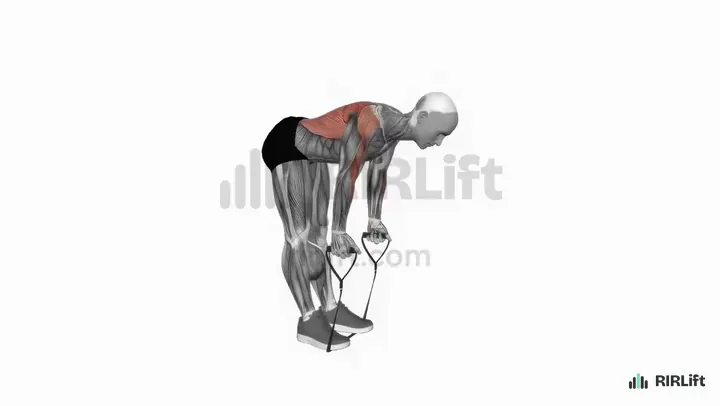
Band Bent-Over Row

Lats, Upper Back

Standing on a long band and rowing it toward your ribs costs a few dollars and fits in a drawer, and the band gets harder as you pull, so the squeeze at the top is the hardest part of the rep. It is the row for the no-bar, no-weights plan.

How to do it

  1. Stand on the middle of a long band with your feet hip-width apart and hold an end in each hand.
  2. Hinge forward from the hips with soft knees until your torso is at about 45 degrees, back flat.
  3. Row both handles toward your lower ribs, elbows close, and pause with your shoulder blades pulled together.
  4. Let the band pull your arms back to straight slowly and repeat.

Cues

  • Hold the squeeze for a second
  • Slow on the way back
  • Shorten your grip to add tension

Common mistakes

  • Letting the band snap your arms back down: resist it all the way, because the lowering counts.
  • Using a band so light the set never gets close to failure: choke up on the band or switch to a heavier one.

Swap for: One-Arm Dumbbell Row, TRX Row, Dumbbell Bent-Over Row

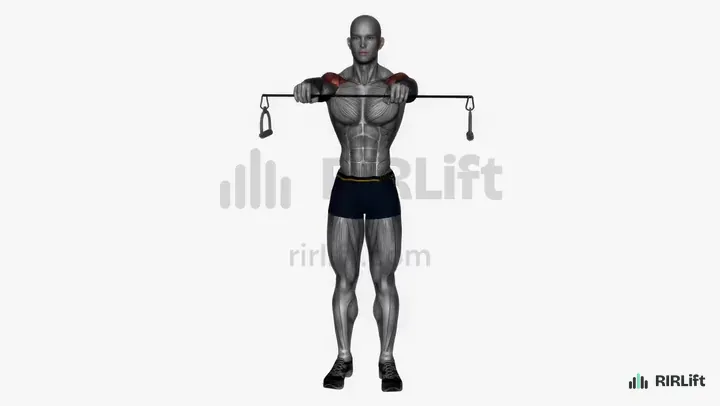
Rear delts and rhomboids, band pull-apart

Band Pull-Apart

Shoulders, Upper Back

Pulling a band apart in front of your chest trains the muscles between and behind your shoulder blades, which most home rows barely touch. It takes a minute between harder sets and is easy to do daily at a desk.

How to do it

  1. Hold a light band at chest height, arms long, hands about shoulder-width apart, palms down.
  2. Pull your hands apart and wide until the band touches your chest.
  3. Hold for a second with your shoulder blades squeezed together.
  4. Return slowly to the start, keeping tension on the band, and repeat.

Cues

  • Arms stay straight
  • Band to the chest
  • Shoulders stay away from the ears

Common mistakes

  • Bending the elbows to make it easier: narrow your hands on the band instead.
  • Arching your lower back to finish the rep: keep your ribs down and stand tall.

Swap for: Band Face Pull, TRX Row, Band Bent-Over Row

Rear delts and upper back, band face pull

Band Face Pull

Shoulders, Upper Back

Anchor a band at head height on a door and pull it toward your face with your elbows high: it trains the rear delts and the external rotators that keep your shoulders healthy for all the pulling and pushing you do. It is the band version of the cable face pull from the gym.

How to do it

  1. Anchor a band at about face height in a door and hold an end in each hand, palms facing down.
  2. Step back until there is tension with your arms reaching forward.
  3. Pull the band toward your forehead, splitting your hands apart and lifting your elbows high and wide.
  4. Pause, then let the band return under control.

Cues

  • Elbows high and wide
  • Hands finish beside your ears
  • Pause at the face

Common mistakes

  • Pulling to the chest with the elbows low, which turns it into a row: aim the hands at your eyes.
  • Leaning back to move the band: stand tall and use a lighter band.

Swap for: Band Pull-Apart, Dumbbell Rear Delt Fly, TRX Face Pull

Lower back exercises at home

The lower back works whenever you hold your spine still while your hips move. With no gear, that is the superman with a long hold; with one kettlebell, it is the swing. Do one of them to close out a back session.

Lower back and glutes, floor extension

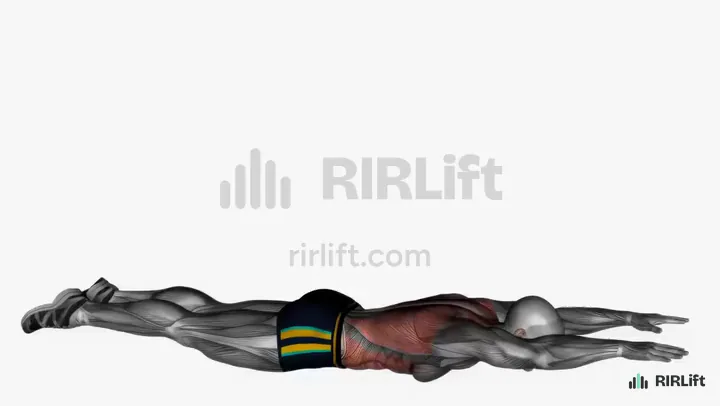
Superman

Lower Back

Lying face down and lifting your arms and legs works the muscles along your spine with no equipment at all. It is the lower-back exercise for a home with nothing in it, and with a pause at the top it gets hard quickly.

How to do it

  1. Lie face down on a mat, arms reaching past your head, legs long.
  2. Squeeze your glutes and raise your arms, upper chest and legs a few inches off the mat together.
  3. Hold the top for two to three seconds, looking at the floor.
  4. Lower slowly back to the mat and repeat.

Cues

  • Long body, reach away
  • Glutes tight first
  • Gaze at the floor

Common mistakes

  • Throwing your head back to lift higher: keep your neck long, the height comes from your back and hips.
  • Rushing through reps: the pause at the top is what makes the set work.

Swap for: Kettlebell Swing, Band Good Morning, Exercise Ball Back Extension

Build a session with Superman

Lower back, glutes and hamstrings, ballistic hinge

Kettlebell Swing

Glutes, Hamstrings

A swing trains the hinge with a snap at the top, so your spinal erectors and glutes work hard in short sets, and one kettlebell covers it. It is the home lower-back move with a load that you can actually progress.

How to do it

  1. Stand with your feet a little wider than your hips, the bell set about a foot in front of you.
  2. Hinge down, grip the handle with both hands, and hike the bell back between your thighs.
  3. Snap your hips forward to stand tall, letting the bell float up to chest height on straight arms.
  4. Let it fall back between your legs as you hinge again, and go straight into the next rep.

Cues

  • Hips snap, arms just hold on
  • Stand tall at the top
  • Bell passes high between the thighs

Common mistakes

  • Squatting the swing by bending the knees deeply: push your hips back and keep the shins nearly vertical.
  • Lifting the bell with your shoulders: if your arms are working, the hips are not driving it.

Swap for: Dumbbell Romanian Deadlift, Kettlebell Deadlift, Superman

Put them together: example sessions

Each session below picks from the exercises above for one situation, with the sets, reps, rest and RIR filled in. Open one in the session builder to change a pick, price it from a recent set, and add it to RIRLift.

Session 1

Pull-up bar and bands, no weights

Open in the session builder
  • Workouts2× a week
  • Working sets24 a week
  • Per workout~30 min
  • EquipmentPull-Up Bar, Resistance Bands, Suspension Trainer

You have a doorframe pull-up bar, a few loop or long bands, and maybe straps for the door, but no dumbbells.

The bar does the heavy lifting here: pull-ups or band-assisted pull-ups come first in both sessions because they are the hardest back exercise you own, and the rows that follow use bands and straps that you adjust by stance and band thickness. Sets stop 1 rep short of failure on the pulls and 0 to 1 on band work, because bands only get hard at the top. Each session is 12 working sets, with the superman as the lower-back finisher.

Back A
ExerciseSets × repsRIRRest
Pull-Up1 warm-up set firstUse a band if you cannot reach 5 reps. 4 × 5–10 1 2:30 min
Band Bent-Over RowPause 1 s at the ribs. 3 × 12–20 1 1 min
Band Pull-ApartArms straight. Band to the chest. 3 × 15–25 0 45 s
SupermanHold 3 s at the top. 2 × 8–12 2 1 min

Open Back A in the session builder

Back B
ExerciseSets × repsRIRRest
Chin-Up1 warm-up set firstPalms toward you. Full hang. 4 × 5–10 1 2:30 min
TRX RowKnees bent. Walk feet forward to progress. 3 × 8–15 1 90 s
Band Face PullHands to the forehead. 3 × 15–25 0 45 s
SupermanHold 3 s at the top. 2 × 8–12 2 1 min

Open Back B in the session builder

How to run it
Do Back A and Back B on two non-consecutive days a week. If you cannot do 5 pull-ups yet, use the band-assisted version for every pull-up set and keep the chin-ups band-assisted too.
How to progress
On the bar, add a rep to each set until you reach the top of the range, then switch to a thinner band or, once unassisted, slow the lowering to four seconds. On straps, walk your feet forward a few inches; on bands, choke up or step to the next band.

Session 2

Dumbbells or kettlebells, no pull-up bar

Open in the session builder
  • Workouts2× a week
  • Working sets23 a week
  • Per workout~25 min
  • EquipmentDumbbells, Resistance Bands, Kettlebells

You train at home with a pair of dumbbells or two kettlebells and a sturdy chair, but there is nowhere to hang a bar.

Without a bar, the pullover stands in for the vertical pull and every other slot is a row: the one-arm row first while you are fresh, a two-arm or gorilla row second, and band work for the rear delts. Rows run 8 to 15 reps at 1 rep in reserve, and the swing finishes at 2 to 3 reps short of a form break, because a tired hinge loses its snap before the muscle fails. Each session is 12 working sets.

Back A
ExerciseSets × repsRIRRest
One-Arm Dumbbell Row1 warm-up set firstPer arm. Hand on a chair seat. 3 × 8–15 1 90 s
Dumbbell Bent-Over RowPause 1 s at the top. 3 × 8–15 1 90 s
Band Pull-ApartLight band. 3 × 15–25 0 45 s
Kettlebell SwingSnap the hips. Stop when the snap fades. 3 × 12–20 2 90 s

Open Back A in the session builder

Back B
ExerciseSets × repsRIRRest
Kettlebell Gorilla Row1 warm-up set firstPer side. Push the other bell into the floor. 3 × 8–12 1 90 s
Dumbbell Lat PulloverOn the floor, knees bent. 3 × 10–15 1 75 s
Band Face PullBand anchored in a door. 3 × 15–25 0 45 s
SupermanHold 3 s at the top. 2 × 8–12 2 1 min

Open Back B in the session builder

How to run it
Do Back A and Back B once each per week. Use the gorilla row if you have kettlebells and the bent-over row if you have dumbbells; the pullover works lying on the floor.
How to progress
Double progression: when every set reaches the top of the rep range at the target reps in reserve, move up to the next dumbbell or kettlebell. If you only have one fixed pair, slow the lowering to three seconds and pause at the top of each row before you need heavier weights.

Session 3

Pull-up bar plus adjustable weights

Open in the session builder
  • Workouts2× a week
  • Working sets26 a week
  • Per workout~35 min
  • EquipmentPull-Up Bar, Dumbbells, Kettlebells, Suspension Trainer +1

You have a bar, adjustable dumbbells or several kettlebells, and you want back to grow as fast as it would in a gym.

Having both a bar and weights means you can pair a vertical pull with a loaded row in every session, which covers the lats from overhead and the mid-back from the front the way a gym day would. One session is heavier, with pull-ups for 5 to 8 and long rests, and the other is lighter, with chin-ups and higher-rep rows, so the week has both kinds of stimulus. Sets end at 1 rep in reserve and the rear delt work at 0, for 13 working sets per session.

Heavy
ExerciseSets × repsRIRRest
Pull-Up2 warm-up sets firstAdd weight past 10 clean reps. 4 × 5–8 1 3 min
Dumbbell Bent-Over RowHeavy pair. Torso near flat. 3 × 6–10 1 2 min
Dumbbell Lat PulloverAcross a bench or on the floor. 3 × 10–15 1 75 s
Kettlebell SwingHeaviest bell you can snap. 3 × 10–15 2 90 s

Open Heavy in the session builder

Volume
ExerciseSets × repsRIRRest
Chin-Up1 warm-up set firstSlow lowering. 3 × 8–12 1 2 min
One-Arm Dumbbell RowPer arm. Full stretch at the bottom. 3 × 10–15 1 75 s
TRX RowFeet forward until hard. 3 × 10–15 1 1 min
Band Face PullPause at the face. 2 × 15–25 0 45 s
Band Pull-ApartStraight arms. 2 × 15–25 0 45 s

Open Volume in the session builder

How to run it
Do the Heavy day early in the week and the Volume day at least two days later. Add a belt or a dumbbell between your feet for the pull-ups once you pass 10 clean reps.
How to progress
On pull-ups, add reps until you reach 8 on every set, then add weight. On rows, move up a dumbbell step once every set hits the top of the range at the target reps in reserve.

Make it fit you

Questions

Can you train your back at home without equipment?

Yes, but only partly. With nothing, you can do supermans for the lower back and a towel row against a closed door for the mid-back. To train the lats properly you need something to pull from overhead, which is why a doorframe bar or a set of bands is the first purchase worth making.

What are the big 3 exercises for back?

At home, the big three are a vertical pull (pull-up or chin-up), a horizontal row (one-arm dumbbell row, band row or suspension row) and a hinge for the lower back (superman or kettlebell swing). Those three cover the lats, the mid-back and the spinal erectors.

What are the 5 best back exercises at home?

The pull-up, the chin-up, the one-arm dumbbell row, the suspension row and the kettlebell swing. If you have no bar, swap the two bar exercises for the band bent-over row and the dumbbell pullover.

What is the #1 back exercise?

The pull-up. It trains the lats through their full range against your whole bodyweight, it works with a cheap bar, and you can make it easier with a band or harder with added weight, so it lasts from your first week to your fifth year.

How many sets of back should I do at home?

Aim for 10 to 20 hard sets a week across your lats and upper back, split over two sessions. A set is hard when it ends within 1 or 2 reps of failure, which with bands and light weights usually means 12 to 25 reps.

Can resistance bands build back muscle?

Yes, if the sets get close to failure. Bands are hardest near full contraction, so pause at the top of each rep, control the return, and switch to a heavier band or choke up once you can do more than 25 reps.