
Dumbbell quad exercises: squats, split squats, lunges and step-ups
Published October 19, 2026
The best dumbbell quad exercises are the heels-elevated goblet squat, the Bulgarian split squat, the dumbbell front squat and the step-up. What makes a dumbbell exercise hit the quads rather than the glutes is how far your knee travels forward and how upright your torso stays, so pick squats with the weight in front of you and lunges with a short stride. One squat and one single-leg exercise per session, taken close to failure, is enough to grow your quads with dumbbells alone.
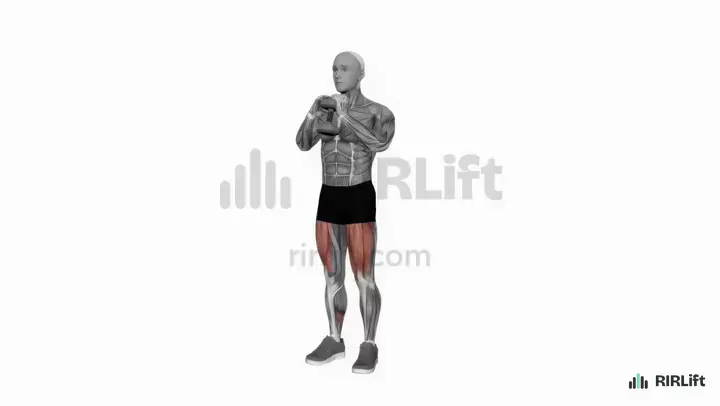
- Heels-Elevated Goblet Squat Quads
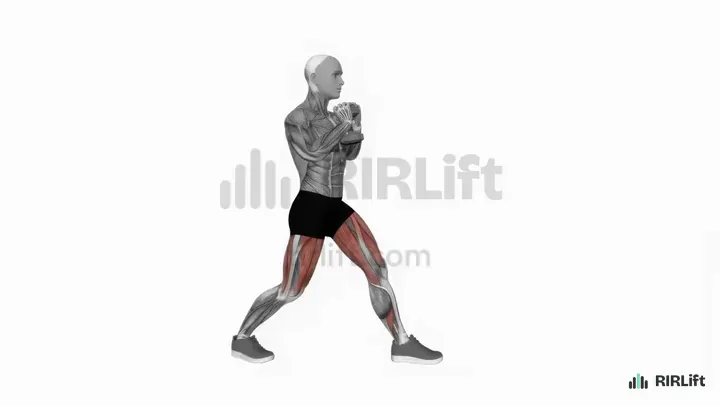
- Bulgarian Split Squat Quads, Glutes
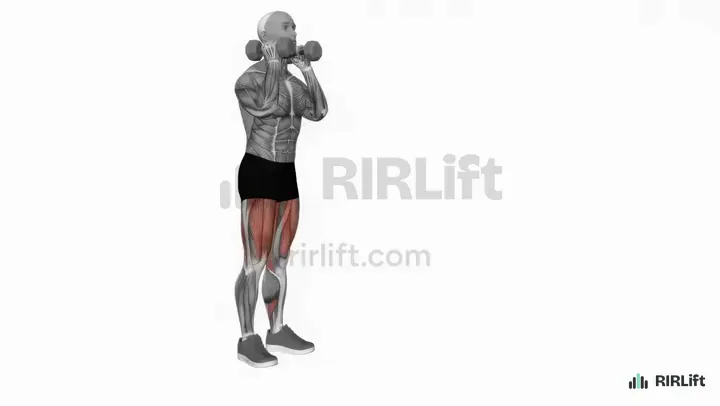
- Dumbbell Front Squat Quads, Glutes
- Step-Up Quads, Glutes
- Goblet Squat Quads, Glutes
- Dumbbell Goblet Split Squat Quads, Glutes
- Dumbbell Front Rack Lunge Quads, Glutes
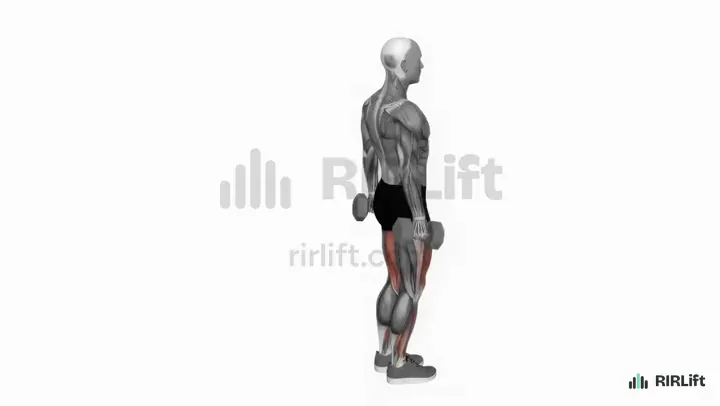
- Dumbbell Reverse Lunge Quads, Glutes
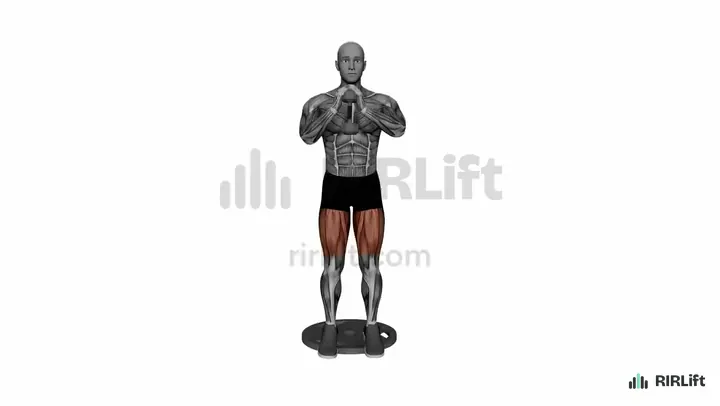
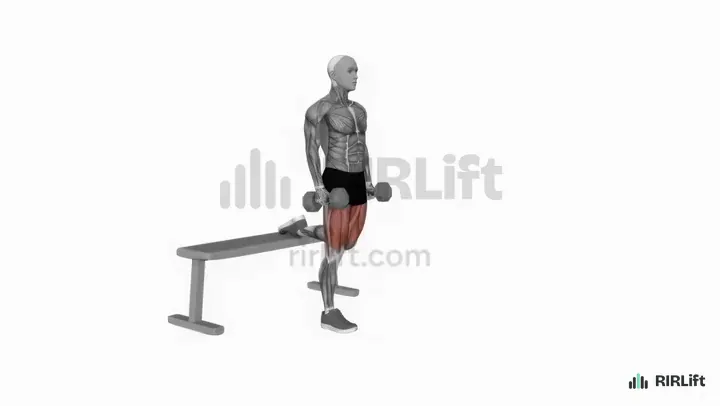
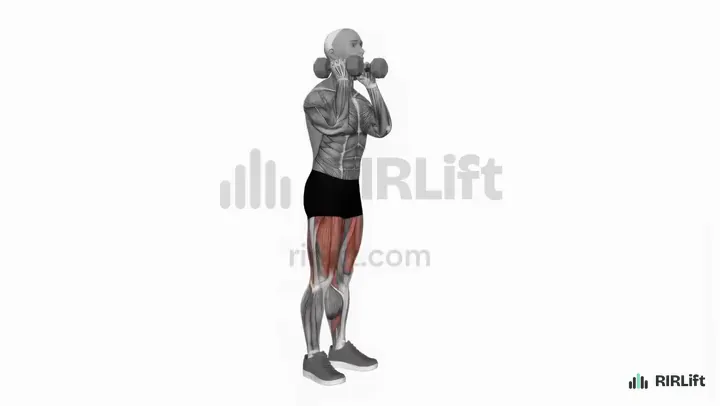
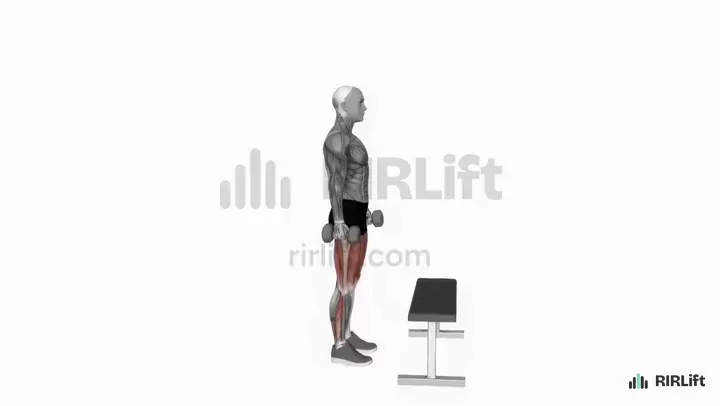
Put them together: example sessions
Each session below picks from the exercises above for one situation, with the sets, reps, rest and RIR filled in. Open one in the session builder to change a pick, price it from a recent set, and add it to RIRLift.
-
Session 1
One light pair of dumbbells, no bench
You train at home with one pair of light or medium dumbbells and floor space, and you want your quads to grow without buying heavier weights.
2× a week · 20 sets a week · ~25 min
-
Session 2
Heavy or adjustable dumbbells and a bench
You have heavy dumbbells (or an adjustable set) and a bench at home or in a gym, and quads are your priority.
2× a week · 22 sets a week · ~35 min
-
Session 3
Knees that ache on deep squats and forward lunges
Deep squats or forward lunges bother your knees, and you still want to train your quads hard with dumbbells.
2× a week · 20 sets a week · ~25 min
Session 1
One light pair of dumbbells, no bench
- Workouts2× a week
- Working sets20 a week
- Per workout~25 min
- EquipmentDumbbells
You train at home with one pair of light or medium dumbbells and floor space, and you want your quads to grow without buying heavier weights.
Light dumbbells only work for the quads if the exercise makes them heavy, so the plan leans on the heels-elevated goblet squat with one dumbbell, a goblet split squat that loads one leg at a time, and the goblet forward lunge. Reps run 12 to 25 and every set ends 0 to 1 reps short of failure, which grows muscle about as well as heavier sets. Each session is 10 hard sets.
| Exercise | Sets × reps | RIR | Rest |
|---|---|---|---|
| Heels-Elevated Goblet SquatHeels on a plate. One dumbbell. | 4 × 12–25 | 1 | 90 s |
| Dumbbell Goblet Split SquatPer leg. 3 s down. | 3 × 10–20 | 0 | 1 min |
| Dumbbell Forward LungePer leg. Alternate. | 3 × 10–20 | 1 | 1 min |
Open Quads A in the session builder
| Exercise | Sets × reps | RIR | Rest |
|---|---|---|---|
| Dumbbell Goblet Split SquatPer leg. Pause at the bottom. | 4 × 10–20 | 1 | 1 min |
| Heels-Elevated Goblet Squat1 s pause at the bottom. | 3 × 15–25 | 0 | 90 s |
| Dumbbell Lateral LungePer side. | 3 × 10–15 | 1 | 1 min |
Open Quads B in the session builder
- How to run it
- Do Quads A and Quads B once each per week with at least two days between them. A couple of plates or a thick book under your heels is enough for the heels-elevated squat.
- How to progress
- When every set hits the top of its range, slow the lowering to three seconds, then add a one-second pause at the bottom. Add a dumbbell only once 25 slow reps with a pause are easy.
Session 2
Heavy or adjustable dumbbells and a bench
- Workouts2× a week
- Working sets22 a week
- Per workout~35 min
- EquipmentDumbbells, Flat Bench
You have heavy dumbbells (or an adjustable set) and a bench at home or in a gym, and quads are your priority.
With real load, the dumbbell front squat leads each session at 6 to 10 reps and 2 reps in reserve, a heavy set where form is the limit. The Bulgarian split squat and step-up then push each leg close to failure on the bench, and the front-rack lunge adds volume without a grip limit. Session A is 12 hard sets and session B is 11.
| Exercise | Sets × reps | RIR | Rest |
|---|---|---|---|
| Dumbbell Front Squat2 warm-up sets firstElbows up. Thighs to parallel. | 4 × 6–10 | 2 | 2:30 min |
| Bulgarian Split SquatPer leg. Short stance. | 4 × 8–12 | 1 | 90 s |
| Dumbbell Front Rack LungePer leg. | 3 × 8–12 | 1 | 90 s |
Open Quads Heavy A in the session builder
| Exercise | Sets × reps | RIR | Rest |
|---|---|---|---|
| Bulgarian Split Squat1 warm-up set firstPer leg. Weaker leg first. | 4 × 8–12 | 1 | 90 s |
| Step-UpPer leg. Knee-height bench. | 4 × 8–12 | 1 | 90 s |
| Heels-Elevated Goblet SquatHeaviest single dumbbell. | 3 × 12–20 | 0 | 90 s |
Open Quads Heavy B in the session builder
- How to run it
- Do Quads Heavy A and Quads Heavy B once each per week. Warm up with one light set of the first exercise.
- How to progress
- For the front squat, add reps until all sets reach 10, then go up the smallest jump your dumbbells allow. For the single-leg exercises, add reps first and weight second, always starting with the weaker leg.
Session 3
Knees that ache on deep squats and forward lunges
- Workouts2× a week
- Working sets20 a week
- Per workout~25 min
- EquipmentDumbbells, Flat Bench
Deep squats or forward lunges bother your knees, and you still want to train your quads hard with dumbbells.
This plan keeps the quads working but chooses the exercises that load them with less knee bend or a more vertical shin: the reverse lunge, the static split squat to a depth you control, and the step-up on a lower box. A goblet squat to a bench or box sets a depth that stays comfortable. Sets stop at 2 reps in reserve so you do not grind reps with poor form, and a 3-second lowering adds work without adding weight. Ten hard sets per session.
| Exercise | Sets × reps | RIR | Rest |
|---|---|---|---|
| Dumbbell Reverse LungePer leg. Weight on the front heel. | 4 × 8–12 | 2 | 90 s |
| Goblet SquatSquat to a bench. 3 s down. | 3 × 10–15 | 2 | 90 s |
| Dumbbell Split SquatPer leg. Pain-free depth. | 3 × 8–12 | 2 | 1 min |
Open Knee-Friendly A in the session builder
| Exercise | Sets × reps | RIR | Rest |
|---|---|---|---|
| Step-UpPer leg. Start with a shin-height box. | 4 × 8–12 | 2 | 90 s |
| Dumbbell Reverse LungePer leg. 3 s down. | 3 × 10–12 | 2 | 90 s |
| Dumbbell Lateral LungePer side. Short range first. | 3 × 8–12 | 2 | 1 min |
Open Knee-Friendly B in the session builder
- How to run it
- Do Knee-Friendly A and B once each per week. Only go as deep as is comfortable on every rep, and raise the depth over weeks as it allows.
- How to progress
- Add depth before weight: lower the box for the goblet squat, or let the back knee travel closer to the floor on split squats. Once full depth feels fine for two weeks, add reps, then load.
Make it fit you
-
Only one dumbbell
Run the light pair plan as written: every exercise in it uses a single dumbbell at the chest. Hold the dumbbell at your side on the working-leg side for split squats once the goblet hold gets too easy to balance.
-
Quads lag behind your glutes
Elevate your heels on every squat and shorten the stance on every split squat until your front knee travels past your toes. Move the heels-elevated goblet squat to the first slot of every session.
-
Grip gives out before your legs
Swap dumbbells-at-your-sides versions for the front rack: the front squat instead of the dumbbell squat, and the front-rack lunge instead of a lunge holding the dumbbells at your sides.
-
Only 20 minutes
Pick one squat and one split squat, three sets each, and superset them: squat set, rest 60 seconds, split squat set on each leg, rest 60 seconds. Twice a week, that is 12 hard quad sets.
-
New to lifting
Start with the goblet squat, split squat and reverse lunge at 2 to 3 reps in reserve, three sets each, twice a week. Add the Bulgarian split squat and step-up after a month of steady form.
-
Log the RIR, not just the weight
Write down how many reps you had left on every working set, per leg on the single-leg exercises. If you log in RIRLift, it picks your next weight from those numbers, so you can see when the weaker leg catches up.
Questions
What is the best dumbbell exercise for quads?
The heels-elevated goblet squat for two legs and the Bulgarian split squat for one leg. In both, your torso stays upright and your knees travel forward, which loads the quads more than the glutes. If you only do one, pick the Bulgarian split squat: it stays hard with light dumbbells.
How do you squat with dumbbells?
Hold one dumbbell at your chest for a goblet squat, two on your shoulders for a front squat, or two at your sides for a dumbbell squat. In each, brace your stomach, sit down between your heels with your knees tracking over your toes, and stand back up with your chest tall. The goblet squat is the easiest to learn first.
How do you strengthen your quads without squatting?
Use step-ups, split squats and reverse lunges. Each trains the quads one leg at a time, and step-ups and reverse lunges let you control how far the knee bends. The knee-friendly plan on this page is built from them.
What are signs of weak quads?
In training, weak quads show up as leaning forward to finish a squat, knees caving inward on the way up, using your hands to push off your thighs when standing from a low chair, or a split squat that is much harder than a hip thrust or deadlift at the same effort. All of them improve with the exercises on this page.
Can you build big quads with only dumbbells?
Yes. Muscle grows from hard sets taken close to failure, and one-leg dumbbell exercises let each quad carry heavy enough loads for years. The limit comes when your heaviest dumbbells stop making 20 reps hard on a Bulgarian split squat; then slow the tempo or get heavier dumbbells.
How many quad exercises should I do per session?
Two or three: one squat and one or two single-leg exercises. Three to four hard sets each, twice a week, gives your quads 12 to 20 weekly sets, which is plenty for most people.
Is 4 exercises enough for a leg day?
Yes. For a quad-focused day, a squat, a split squat, a lunge or step-up and a hamstring or calf exercise covers it. Four exercises done hard beat eight done halfway.
Related templates
-
Quad exercises at home: squats, split squats and no-equipment moves
Bodyweight and home-gear quad work when you have little or no equipment.
-
Leg exercises with dumbbells: quads, hamstrings, glutes and calves
Full dumbbell leg days that add hamstrings, glutes and calves.
-
Dumbbell lower body exercises: squat, hinge, lunge, thrust and carry
Squats, hinges, hip thrusts and carries for the whole lower body.
-
Dumbbell squats: how to do them and how to hold the weights
Full form guide for the squat with dumbbells at your sides.
-
The best workout for thighs, inner thighs included
Complete programs for the front, back and inside of the thigh.