Quad exercises at home: squats, split squats and no-equipment moves

The best quad exercises at home are the heels-elevated goblet squat, the Bulgarian split squat and the step-up if you own a dumbbell and a chair, and the sissy squat, skater squat and wall sit if you have nothing at all. Quads grow from bending the knee deeply under load, so pick one squat and one single-leg move per session, do 3 or 4 hard sets of each 1 to 2 reps short of failure, and train them twice a week. With light weights or none, single-leg moves and slow lowering keep the sets hard.

  1. Heels-Elevated Goblet Squat Quads
  2. Bulgarian Split Squat Quads, Glutes
  3. Goblet Squat Quads, Glutes
  4. Step-Up Quads, Glutes
  5. Sissy Squat Quads
  6. Skater Squat Quads, Glutes
  7. Dumbbell Forward Lunge Quads, Glutes
  8. Wall Sit Quads

Squats for quads at home

A squat with an upright torso and knees traveling forward puts the most load on your quads. Holding a dumbbell at your chest and raising your heels both push you into that position, which is why the goblet and heels-elevated versions beat a plain squat when the goal is the front of the thigh.

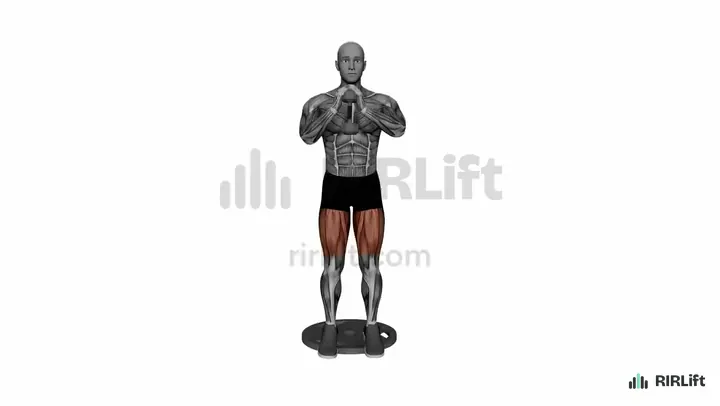
Quads, squat with one dumbbell

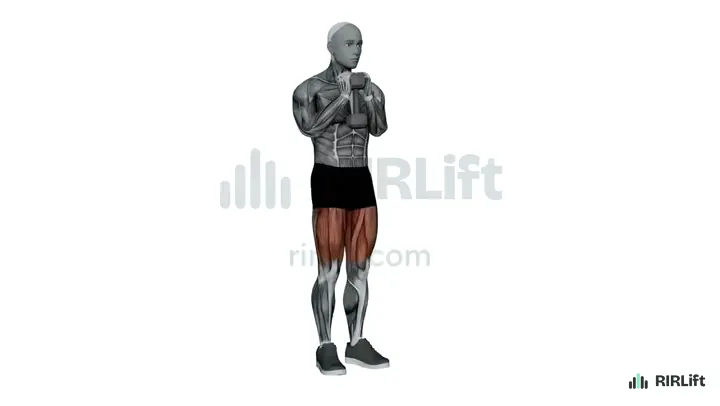
Goblet Squat

Quads, Glutes

Holding one dumbbell at your chest keeps your torso upright and lets you sit deep between your knees, which is exactly where the quads work hardest. It is the first loaded squat to learn at home.

How to do it

  1. Cup the top end of one dumbbell in both hands, held upright at your chest.
  2. Set your feet a little wider than your hips, toes turned out slightly.
  3. Sit straight down between your heels, letting your knees travel forward over your toes, until your elbows reach the insides of your knees.
  4. Stand up by pushing the floor away, keeping your chest tall.

Cues

  • Elbows inside the knees at the bottom
  • Chest up against the weight
  • Knees forward, heels down

Common mistakes

  • Leaning forward as you stand: the dumbbell pulls you over. Keep it tight to your chest.
  • Cutting depth short: go as low as your heels allow; that is where the quads work.

Swap for: Heels-Elevated Goblet Squat, Dumbbell Front Squat, Bulgarian Split Squat

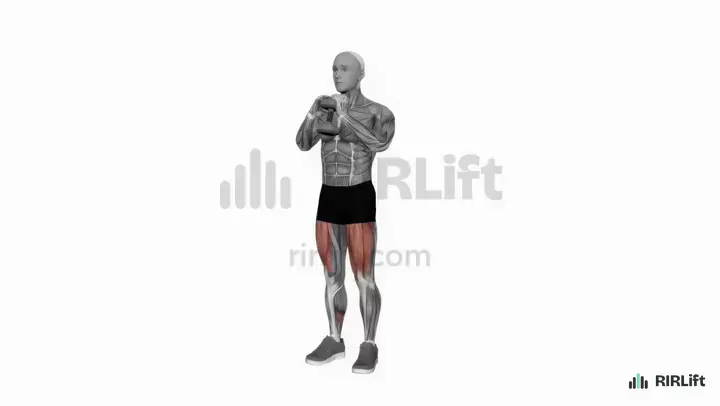
Quads, knee-forward squat

Heels-Elevated Goblet Squat

Quads

Putting your heels on a plate, book or wedge lets your knees go further forward, which shifts more of the work from your hips to your quads. A narrow stance adds to it, so this is the most quad-focused squat you can do with one dumbbell.

How to do it

  1. Stand with your heels on two small plates or a thick book, feet close together, a dumbbell held at your chest.
  2. Sit straight down, letting your knees travel well past your toes.
  3. Go as deep as you can with your torso upright.
  4. Stand back up, driving through your whole foot.

Cues

  • Knees chase the toes
  • Torso stays vertical
  • Slow on the way down

Common mistakes

  • Raising the heels too high: an inch or two is enough.
  • Bouncing at the bottom: control the lowering and pause briefly.

Swap for: Goblet Squat, Dumbbell Front Squat, Sissy Squat

Quads, squat with two dumbbells

Dumbbell Front Squat

Quads, Glutes

Two dumbbells resting on your shoulders let you load the squat heavier than one at your chest, once your goblet squat is too light.

How to do it

  1. Rest a dumbbell on each shoulder, elbows pointing forward, feet about hip-width.
  2. Squat down between your heels, keeping your elbows high and chest up.
  3. Go to at least parallel.
  4. Drive back up to standing.

Cues

  • Elbows high
  • Sit between the heels
  • Brace before each rep

Common mistakes

  • Dropping the elbows: the dumbbells pull you forward.
  • Letting the knees cave in: press them out over the toes.

Swap for: Goblet Squat, Heels-Elevated Goblet Squat, Bulgarian Split Squat

Quads, unloaded squat

Bodyweight Squat

Quads

It is where to start if you are new, and a high-rep finisher for everyone else. On its own, it gets too easy for most people within weeks, so treat it as a stepping stone.

How to do it

  1. Stand with your feet a little wider than your hips, arms reaching forward for balance.
  2. Sit down between your heels as deep as you can with your chest up.
  3. Pause a moment at the bottom.
  4. Stand back up and repeat.

Cues

  • Arms forward for balance
  • Deep and controlled
  • Heels stay down

Common mistakes

  • Rushing reps: slow the lowering to three seconds to make it count.
  • Doing 50 easy reps: once 25 is easy, move to a goblet or split squat.

Swap for: Goblet Squat, Wall Sit, Sissy Squat

Split squats, lunges and step-ups

On one leg, a light dumbbell becomes a hard set, so these are the main quad builders for most home setups. A chair or couch is enough for the Bulgarian split squat and the step-up; the forward lunge needs only floor space.

Quads and glutes, rear-foot-elevated split squat

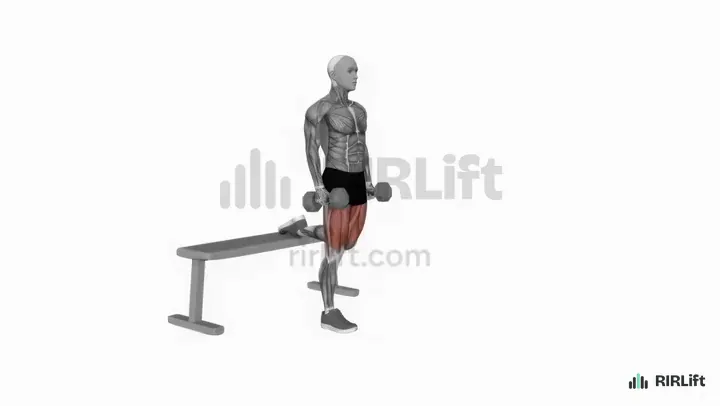
Bulgarian Split Squat

Quads, Glutes

With your back foot on a chair or couch, almost all your weight goes onto the front leg, so light dumbbells or none still make a hard set. It is the best single quad exercise for a home setup.

How to do it

  1. Stand in front of a chair or couch and rest the laces of your back foot on it, dumbbells at your sides.
  2. Sink until the front thigh is about level with the ground.
  3. Let your front knee travel forward over the toes, keeping your torso fairly upright for quads.
  4. Drive up through the front foot. Finish the set, then switch legs.

Cues

  • Front knee forward, torso tall
  • Back foot just rests
  • Straight down, straight up

Common mistakes

  • Standing too close to the chair: you end up on your toes. Move the front foot out.
  • Leaning far forward: that shifts work to the glutes. Stay upright for quads.

Swap for: Step-Up, Dumbbell Forward Lunge, Skater Squat

Quads and glutes, step onto a box

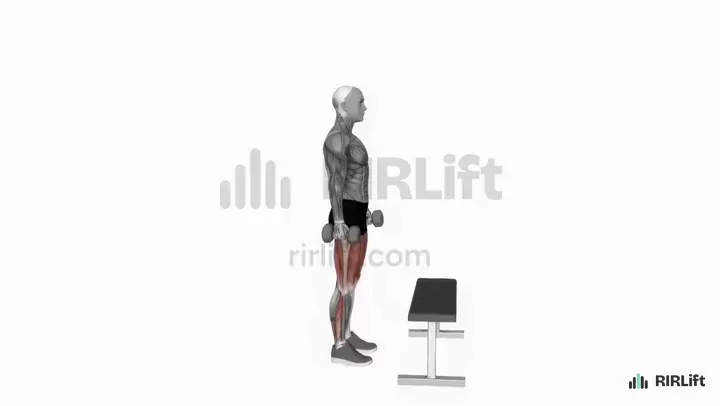
Step-Up

Quads, Glutes

It trains one leg at a time with your knee in a safe position, and a sturdy chair or bench is all it needs. Lower boxes work the quads more, higher ones the glutes.

How to do it

  1. Stand facing a sturdy bench, dumbbells at your sides.
  2. Set your whole right foot on the seat of the bench.
  3. Press through that foot to stand on the bench, letting the left foot come up after.
  4. Step back down slowly with the left foot. Finish the set on the right leg, then switch.

Cues

  • Push through the top foot only
  • Control the step down
  • Knee over the toes

Common mistakes

  • Pushing off the floor foot: keep its job to balance.
  • Using a box so high you twist to get up: go lower.

Swap for: Bulgarian Split Squat, Dumbbell Forward Lunge, Skater Squat

Build a session with Step-Up

Quads and glutes, forward step

Dumbbell Forward Lunge

Quads, Glutes

Stepping forward makes your front knee brake your body, which is hard work for the quads. Holding the dumbbell at your chest keeps your torso upright.

How to do it

  1. Cup a dumbbell upright at your chest and stand with feet together.
  2. Take a big step forward and lower until both knees bend about 90 degrees.
  3. Stay tall, front knee over the toes.
  4. Push off the front foot to step back to the start. Alternate legs or finish one side first.

Cues

  • Big step, upright torso
  • Brake with the front leg
  • Push back to the start

Common mistakes

  • Stepping too short: it jams the front knee forward over the toes.
  • Leaning forward: keep the dumbbell close and the chest up.

Swap for: Bulgarian Split Squat, Step-Up, Goblet Squat

Quad exercises with no equipment

With bodyweight alone, your options are long levers and one leg. The sissy squat leans your body back from the knees, the skater and pistol put everything on one leg, and the Cossack squat drops deep to one side. All of them get hard fast, even for strong lifters.

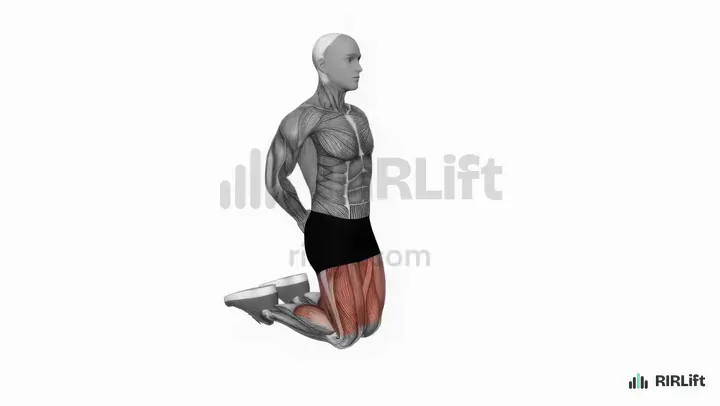
Quads, kneeling lean-back

Sissy Squat

Quads

The kneeling version leans your body back from the knees, so the quads work alone with no weight at all. It is the closest home move to a leg extension.

How to do it

  1. Kneel on a pad with your feet hooked under a couch, torso upright.
  2. Keeping a straight line from knees to head, lean back slowly.
  3. Go as far back as you can control.
  4. Pull yourself back to upright using your quads.

Cues

  • Hips stay forward
  • Lean back as one piece
  • Control the way back up

Common mistakes

  • Bending at the hips: it takes the quads out. Keep the hips extended.
  • Leaning so far you cannot come back: start with a small range.

Swap for: Heels-Elevated Goblet Squat, Wall Sit, Skater Squat

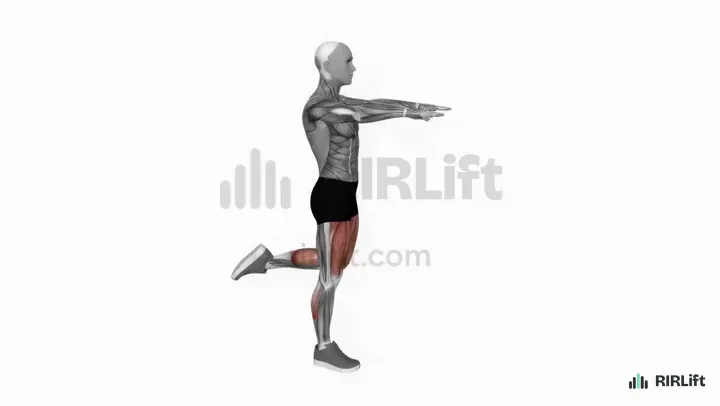
Quads and glutes, one-leg squat

Skater Squat

Quads, Glutes

It is a single-leg squat where the back knee drops to the floor behind you, easier to balance than a pistol and very hard on the quads.

How to do it

  1. Stand on your right foot with your left knee bent and foot behind you, arms reaching forward.
  2. Lower yourself on the right leg until the left knee lightly touches a pad on the floor.
  3. Keep your chest up and arms forward for balance.
  4. Stand back up on the right leg. Finish the set, then switch.

Cues

  • Arms forward as a counterweight
  • Back knee taps the pad
  • Stand up through the whole foot

Common mistakes

  • Crashing down onto the knee: control the lowering.
  • Starting without a pad: put a folded towel or pillow down.

Swap for: Pistol Squat, Bulgarian Split Squat, Step-Up

Quads and glutes, one-leg squat to a box

Pistol Squat

Quads, Glutes

Squatting on one leg to a chair or box is a strong lifter's quad exercise at home. The box sets the depth, so you can lower it over time.

How to do it

  1. Stand in front of a box or chair on one leg, the other leg held forward.
  2. Sit back and down on the standing leg until you touch the box.
  3. Pause for a moment without relaxing.
  4. Stand up on the same leg. Finish the set, then switch.

Cues

  • Touch, do not sit
  • Free leg out front
  • Knee tracks over the toes

Common mistakes

  • Plopping onto the box: control the lowering.
  • Letting the knee cave in: push it out over the toes.

Swap for: Skater Squat, Bulgarian Split Squat, Step-Up

Quads and inner thighs, side squat

Cossack Squat

Quads, Adductors

It drops you deep to one side, working the quads of the bent leg and stretching the inner thigh of the straight one. With bodyweight it is a solid quad exercise and good for hip mobility.

How to do it

  1. Stand in a wide stance, toes turned slightly out.
  2. Shift your weight to one leg and sit deep over that foot, keeping the other leg straight with its toes up.
  3. Go as low as you can with your heel down.
  4. Push back to the middle, then go to the other side.

Cues

  • Sit deep over one heel
  • Other leg long, toes up
  • Chest tall

Common mistakes

  • Heel lifting on the bent leg: go less deep.
  • Rounding the back to get lower: keep the chest up.

Swap for: Skater Squat, Goblet Squat, Bulgarian Split Squat

Knee-friendly quad exercises

If deep squats bother your knees, these let you work the quads hard at angles you can control. The wall sit holds one position, and the Spanish split squat uses a band pulling behind your knee to keep the shin vertical.

Quads, static hold

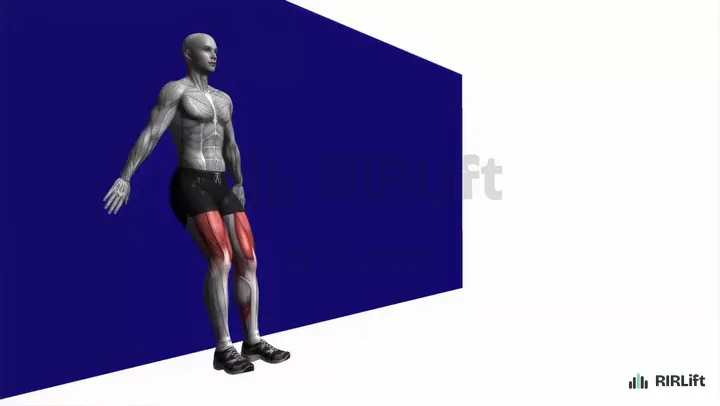
Wall Sit

Quads

A wall sit loads your quads without any movement at the knee, so it is a good option when moving through deep ranges hurts. Hold it at the angle you can tolerate.

How to do it

  1. Lean your back on a wall, feet about two feet in front of you.
  2. Slide down until your thighs are level with the ground, or to whatever depth feels comfortable.
  3. Keep your back flat on the wall and your knees over your ankles.
  4. Hold for the target time, then slide back up.

Cues

  • Back flat on the wall
  • Knees over the ankles
  • Breathe through the hold

Common mistakes

  • Pushing your hands on your thighs: keep them off.
  • Feet too close to the wall: the knees end up past your toes.

Swap for: Band Spanish Split Squat, Bodyweight Squat, Sissy Squat

Build a session with Wall Sit

Quads, band-supported split squat

Band Spanish Split Squat

Quads

A band anchored in front of you pulls behind the front knee, so the shin stays vertical and the quads do the work without stress on the front of the knee.

How to do it

  1. Anchor a band at knee height in front of you and loop it behind your front knee, stepping back until it is tight.
  2. Set up in a long stance, back heel raised.
  3. Sink down, letting the band hold your front shin vertical.
  4. Push back up through the front foot. Finish the set, then switch.

Cues

  • Shin stays vertical
  • Sit back into the band
  • Straight down

Common mistakes

  • Band too loose: step back further.
  • Leaning forward: stay upright so the quads work.

Swap for: Wall Sit, Step-Up, Bulgarian Split Squat

Put them together: example sessions

Each session below picks from the exercises above for one situation, with the sets, reps, rest and RIR filled in. Open one in the session builder to change a pick, price it from a recent set, and add it to RIRLift.

Session 1

No equipment at all

Open in the session builder
  • Workouts2× a week
  • Working sets24 a week
  • Per workout~25 min
  • EquipmentBodyweight

You have no weights, just a floor, a couch to hook your feet under, a pillow for your knee and a wall.

Without weights, sets only get hard through one leg or a long lever, so the session uses the skater squat and the sissy squat as its main lifts, each at 1 rep in reserve. The wall sit finishes the quads without moving the knee, and the bodyweight squat burns out what is left. That is 12 hard sets, twice a week.

Quads (No Equipment)
ExerciseSets × repsRIRRest
Skater SquatPer leg. Pad under the back knee. 4 × 6–15 1 75 s
Sissy SquatFeet under the couch. 3 × 8–15 1 75 s
Wall SitSeconds, not reps. 2 × 30–50 1 1 min
Bodyweight Squat3 s down. 3 × 20–40 0 1 min
How to run it
Do the session twice a week with at least two days between. Warm up with a set of bodyweight squats before the skater squats.
How to progress
Add reps or slow the lowering on the skater and sissy squats; when 15 reps are easy, move to pistols to a box. Hold the wall sit 10 seconds longer each week.

Session 2

Dumbbells and a chair or bench

Open in the session builder
  • Workouts2× a week
  • Working sets21 a week
  • Per workout~30 min
  • EquipmentDumbbells, Flat Bench

You have a pair of dumbbells, adjustable or fixed, and a sturdy chair or bench.

Dumbbells make the squats loadable, so each day starts with one: the heels-elevated goblet squat on Day A for the most quad bias, the front squat on Day B for more load. A single-leg move follows each squat, and Day B ends with sissy squats as a home leg extension. That is 11 hard sets per day at 1 to 2 reps in reserve, twice a week.

Quads A
ExerciseSets × repsRIRRest
Heels-Elevated Goblet Squat1 warm-up set firstHeels on a plate or book. 4 × 8–15 1 2 min
Bulgarian Split SquatPer leg. Back foot on a chair. 4 × 8–12 1 90 s
Step-UpPer leg. 3 × 8–12 2 75 s

Open Quads A in the session builder

Quads B
ExerciseSets × repsRIRRest
Dumbbell Front Squat1 warm-up set firstDumbbells on the shoulders. 4 × 8–12 1 2 min
Dumbbell Forward LungePer leg. Dumbbell at the chest. 3 × 8–12 1 90 s
Sissy SquatFeet under the couch. 3 × 8–15 1 1 min

Open Quads B in the session builder

How to run it
Do Quads A and Quads B once each per week with at least two days between them.
How to progress
When you reach the top of the range at the target RIR on every set, use the next dumbbell up.

Session 3

Your knees complain on deep squats

Open in the session builder
  • Workouts2× a week
  • Working sets22 a week
  • Per workout~25 min
  • EquipmentResistance Bands, Dumbbells, Flat Bench

You want to train your quads but deep squats or lunges make your knees ache, and you have a band, a chair and a light dumbbell.

This plan keeps the knee work at controlled angles. The Spanish split squat keeps the front shin vertical, the step-up lets you pick a box height that feels fine, the wall sit loads the quads without movement, and the goblet squat goes only as deep as is comfortable. All sets stop 2 reps short of failure, because hard sets near pain cost more than they give. Eleven sets, twice a week.

Quads (Knee-Friendly)
ExerciseSets × repsRIRRest
Band Spanish Split SquatPer leg. Band behind the front knee. 3 × 10–15 2 75 s
Step-UpPer leg. Pain-free box height. 3 × 8–15 2 75 s
Goblet SquatTo a chair at a comfortable depth. 3 × 10–15 2 90 s
Wall SitSeconds. Hold at a comfortable angle. 2 × 30–60 2 1 min
How to run it
Do the session twice a week. For the goblet squat, squat to a chair or box at a depth that feels fine, and lower it over time if it stays comfortable.
How to progress
Add reps first, then lower the box or chair a little, then add load.

Make it fit you

Questions

What are the 3 best exercises for quads at home?

The heels-elevated goblet squat, the Bulgarian split squat and the sissy squat. The first two need one dumbbell and a chair; the sissy squat needs nothing. Together they cover loaded squatting, single-leg work and isolation.

How do I strengthen my quads with bad knees?

Use exercises that keep the knee at controlled angles, like the wall sit, the Spanish split squat and step-ups onto a low box, and go only as deep as feels fine. Stop sets 2 reps short of failure. The knee-friendly plan above is built for this.

How can seniors strengthen their quads at home?

Start with the bodyweight squat to a chair, the wall sit and step-ups onto a low step, holding a wall or rail for balance. Add reps each week, then a light dumbbell once 15 reps feel easy.

What are signs of weak quads?

In training, you may notice that standing up from a low chair needs your hands, that you lean far forward to get out of a squat, or that stairs feel hard. These suggest your quads would benefit from direct work, but they are not a diagnosis.

Are these quad exercises good for women?

Yes. Quads respond the same way to training in women and men. The exercises and plans here suit anyone who wants stronger, more defined thighs; pair them with glute work for balanced legs.

Is training quads 4 times a week too much?

It depends on how many sets each session has. Two sessions of 10 to 12 hard sets, as in the plans here, is enough for most people. Four short sessions can work if your total weekly volume stays similar.

Will walking strengthen my quads?

Walking keeps your legs active but does not load your quads enough to make them much stronger. Uphill walking and stairs help a little; squats and split squats taken close to failure do far more.