Kettlebell upper body exercises: rows, presses and arms

The best kettlebell upper body exercises are the one-arm row, gorilla row and pullover for your back, the one-arm overhead press and seesaw press for your shoulders, the shrug and rear delt row for your traps and rear shoulders, and the curl, skullcrusher and overhead triceps extension for your arms. A kettlebell has no good chest press without a bench, so rows and presses do most of the work. Pick one row, one press and one arm exercise, and you have a full upper-body session with a single bell.

  1. Kettlebell Row Lats, Upper Back
  2. Kettlebell Overhead Press Shoulders
  3. Kettlebell Gorilla Row Lats, Upper Back
  4. Kettlebell Pullover Lats
  5. Kettlebell Seesaw Press Shoulders
  6. Kettlebell Shrug Traps
  7. Kettlebell Skullcrusher Triceps
  8. Kettlebell Curl Biceps

Back: rows and pullovers

Your back is the strongest part of your upper body, so it's where a heavier kettlebell pays off. The one-arm row is the main exercise, the gorilla row needs two bells and adds a trunk challenge, and the pullover trains the lats overhead with one bell in both hands.

Back, bent-over row

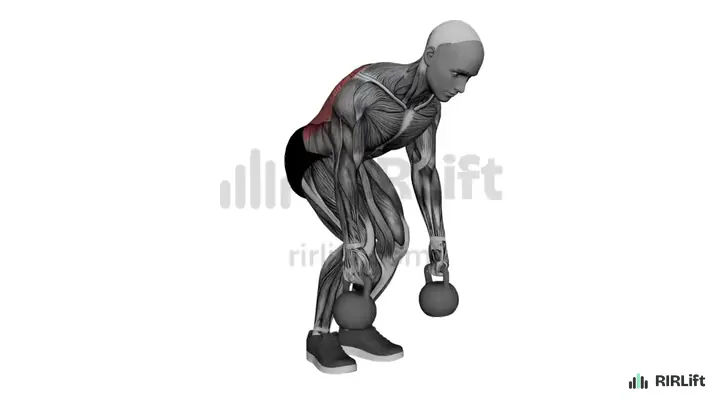
Kettlebell Row

Lats, Upper Back

The one-arm row is the upper-body kettlebell exercise you can load hardest, because your back can pull more than your shoulders can press. That makes it the move that still works when your only bell feels too heavy for everything else.

How to do it

  1. Hold one bell per hand, hinge forward with soft knees and a flat back.
  2. Let the bells hang under your shoulders, arms straight.
  3. Pull one bell toward your hip, elbow brushing your side, until it reaches your ribs.
  4. Lower until your arm is straight and your shoulder blade slides forward, then row the other side. With only one bell, do all your reps on one side, then switch.

Cues

  • Elbow to the hip
  • Shoulders square to the floor
  • Full stretch at the bottom

Common mistakes

  • Twisting your chest up to finish the rep: keep both shoulders level and slow down.
  • Short pulls that never straighten the arm: let the bell hang fully every rep.

Swap for: Kettlebell Gorilla Row, One-Arm Dumbbell Row, Band Bent-Over Row

Back, alternating row from the floor

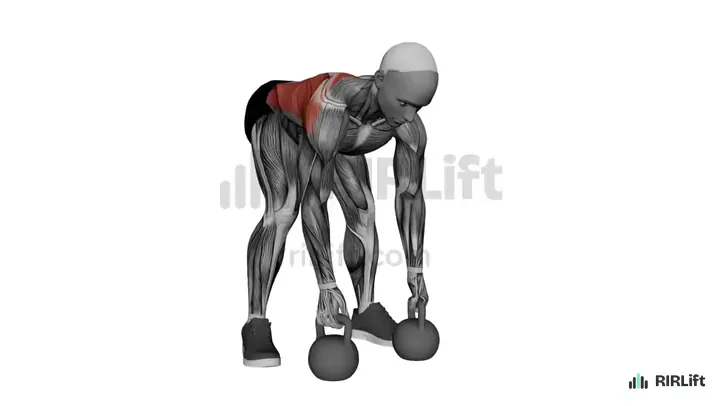
Kettlebell Gorilla Row

Lats, Upper Back

Two bells on the floor and a deep hinge let you row one while you brace on the other. You get the row's back work plus a hard isometric hold for your trunk and the opposite arm, without a bench.

How to do it

  1. Place two bells side by side under you, stand wide and hinge until you can grip both handles with a flat back.
  2. Press one bell into the floor and row the other to your hip.
  3. Lower it to the floor under control.
  4. Row with the other arm. One rep is both sides.

Cues

  • Wide stance, low hips
  • Press one bell, pull the other
  • Don't let your hips turn

Common mistakes

  • Rocking your torso to swing the bell up: lower the weight or slow the reps.
  • Rounding to reach the floor: bend your knees more until your back is flat.

Swap for: Kettlebell Row, Renegade Row, Dumbbell Bent-Over Row

Lats and chest, overhead stretch

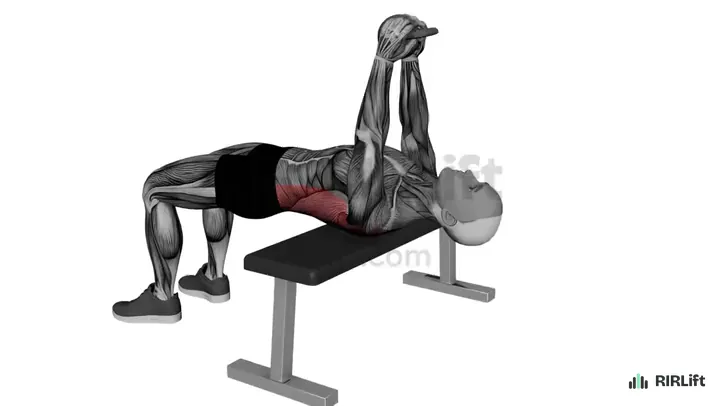
Kettlebell Pullover

Lats

Holding one bell with both hands and lowering it behind your head stretches your lats and chest under load. It's the only kettlebell exercise that trains your lats through an overhead arc, and it works well with a single heavier bell.

How to do it

  1. Lie on your back on the floor or across a bench, holding one bell by the horns over your chest with arms nearly straight.
  2. Keep your ribs down and your elbows softly bent.
  3. Lower the bell back behind your head in an arc until your arms are beside your ears or you feel a strong stretch under your arms.
  4. Pull it back over your chest along the same arc.

Cues

  • Ribs pinned down
  • Same elbow bend throughout
  • Pull from the armpits

Common mistakes

  • Arching your lower back as the bell goes back: shorten the range until your ribs stay down.
  • Bending the elbows more to make it a triceps extension: keep the arm angle fixed.

Swap for: Dumbbell Lat Pullover, Dumbbell Chest Pullover, Kettlebell Row

Traps and rear shoulders

The shrug uses a heavy bell well, and the rear delt row covers the back of your shoulders by flaring the elbow wide on a row. Both balance out pressing and take only a few minutes at the end of a session.

Traps

Kettlebell Shrug

Traps

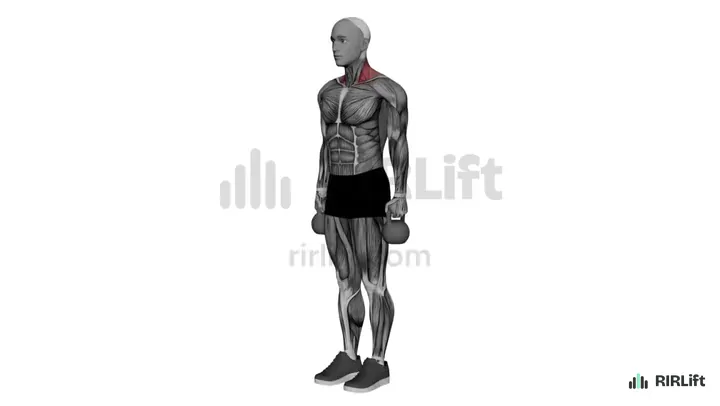
Your traps are strong, so a single heavy bell or a pair suits them well. Shrugs take two minutes at the end of a session and they're one of the few upper-body moves where a too-heavy bell is useful.

How to do it

  1. Stand tall holding a bell in each hand at your sides, or one heavy bell with both hands in front of your thighs.
  2. Keep your arms straight.
  3. Lift your shoulders straight up toward your ears as high as they go.
  4. Hold for a second, then lower all the way down.

Cues

  • Straight up, not rolled
  • Hold one second
  • All the way down

Common mistakes

  • Rolling your shoulders in circles: just lift and lower.
  • Bending the elbows to help: arms stay long; the traps do it.

Swap for: Dumbbell Shrug, Trap Bar Shrug, Cable Shrug

Rear shoulders and upper back

Kettlebell Rear Delt Row

Shoulders, Upper Back

Rowing with your elbow flared out wide, toward the side instead of the hip, shifts the work to your rear delts and upper back. It's how kettlebell training covers the back of your shoulders with a bell too heavy for flies.

How to do it

  1. Hinge forward with your free hand on a bench or thigh, bell hanging under your shoulder.
  2. Turn your knuckles to face forward so your elbow points out to the side.
  3. Pull the bell up and out, elbow flared wide, until your upper arm is level with your back.
  4. Lower slowly. Do all reps, then switch.

Cues

  • Elbow wide, not tight
  • Upper arm level at the top
  • Lead with the elbow

Common mistakes

  • Tucking the elbow so it becomes a normal row: keep the upper arm out at about 70 to 90 degrees.
  • Heaving with the torso: keep your chest still and lighten up.

Swap for: Kettlebell Rear Delt Fly, Band Face Pull, Dumbbell Rear Delt Row

Pressing: overhead and full body

Kettlebells press overhead well and press horizontally badly, so your pushing comes from overhead work. The strict one-arm press is the core of it, the seesaw press uses a pair, the bottoms-up press turns a light bell into a hard grip and shoulder exercise, and the clean and press adds your legs and hips.

Shoulders, one-arm strict press

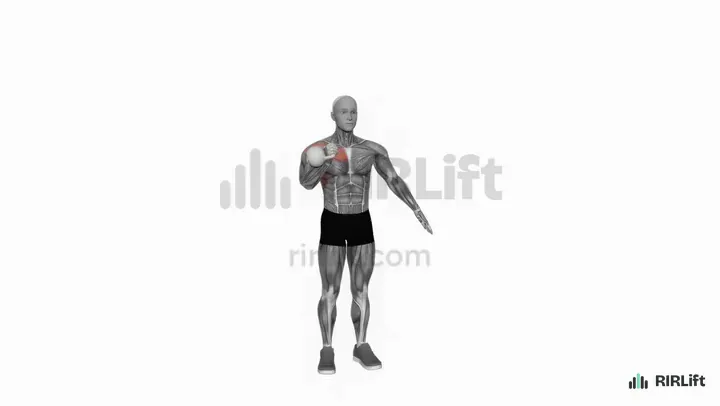
Kettlebell Overhead Press

Shoulders

Pressing one bell from your shoulder to overhead is the main kettlebell shoulder builder. The bell sits behind your wrist, so your forearm stays vertical and the press runs straight up, and working one arm at a time makes your trunk brace against the side load.

How to do it

  1. Bring the bell to your right shoulder with the handle in your palm, the bell resting on the outside of your forearm, elbow tucked down.
  2. Squeeze your glutes and brace your stomach.
  3. Press the bell straight up until your arm is locked out next to your ear.
  4. Lower it back to your shoulder under control. Finish the set, then switch arms.

Cues

  • Forearm vertical
  • Glutes tight
  • Bicep by your ear at the top

Common mistakes

  • Leaning back to get the bell up: stop the set or use a lighter bell.
  • Pressing out in front of your face: finish with the bell over your shoulder.

Swap for: Kettlebell Seesaw Press, Dumbbell Shoulder Press, Landmine Press

Shoulders, alternating two-bell press

Kettlebell Seesaw Press

Shoulders

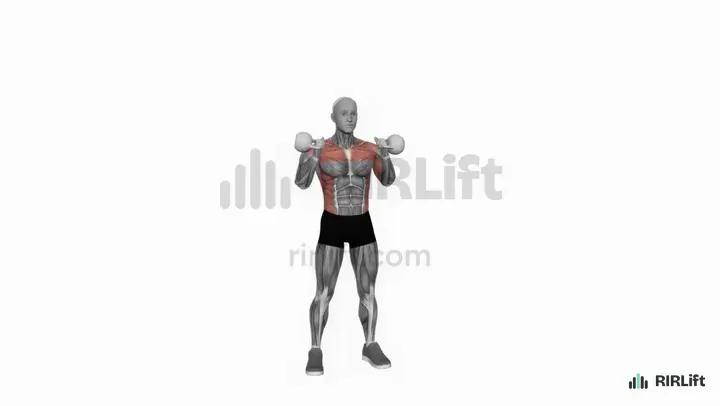
With a bell in each hand, you press one up as the other comes down, so one shoulder is always working and the trunk has to resist the shifting load. It packs more pressing into a set than doing each side separately.

How to do it

  1. Bring a bell to each shoulder in the rack position, elbows down.
  2. Press the right bell overhead.
  3. As you lower the right bell, press the left one up so they pass each other at mid-height.
  4. Keep alternating for the set. Count each side as one rep.

Cues

  • Smooth hand-over-hand rhythm
  • Stand tall, don't sway
  • Lock out each press

Common mistakes

  • Swaying side to side with each press: brace harder and slow the tempo.
  • Half presses: get a full lockout on every rep.

Swap for: Kettlebell Overhead Press, Alternating Dumbbell Shoulder Press, Kettlebell Bottoms-Up Press

Shoulders and grip, balance press

Kettlebell Bottoms-Up Press

Shoulders

Pressing a bell upside down, with the ball balanced above your fist, forces a hard grip and a perfectly stacked wrist and elbow. You'll use a much lighter bell than for a normal press, which makes it a good use for a small one.

How to do it

  1. Grip a light bell in your right fist with the ball pointing up, crushing the handle.
  2. Bring it to shoulder height with your forearm vertical and the other hand resting on your hip.
  3. Press it overhead slowly, keeping the bell balanced.
  4. Pause at the top, then lower under control. Finish the set, then switch.

Cues

  • Crush the handle
  • Forearm straight up and down
  • Slow and steady

Common mistakes

  • Letting the bell tip over: squeeze harder or use a lighter bell.
  • Rushing the press: slow reps keep the bell balanced.

Swap for: Kettlebell Overhead Press, Kettlebell Seesaw Press, Landmine Press

Shoulders and full body

Kettlebell Clean & Press

Shoulders, Quads

Cleaning the bell from the floor to your shoulder, then pressing it overhead, trains your shoulders and adds your hips, legs and back. It's the upper-body pick for when you want a session to raise your heart rate too.

How to do it

  1. Stand over the bell, which sits on the ground just behind your toes, hinge and grab it with one hand.
  2. Drive your hips forward to bring the bell up close to your body and catch it at your shoulder, bell resting on your forearm.
  3. Press it overhead to lockout.
  4. Lower it to your shoulder, then let it swing down between your legs and set it on the floor or go straight into the next rep. Switch sides after the set.

Cues

  • Bell travels close to your body
  • Catch softly at the shoulder
  • Hips power the clean, the arm presses

Common mistakes

  • Letting the bell flip over and bang your wrist: pull it in close and punch your hand through as it arrives.
  • Curling the bell up with your arm: the hip drive does the lifting.

Swap for: Kettlebell Overhead Press, Kettlebell Snatch, Barbell Clean and Press

Side shoulders and stability

The lateral raise is the only exercise here that hits the side delt directly, so use your lightest bell for it. The Turkish get-up trains the shoulder to hold weight overhead while your body moves under it.

Side shoulders, one-arm raise

Kettlebell Lateral Raise

Shoulders

The lateral raise is the one move that targets the side of your shoulder, the part that makes your shoulders look wider. Kettlebells jump in big weight steps, so working one arm at a time with a light bell is the practical way to do it.

How to do it

  1. Stand tall with a light bell in your right hand at your side, handle neutral.
  2. Keep a slight bend in the elbow.
  3. Raise your arm out to the side until it is level with your shoulder.
  4. Lower slowly. Finish the set, then switch arms.

Cues

  • Lead with the elbow
  • Stop at shoulder height
  • Slow on the way down

Common mistakes

  • Shrugging the bell up with your traps: keep your shoulder down and use a lighter bell.
  • Swinging the bell: start each rep from a dead stop at your side.

Swap for: Kettlebell Upright Row, Band Lateral Raise, Single-Arm Dumbbell Lateral Raise

Shoulders and full body stability

Kettlebell Turkish Get-Up

Shoulders, Abs

Standing up from the floor with a bell held overhead the whole way makes your shoulder hold a heavy load in many positions. It's slow and technical, so do it with a light bell, for few reps, near the start of a session.

How to do it

  1. Lie on your back with the bell pressed straight up in your right hand, right knee bent, left arm and leg out at an angle.
  2. Roll onto your left forearm, then your left hand, keeping your eyes on the bell.
  3. Lift your hips, sweep your left leg under you to a kneeling position, then stand up.
  4. Reverse the steps back to the floor. Do all reps on one side, then switch.

Cues

  • Eyes on the bell
  • Arm locked the whole time
  • Slow, one step at a time

Common mistakes

  • Letting the arm bend as you move: drop the weight; the locked arm is the point.
  • Rushing between positions: pause at each step.

Swap for: Kettlebell Overhead Press, Kettlebell Windmill, Kettlebell Bottoms-Up Press

Arms: biceps and triceps

Rows train your biceps and presses train your triceps, but direct arm work fills them out. The curl covers biceps; the skullcrusher and overhead extension cover triceps, and both work with one bell held by the horns.

Biceps

Kettlebell Curl

Biceps

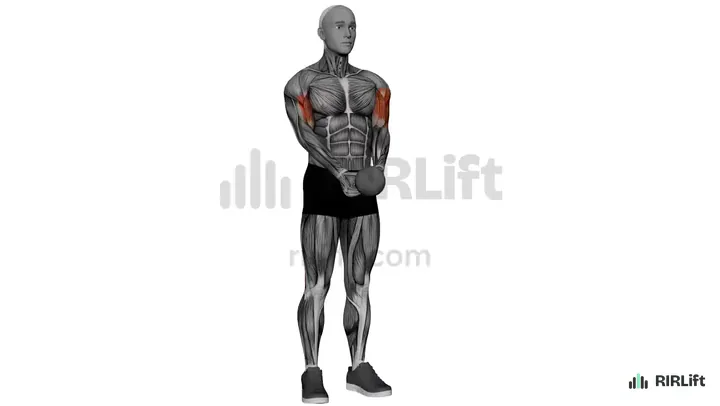
A kettlebell's weight sits below the handle, so the bell pulls hardest at the bottom of the curl. Curls take one or two bells and fit at the end of any upper session.

How to do it

  1. Stand tall holding a bell by the handle in each hand, arms straight and palms facing forward.
  2. Pin your elbows to your sides.
  3. Curl the bells up to your shoulders, letting them rest on your forearms if they tip.
  4. Lower all the way to straight arms. With one bell, alternate arms.

Cues

  • Elbows pinned
  • All the way down
  • No swinging

Common mistakes

  • Swinging your body to start the curl: stand against a wall if you need to.
  • Stopping short of straight arms: finish every rep at the bottom.

Swap for: Kettlebell Goblet Curl, Kettlebell Single-Arm Curl, Dumbbell Curl

Triceps, lying

Kettlebell Skullcrusher

Triceps

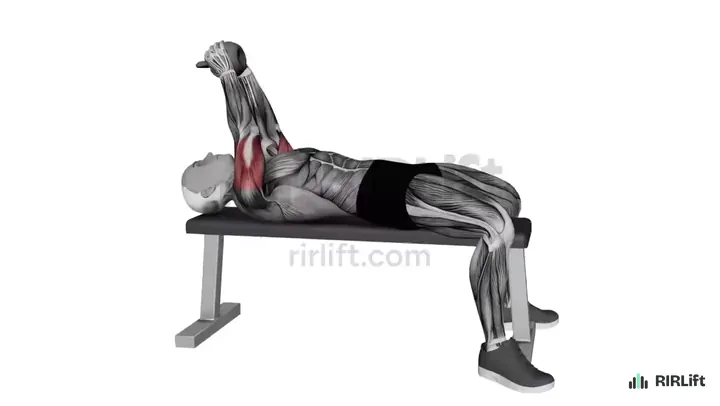
Lying down takes your back out of the triceps exercise and lets you lower the bell toward your forehead under control. It works with one bell held in both hands or two light ones.

How to do it

  1. Lie on the floor or a bench, holding one bell by the horns or two by their handles, arms straight over your shoulders.
  2. Keep your upper arms still.
  3. Bend your elbows to lower the weight toward your forehead or just behind it.
  4. Straighten your arms to bring it back up over your shoulders.

Cues

  • Upper arms fixed
  • Lower slowly
  • Lock out at the top

Common mistakes

  • Letting the elbows drift toward your feet: keep them pointed at the ceiling.
  • Dropping the bell fast: control every inch on the way down.

Swap for: Kettlebell Overhead Triceps Extension, Kettlebell Decline Skullcrusher, Dumbbell Skullcrusher

Triceps, overhead

Kettlebell Overhead Triceps Extension

Triceps

Holding one bell with both hands behind your head stretches the long head of your triceps, the biggest part of the muscle. One bell held by the horns is enough, and a heavy one works here because two arms share it.

How to do it

  1. Stand tall holding one bell by the horns overhead, arms straight.
  2. Keep your upper arms close to your head.
  3. Bend your elbows and lower the bell behind your head until your forearms touch your biceps.
  4. Straighten your arms to press it back up.

Cues

  • Elbows point forward
  • Upper arms stay still
  • Deep stretch behind the head

Common mistakes

  • Elbows flaring wide: keep them narrow, pointed ahead.
  • Arching your lower back: squeeze your glutes and keep your ribs down.

Swap for: Kettlebell Skullcrusher, Seated Dumbbell Overhead Triceps Extension, Overhead Cable Triceps Extension

Put them together: example sessions

Each session below picks from the exercises above for one situation, with the sets, reps, rest and RIR filled in. Open one in the session builder to change a pick, price it from a recent set, and add it to RIRLift.

Session 1

One moderate bell, three sessions a week

Open in the session builder
  • Workouts3× a week
  • Working sets39 a week
  • Per workout~35 min
  • EquipmentKettlebells

You have one kettlebell you can press for 6 to 10 reps with one arm, and want to train your upper body on three days a week alongside leg work.

With one bell, every exercise is either one-arm (row, press, rear delt row) or two hands on the bell (pullover, overhead extension), so the same weight suits all of them. The row and press come first because they're the heaviest and need the freshest arms. Three sets on those, two on the rest, at 1 to 2 reps in reserve: 13 working sets in about 30 minutes, and nine or more hard sets a week for back and shoulders.

One-Bell Upper
ExerciseSets × repsRIRRest
Kettlebell RowPer arm. Hand on your thigh or a bench. 3 × 8–15 1 90 s
Kettlebell Overhead PressPer arm. 3 × 5–10 2 2 min
Kettlebell PulloverHold by the horns. Ribs down. 2 × 10–15 1 1 min
Kettlebell Rear Delt RowPer arm. Elbow wide. 2 × 10–15 1 1 min
Kettlebell Overhead Triceps ExtensionHold by the horns. 2 × 10–15 1 1 min
Kettlebell Turkish Get-UpPer side. Slow, light. 1 × 2–3 2 90 s
How to run it
Do the session three times a week with a day between, either on its own or after a short leg session. Work the weaker arm first on one-arm moves and match its reps on the other side.
How to progress
When a one-arm move reaches 12 reps at 1 in reserve, slow the lowering to three seconds and pause at the top. When the pullover and extension reach 15, add a one-second pause in the stretched position. Move to a heavier bell once the press hits 10 strict reps.

Session 2

A matched pair, two upper days

Open in the session builder
  • Workouts2× a week
  • Working sets24 a week
  • Per workout~30 min
  • EquipmentKettlebells

You have two bells of the same size and train upper and lower body on separate days, twice each a week.

A pair unlocks the gorilla row, seesaw press, and curls with both arms at once, so you can do more work per minute. Upper A leans on the double-bell moves; Upper B goes back to one-arm work with the clean and press for a harder, faster session. Three sets on the first two exercises, two on the rest, with presses at 2 reps in reserve and everything else at 1. Each day is 12 or 13 working sets.

Upper A
ExerciseSets × repsRIRRest
Kettlebell Gorilla RowPer arm. Wide stance. 3 × 8–12 1 90 s
Kettlebell Seesaw PressPer arm. 3 × 6–10 2 2 min
Kettlebell SkullcrusherTwo bells or one by the horns. 2 × 10–15 1 1 min
Kettlebell Curl 2 × 10–15 1 1 min
Kettlebell ShrugHold the top 1 s. 2 × 12–20 1 1 min

Open Upper A in the session builder

Upper B
ExerciseSets × repsRIRRest
Kettlebell Clean & PressPer arm. 3 × 5–8 2 2 min
Kettlebell RowPer arm. 3 × 10–15 1 90 s
Kettlebell Lateral RaisePer arm. Lightest bell. 2 × 10–15 1 1 min
Kettlebell Rear Delt RowPer arm. 2 × 10–15 1 1 min
Kettlebell Overhead Triceps Extension 2 × 10–15 1 1 min

Open Upper B in the session builder

How to run it
Alternate Upper A and Upper B with your leg days, for example Upper A Monday, Legs Tuesday, Upper B Thursday, Legs Friday.
How to progress
Work to the top of each range at the target reps in reserve, then move up one bell size for that exercise only. If the next bell is too big a jump, keep the bell and add a set instead.

Session 3

Only one bell, and it's too heavy to press

Open in the session builder
  • Workouts2× a week
  • Working sets26 a week
  • Per workout~35 min
  • EquipmentKettlebells

You own a single heavy bell, perhaps bought for swings, that you can't press for more than a rep or two.

A bell you can't press is still a good weight for the parts of your upper body that are stronger than your shoulders: rows, shrugs, and two-handed moves where both arms share the load. This session drops pressing altogether and uses the bell for back, traps and triceps. Reps stay at 6 to 15 and sets end 1 rep short of failure; the pullover and extension stop 2 short because a heavy bell over your face needs control on the last rep. Thirteen working sets.

Heavy-Bell Upper
ExerciseSets × repsRIRRest
Kettlebell RowPer arm. 3 s down. 4 × 6–12 1 2 min
Kettlebell PulloverBoth hands, horns. Ribs down. 3 × 8–12 2 90 s
Kettlebell ShrugBoth hands, in front. 3 × 10–15 1 1 min
Kettlebell Overhead Triceps ExtensionBoth hands, horns. 3 × 8–12 2 90 s
How to run it
Do the session twice a week. Add push-ups after it to cover your chest and shoulders until you have a lighter bell for pressing.
How to progress
Add reps until every set reaches the top of the range, then slow down: three seconds on the way down for rows, and a two-second hold at the top of shrugs. Once rows reach 15 slow reps, it's time for the next bell up.

Make it fit you

Questions

What upper body muscles can you work with kettlebells?

Your back (lats and upper back), shoulders, traps, biceps and triceps. Chest is the exception: without a bench, kettlebells have no good horizontal press, so pair them with push-ups.

Can you build upper body muscle with only kettlebells?

Yes, as long as your sets end close to failure. Rows and presses will outgrow a single light bell first, so plan on a heavier bell or slower, paused reps after a few months.

What is the best kettlebell exercise for the upper body?

The one-arm row, because your back can handle the most weight and the row trains your biceps too. The one-arm overhead press is a close second and is what most people mean when they ask about kettlebell shoulders.

What can you do with a kettlebell that's too heavy to press?

Rows, shrugs, two-handed pullovers and overhead triceps extensions, as in the heavy-bell plan above. Leave the pressing to push-ups until you get a lighter bell.

Is a 20 minute kettlebell workout enough for the upper body?

It is, if you do it two or three times a week and every set is hard. Pick one row, one press and one arm exercise, three sets each, and stop each set 1 to 2 reps short of failure.

What weight kettlebell should I use for upper body exercises?

Use a bell you can press 6 to 10 times with one arm for the overhead press, which is usually also right for curls and extensions. Rows and shrugs can take a heavier one, so a second, bigger bell is the most useful next purchase.