Kettlebell shoulder exercises for strength, size and stability

The best kettlebell shoulder exercises are the single-arm overhead press, the seesaw press and the clean and press for strength, the lateral raise and upright row for the side delts, the rear delt row and fly for the back of the shoulder, and the Turkish get-up for stability. A shoulder session takes one press, one side delt move and one rear delt move, 2 to 4 sets each, ending 0 to 2 reps short of failure.

  1. Kettlebell Overhead Press Shoulders
  2. Kettlebell Seesaw Press Shoulders
  3. Kettlebell Clean & Press Shoulders, Quads
  4. Kettlebell Bottoms-Up Press Shoulders
  5. Kettlebell Lateral Raise Shoulders
  6. Kettlebell Upright Row Shoulders, Traps
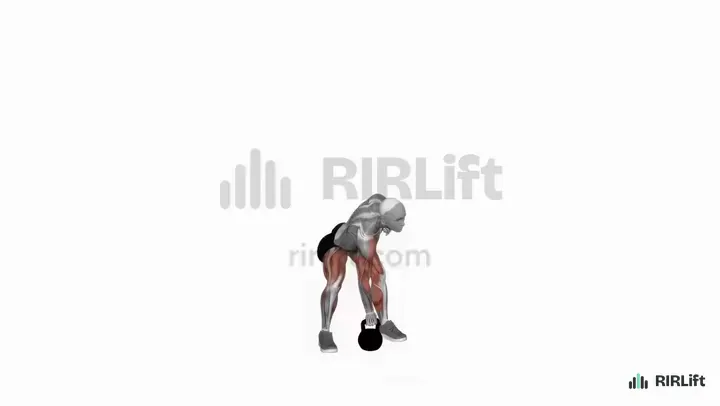
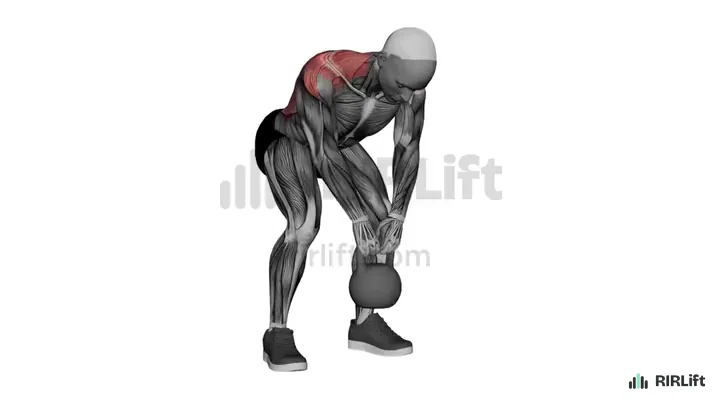
  7. Kettlebell Rear Delt Row Shoulders, Upper Back
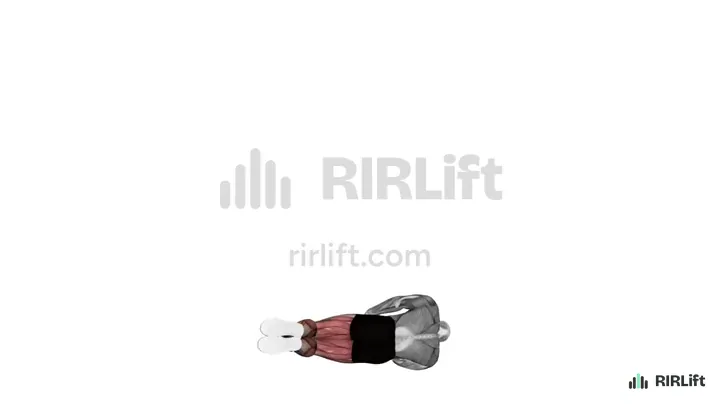
  8. Kettlebell Turkish Get-Up Shoulders, Abs
Kettlebell presses for the shoulders

Presses are where the weight is. The bell sits on the back of your forearm, so its weight lines up behind your wrist and the press feels more natural than with a dumbbell. Start with the strict single-arm press; use the seesaw to add volume and the bottoms-up press to clean up your form.

Front and side delts, the main press

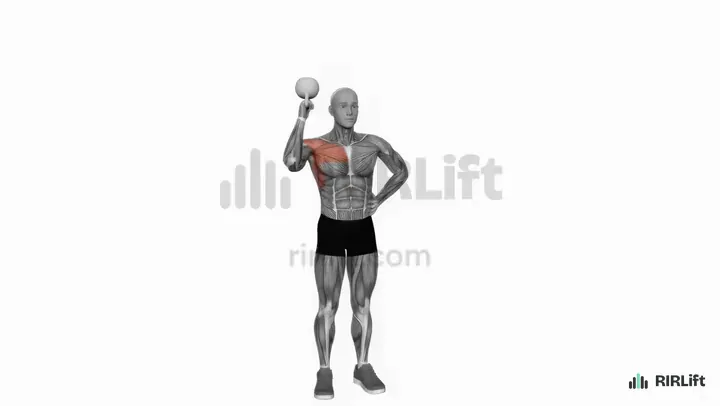
Kettlebell Overhead Press

Shoulders

This is the lift the rest of the page is built around. Pressing one bell from the rack position lets your arm travel in a natural groove instead of a fixed bar path, and the offset load makes your trunk work to stay upright.

How to do it

  1. Clean the bell to your shoulder so it rests on the back of your forearm, wrist straight.
  2. Squeeze your glutes and brace your stomach as if you were about to be poked.
  3. Press the bell up until your arm is straight and your bicep sits close to your ear.
  4. Lower it back to the rack under control before the next rep.

Cues

  • Wrist stacked
  • Ribs down
  • Bicep by ear

Common mistakes

  • Leaning away from the bell to finish the rep: that turns a shoulder press into a side bend.
  • Letting the bell flop onto the wrist: keep the handle low in the palm.

Swap for: Dumbbell Shoulder Press, Single-Arm Dumbbell Shoulder Press

Shoulders, with constant tension

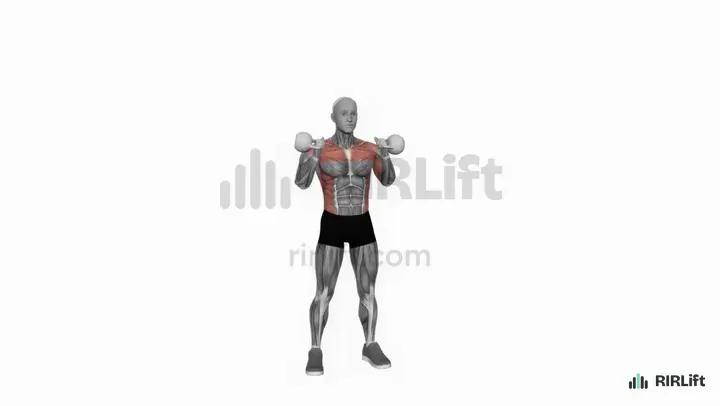
Kettlebell Seesaw Press

Shoulders

With two bells, you press one up while the other comes down, so each shoulder works while the other is still loaded in the rack. It is a good way to pile up pressing volume with a pair that is too light for strict double presses.

How to do it

  1. Rack both bells, one on each shoulder.
  2. Press the right bell overhead.
  3. As you lower the right bell, press the left one up so they pass at roughly head height.
  4. Keep alternating for the full set; count each arm.

Cues

  • Smooth handoff
  • Hips square
  • Full lockout

Common mistakes

  • Rushing into a rhythm that shortens the lockout on each side.
  • Twisting the torso toward the pressing arm.

Swap for: Alternating Dumbbell Shoulder Press, Kettlebell Overhead Press

Shoulder stability and grip

Kettlebell Bottoms-Up Press

Shoulders

Holding the bell upside down means it tips over the instant your wrist, elbow or shoulder drifts out of line. That forces a slow, perfectly stacked press with a light weight, which is why it is a favorite for shoulders that feel cranky under heavier pressing.

How to do it

  1. Grip the handle hard and flip the bell so its base points at the ceiling, forearm vertical.
  2. Bring it to shoulder height with your elbow under the bell.
  3. Press it straight up slowly, keeping the bell balanced the whole way.
  4. Lower it just as slowly to shoulder height.

Cues

  • Crush the handle
  • Forearm vertical
  • Slow both ways

Common mistakes

  • Going too heavy: you should be able to balance the bell for every rep of the set.
  • Letting the elbow flare wide, which tips the bell sideways.

Swap for: Kettlebell Overhead Press, Landmine Press

Full-body kettlebell moves that hit the shoulders

These start from the floor or a squat and finish with the bell overhead or at the chin. They train the shoulders under fatigue and save time, but the legs and hips do much of the lifting, so pair them with strict work if size is the goal.

Full-body press from the floor

Kettlebell Clean & Press

Shoulders, Quads

Starting each rep from the floor adds a hip hinge and a clean, so you train the shoulders and the legs together. It suits short sessions where one exercise has to do a lot.

How to do it

  1. Stand over the bell, hinge at the hips and grab the handle with one hand.
  2. Drive your hips forward and pull the bell up to the rack, letting it roll around your hand.
  3. Press it overhead and lock out.
  4. Bring it back to the rack, then let it swing back between your legs and lower it to the floor.

Cues

  • Hips start it
  • Soft catch
  • Press from a still rack

Common mistakes

  • Curling the bell up with the arm instead of driving it with the hips.
  • Letting the bell slam onto the forearm in the clean.

Swap for: Barbell Clean and Press, Dumbbell Push Press

Shoulders and legs, conditioning

Kettlebell Thruster

Quads, Shoulders

A front squat that flows straight into a press. The leg drive carries the bell through the hardest part of the press, so you can handle more total work and get your heart rate up at the same time.

How to do it

  1. Hold one or two bells in the rack position, elbows tucked.
  2. Squat down until your thighs are about level with the floor.
  3. Stand up fast and use that momentum to press the bells overhead.
  4. Bring them back to the rack as you sink into the next squat.

Cues

  • Elbows in the squat
  • Drive, then press
  • One smooth motion

Common mistakes

  • Pressing before the legs finish: the drive should hand the bell to the arms.
  • Losing the upright torso at the bottom of the squat.

Swap for: Barbell Thruster, Wall Ball

Power and shoulder endurance

Kettlebell Snatch

Shoulders, Glutes, Hamstrings

The bell travels from between your legs to overhead in one pull. It is mainly a hip exercise, but holding the lockout rep after rep builds a lot of work capacity in the shoulders and upper back.

How to do it

  1. Stand with the bell a little in front of you and hike it back between your legs.
  2. Drive your hips forward and let the bell float up close to your body.
  3. As it passes your chest, punch your hand through so the bell turns over and lands softly on your forearm overhead.
  4. Drop it back down along the same path into the next swing.

Cues

  • Hips do the work
  • Punch through
  • Quiet landing

Common mistakes

  • Letting the bell arc far out and crash onto the wrist at the top.
  • Pulling it up with the shoulder instead of letting the hips throw it.

Swap for: One-Arm Dumbbell Snatch, Kettlebell Clean & Press

Traps and side delts, with leg drive

Kettlebell Sumo Deadlift High Pull

Glutes, Quads

A wide-stance deadlift that ends with a high pull to the chin. The hips start the bell moving, and the shoulders and traps finish it, so it fits a circuit better than a slow strength day.

How to do it

  1. Stand with your feet wide and the bell on the floor between them, toes turned out.
  2. Hinge down and grip the handle with both hands, arms long.
  3. Stand up hard and let the momentum carry the bell up as you pull your elbows high.
  4. Lower it under control back to the floor.

Cues

  • Legs first
  • Elbows high
  • Bell close

Common mistakes

  • Pulling with the arms before the hips finish.
  • Rounding the lower back at the bottom.

Swap for: Barbell High Pull, Kettlebell Upright Row

Raises and rows for the side and front delts

Pressing alone leaves the side delt short of work. Add the lateral raise or upright row every week; the front raise is optional, since every press already trains the front delt.

Side delts, for width

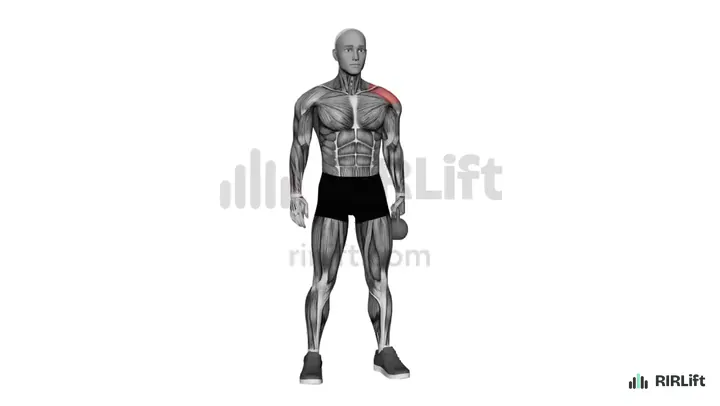
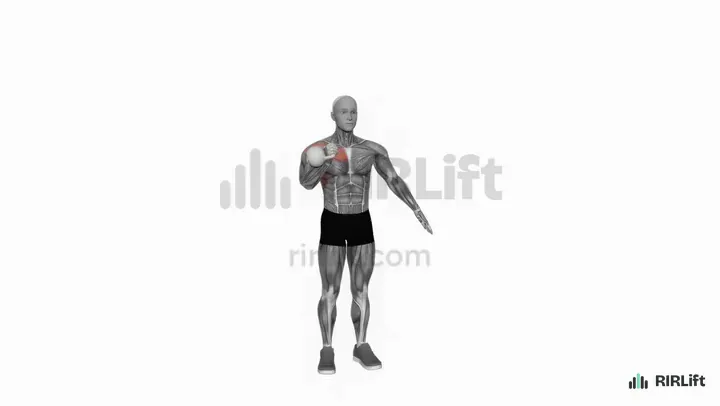
Kettlebell Lateral Raise

Shoulders

The side delt is what makes shoulders look broader, and pressing alone gives it limited work. A kettlebell raise is heavier at the end of the lever than a dumbbell of the same weight, so start lighter than you would with a dumbbell.

How to do it

  1. Stand tall with a light bell in each hand at your sides, handles held with the bell hanging below.
  2. Lift your arms out to the sides with a slight bend in the elbows.
  3. Stop when your hands reach shoulder height.
  4. Lower them slowly back to your sides.

Cues

  • Lead with elbows
  • Stop at shoulder height
  • Slow lowering

Common mistakes

  • Shrugging the bells up with your traps.
  • Swinging the torso to start each rep.

Swap for: Dumbbell Lateral Raise, Band Lateral Raise

Side delts and upper traps

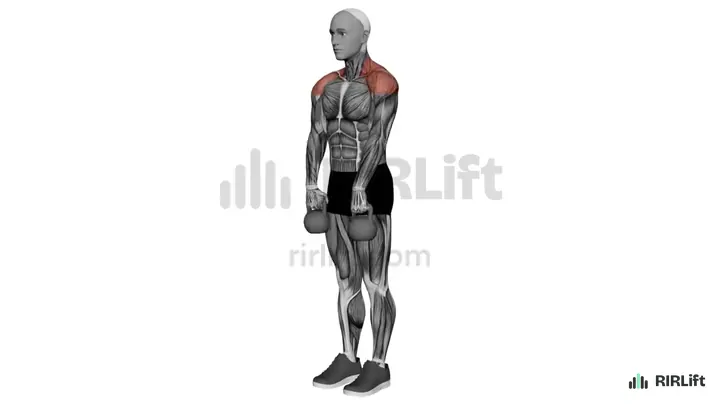
Kettlebell Upright Row

Shoulders, Traps

Pulling the elbows up and out loads the side delts through a range raises do not cover well. Holding one bell by the horns keeps your hands close and the motion smooth.

How to do it

  1. Hold one bell by the horns in front of your thighs, arms straight.
  2. Pull your elbows up and out to the sides, keeping the bell close to your body.
  3. Stop when your elbows reach shoulder height.
  4. Lower the bell to full arm extension.

Cues

  • Elbows above hands
  • Bell close
  • Stop at shoulder height

Common mistakes

  • Yanking the bell up to your chin; the elbows set the end point.
  • Rounding the upper back forward.

Swap for: Dumbbell Upright Row, Band Upright Row

Front delts

Kettlebell Front Raise

Shoulders

Pressing already hits the front delt hard, so treat this as optional finishing work. Holding one bell by the horns with both hands is the easiest way to load it.

How to do it

  1. Hold one bell by the sides of the handle with both hands, the bell resting low.
  2. Keep your arms nearly straight and raise the bell to eye level.
  3. Pause briefly, then lower it to your thighs.

Cues

  • Arms long
  • Stop at eye level
  • No lean back

Common mistakes

  • Rocking back with the hips to get it moving.
  • Lifting above head height, which mostly shifts the work to the traps.

Swap for: Dumbbell Front Raise, Plate Front Raise

Kettlebell rear delt exercises

Hinge forward and move the arm out to the side, not back toward the hip. The row lets you go heavier; the fly isolates the muscle better with a light bell.

Rear delts and upper back

Kettlebell Rear Delt Row

Shoulders, Upper Back

A row with the elbow flared out to the side shifts the work from the lats to the rear delts. It is easier to load heavy than the fly, so it is the better pick when your bells are on the heavy side.

How to do it

  1. Hinge forward with a bell in one hand and your other hand braced on your knee or a bench.
  2. Let the bell hang under your shoulder.
  3. Row it up with the elbow pointing out to the side until your upper arm is level with your back.
  4. Lower it to a straight arm.

Cues

  • Elbow out wide
  • Upper arm level
  • Hips still

Common mistakes

  • Pulling the elbow back toward your hip, which turns it into a lat row.
  • Twisting the torso open to finish the rep.

Swap for: Dumbbell Rear Delt Row, TRX Rear Delt Row

Rear delts

Kettlebell Rear Delt Fly

Shoulders

The rear delt is the part of the shoulder most programs under-train, and it keeps the joint balanced against all the pressing. Use light bells and a slow tempo.

How to do it

  1. Hinge forward until your torso is close to parallel with the floor, a bell in each hand under your shoulders.
  2. With a soft bend in the elbows, raise your arms out to the sides.
  3. Stop when your arms are in line with your body.
  4. Lower them slowly.

Cues

  • Flat back
  • Wide arc
  • Pinkies lead

Common mistakes

  • Squeezing the shoulder blades hard together, which turns it into a back exercise.
  • Standing up taller as the set gets hard.

Swap for: Dumbbell Rear Delt Fly, Band Rear Delt Fly

Kettlebell exercises for shoulder stability

These hold the bell overhead while your body moves under it. They build control more than size, and they make good finishers or warm-ups at 2 to 3 slow reps per side.

Shoulder stability, whole body

Kettlebell Turkish Get-Up

Shoulders, Abs
You stand up from the floor and lie back down while keeping one bell locked out overhead. The shoulder has to hold a stable position through every angle, which makes it one of the best kettlebell exercises for healthy, resilient shoulders.

How to do it

  1. Lie on your back with the bell pressed up in your right hand and your right knee bent.
  2. Roll onto your left forearm, then onto your left hand, keeping your eyes on the bell.
  3. Lift your hips, sweep your left leg under you to a kneeling position, and stand up.
  4. Reverse each step to return to the floor, then switch sides.

Cues

  • Eyes on the bell
  • Arm vertical
  • One step at a time

Common mistakes

  • Rushing the transitions; a slow get-up is the point.
  • Letting the loaded arm drift forward or bend.

Swap for: Dumbbell Single-Arm Overhead Carry, Kettlebell Windmill

Overhead stability and obliques

Kettlebell Windmill

Abs, Shoulders

With the bell locked out overhead, you hinge sideways down toward your opposite foot. Your shoulder holds the weight steady as your body moves underneath it, and the obliques control the side bend.

How to do it

  1. Press the bell overhead and turn both feet about 45 degrees away from that arm.
  2. Push your hip out toward the bell side and slide your free hand down the inside of your front leg.
  3. Go as far as you can with the overhead arm vertical.
  4. Reverse the motion to stand back up.

Cues

  • Arm stays vertical
  • Hip out
  • Eyes up

Common mistakes

  • Bending the overhead elbow to get lower.
  • Twisting forward instead of hinging to the side.

Swap for: Kettlebell Turkish Get-Up, Dumbbell Side Plank

Put them together: example sessions

Each session below picks from the exercises above for one situation, with the sets, reps, rest and RIR filled in. Open one in the session builder to change a pick, price it from a recent set, and add it to RIRLift.

Session 1

One kettlebell at home, 30 minutes

Open in the session builder
  • Workouts2× a week
  • Working sets28 a week
  • Per workout~35 min
  • EquipmentKettlebells

You own one bell, usually 12 to 20 kg, and train shoulders twice a week in the living room.

One bell means every exercise is done one arm at a time, which doubles the work you get from it. The clean and press and the strict press are the heavy pair. The rear delt row and lateral raise use the same bell for higher reps, and the get-up comes last at low reps, because it is about control, not fatigue. Pressing sets stop 1 to 2 reps short of failure to keep form crisp; the raise can go to 1 RIR.

Shoulders
ExerciseSets × repsRIRRest
Kettlebell Clean & Press1 warm-up set firstPer arm. 3 × 5–8 2 90 s
Kettlebell Overhead PressPer arm. Clean once, then press. 3 × 6–10 1 90 s
Kettlebell Rear Delt RowPer arm. 3 × 10–15 1 1 min
Kettlebell Lateral RaiseOne arm at a time. 3 × 12–20 1 1 min
Kettlebell Turkish Get-UpPer side. Slow. 2 × 2–3 2 1 min
How to run it
Do the whole routine on two non-consecutive days. All sets are per arm: finish one side, then switch.
How to progress
Add a rep per set until you reach the top of each range at the listed RIR. When the strict press tops out, slow its lowering to three seconds before you buy a heavier bell.

Session 2

A pair of bells, building size

Open in the session builder
  • Workouts2× a week
  • Working sets23 a week
  • Per workout~30 min
  • EquipmentKettlebells

You have two matching bells and want bigger delts, not conditioning.

Two bells open up the seesaw press for pressing volume and let the raises and flies train both sides at once. Session A leans on presses and the side delt; session B uses the bottoms-up press for strict work and the rear delts. Every delt head gets at least 6 hard sets a week. Isolation sets end 0 to 1 RIR, since a light raise is safe to push.

Shoulders A
ExerciseSets × repsRIRRest
Kettlebell Seesaw Press1 warm-up set firstReps per arm. 4 × 8–12 1 2 min
Kettlebell Upright RowOne bell by the horns. 3 × 10–15 1 75 s
Kettlebell Lateral Raise 3 × 12–20 0 1 min
Kettlebell Rear Delt Fly 3 × 12–20 0 1 min

Open Shoulders A in the session builder

Shoulders B
ExerciseSets × repsRIRRest
Kettlebell Bottoms-Up Press1 warm-up set firstPer arm. Light bell. 3 × 6–10 1 90 s
Kettlebell Front RaiseOne bell by the horns. 2 × 10–15 1 1 min
Kettlebell Rear Delt RowPer arm. 3 × 10–15 1 1 min
Kettlebell WindmillPer side. 2 × 5–8 2 1 min

Open Shoulders B in the session builder

How to run it
Alternate Shoulders A and Shoulders B, with at least one day between them. Pair them with a lower-body or pulling day if you train more often.
How to progress
Once every set of a move hits the top of its range, move up to the next bell size on the presses, or add a pause at the top of each raise.

Session 3

15 minutes, conditioning and shoulders

Open in the session builder
  • Workouts3× a week
  • Working sets42 a week
  • Per workout~20 min
  • EquipmentKettlebells

You have a short window and want a session that hits the shoulders and gets you breathing hard.

The snatch and the thruster are the two kettlebell moves that use the most muscle per rep, so they carry this session. They go in a superset with only the rest it takes to switch. The rear delt fly balances all the overhead work, and the RIR stays at 2 because fatigue breaks down form on ballistic lifts faster than it does on slow ones.

Circuit
ExerciseSets × repsRIRRest
A1 Kettlebell SnatchPer arm. 4 × 6–10 2 15 s
A2 Kettlebell ThrusterOne or two bells. 4 × 8–12 2 75 s
B1 Kettlebell Sumo Deadlift High Pull 3 × 10–15 2 15 s
B2 Kettlebell Rear Delt Fly 3 × 15–20 1 1 min
How to run it
Run the two supersets back to back. Take the listed rest after the second exercise of each pair.
How to progress
Add a round to the first superset before adding weight. When five rounds feel steady at 2 RIR, use a heavier bell for the thruster.

Make it fit you

Questions

Can you build shoulders with just kettlebells?

Yes. A strict press, a lateral raise and a rear delt row cover all three heads of the deltoid, and with sets taken close to failure that is enough to grow. The limit is weight jumps: kettlebells come in 4 kg steps, so you progress with reps and slower lowering between sizes.

What is the best kettlebell exercise for shoulders?

The single-arm overhead press. It loads the front and side delts with the most weight a kettlebell allows, and doing one arm at a time lets each side work at its own level. Add a lateral raise and a rear delt move for full coverage.

Does the kettlebell halo build shoulders?

Not much. Circling a bell around your head is a light mobility drill that warms the shoulders up, but it never loads them hard enough to drive growth. Use it before a session if you like it, and do your actual shoulder work with presses and raises.

What is the hardest kettlebell exercise?

For the shoulders, the Turkish get-up and the bottoms-up press are the most demanding, because a tiny loss of alignment ends the rep. The snatch is the hardest for conditioning. All three are worth learning with a light bell first.

How many kettlebell shoulder exercises should I do in a workout?

Three or four is enough: one press, one side delt move, one rear delt move, and an optional stability drill. Two to four hard sets of each, twice a week, gives every part of the shoulder 6 to 12 sets a week.

Is 3 exercises enough for shoulder day?

Yes, if they cover the front, side and rear delts and you push each set close to failure. A kettlebell press, lateral raise and rear delt row is a complete three-exercise shoulder day.

What weight kettlebell should I use for shoulder exercises?

Use two sizes if you can. For presses, pick a bell you can lift for 6 to 10 reps with 1 to 2 left in the tank. For lateral raises and flies, you need a much lighter bell, often half your press weight or less.