Arm exercises with a kettlebell: biceps, triceps and forearms

The best kettlebell arm exercises are the kettlebell curl and goblet curl for biceps, the overhead triceps extension and skullcrusher for triceps, and the bottoms-up press and wrist curls for forearms. One bell is enough for a full arm session: curl it with both hands, extend it overhead by the horns, and do the one-arm moves for the lighter work. Swings train your hips, not your arms, so they do not count. Aim for 2 to 4 sets per exercise, ending 0 to 2 reps short of failure.

  1. Kettlebell Curl Biceps
  2. Kettlebell Goblet Curl Biceps
  3. Kettlebell Overhead Triceps Extension Triceps
  4. Kettlebell Skullcrusher Triceps
  5. Kettlebell Single-Arm Curl Biceps
  6. Kettlebell Concentration Curl Biceps
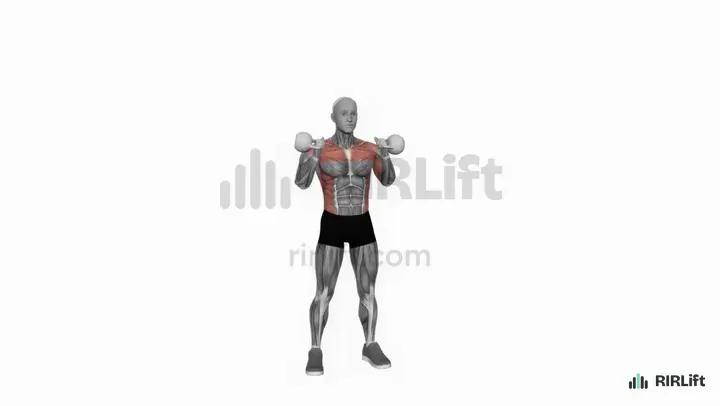
  7. Kettlebell Seesaw Press Shoulders
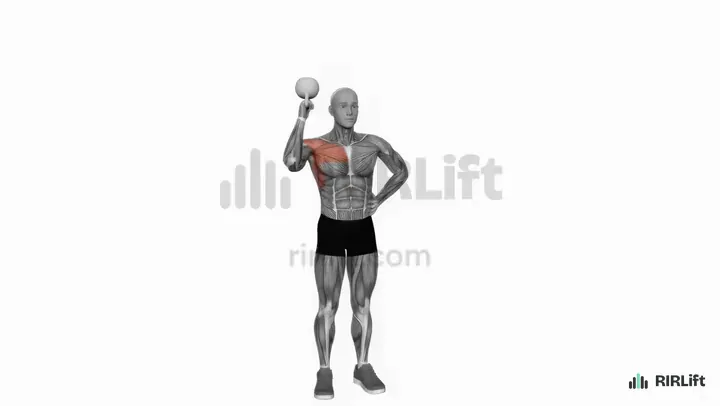
  8. Kettlebell Bottoms-Up Press Shoulders
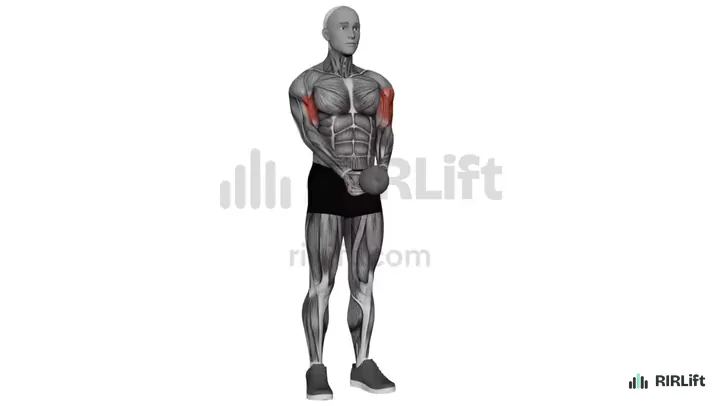
Kettlebell exercises for biceps

A kettlebell's weight hangs below the handle, so it pulls on the biceps differently from a dumbbell: tension stays on near the top of the curl, and the bell wants to tip your wrist back. Two-handed curls let one heavy bell do the job; one-arm curls make a light bell hard. Pick one of each.

Biceps, two-handed curl

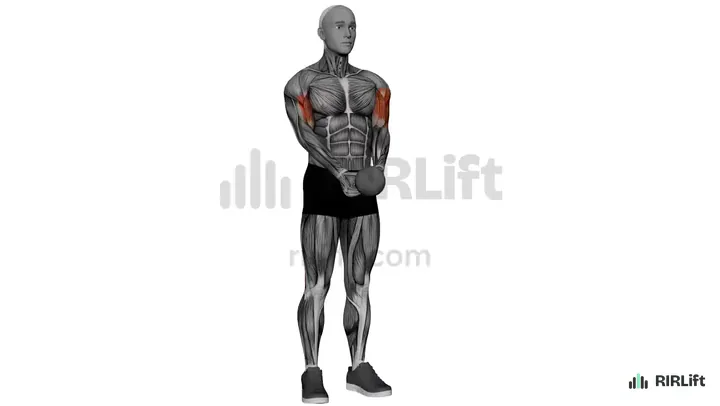
Kettlebell Curl

Biceps

Holding one kettlebell by the handle with both hands lets you curl a heavier bell than either arm could manage alone, and the weight hanging below the handle keeps tension on the biceps near the top. If you own one bell, this is the curl that uses all of it.

How to do it

  1. Stand tall and hold the handle with both hands, palms up, the bell hanging in front of your thighs.
  2. Pin your elbows to your sides.
  3. Curl the bell up toward your chest until your forearms are close to vertical.
  4. Lower it slowly until your arms are straight again.

Cues

  • Elbows stay at your ribs
  • Lower for a slow count of three
  • Stand still, no hip drive

Common mistakes

  • Swinging the bell up with a hip thrust: if you need the hips, the bell is too heavy for curls.
  • Letting the elbows travel forward at the top, which unloads the biceps: stop the curl when the forearms are vertical.

Swap for: Dumbbell Curl, Kettlebell Single-Arm Curl, EZ-Bar Curl

Biceps, horns grip curl

Kettlebell Goblet Curl

Biceps

Cupping the bell by its horns with your palms up puts both hands close together under the load, so the curl is strict and the bell cannot sway. It suits a heavier bell than a one-arm curl and works well as the first biceps exercise of a session.

How to do it

  1. Hold the kettlebell by the two sides of the handle, palms facing up, bell hanging in front of your hips.
  2. Stand with soft knees and your shoulders back.
  3. Curl the bell to the top of your chest, keeping your elbows at your sides.
  4. Lower it all the way back to straight arms.

Cues

  • Hands glued to the horns
  • Wrists straight
  • Full stretch at the bottom

Common mistakes

  • Leaning back to finish the rep: keep your ribs over your hips and stop when the bell reaches your chest.
  • Cutting the bottom short: let your elbows open fully before the next rep.

Swap for: Kettlebell Curl, Hammer Curl, Dumbbell Curl

Biceps, one-arm curl

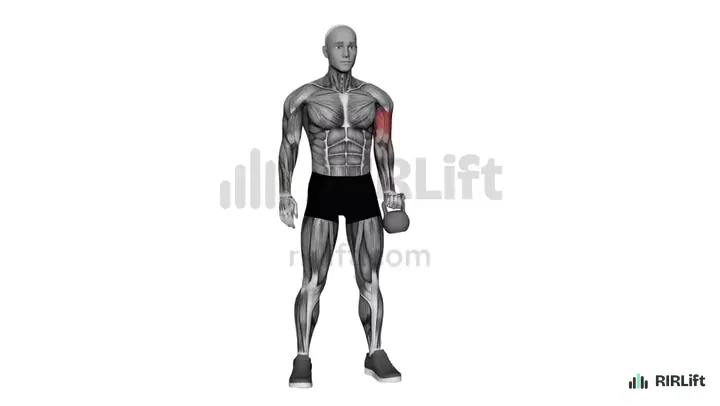
Kettlebell Single-Arm Curl

Biceps

Curling one bell in one hand lets a light kettlebell still challenge you, and the offset weight below the handle makes your forearm work to keep the wrist straight. It is the curl for people who have only light bells.

How to do it

  1. Hold a kettlebell by the handle in one hand, palm facing forward, arm straight at your side.
  2. Keep your elbow tight to your ribs and your shoulder down.
  3. Curl the bell to shoulder height, letting it rotate so it ends resting just below your wrist, not flopping onto it.
  4. Lower slowly to a straight arm. Do all reps, then change hands.

Cues

  • Wrist stays neutral
  • Elbow never leaves your side
  • Same tempo both arms

Common mistakes

  • Rocking your torso to lift the bell: brace and use a lighter one.
  • Letting the wrist bend back as the bell hangs: squeeze the handle hard.

Swap for: Kettlebell Curl, Dumbbell Curl, Concentration Curl

Biceps, seated isolation curl

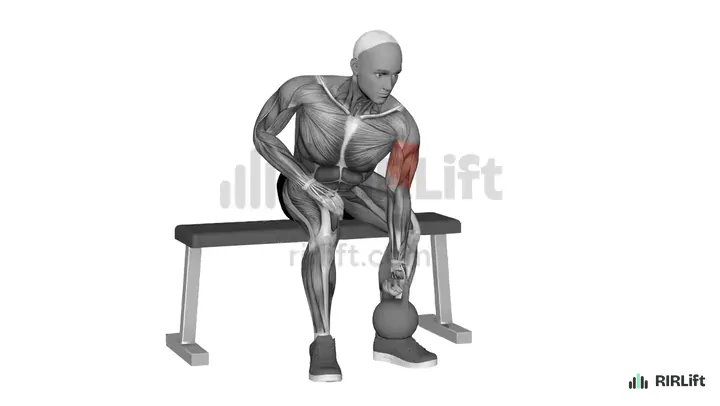
Kettlebell Concentration Curl

Biceps

Bracing your elbow against your inner thigh removes any chance of swinging, so a light bell is enough to take the biceps right to failure. It is the finisher for the end of a session.

How to do it

  1. Sit on a bench or box, feet wide, and lean forward slightly.
  2. Hold a kettlebell in one hand and rest the back of that upper arm against the inside of your thigh.
  3. Curl the bell up toward your shoulder without letting your upper arm move off your leg.
  4. Lower until the arm is fully straight, then repeat. Switch arms after the set.

Cues

  • Upper arm locked to the thigh
  • Squeeze at the top for a second
  • All the way down

Common mistakes

  • Lifting your torso to help the curl: stay leaning forward so only the elbow moves.
  • Stopping above straight arms: the bottom of the curl is part of the work.

Swap for: Concentration Curl, Kettlebell Single-Arm Curl, Dumbbell Curl

Biceps, supported curl

Kettlebell Preacher Curl

Biceps

With your upper arm resting on a preacher pad, the biceps works hardest near the bottom where the arm is long, and nothing else can take over. It needs a preacher bench, so it is the curl for a gym or a well-equipped garage.

How to do it

  1. Sit at a preacher bench with the back of one upper arm flat on the pad.
  2. Hold the kettlebell by the handle, palm up, arm almost straight.
  3. Curl it up until your forearm is nearly vertical.
  4. Lower under control until your elbow is almost locked, then curl again.

Cues

  • Armpit snug to the top of the pad
  • Slow lower
  • Stop just short of locking out

Common mistakes

  • Dropping into the bottom: a fast drop at full stretch strains the elbow. Lower in about three seconds.
  • Lifting your shoulder off the pad: keep the whole upper arm on it.

Swap for: Preacher Curl, Kettlebell Concentration Curl, Spider Curl

Kettlebell exercises for triceps

The triceps makes up most of the upper arm, so give it at least as many sets as the biceps. The overhead extension stretches its long head, and the skullcrusher works it lying down; the decline version needs a bench. Holding the bell by its horns makes all three steadier than gripping the handle.

Triceps long head, standing overhead extension

Kettlebell Overhead Triceps Extension

Triceps

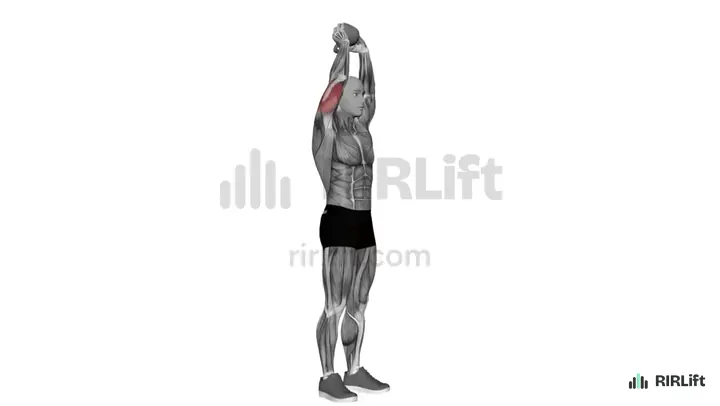
Lowering a kettlebell behind your head stretches the long head of the triceps, the biggest part of the muscle, which other triceps moves leave short. Held upside down by the horns, one bell is all it needs, so it is the main triceps builder on this page.

How to do it

  1. Stand tall and hold a kettlebell by the horns, bell hanging upside down, arms extended overhead.
  2. Keep your elbows pointed forward and close to your head.
  3. Bend your elbows to lower the bell behind your head as far as your shoulders allow.
  4. Straighten your arms to press it back overhead, and repeat.

Cues

  • Elbows point at the wall in front
  • Ribs down, no arching
  • Deep stretch at the bottom

Common mistakes

  • Letting the elbows flare out: keep them narrow even if you need a lighter bell.
  • Arching your lower back to get the bell up: squeeze your glutes and brace.

Swap for: Seated Dumbbell Overhead Triceps Extension, Overhead Cable Triceps Extension, Kettlebell Skullcrusher

Triceps, lying extension

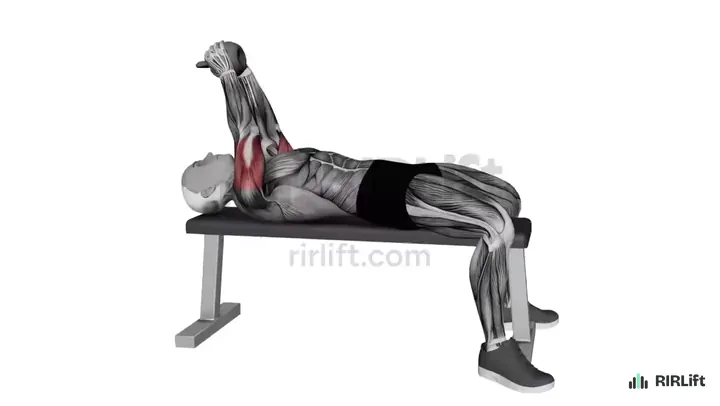
Kettlebell Skullcrusher

Triceps

Lying on your back lets the triceps work through a full bend at the elbow without your lower back being involved. On the floor, the ground stops the bell before your head, so it is safe to push sets close to failure even with nobody around.

How to do it

  1. Lie on the floor or a flat bench holding a kettlebell by the horns above your chest, arms straight.
  2. Tilt your upper arms slightly back toward your head and keep them there.
  3. Bend your elbows to lower the bell toward the top of your head.
  4. Extend your elbows to lift it back to the start.

Cues

  • Only the forearms move
  • Elbows shoulder-width or narrower
  • Control the bottom

Common mistakes

  • Turning it into a press by moving the upper arms: keep them fixed at one angle.
  • Flaring the elbows wide: point them at your feet.

Swap for: Dumbbell Skullcrusher, EZ-Bar Skullcrusher, Kettlebell Overhead Triceps Extension

Triceps, decline lying extension

Kettlebell Decline Skullcrusher

Triceps

On a decline bench, your arms start angled back from your body, which keeps the triceps loaded at the top where a flat skullcrusher goes slack. It needs a decline bench, so it is the heavier triceps option when you train somewhere that has one.

How to do it

  1. Lie on a decline bench with your feet secured and hold a kettlebell by the horns above your chest.
  2. Lean your upper arms slightly back toward your head.
  3. Lower the bell toward your forehead by bending your elbows only.
  4. Press it back up to almost straight arms and repeat.

Cues

  • Upper arms fixed
  • Elbows pointed up
  • Smooth lower, no bounce

Common mistakes

  • Letting the bell travel toward your face because the elbows drifted: reset the arm angle each rep.
  • Locking the elbows hard at the top: stop just short to keep the triceps working.

Swap for: Kettlebell Skullcrusher, EZ-Bar Skullcrusher, Dumbbell Skullcrusher

Kettlebell presses and rows that build the arms

Compound lifts let your arms move more weight than any curl or extension. Presses load the triceps hard at lockout, and rows bring in the biceps alongside the back. One of each makes a strong start to a kettlebell arm session.

Triceps and shoulders, alternating press

Kettlebell Seesaw Press

Shoulders

Pressing one bell up as the other comes down keeps your trunk working against the uneven load while each arm straightens fully overhead. It is a compound press, so it gives the triceps heavier work than any extension and trains your shoulders in the same set.

How to do it

  1. Stand with a kettlebell at each shoulder, palms facing in and elbows tucked.
  2. Press the right bell overhead until the arm is straight.
  3. Lower it back to the shoulder as you press the left bell up, so one bell always moves while the other travels the opposite way.
  4. Keep alternating until each arm has done its reps.

Cues

  • Ribs down
  • Full lockout each side
  • Move both bells at the same speed

Common mistakes

  • Leaning away from the pressing arm: brace your stomach and squeeze your glutes.
  • Rushing so the bells meet halfway: let each arm finish its lockout.

Swap for: Kettlebell Overhead Press, Dumbbell Shoulder Press, Alternating Dumbbell Shoulder Press

Back with biceps, alternating row

Kettlebell Gorilla Row

Lats, Upper Back

Rowing one bell while you press the other into the floor gives your biceps heavy pulling work alongside the back, and the wide stance spares your lower back. Pair it with a press for a kettlebell session that trains both arms through big movements before the isolation work.

How to do it

  1. Place two kettlebells between your feet, stand wider than shoulder-width and hinge until your torso is close to level with the floor.
  2. Grip both handles with your back flat.
  3. Row the right bell to your hip while pushing the left one into the floor.
  4. Lower it, then row the left. Alternate for the full set.

Cues

  • Flat back throughout
  • Elbow to the hip
  • Push the other bell into the ground

Common mistakes

  • Twisting your torso open to row higher: keep your shoulders square to the floor.
  • Standing up between reps: stay in the hinge for the whole set.

Swap for: Kettlebell Row, One-Arm Dumbbell Row, Dumbbell Bent-Over Row

Kettlebell exercises for forearms and grip

The offset handle is what makes kettlebells good for forearms: the bell is always trying to twist out of your hand. The bottoms-up press trains the grip that resists it, and the two wrist curls cover the front and back of the forearm with a light bell.

Forearms, grip and triceps, unstable press

Kettlebell Bottoms-Up Press

Shoulders
Holding the bell upside down by its handle forces your forearm and grip to squeeze hard the whole set just to keep it balanced, while the triceps straightens the arm overhead. It is the kettlebell's own forearm exercise, and a light bell is enough.

How to do it

  1. Hold a light kettlebell upside down by the handle at your shoulder, bell pointing up.
  2. Squeeze the handle hard and brace your trunk.
  3. Press the bell straight overhead, keeping it balanced above your fist.
  4. Bring it back to your shoulder slowly and repeat. Switch hands after the set.

Cues

  • Crush the handle
  • Wrist stacked under the bell
  • Slow and balanced

Common mistakes

  • Gripping loosely so the bell tips over: squeeze harder before the press begins.
  • Pressing too fast: a quick rep loses the balance. Move steadily.

Swap for: Kettlebell Overhead Press, Single-Arm Dumbbell Shoulder Press, Farmer's Walk

Forearm flexors, wrist curl

Kettlebell Wrist Curl

Forearms

The kettlebell's handle sits well off-center from its weight, so even a light bell makes the forearm flexors on the palm side work hard. It builds the inside of the forearm and the grip for heavier curls and rows.

How to do it

  1. Kneel or sit with your forearm resting on your thigh or a bench, palm up, wrist hanging past the edge.
  2. Hold a light kettlebell by the handle with the bell hanging below.
  3. Let your wrist bend back to lower the bell, then curl your wrist up as far as it goes.
  4. Lower under control and repeat. Switch arms after the set.

Cues

  • Forearm stays on the support
  • Full range at the wrist
  • Slow at the bottom

Common mistakes

  • Lifting the forearm to move the bell: only the wrist bends.
  • Using a bell so heavy the range shrinks to an inch: lighten it until the wrist moves fully.

Swap for: Wrist Curl, Reverse Wrist Curl, Farmer's Walk

Forearm extensors, reverse wrist curl

Kettlebell Wrist Extension

Forearms

Lifting the back of your hand against the bell trains the extensor muscles on top of the forearm, which are usually much weaker than the flexors. Balancing the two keeps your elbows happier when you curl and press a lot.

How to do it

  1. Rest your forearm on your thigh or a bench, palm facing down, hand past the edge.
  2. Hold a light kettlebell by the handle.
  3. Lift the back of your hand up as high as it goes.
  4. Lower slowly and repeat. Switch arms after the set.

Cues

  • Palm down the whole set
  • Light bell, high reps
  • Pause at the top

Common mistakes

  • Rolling the elbow up to help the lift: keep the forearm flat on the support.
  • Going too heavy: these muscles are small and respond best to 15 to 25 reps.

Swap for: Reverse Wrist Curl, Kettlebell Wrist Curl, Reverse Curl

Put them together: example sessions

Each session below picks from the exercises above for one situation, with the sets, reps, rest and RIR filled in. Open one in the session builder to change a pick, price it from a recent set, and add it to RIRLift.

Session 1

One kettlebell, 20 minutes

Open in the session builder
  • Workouts2× a week
  • Working sets24 a week
  • Per workout~15 min
  • EquipmentKettlebells

You own a single moderate kettlebell and want a short arm session you can do in the living room.

With one bell, the two-handed moves take the heavy work: the goblet curl and the overhead extension both let you use the whole bell. The one-arm curl and the floor skullcrusher come next, because they make the same bell harder by loading one arm or by using a full range on the floor. Pairing a biceps and a triceps move with short rest keeps the session to about 20 minutes with 6 sets per muscle, and the sets end at 0 to 1 RIR because a single bell does not get heavier.

One Bell Arms
ExerciseSets × repsRIRRest
A1 Kettlebell Goblet Curl 3 × 8–15 1 30 s
A2 Kettlebell Overhead Triceps ExtensionHold by the horns. 3 × 8–15 1 1 min
B1 Kettlebell Single-Arm CurlPer arm. 3 × 10–20 0 30 s
B2 Kettlebell SkullcrusherOn the floor. 3 × 10–20 0 1 min
How to run it
Do the session twice a week. Move from the first exercise in a pair to the second with 30 seconds of rest, then rest 60 seconds before the next round.
How to progress
Add reps until every set reaches the top of the range, then slow the lowering to three seconds. When that also tops out, get the next bell size up.

Session 2

A pair of kettlebells, arms and shoulders

Open in the session builder
  • Workouts2× a week
  • Working sets28 a week
  • Per workout~40 min
  • EquipmentKettlebells

You have two matching bells and train arms on your upper-body days.

Two bells open up the compound moves: the seesaw press loads the triceps through full lockouts, and the gorilla row gives the biceps heavy pulling. These go first at 2 RIR, since they are the lifts where form slips if you go to failure. The two-handed curl and the overhead extension follow at 1 RIR, and the bottoms-up press ends the session for grip with a light bell. Each muscle gets 9 to 10 sets across the session.

Press, Row, Arms
ExerciseSets × repsRIRRest
Kettlebell Seesaw PressReps per arm. 3 × 6–10 2 2 min
Kettlebell Gorilla RowReps per arm. 3 × 8–12 2 2 min
Kettlebell Curl 3 × 8–12 1 75 s
Kettlebell Overhead Triceps Extension 3 × 10–15 1 75 s
Kettlebell Bottoms-Up PressLight bell. Per arm. 2 × 6–10 2 1 min
How to run it
Do it twice a week on your upper-body days, or alone on two separate days.
How to progress
Use double progression: reach the top of the rep range on every set at the target RIR, then go up a bell size on that exercise only.

Session 3

Bench, preacher pad and several bells

Open in the session builder
  • Workouts2× a week
  • Working sets21 a week
  • Per workout~25 min
  • EquipmentDecline Bench, Kettlebells, Preacher Bench

You train in a garage or a gym with a rack of kettlebells, a decline bench and a preacher bench.

The benches add supported curls and extensions that keep your body still, so you can take isolation sets close to failure. The preacher and concentration curls load the biceps where it is stretched and where it is squeezed; the decline skullcrusher and overhead extension cover the triceps at both ends. Forearm work gets its own pair of light sets, since grip often runs out first on kettlebell days. Two routines split the work so each gets full effort.

Arms A
ExerciseSets × repsRIRRest
Kettlebell Decline Skullcrusher 3 × 8–12 1 90 s
Kettlebell Preacher CurlPer arm. 3 × 8–12 1 90 s
Kettlebell Overhead Triceps Extension 3 × 10–15 1 75 s
Kettlebell Wrist CurlPer arm. 2 × 15–25 0 45 s

Open Arms A in the session builder

Arms B
ExerciseSets × repsRIRRest
Kettlebell Curl 3 × 8–12 1 90 s
Kettlebell SkullcrusherOn the bench. 3 × 10–15 1 75 s
Kettlebell Concentration CurlPer arm. 2 × 10–15 0 1 min
Kettlebell Wrist ExtensionPer arm. 2 × 15–25 0 45 s

Open Arms B in the session builder

How to run it
Run Arms A and Arms B on two days a week, at least two days apart.
How to progress
Add a rep per set each week. When you reach the top of the range at the target RIR on all sets, move up a bell size.

Make it fit you

Questions

Can you build arms with just a kettlebell?

Yes. Curls, overhead extensions and skullcrushers all work with a kettlebell, and one bell covers the whole session if you mix two-handed and one-arm moves. As you get stronger you need a heavier bell or slower reps, which is the same progression as with dumbbells.

Are kettlebell swings an arm workout?

No. In a swing your hips drive the bell and your arms act like ropes, so the biceps and triceps do very little. Swings build your glutes, hamstrings, grip and conditioning; train arms with curls and extensions.

What is the best kettlebell exercise for biceps?

The two-handed kettlebell curl, because it lets you use your heaviest bell through a full range. Add the single-arm curl or concentration curl for a second exercise.

What is the best kettlebell exercise for triceps?

The overhead triceps extension holding the bell by the horns. It stretches the long head of the triceps, the largest part of the muscle, and one bell is all it needs.

Is a 20 minute kettlebell workout enough for arms?

Yes, if the sets are hard. Twenty minutes fits four exercises done as two supersets, 3 sets each, giving each muscle 6 sets that end 0 to 1 reps short of failure. Done twice a week, that is enough to build arm muscle.

What weight kettlebell should I use for arm exercises?

Pick the bell you can curl or extend for about 10 reps with 1 or 2 reps left. For most people that is lighter than the bell they swing, often half of it or less, because the arms are much smaller muscles than the hips.

Can flabby arms be toned with kettlebells?

Kettlebell arm training builds muscle under the skin, which changes the shape of the arm. Losing the fat over it depends on your overall diet; there is no way to burn fat from just the arms.