Leg exercises without equipment: squats, single-leg work and hamstrings with body weight

The best leg exercises without equipment are bodyweight squats and wall sits to start, skater squats, pistol squats and Cossack squats for single-leg strength, Nordic hamstring curls for the back of the thigh, donkey kicks and fire hydrants for the glutes, and single-leg calf raises off a step. Without weights, make the leg do more of your body weight: move from two legs to one, slow the lowering to 3 seconds, and pause at the bottom. Train legs two or three times a week, 10 to 16 hard sets, stopping 1 to 3 reps short of failure.

  1. Bodyweight Squat Quads
  2. Skater Squat Quads, Glutes
  3. Pistol Squat Quads, Glutes
  4. Cossack Squat Quads, Adductors
  5. Nordic Hamstring Curl Hamstrings
  6. Wall Sit Quads
  7. Single-Leg Calf Raise Calves
  8. Jump Squat Quads, Glutes

Two-leg squats and holds

Start here if a set of 20 squats still feels hard. Once it doesn't, these become warm-ups and finishers, because two legs sharing your body weight runs out of challenge fast for the quads.

Quads and glutes, two-leg squat

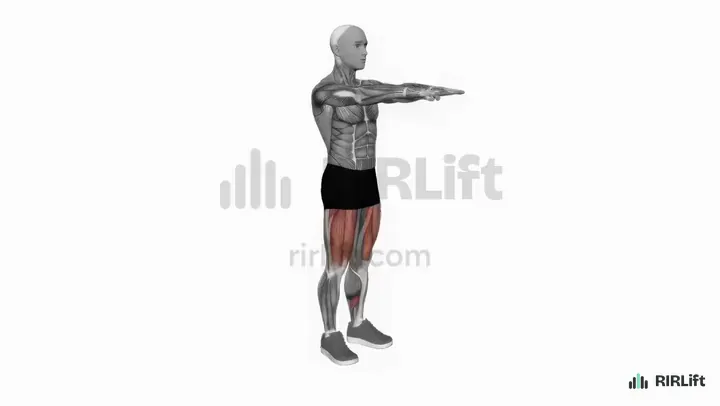
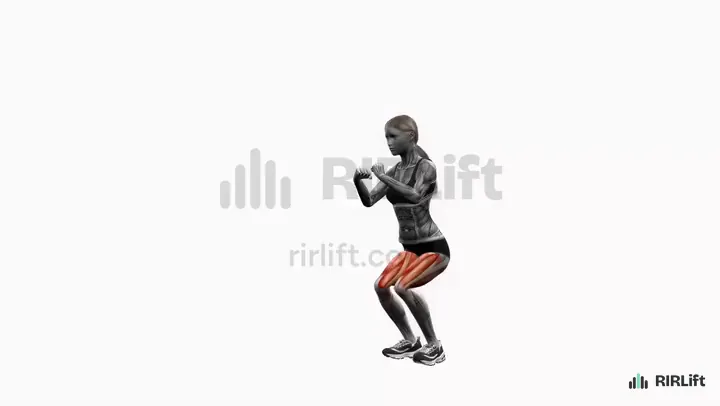
Bodyweight Squat

Quads

The entry point for everyone and the warm-up for every plan here. When you can do 25 clean reps, slow it to 3 seconds down and hold the bottom for a second before moving on to one leg.

How to do it

  1. Stand with your feet about shoulder-width apart, toes turned out slightly, arms out in front for balance.
  2. Push your hips back and bend your knees, keeping your heels flat and your chest up.
  3. Lower until your thighs are at least parallel to the floor, deeper if your heels stay down.
  4. Drive through your whole foot to stand tall, then go straight into the next rep.

Cues

  • Heels glued to the floor
  • Knees over toes
  • Thighs to parallel or lower

Common mistakes

  • Knees caving in on the way up: push them out over your little toes.
  • Quarter squats to hit a rep count: a full-depth set of 12 beats a shallow set of 30.

Swap for: Reverse Lunge, Wall Sit, Jump Squat

Quads, isometric hold

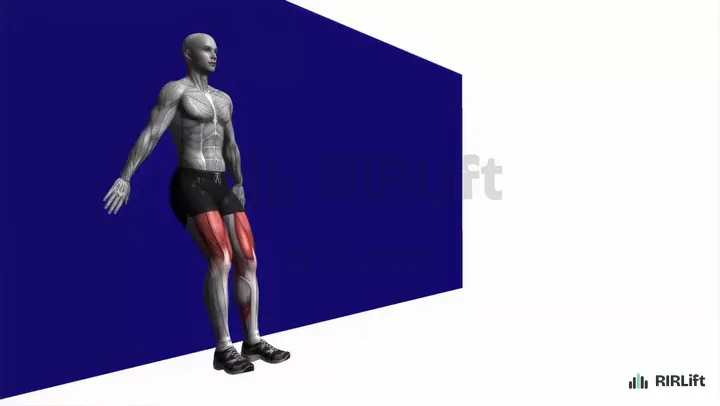
Wall Sit

Quads

A wall sit loads the quads hard at the angle where most squats get tough, with no balance and no technique to learn. It is the easiest way to make a short session burn when a beginner's reps are still low.

How to do it

  1. Lean your back on a wall with your feet roughly two feet out from it.
  2. Slide down until your thighs are close to parallel with the floor.
  3. Keep your knees over your ankles and press your back into the wall.
  4. Hold the position for the target time, then slide back up.

Cues

  • Thighs level
  • Press the heels
  • Back flat on the wall

Common mistakes

  • Feet too close: the knees end up past the toes.
  • Resting hands on the thighs: keep them off your legs.

Swap for: Bodyweight Squat, Cossack Squat

Quads, knees-forward squat

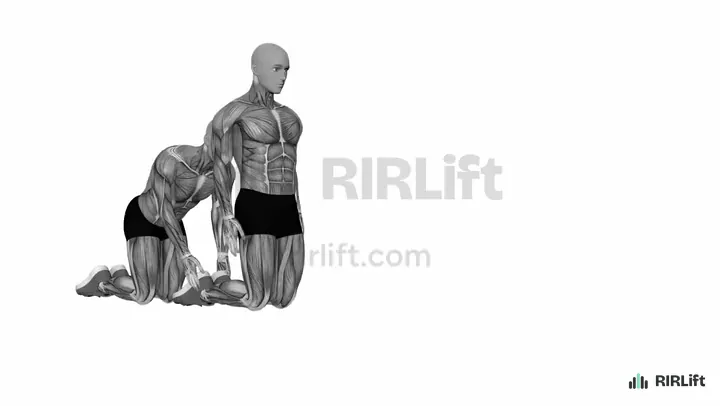
Sissy Squat

Quads

Leaning back while your knees travel forward stretches the front of the thigh under load, something regular squats cannot do without a barbell. The kneeling version shown is gentle enough to start with and still hard for the quads.

How to do it

  1. Kneel on a soft surface knees about hip-width apart, toes tucked or flat, and your body upright from knees to head.
  2. Keep your hips pushed forward so your body stays in one straight line, and lean back slowly from the knees.
  3. Go back as far as you can control, until you feel a strong pull along the front of your thighs.
  4. Pull yourself back to upright with your quads, keeping the hips from folding.

Cues

  • Hips forward, body straight
  • Lean back from the knees only
  • Slow on the way back

Common mistakes

  • Bending at the hips to lean back: that takes the stretch off the quads. Squeeze your glutes to stay straight.
  • Going further back than you can return from: start with a short lean and increase it as you get stronger.

Swap for: Wall Sit, Pistol Squat, Skater Squat

Single-leg strength

This is where no-equipment leg training gets heavy. Standing on one leg roughly doubles the load on it, so a skater or pistol squat taken to 6 to 10 hard reps is a real strength set, not an endurance set.

Quads and glutes, single-leg squat

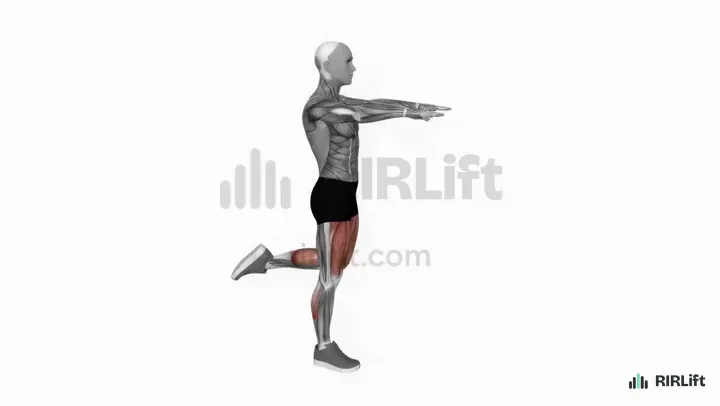
Skater Squat

Quads, Glutes

The most useful single-leg squat for home: the back knee touches down behind you, so depth is built in and you need less balance and mobility than a pistol. Most people can do a few reps after a couple of weeks of bodyweight squats.

How to do it

  1. Stand on one foot and bend the other knee so that foot is behind you, arms straight out in front as a counterweight.
  2. Push your hips back and lean your chest forward as you bend the standing knee.
  3. Lower until the back knee is just above the floor.
  4. Drive through your standing foot to stand tall; sets are per leg.

Cues

  • Arms forward as the counterweight
  • Chest leans, back stays flat
  • Back knee to a folded towel

Common mistakes

  • Only going down a few inches: put a folded towel or cushion where your knee should land and touch it every rep.
  • Letting the standing knee collapse inward: track it over your toes, and slow the lowering if it wobbles.

Swap for: Pistol Squat, Reverse Lunge, Cossack Squat

Quads and glutes, full single-leg squat

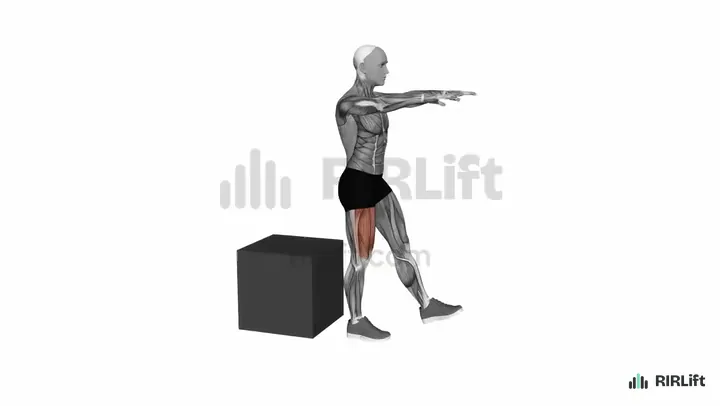
Pistol Squat

Quads, Glutes

The pistol puts your whole body weight on one leg through a full range, enough load to build muscle for years without equipment. Squatting to a chair or box, as in the demo, lets you start before you can go all the way down.

How to do it

  1. Stand on one leg in front of a chair or box, the other leg straight out in front and arms reaching forward.
  2. Push your hips back and bend the standing knee, lowering slowly toward the seat.
  3. Touch the chair lightly, without sitting your weight down, and keep the front leg off the floor.
  4. Drive through the standing heel to stand all the way up; sets are per leg.

Cues

  • Touch the chair, don't sit
  • Reach forward to stay balanced
  • Lower the chair as you get stronger

Common mistakes

  • Dropping onto the seat and bouncing back up: control the lowering and barely touch, or raise the seat.
  • Heel popping up at the bottom: shift your weight to mid-foot and use a higher box until it stays down.

Swap for: Skater Squat, Reverse Lunge, Sissy Squat

Quads and adductors, side-to-side squat

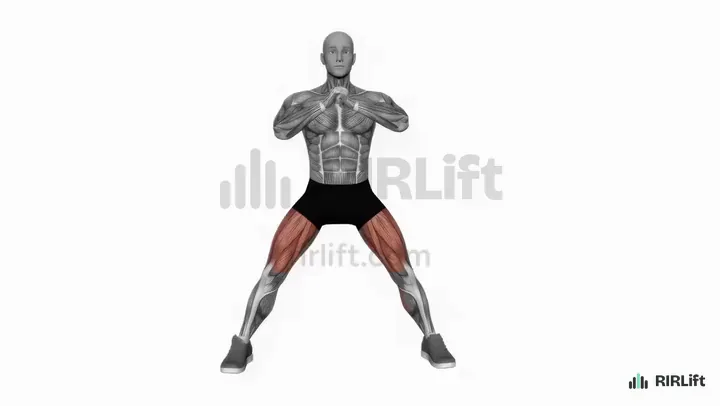
Cossack Squat

Quads, Adductors

Shifting into a deep side squat trains the inner thighs and hips through a range forward lunges miss, which pays off for sports with cutting and lateral steps. It is also a good way to open the hips before single-leg work.

How to do it

  1. Take a very wide stance, about twice the width of your shoulders, with the toes turned out a little.
  2. Bend your right knee and sit your hips down toward your right heel, letting the left leg straighten with the toes pointing up.
  3. Sink as deep as you can with the right foot flat and your chest lifted.
  4. Press the floor away with the right foot to return to the middle, then sit to the left.

Cues

  • Sit down, not forward
  • Flat foot on the bent side
  • Long leg stays straight

Common mistakes

  • Folding the chest down to the knee to get lower: hold a light weight out in front as a counterbalance instead.
  • Rushing from side to side: stop in the middle for a breath between reps.

Swap for: Dumbbell Lateral Lunge, Kettlebell Lateral Lunge, Balance Board Lateral Squat

Hamstrings, glutes and inner thighs

Squats and lunges barely train the hamstrings, and they are the hardest muscle to load without equipment. The Nordic curl solves it with a couch or a partner holding your ankles. The other three cover the glutes and adductors from the floor.

Hamstrings, knee flexion

Nordic Hamstring Curl

Hamstrings

The one no-equipment exercise that truly overloads the hamstrings. Lowering your body toward the floor with your ankles anchored is hard enough that 3 to 6 slow reps are a real set, even for strong lifters.

How to do it

  1. Kneel on a cushion with your ankles pinned under a couch, or held by a partner, and your body upright from knees to head.
  2. Squeeze your glutes and lower your torso forward as slowly as you can, bending only at the knees.
  3. When your hamstrings can't hold you, catch yourself with your hands on the floor.
  4. Push off the floor lightly and pull with your hamstrings to come back up to kneeling.

Cues

  • Hips stay open, no folding
  • Lower as slowly as possible
  • Hands catch, then help up

Common mistakes

  • Bending at the hips to make the lowering easier: keep a straight line from knees to shoulders.
  • Flopping to the floor after a few inches: fight it the whole way down; the slow lowering is the rep.

Swap for: Single-Leg RDL, Band Good Morning, Superman

Glutes, hip extension on all fours

Donkey Kick

Glutes

Kicking one leg up from all fours isolates the glute without asking anything of the knees. High reps with a squeeze at the top build the glutes in sessions where squats have already tired the quads.

How to do it

  1. Get on hands and knees with your wrists under your shoulders and knees under your hips.
  2. Keep one knee bent at a right angle and lift that foot toward the ceiling.
  3. Stop when your thigh is level with your back and squeeze for a second.
  4. Lower the knee back under your hip without touching the floor, finish the set, then switch legs.

Cues

  • Foot to the ceiling
  • Flat back
  • Squeeze at the top

Common mistakes

  • Arching your lower back to kick higher: the lift should come from your hip.
  • Swinging the leg: if momentum is moving it, slow down and pause at the top.

Swap for: Fire Hydrant, Single-Leg Glute Bridge, Band Glute Kickback

Glute medius, hip abduction

Fire Hydrant

Abductors

Lifting the bent knee out to the side trains the side of the hip that keeps your knee in line on single-leg squats and runs. It fits as the last exercise of a session, or a warm-up before pistols.

How to do it

  1. Start on hands and knees with your back flat.
  2. Keep the knee bent and swing one thigh sideways, away from your body.
  3. Lift until the thigh is close to level with your hip without tipping your body.
  4. Lower slowly and repeat before changing legs.

Cues

  • Hips stay square
  • Knee leads
  • Slow down

Common mistakes

  • Rolling the body away to lift higher: a smaller lift with level hips works more.
  • Letting the foot rise above the knee: it turns the thigh the wrong way.

Swap for: Clamshell, Standing Side Leg Raise

Adductors and trunk, side plank

Copenhagen Plank

Adductors, Abs

With your top leg on a couch or chair, the inner thigh holds your body up. It is the hardest adductor exercise you can do at home, and short holds are enough.

How to do it

  1. Lie on your side next to a flat bench or sturdy chair, propped on your bottom forearm with the elbow under your shoulder.
  2. Lay your straight top leg on the seat so the inside of your foot and ankle rest on it; tuck the bottom leg under it or let it rest on the floor.
  3. Press the top foot down into the seat and raise your hips until your body runs in one line from head to feet.
  4. Hold for the set's time or lower and raise your hips for reps, then turn over and do the other side.

Cues

  • Push the seat away with your top foot
  • Hips stacked, not rolled back
  • Breathe while you hold

Common mistakes

  • Starting with the foot on the seat before you can hold a side plank: rest your knee there instead until 30-second holds feel solid.
  • Hips drifting backward so the plank turns into a pike: keep your hips in line with your shoulders.

Swap for: Band Hip Adduction, Cossack Squat, Balance Board Lateral Squat

Calves and jumps

A stair is all your calves need: one leg at a time, full stretch at the bottom. Jumps add speed and stiffness for running and sport, and they double as conditioning at the end of a session.

Calves, one leg on a step

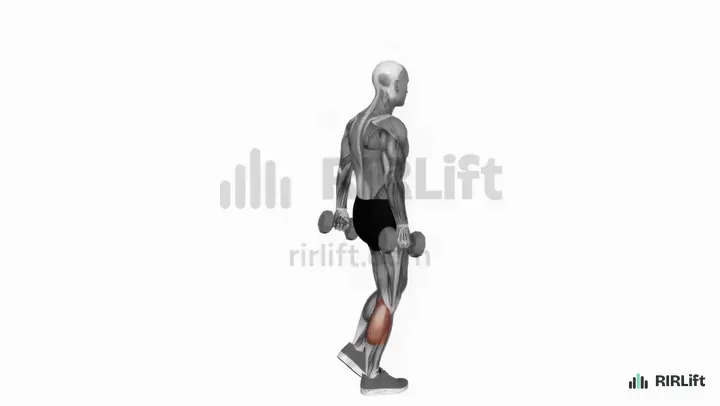
Single-Leg Calf Raise

Calves

Your body weight on one calf, with the heel dropping below a stair, is a real load. Two-leg calf raises on flat floor rarely get past easy, so this is the version that grows calves without weights.

How to do it

  1. Stand on one foot with the other lifted just off the floor, arms by your sides; hold a dumbbell in each hand once body weight is easy.
  2. Rise onto the ball of your foot as high as you can and hold for a second.
  3. Lower your heel to the floor over two seconds.
  4. Finish all reps on one leg, then switch; sets are per leg.

Cues

  • Rise as high as you can
  • Pause at the top
  • Two seconds down

Common mistakes

  • Bouncing through the reps: pause for a beat at the top of each one.
  • Rolling onto the outside of the foot: keep your weight over the big toe.

Swap for: Dumbbell Standing Calf Raise, Kettlebell Calf Raise, Standing Calf Raise

Quads and glutes, explosive squat

Jump Squat

Quads, Glutes

Jumping turns a bodyweight squat into power training, and stopping each set well before you slow down keeps it that way. It also lifts your heart rate when you want legs and conditioning in one session.

How to do it

  1. Stand with your feet about shoulder width and your arms ready.
  2. Dip into a quarter to half squat, then jump straight up, swinging your arms.
  3. Land softly with bent knees and reset before the next jump.

Cues

  • Soft, quiet landing
  • Reset between reps

Common mistakes

  • Landing stiff-legged: let the hips and knees bend to absorb the landing.

Swap for: Box Jump, Bodyweight Squat

Glutes and quads, lateral bounds

Skater Hop

Glutes, Quads, Abductors

Bounding side to side on one leg trains landing and pushing off sideways, the way you move in court and field sports. Stick each landing for a second before the next hop to make it a strength drill.

How to do it

  1. Stand on your right leg with a slight bend in the knee.
  2. Push off sideways and land on your left foot, letting your right leg swing behind you.
  3. Stick the landing, then bound back to the right.

Cues

  • Stick each landing
  • Push sideways, not up

Common mistakes

  • Taking off before you are balanced: pause for a beat on each landing.

Swap for: Lateral Box Jump, Single-Leg Jump

Put them together: example sessions

Each session below picks from the exercises above for one situation, with the sets, reps, rest and RIR filled in.

Session 1

Starting out, no equipment, two days a week

  • Workouts2× a week
  • Working sets15 a week
  • Per workout~20 min
  • EquipmentBodyweight

You are new to training or coming back after a long break, and squats to a chair are where you are right now.

Two short sessions give each leg muscle about 6 to 8 hard sets a week, enough for fast early progress while your knees and hips get used to the work. Everything stays 2 to 3 reps short of failure so the soreness does not stop you training.

Day 1: Squat and glutes
ExerciseSets × repsRIRRest
Bodyweight Squat 3 × 12–20 3 75 s
Donkey KickPer leg. 3 × 12–20 2 1 min
Single-Leg Calf RaisePer leg. Hold a wall. 2 × 8–15 2 1 min
Day 2: Holds and hips
ExerciseSets × repsRIRRest
Wall SitSeconds per hold. 3 × 20–45 3 75 s
Cossack SquatPer side. Hold a doorframe if needed. 2 × 5–8 3 75 s
Fire HydrantPer leg. 2 × 12–15 2 1 min
How to run it
Do Day 1 and Day 2 with at least a day between them, for example Monday and Thursday. Each takes about 20 minutes.
How to progress
Use double progression: when every set reaches the top of the rep range at the target reps in reserve, add a slower 3-second lowering, then move to the next harder exercise (squat to skater squat, wall sit to longer holds). RIRLift sets the next session's target from the reps in reserve you log.

Session 2

Building leg muscle with body weight only

  • Workouts2× a week
  • Working sets30 a week
  • Per workout~45 min
  • EquipmentBodyweight

Twenty-five squats are easy, you train at home, and you want bigger, stronger legs without buying weights.

Muscle growth needs about 10 to 16 hard sets per muscle a week, and body weight only gets heavy enough when one leg does the work. The two days give the quads 14 sets, the hamstrings 6 and the calves 7, close to failure.

Day A: Pistols and Nordics
ExerciseSets × repsRIRRest
Pistol Squat1 warm-up set firstPer leg. Squat to a box or chair. 4 × 5–8 2 2 min
Sissy Squat 3 × 8–15 1 90 s
Nordic Hamstring Curl 3 × 3–6 2 2 min
Single-Leg Calf RaisePer leg. 4 × 10–20 1 1 min
Day B: Skaters and adductors
ExerciseSets × repsRIRRest
Skater Squat1 warm-up set firstPer leg. 4 × 6–10 2 2 min
Cossack SquatPer side. 3 × 6–10 2 90 s
Copenhagen PlankSeconds per side. 3 × 15–30 2 1 min
Nordic Hamstring Curl 3 × 3–6 2 2 min
Single-Leg Calf RaisePer leg. 3 × 10–20 1 1 min
How to run it
Train Day A and Day B once each, two or three days apart, alongside any upper-body days. Each session is about 35 to 40 minutes.
How to progress
Add reps until you hit the top of the range at 1 to 2 reps in reserve, then make the rep harder: slower lowering, a pause at the bottom, or a lower box for pistols. Nordic curls progress by lowering slower and further before you catch yourself.

Session 3

Legs for running and sport

  • Workouts2× a week
  • Working sets25 a week
  • Per workout~35 min
  • EquipmentBodyweight

You run, play a field or court sport, or ski, and you want legs that push off, land and change direction well, with no gym.

Sport already takes energy, so each session stays at 12 or 13 short sets, a third of them jumps and none taken close to failure. Jumps come first while you are fresh, then single-leg strength and Nordic curls for the hamstrings that sprinting depends on.

Day 1: Power and hamstrings
ExerciseSets × repsRIRRest
Jump SquatReset between reps. 4 × 4–6 3 90 s
Skater SquatPer leg. 3 × 6–8 2 90 s
Nordic Hamstring Curl 3 × 3–5 2 2 min
Single-Leg Calf RaisePer leg. 3 × 10–15 2 1 min
Day 2: Lateral and adductors
ExerciseSets × repsRIRRest
Skater HopPer side. Stick each landing. 4 × 5–8 3 90 s
Pistol SquatPer leg. To a box. 3 × 4–6 2 2 min
Copenhagen PlankSeconds per side. 3 × 15–25 2 1 min
Wall SitSeconds per hold. 2 × 30–60 2 1 min
How to run it
Do the sessions on two easy days or before an easy run, not the day before a race or match. About 30 minutes each.
How to progress
Keep the jumps crisp and stop each set if the height drops. Progress the strength exercises with double progression: reach the top of the rep range at the target reps in reserve, then slow the lowering or move to the harder variation.

Make it fit you

Questions

Can I build leg muscle without weights?

Yes, if the exercises are hard enough. Single-leg squats like the pistol and skater squat put your full body weight on one leg, and Nordic curls overload the hamstrings. Sets of 6 to 15 reps taken close to failure build muscle whether the load is a barbell or your body.

Are 4 exercises enough for leg day?

Yes. One squat pattern, one single-leg exercise, one hamstring exercise and one calf exercise cover the legs. What matters more is about 10 to 16 hard sets per muscle across the week.

What are the best leg exercises for seniors without equipment?

Bodyweight squats to a chair, wall sits, single-leg calf raises holding a wall and Cossack squats with a hand on a doorframe. Keep 2 to 3 reps in reserve and lower the chair height or lengthen the holds as they get easier.

What is a good 5-minute leg workout?

Alternate 40 seconds of bodyweight squats, a 40-second wall sit and 40 seconds of jump squats with 20 seconds of rest, twice through. It works as a quick session, but two 20 to 30 minute sessions a week build far more.

How many times a week should I train legs at home?

Two or three times. Each session can be short, as long as the weekly total reaches about 10 hard sets for the quads and 6 for the hamstrings.