
The workout app for friends who lift at different weights
Published October 27, 2026
A workout app for friends has to do two jobs: keep each of you on your own program, and make the group visible enough that nobody quietly skips a week. RIRLift does both. Your friends see when you train, every finished workout posts to them, and the weekly board scores sessions against each person's own target, so a friend who benches 95 lb competes on equal terms with one who benches 225.
Free on iPhone and Apple Watch · No account · Coming to Android: join the waitlist
What friends who train together need from an app
-
A board that's fair when your strength isn't
The weekly board counts sessions against each person's own weekly target and resets every Monday. Three sessions out of three beats four out of five, whoever lifts more. Your friends see the same board you do.
-
Seeing each other train, without sending texts
Friends see when you're training, and every finished workout posts itself to them. Cheer a workout and your friend sees it while they rest between sets.
-
Challenges with an end date
Challenge one friend head-to-head, or the whole group together, for 7, 14 or 30 days. A dated finish line keeps the push short enough to win and long enough to matter.
-
Your own weights, even on the same plan
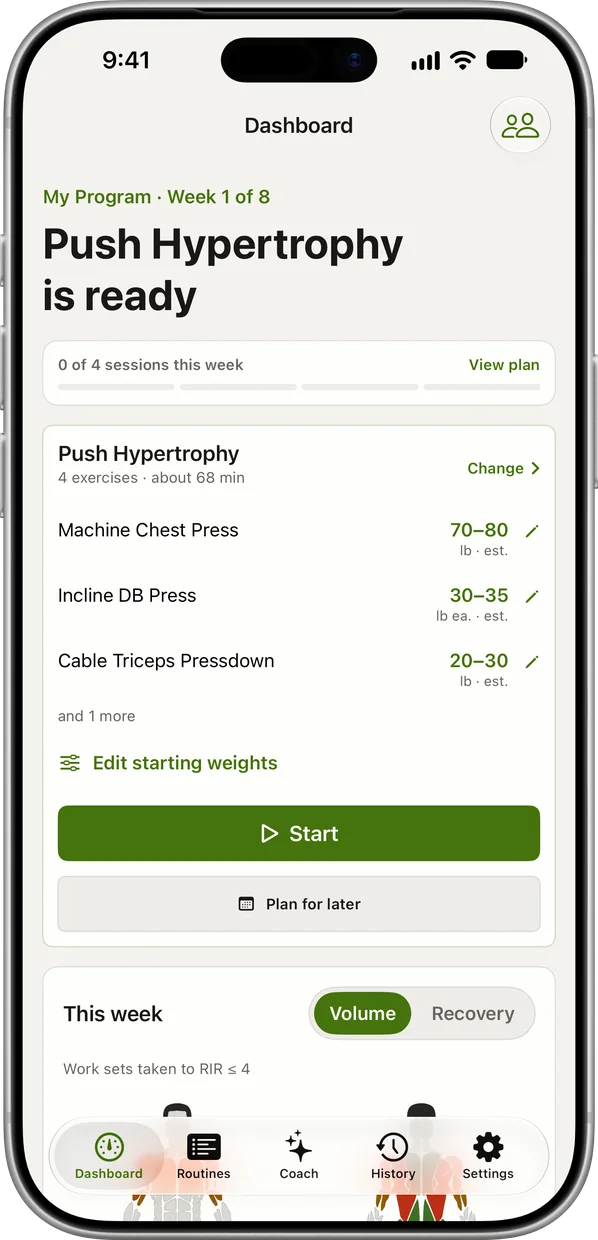
Run the same routine as your friends and each of you gets your own numbers. Weights come from the sets you logged and the reps you had left, so nobody copies a load that belongs to someone else.
-
Getting the group in
Invite friends who don't have RIRLift yet. When you're both on the app, a QR invite lets you see each other's lifts.
-
Logging fast enough to keep talking
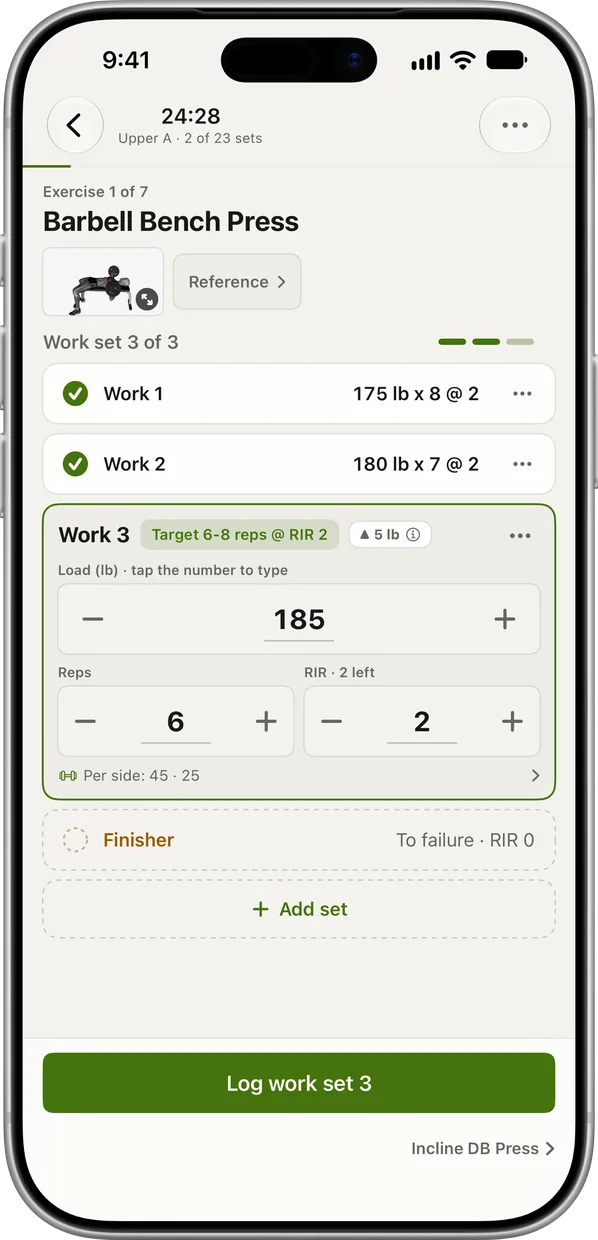
Weight and reps are prefilled from last time; after each set you tap how many reps you had left. With an Apple Watch the whole session runs from your wrist, rest timer included.
Two friends, one plan, different numbers
Same plan, a long way apart on the bar
Jake and Priya both run the 3-day full-body plan below. Jake has lifted for years; Priya started in the spring. Day B, bench press for 6–10 reps with 2 left.
| Exercise | You logged | Next session | Why |
|---|---|---|---|
| Barbell Bench Press | Jake: 185 lb, 10 / 10 / 10 reps, 2 left | 190 lb × 6–10 | Every set reached the top of the range, so the bar goes up one 5 lb step and the rep target resets to 6. |
| Barbell Bench Press | Priya: 95 lb, 9 / 8 / 8 reps, 2 left (target 8) | 95 lb × 9 | Her weakest set hit the target, but not the top of the range. Same weight, one more rep. |
| Leg Press | Priya: 180 lb, 15 / 15 / 15 reps, 2 left | 190 lb × 10–15 | Top of the 10–15 range on every set: one step up, reps back to 10. |
Neither of you looks at the other's weights to decide your own. On the board, both of you got credit for the same session.
Training side by side, egging each other on
Upper day on the 4-day plan, both at the same gym. Target: 8 reps with 2 left on bench, 10 reps with 1 left on the shoulder press.
| Exercise | You logged | Next session | Why |
|---|---|---|---|
| Barbell Bench Press | Set 1: 185 lb × 8, 4 left | Set 2: 195 lb | Four left instead of two: 185 × 41 ÷ 39 ≈ 194.5, rounded to 195 lb. |
| Barbell Bench Press | Set 2: 195 lb × 8, nothing left | Set 3: 195 lb | Your friend talked you into a grinder. You still got the reps, so the weight holds. Pushing harder never cuts it. |
| Dumbbell Shoulder Press | 50 lb pair × 7, 1 left | 45 lb pair | Below the 8–12 range: 50 × 37 ÷ 40 ≈ 46, rounded down to the next dumbbell. |
Train as hard as the company makes you. The next set adjusts to what you logged, not to what you meant to do.
A friend comes back after a month away
Marcus missed four weeks with work travel. The group's challenge starts Monday and he wants to be on the board from day one.
| Exercise | You logged | Next session | Why |
|---|---|---|---|
| Barbell Back Squat | Last session: 250 lb × 8, 2 left | 225 lb × 6–10 | After three weeks or more away, the app offers Ease back in: one week about 10% lighter, rounded to the plates. |
| Lat Pulldown | Last session: 140 lb × 12, 1 left | 125 lb × 8–12 | Same easier week across every lift. Pick up where I left off skips it if he kept training on the road. |
Marcus counts sessions on the board straight away. The lighter week only changes what's on the bar.
Plans a group can run together
-
The best workout routine for the days you can train
3 days a week: full body
The plan Jake and Priya share: three full-body days, so a group that trains Monday, Wednesday and Friday stays in step.
3× a week · 51 sets a week · ~45 min
Add to RIRLiftSee the planAdd to RIRLift
Scan with your iPhone camera to add this plan.
-
The best workout routine for the days you can train
4 days a week: upper/lower
For the friends with a year or more behind them. Two upper and two lower days, so you can pair up on the days that match.
4× a week · 68 sets a week · ~40 min
Add to RIRLiftSee the planAdd to RIRLift
Scan with your iPhone camera to add this plan.
Make it fit you
-
Set a weekly target you'll actually hit
The board scores you against your own target, so pick the number of sessions your week really holds. Three you hit beats five you miss.
-
Start a challenge with a finish line
Head-to-head for a rivalry, or together for the whole group, for 7, 14 or 30 days. Two weeks is long enough to build the habit and short enough that nobody gives up.
-
Add the friend who isn't on the app yet
Send an invite from Friends. Once they're in, swap QR invites at the gym to see each other's lifts.
-
Tell it what your gym has
Choose your equipment once. When you both want the same rack, the swap picker shows a replacement with the weight it would start you at.
-
Use the Watch when you're training together
Log, rest and see which plates to load from your wrist. The phone stays in your pocket and the conversation keeps going.
When a different app fits better
- Your group mostly runs or counts steps. A running or step-challenge app fits a cardio group better.
Questions
Do my friends need RIRLift to join?
To see your workouts and be on the board, yes. You can invite friends who don't have it yet, and the invite gets them there.
Is it fair if my friends are much stronger than me?
Yes. The weekly board counts sessions against each person's own weekly target, not pounds lifted. Showing up is what scores.
How long do challenges last?
You choose: 7, 14 or 30 days, head-to-head with one friend or together as a group.
Can we follow the same program?
Yes. Add the same plan and each of you gets your own weights, worked out from your own sets and the reps you had left.
Does it help with accountability if I train alone?
That's what the board is for. Your friends see when you train and when you don't, and it resets every Monday so a bad week doesn't follow you. If two days pass with nothing planned, the Dashboard also offers to pick a time and remind you.
Read next
-
The best workout routine for the days you can train
Plans for three, four and six days a week, so the group can pick one that fits.
-
How RIRLift picks your next weight
Why two friends on one plan end up with different numbers.
-
The best workout log apps for lifters
What to look for in the logging underneath the social features.
-
Strength calculator: how strong am I?
Compare lifts fairly across bodyweights, outside the app.
-
How to use reps in reserve (RIR) in your workouts
The one number each of you logs after every set.
More ways lifters use RIRLift
-
The workout app for couples who lift, together or apart
Same plan, two sets of weights. See each other train, cheer workouts and run challenges on your own schedules.
-
The gym tracker that turns your logs into your next weight
Bring your old logs, chart every lift, and see a stall answered before it eats another month.
-
The Apple Watch weightlifting app that runs the whole session
Log sets, rest, load plates and swap machines from your wrist, with the next weight set on the Watch.