
Blog
What is the Arnold split? The pairing decides it, not six days
Published August 9, 2026 · updated August 20, 2026 · 12 min read
Search interest in the Arnold split has climbed about 50% in a year, which makes it one of the few training terms currently growing while the generic ones (5 day split, 6 day split, push pull legs) all shed volume. Something about it is landing.
Open the results and you get the same artifact six times. Day one, chest and back. Day two, shoulders and arms. Day three, legs. Repeat. Here are the exercises, here are the sets, train hard.
Not one of them answers the question you actually have to answer before running it, and the top Reddit thread on the subject is chasing exactly that gap. What defines the Arnold split is not that it runs six days. Plenty of splits run six days. It is that it asks two large muscle groups to share one session, twice a week, every week. That pairing is the whole personality of the split, and it decides who it works for.
What is the Arnold split?
The Arnold split is a six-day training routine that pairs chest with back, shoulders with arms, and trains legs alone, running the three-day rotation twice per week so every muscle is trained twice. It is loosely modelled on Arnold Schwarzenegger's training and is the highest-frequency, highest-day-count structure in common use.
The standard arrangement looks like this.
| Day | Session | Muscles trained |
|---|---|---|
| Monday | Chest and back | Chest, back |
| Tuesday | Shoulders and arms | Delts, biceps, triceps |
| Wednesday | Legs | Quads, hamstrings, glutes, calves |
| Thursday | Chest and back | Chest, back |
| Friday | Shoulders and arms | Delts, biceps, triceps |
| Saturday | Legs | Quads, hamstrings, glutes, calves |
| Sunday | Rest |
Two things follow immediately. Every muscle gets trained twice a week, which is the frequency most volume guidance settles on. And six of your seven days are training days, which is the largest time commitment any mainstream split asks for.
Both of those are usually presented as the pitch. Neither of them is the interesting part.
It was never Arnold's mass-gaining program
Worth saying plainly, because the name does a lot of work here. The routine sold as the Arnold split is a simplified descendant of how Schwarzenegger trained, not a transcription of it.
Golden-era training at that level ran twice a day, six days a week, at set counts that would read as satire in a modern program. Whatever produced those results, it was not three sessions rotated twice with four exercises each. The name is doing marketing, and the most-cited thread on the subject says so in its title.
This matters for one practical reason. If you adopt the split because you believe it is the program that built the physique, you have adopted it for a reason that is not true, and you will be reluctant to change the parts of it that do not suit you. Judge the structure on what it does to your week, not on the name attached to it.
Two large muscles, one session
Here is the part no template addresses.
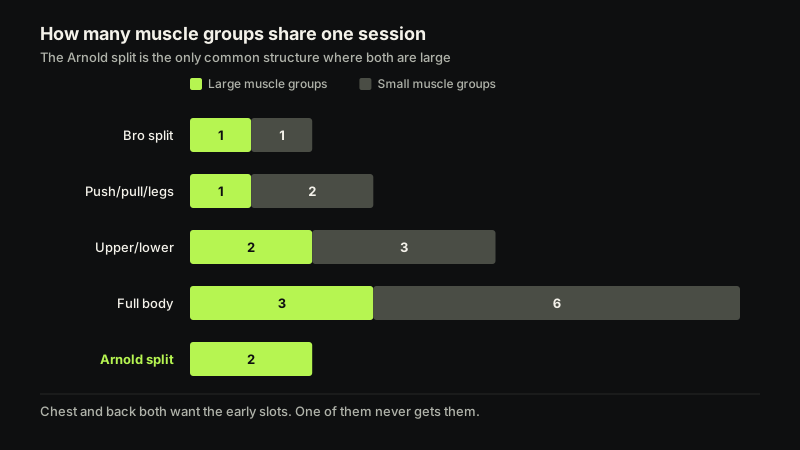
Every split makes a choice about how many muscle groups have to share one session's usable effort. Count them honestly.
| Split | Muscle groups per session | Large groups per session |
|---|---|---|
| Bro split | 1 to 2 | 1 |
| Push/pull/legs | 2 to 3 | 1 |
| Upper/lower | 4 to 5 | 2 |
| Full body | 8 to 9 | 3 |
| Arnold split (chest and back) | 2 | 2 |
The Arnold split looks lean on that first column. Two muscle groups per session is second only to the bro split. But read the second column, because that is the one that costs you. Chest and back are both large, both demanding, and both want the early, high-quality slots in a session. On a push/pull/legs day, chest shares its session with delts and triceps, which are small and cheap. On an Arnold day, chest shares with back.
A session trains its muscles in sequence, and quality declines along that sequence. That is true everywhere, but it is usually the small muscles that eat the decline. Calves and rear delts have always been structurally last, and lifters have made peace with it.
The Arnold split puts a large muscle group in that position. Whichever of chest or back you place second is trained on the degraded half of the session, twice a week, for every week of the block. The template names the exercises and says nothing about the order, which means most people run the same order every session and hand one of their two biggest muscle groups a permanently compromised dose.
The fix is not complicated, and it is covered further down. The point is that it is a decision the template quietly makes for you.
Does the Arnold split actually work?
On the evidence, the structure has no inherent advantage and no inherent penalty. What it has is a ceiling and a failure mode, same as every other split.
The frequency argument is the one usually made in its favour. Schoenfeld, Grgic and Krieger's 2019 meta-analysis applied volume-equated inclusion criteria across 25 studies and found no significant hypertrophy difference between higher and lower weekly training frequencies once total weekly sets were held constant. The Sports Medicine dose-response meta-regression reaches the same conclusion from the other direction: weekly volume drives the response, and frequency is mostly the delivery mechanism.
So training chest twice a week instead of once earns you nothing on its own. It earns you something only if the two sessions add up to more usable weekly volume than one session could have delivered, which is a real advantage but a smaller one than the frequency framing implies.
Where the Arnold split does genuinely score is per-session efficiency. A meta-regression on per-session set volume modelled the returns on sets performed for one muscle inside a single workout and found clear diminishing returns, with the point of undetectable outcome superiority landing near 11 fractional sets per session. That paper is a preprint rather than a peer-reviewed publication, and its data at very high per-session volumes is thin, so treat the number as a rough landmark rather than a threshold.
As a landmark it is useful. Splitting a muscle's weekly volume across two sessions keeps almost every set in the productive part of that curve, which is precisely what a bro split cannot do when a muscle's entire weekly volume lands in one session. Ten weekly sets for chest delivered as two sessions of five is a better-spent ten than one session of ten.
That is the real case for the Arnold split, and it is a decent one. It is just a case about volume distribution, not about six days or about Arnold.
Arnold split vs PPL
The most common question, and the fairest comparison, because both are six-day, twice-weekly structures.
| Arnold split | Push/pull/legs | |
|---|---|---|
| Days per week | 6 | 6 |
| Frequency per muscle | 2x | 2x |
| Large groups sharing a session | 2 (chest and back) | 1 |
| Where the small muscles sit | Their own dedicated day | Tacked onto a large group's day |
| Biceps and triceps | Trained together, fresh | Trained after back / after chest |
| Main weakness | One large group always runs second | Arms and delts always run last |
| Cost of one missed session | Half a muscle's weekly volume | Half a muscle's weekly volume |
Neither wins outright. They make opposite trades with the same six days.
Push/pull/legs protects your large muscle groups and sacrifices the small ones. Chest gets the front of every push day; triceps get whatever is left after four pressing movements. The Arnold split does the reverse. It gives delts and arms a dedicated day where they are trained fresh, which is genuinely the best deal small muscles get in any common split, and it pays for that by making chest and back share. Before you compare them at all, though, settle the frequency a push pull legs split never states in its name, because a three-day PPL and a six-day PPL are not the same opponent.
Choose on which trade suits your weak point. If your arms lag and you suspect it is because they only ever get trained tired, the Arnold split fixes that directly. If your back is the priority, a structure that gives it a session it does not have to share will serve you better.
Who the Arnold split actually works for
Six training days is a real constraint and it filters most people out before any of the above matters.
It works if you can genuinely train six days a week without the sixth session becoming a token appearance, your arms or delts are a known weak point, you recover well, and you are willing to rotate which muscle leads the paired sessions.
It does not work if six days is aspirational rather than actual. This is the failure that matters most in practice. The Arnold split's weekly volume is entirely dependent on running both halves of the rotation. Miss a Thursday and chest and back both drop to one session that week, which is exactly the bro split you were trying to avoid, without the longer session that would have compensated. A four-day structure you actually complete beats a six-day structure you complete two thirds of.
It also does not work if you are early enough in training that the volume it prescribes is more than you need. Six days of training to accumulate 10 to 14 weekly sets per muscle is a lot of gym time for a total you could reach on a three-day full body split run properly.
How to run it without lying to yourself
If the split fits, four adjustments make it work considerably better.
Alternate which muscle leads. Monday leads with chest, Thursday leads with back. This is the single highest-value change available, and it costs nothing. It turns "back is permanently second" into "back is second once a week", which halves the order penalty on both muscles.
Do not train both paired muscles to the same total. A chest and back day cannot deliver a full dose to both. Give the leading muscle five or six working sets and the trailing muscle three or four, then invert on the second session of the week. Across the week both end up even, and every set was performed in a position where it counted.
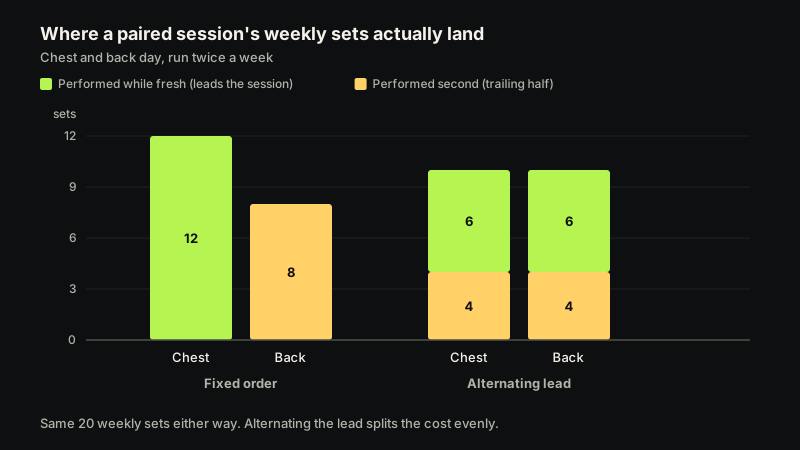
The weekly total is identical either way. What changes is that no muscle spends the whole block in the trailing half.
Keep the paired session inside a set count you can actually finish. Around 18 to 22 working sets is where most people's set quality holds, and a chest and back day reaches that faster than any other session in the rotation. If your plan puts 30 sets on Monday, most of the last ten are buying fatigue rather than stimulus.
Treat the arms day as the payoff, not the filler. It is the reason to run this split at all. Do not schedule it as the session you skip when the week gets busy.
The two numbers that settle it
The Arnold split is a reasonable structure with an unusually specific catch. It gives small muscles the best treatment they get anywhere, and it pays by making two large muscle groups share a session that only one of them can lead.
Whether that trade works for you is not answerable from a template, because both variables live in your log. The first is your actual weekly hard sets per muscle, which on a six-day split is only what you think it is if you ran all six days. The second is where in each session those sets happened, because a set performed second on a chest and back day is not worth the same as the identical set performed first.
Most guidance places working sets at one to three reps in reserve, and the honest problem with a paired session is that the estimate stays accurate while the set gets cheaper. You finish the last row and log 2 RIR. It probably was 2 RIR. It was also 2 RIR against a version of you that had already trained chest for six sets, on a load well below what you would have pulled fresh.
RIRLift totals hard sets per muscle across the week automatically, so the gap between the 12 weekly sets the template promised chest and the 8 a missed Thursday actually delivered shows up as a number instead of a feeling. Logging load, reps and RIR per set as the session runs is what exposes the order cost, because the decay lives in the sequence rather than in the weekly total. You can see how a session runs from your wrist without reaching for a phone between sets, which matters on a day carrying twenty of them. For where those weekly targets should land in the first place, the training volume guide covers the ranges, and how many sets one session can actually hold covers the per-session ceiling a paired day runs into first.
Run the Arnold split if six days is real for you. Just alternate the lead, and count what actually happened.