
Blog
How to increase your deadlift: find the limiter, then fix the program
Published November 15, 2026 · 15 min read
Most advice on how to increase your deadlift is a list of exercises. Do deficits, do rack pulls, do hip thrusts, train your grip. All of those can help, and none of them tells you which one you need. A lifter whose bar never leaves the floor and a lifter who stalls an inch below lockout have different problems, and a lifter who is simply pulling a grinding max every Monday has a third problem that no accessory will fix.
So this guide runs in the order a coach would think about it. First, where the lift fails. Then how the top set is being progressed, because that is where most stalled deadlifts actually live. Then how often you pull and how much hinge work you do in a week, then the accessories, and last, the setup details that cost you kilos without you noticing. At the end there is a sample eight-week block and a way to read a stall from your own training log.
Why your deadlift stops going up
The deadlift is the lift that stalls earliest for a lot of intermediates, and a deadlift plateau is usually not a sign that they have stopped getting stronger. Three causes account for most stuck pulls:
- The heavy work is too heavy, too often. A true max or a grinding triple every week accumulates fatigue faster than the lift can adapt. The number you can show on the day falls behind the strength you have actually built.
- There is not enough useful work around the heavy set. One top set and nothing else is a low weekly dose for the back, glutes and hamstrings. Strength keeps responding to more hard sets per week up to a point, and many deadlift programs sit well below it.
- One part of the lift is weaker than the rest. The lift fails at the same point every time because one muscle group or one position is the limiter. This is the cause every listicle addresses, and it is real, but it is the third most common one, not the first.
The fixes for the first two are programming. The fix for the third is exercise selection. You need to know which you have before you change anything, and the next section is how to find out.
Step 1: find where the deadlift fails
Film a heavy set from the side, or simply pay attention to the last hard rep. Where the bar slows down is where the lift is weakest. Each sticking point has a typical cause and a typical fix:
| Where it fails | What usually limits it | What to add |
|---|---|---|
| Off the floor (bar will not break) | Quads and the start position; hips shooting up | Deficit deadlifts, paused deadlifts an inch off the floor, front squats |
| Between shin and knee | Upper back rounding, bar drifting away from the legs | Paused deadlifts below the knee, heavy rows, lat work |
| Above the knee to lockout | Glutes and hip extension | Romanian deadlifts, block pulls, hip thrusts |
| Grip opens before the lift ends | Grip strength or grip choice | Heavy holds, double overhand warm-ups, hook grip or straps on back-off sets |
| Fails at random points, or form breaks on every heavy set | Fatigue, bracing, or loads too close to max | Back off the top set first (Step 2), then fix bracing (Step 5) |
Two cautions. A miss off the floor is often a setup problem rather than a strength problem: if the bar starts too far forward or your hips start too low, the first inch is a fight you set up yourself, and deadlift stance is where to look first. And the last row matters more than it looks. If every heavy set looks different, there is no consistent weak point to train yet. There is a program that is too hard.
Step 2: progress the top set by effort, not by grinding
The most useful single change most lifters can make to their deadlift is to stop testing it every week. Instead, work up to a heavy top set with a target effort, recorded as reps in reserve (RIR): how many more reps you could have done with good form.
A top set of three at 2 RIR is heavy and productive. It is far less fatiguing than a three that you barely finished, and it still lets you see strength rising week to week, because the same load gets easier before it gets heavier. Helms and colleagues laid out how to use this kind of RIR-based effort scale in resistance training, and the study that introduced the scale found that RIR-based ratings tracked bar speed closely in both experienced and novice squatters, concluding it is a practical way to regulate daily training load. That is exactly the job a heavy deadlift triple at 1 to 3 RIR needs it to do.
A simple progression rule:
- Pick a rep target for the top set (3 to 5 for most lifters) and an effort target (2 RIR is a sensible default).
- If you hit the reps at 2 RIR or easier, add the smallest sensible jump next session: 2.5 to 5 kg for most people.
- If you hit the reps but it was a 1 RIR grind, repeat the load next time.
- If you missed reps, or it was 0 RIR, take 5 to 10% off and rebuild.
This is deadlift progression by the same logic as progressive overload on any lift, applied to the one lift where people most often skip it in favour of testing.
Turn each top set into an estimated max
You do not need a true max to know whether your deadlift is going up. Reps plus RIR give you an estimate. A common approach is to treat the set as if you had taken it to failure, so 3 reps at 2 RIR counts as a 5-rep max, then use a standard formula such as Epley's (load × (1 + reps ÷ 30)).
| Top set | Reps to failure | Estimated 1RM |
|---|---|---|
| 180 kg × 3 @ 2 RIR | 5 | about 210 kg |
| 185 kg × 3 @ 2 RIR | 5 | about 216 kg |
| 185 kg × 3 @ 1 RIR | 4 | about 210 kg |
Read the last two rows together. The load went up, but the effort did too, so the estimate did not move. That is what a stall looks like before it shows up as a missed rep, and it is why the effort rating belongs in the log next to the weight. An app that already estimates your 1RM per exercise and suggests your next weight from the last set's load, reps and RIR keeps that running estimate for you; on paper, it is one line per session.
Add back-off sets
The top set is the test. The back-off sets are most of the training. After the top set, drop 10 to 15% and do two to four more sets of the same reps, also around 2 RIR. A lifter who pulls 180 × 3 as a top set might follow it with 3 × 3 at 155 to 160 kg. The top set and back-off set structure is well suited to the deadlift because it gets you useful volume at a weight that does not leave you wrecked for the rest of the week.
Step 3: set your frequency and weekly hinge volume
How often should you deadlift? For most lifters, heavy conventional or sumo deadlifts once a week, plus a second, lighter hinge session, is the most practical answer.
The research backs the general shape. A systematic review and meta-analysis by Grgic and colleagues found that training a lift more often produced larger strength gains, but the effect largely disappeared once weekly volume was equated. The frequency effect was also not significant for lower-body strength on its own. In other words, frequency mostly helps because it is an easy way to fit in more work. A separate meta-analysis found that higher weekly set counts produced more strength gain than low ones, although the differences were modest. Neither study was deadlift specific, so treat them as the general rule a deadlift program should follow, not as a deadlift prescription.
What that means in practice:
| Lifter | Heavy pull | Second hinge | Hard hinge sets per week |
|---|---|---|---|
| Early intermediate | 1 top set + 2 back-off sets | Romanian deadlift, 3 × 6 to 8 | About 6 to 8 |
| Intermediate | 1 top set + 3 to 4 back-off sets | Paused or deficit deadlift, 3 × 3 to 5, or RDL | About 8 to 10 |
| Advanced, peaking for a test | Top set, fewer back-offs | Light technique pulls | Volume tapers down |
Count only sets that were genuinely hard, roughly 1 to 3 RIR. Warm-ups and easy technique pulls do not count toward the total. If your current week is one heavy set and nothing else, the most likely fix for your deadlift is not a new exercise, it is a second session.
The RDL vs deadlift comparison is worth reading before you pick the second hinge: a Romanian deadlift loads the hamstrings and glutes through a long range with much less fatigue than a second heavy pull from the floor, which is why it is the usual choice.
Step 4: deadlift accessory exercises that carry over
Accessories work when they train the limiter you found in Step 1. Pick one or two, not six, and progress them like any other lift.
| Accessory | Trains | Best for | Typical dose |
|---|---|---|---|
| Deficit deadlift | Start position, quads, leg drive | Slow off the floor | 3 × 3 to 5, 1 to 2 inch deficit |
| Paused deadlift | Position and tightness below the knee | Bar drifts forward, back rounds | 3 × 2 to 4, 2-second pause |
| Romanian deadlift | Hamstrings, glutes, hip hinge | Slow above the knee, general hinge volume | 3 × 6 to 10 |
| Block or rack pull | Lockout, upper back under heavy load | Fails near lockout | 3 × 3 to 5 from just below the knee |
| Hip thrust | Glutes, hip extension | Hips do not finish | 3 × 8 to 12 |
| Barbell or chest-supported row | Upper back, lats | Rounding, bar drifting | 3 to 4 × 8 to 12 |
| Front squat | Quads, upright torso | Hips shoot up off the floor | 3 × 4 to 6 |
Two rules keep accessories useful. Take them to roughly 1 to 3 RIR, close enough to failure to drive adaptation without adding the kind of fatigue that hurts next week's top set. And keep them for at least four to six weeks before you judge them. An accessory you change every week cannot be progressed, so you will never know whether it helped.
Step 5: grip, bracing and setup
These are not glamorous, and they are often worth more than any exercise.
- Grip. If your hands open before your hips lock out, your grip is the limiter. Use double overhand for as many warm-up sets as you can, then switch to mixed or hook grip for heavy sets. Straps on back-off sets let you train the back and hips past what your hands can hold, without letting grip set the ceiling.
- Bracing. A deadlift that leaks air rounds at the top of the knee. Take the breath into your belly and sides before you pull the slack out of the bar, and hold it through the hardest part. How to brace your core goes through the sequence step by step.
- Setup. Bar over mid-foot, shins close, slack pulled out of the bar before it leaves the floor. If your hips rise first every time, your start position is probably too low, not too high.
How to read a stalled deadlift from your training log
When the deadlift has not moved in three or four weeks, do not change everything at once. Read the log and change one thing.
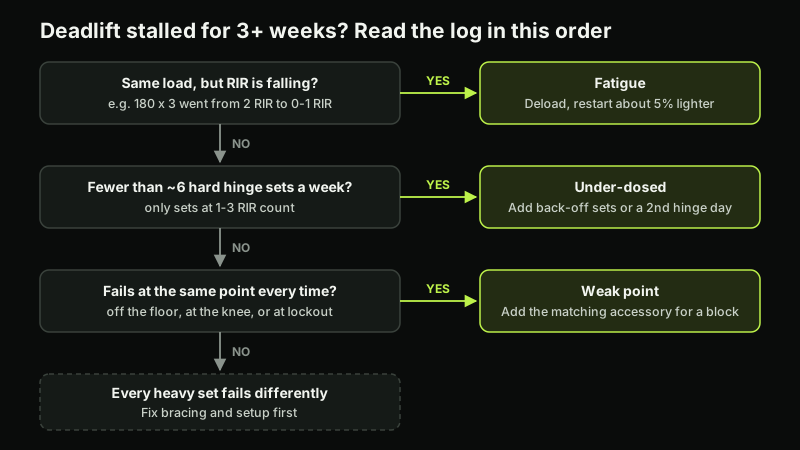
- Same load, rising effort. If 180 × 3 was 2 RIR four weeks ago and is 0 to 1 RIR now, you are carrying fatigue. Take a deload week, then restart about 5% lighter with the same progression rule.
- Same load, same effort, no progress. The program is under-dosed. Add one back-off set or a second hinge session before you touch exercise selection.
- The bar fails at the same point on every heavy set. That is a real weak point. Add the matching accessory from Step 4 and keep it for a block.
- Every heavy set fails differently. Look at bracing and setup before anything else, and check that the top set is not being taken to 0 RIR.
This only works if you write down effort as well as load and reps. Weight and reps alone cannot tell a fatigued lifter from an under-trained one, because both see the same flat number. Logging RIR on the watch between sets makes that cheap enough to do on every set, which is the reason RIRLift rates effort on the wrist rather than after the workout.
A sample eight-week block to increase your deadlift
This is a simple intermediate template using a top set with back-off sets on day one and a lighter hinge on day two. Adjust loads to your own numbers; the effort targets are what matter.
| Week | Day 1: deadlift | Day 2: second hinge |
|---|---|---|
| 1 | Top set 1 × 5 @ 3 RIR, back-off 3 × 5 at -12% | Romanian deadlift 3 × 8 @ 3 RIR |
| 2 | Top set 1 × 5 @ 2 RIR, back-off 3 × 5 at -12% | Romanian deadlift 3 × 8 @ 2 RIR |
| 3 | Top set 1 × 4 @ 2 RIR, back-off 3 × 4 at -12% | Paused deadlift 3 × 3 @ 3 RIR |
| 4 | Top set 1 × 4 @ 2 RIR, back-off 3 × 4 at -10% | Paused deadlift 3 × 3 @ 2 RIR |
| 5 | Top set 1 × 3 @ 2 RIR, back-off 3 × 3 at -10% | Romanian deadlift 3 × 6 @ 2 RIR |
| 6 | Top set 1 × 3 @ 1 to 2 RIR, back-off 2 × 3 at -10% | Romanian deadlift 3 × 6 @ 2 RIR |
| 7 | Lighter week: 3 × 3 at about 80% of week 6's top set | Light technique pulls or skip |
| 8 | Work up to a heavy single @ 1 RIR, or retest a 3-rep max | Off |
Compare week 8 with your estimated max from week 1, not with your last test. If it went up, run the block again from a slightly heavier week 1. If it did not, go back to the log and use the section above to find out why.
Frequently asked questions
How fast can you increase your deadlift?
Beginners can often add weight to the deadlift every session for months. Intermediates usually progress week to week or across a four- to eight-week block, and advanced lifters may need several months for a few kilos. If you are still early, a simple linear progression will move your deadlift faster than anything in this guide.
How often should you deadlift to get stronger?
Once a week heavy, plus a second lighter hinge session, suits most lifters. Pulling heavy twice a week can work, but it is hard to recover from, and the evidence suggests the benefit of extra frequency comes mostly from the extra work it lets you do.
Should you max out on deadlifts every week?
No. Weekly maxing accumulates fatigue and makes it harder to see whether you are getting stronger. Work to a heavy top set with 1 to 3 reps in reserve and estimate your max from it instead. Test a true max at the end of a block, not every Monday.
Do deadlift accessory exercises actually help?
They help when they target the part of the lift that is limiting you and when you progress them for a full block. Picking accessories at random, or rotating them weekly, rarely moves the main lift.
Is it better to increase weight or reps on the deadlift?
Both work, and the cleanest approach is to do one at a time. Hold the load until the target reps come in at your target effort, then add weight. Adding load while effort climbs is how most lifters talk themselves into a stall.
The short version
To increase your deadlift, find where it fails, stop grinding a max every week, and progress a heavy top set by reps in reserve. Add back-off sets and a second, lighter hinge day so the weekly dose is high enough. Then, and only then, choose one or two accessories for the weak point you actually have. Keep the effort rating in your log next to every set, because that is the number that tells you which of those fixes you need next.