Blog
Pause Reps: What They Are, Why They Work, How to Program
Published November 19, 2026 · 15 min read

Scan with your phone camera
A pause rep is a repetition where you stop dead for one to three seconds in the hardest position, usually the bottom, before you drive up. It removes the bounce, makes the lift honest, and builds strength exactly where you are weakest. Start with a two-second pause, a load well below your normal working weight, and a rep or two left in reserve.
This guide covers what pause reps are, what they do for strength and muscle, how to run paused squats, bench presses and deadlifts, and how to log them so your progress stays readable.
TL;DR
- A pause rep is a full stop of about 1 to 3 seconds at the bottom of a lift, with no bounce, followed by a drive up from a dead stop.
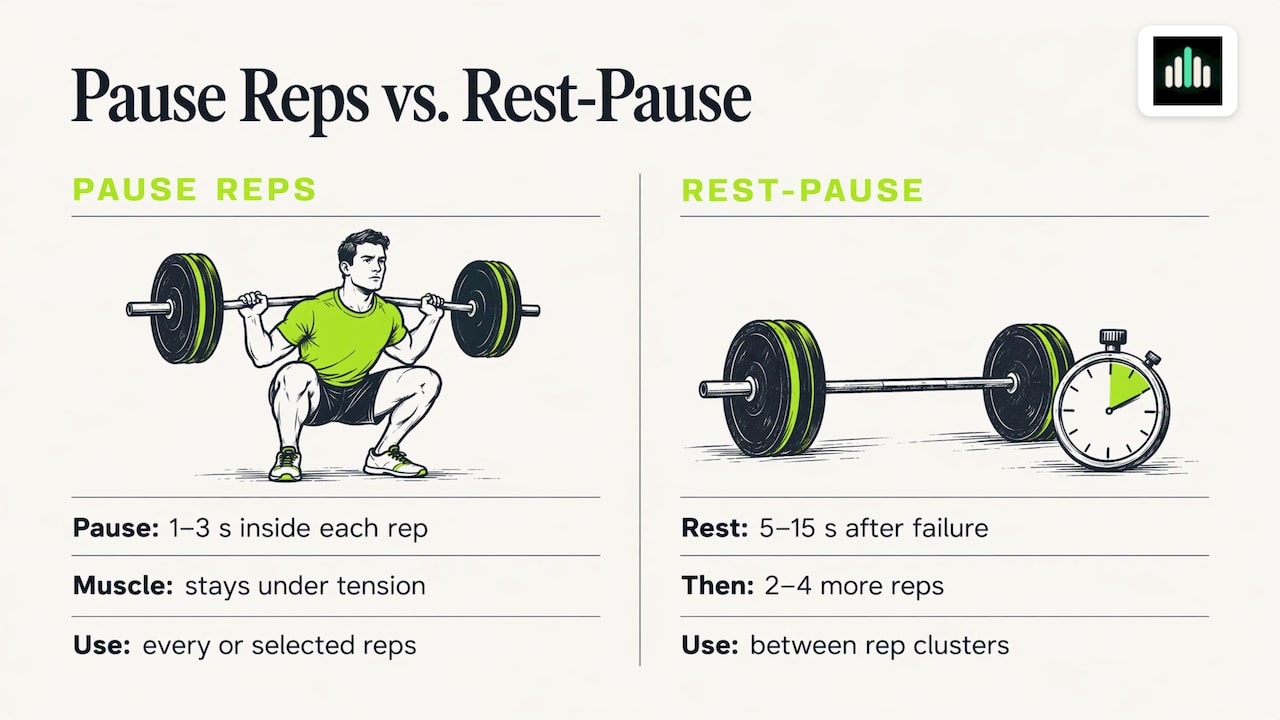
- It is not a rest-pause set. Pause reps pause inside the rep; rest-pause sets pause between mini-sets taken near failure.
- Expect to lift lighter than normal. A common benchmark for a paused squat single is about 90% of your regular squat max.
- Use 2 seconds as the default, keep sets in the 3 to 5 rep range for strength, and leave one or two reps in reserve.
- Log the pause length with the load, reps and RIR so you compare like with like from week to week.
Table of Contents
- What pause reps are, and what they are not
- Why a pause changes the lift
- Do pause reps build muscle?
- How to do paused squats
- Pause bench press and paused deadlifts
- How long, how heavy, how many reps
- Three ways to put pauses into a program
- Log pause reps so progress stays readable
- Where RIRLift fits
- Common mistakes with pause reps
- FAQ
- Sources
What pause reps are, and what they are not
A pause rep inserts a deliberate stop inside the repetition. You lower the bar under control, hold the bottom position without relaxing, then press or stand up from that dead stop. The pause usually lasts one to three seconds. In the squat it happens in the hole, in the bench press with the bar resting on your chest without sinking into it, and in the deadlift just off the floor or at a point where you tend to stall.
The term gets confused with rest-pause training, which is a different tool. In a rest-pause set you take an exercise to failure, rest roughly 5 to 15 seconds, and then squeeze out two to four more reps with the same weight, according to Men's Health. The pause there is a breather between clusters of reps. In a pause rep, the pause is part of every rep (or selected reps) and the muscle never gets to rest. If rest-pause is the technique you are after, our guide to rest-pause sets and how to log one covers it in full.
The two do share a research footprint, which is why search results mix them. A 2021 randomized trial of 28 resistance-trained men compared rest-pause, drop-set and traditional training with equal volume over 8 weeks. Rest-pause produced slightly larger back squat 1RM gains, while thigh muscle thickness changes were similar across all three groups. That is evidence about rest-pause, not about paused reps, so keep the two ideas separate when you read.
Why a pause changes the lift
During a normal rep, the muscles and tendons store elastic energy as you lower the weight, and part of that energy returns as you reverse direction. This is the stretch-shortening cycle. A pause at the bottom lets that stored energy dissipate. NASM explains that an intentional pause at the end of the lowering phase eliminates the stretch-shortening cycle, so the upward phase starts from a dead stop. That raises neuromuscular demand and motor unit recruitment, which is why paused squats, deadlifts and bench presses are staples in strength programs.
Breaking Muscle's Robert Camacho makes a useful point about this: with no stored elastic energy to exploit, you face the weight with strength alone. A pause becomes a quick way to find out whether you are genuinely strong in the bottom position or just good at bouncing through sticking points.
There are three practical consequences:
- Your technique is exposed. You cannot cover a loose brace or a shifted balance point with momentum. If your chest folds forward in the squat hole or the bar drifts on your chest, the pause shows it.
- Weak positions get trained. Most missed lifts fail at the same spot. Pausing there puts more work into it per rep.
- Confidence builds. Sitting calmly in the bottom of a heavy squat teaches you the position is manageable.
Do pause reps build muscle?
Pause reps can contribute to muscle growth, mostly through two mechanisms. The first is time under tension. A paused rep takes longer than a normal rep, and the hold sits at the most mechanically demanding point of the lift. Horton Barbell notes that pausing in the lengthened, stretched position has been associated in emerging research with an enhanced hypertrophic stimulus, often discussed as stretch-mediated hypertrophy.
The second is that paused reps demand more from the quads and other prime movers because the stretch reflex cannot help. BarBend cites a 2018 study that found greater hypertrophy with paused squats than regular squats in women, and describes the isometric hold as a driver of extra quad strength out of the bottom.
A fair summary: pause reps are a strong strength tool and a reasonable hypertrophy tool, particularly in movements that load the muscle at long lengths such as the squat, the bench press and the Romanian deadlift. They work best as a planned variation inside a program, not as a replacement for your main heavy sets.
How to do paused squats
The paused squat is the most searched version of this technique, and the setup is simple.
- Set up and brace as you normally would.
- Descend at your normal tempo to parallel or slightly below. Powerlifters should keep the hip crease below the knee, per BarBend's instructions.
- Hold for about two seconds. Keep your hips and torso stable, your upper back tight and your abs braced. Do not relax into the bottom.
- Drive up explosively. The pause removes the rebound, but your intent should still be to move the bar fast.
Load: because the pause takes away the bounce, you cannot use your usual weights. BarBend suggests about 90% of your regular squat 1RM for a paused single; for a lifter who squats 315 lb, that is roughly 280 lb. For sets, its example is 5 sets of 5 at 70% of 1RM with a two-second pause, and it advises leaving a rep or two in reserve because getting stuck in the hole is easier than in a normal squat.
If you do not know your max, estimate it from a recent hard set with the rep max calculator, then take your percentages from that number.
A different use: breathing squats
Greg Nuckols of Stronger by Science describes a lighter variation for building torso rigidity. You squat to the bottom with light weight, tense your abs, and breathe fully in and out for 5 to 10 breaths, progressing the load until breath depth suffers, then dropping back about 5% and doing 2 to 3 sets of 5 to 10 breaths before heavy sets, after them, or on an off day. The method is laid out in his guide to implementing paused squats.
Pause bench press and paused deadlifts
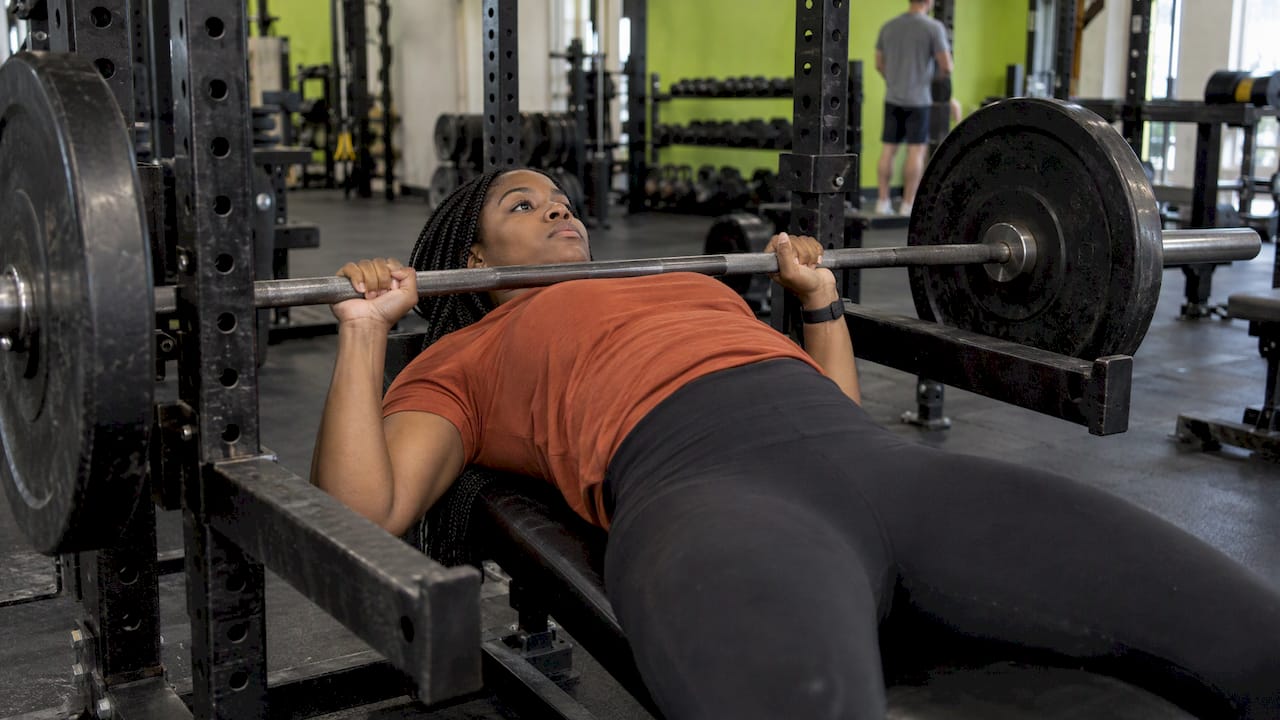
Pause bench press. Lower the bar to your chest under control, let it rest there for one to three seconds while keeping your upper back tight and your chest high, then press. It builds the ability to start the press from the chest, which is where many lifters lose tension. Competition lifters use it because meets require a pause on the chest. If you press mostly with a barbell, our list of barbell chest exercises shows where a paused variation fits. Lifters without a barbell or spotter can pause on a dumbbell floor press, where the upper arms resting on the floor create a natural stop.
Paused deadlift. Pause just off the floor, or at the point where the bar usually slows, for a second or so. This trains the first pull and keeps your back position honest. It is most useful for lifters who lose position early. For a Romanian deadlift, a short pause at the bottom of the hinge is a sensible way to keep the hamstrings loaded and the rep slow, without turning it into a max-effort lift. Pair any deadlift variation with a proper deadlift warm-up before the heavy work.
Other lifts. The principle carries over to rows, overhead presses and lunges. Pausing where the muscle is most stretched is the logic, and a pause of one second is usually enough for accessory work.
How long, how heavy, how many reps
Pause length is the main dial. Longer pauses remove more of the stretch reflex but also add fatigue and cost you load. NASM's view is that a tempo change should be a planned variable, not something that changes randomly from session to session. Nuckols, for his part, increases pause length from 2 to 3 seconds up to 8 to 10 seconds across workouts, which dissipates more of the stretch reflex and fatigues the muscle more before the concentric phase. He limits himself to one paused rep per set to protect rep quality.
The table below turns that research and standard practice into starting points. Treat it as a practical framework, not a prescription.
| Goal | Pause length | Load | Reps and sets |
|---|---|---|---|
| Learning the position | 1 to 2 seconds | Light, well below working weight | 3 to 5 reps, 2 to 3 sets |
| Strength | About 2 seconds (up to 3) | Around 70% of 1RM for sets; about 90% of regular 1RM for a single | 3 to 5 reps, 3 to 5 sets |
| Muscle size on accessories | 1 second | Moderate, 1 to 3 reps in reserve | 6 to 10 reps, 2 to 4 sets |
| Peak fatigue (advanced) | 3 to 10 seconds | Reduced | One paused rep per set |
Some rules that hold across all of them:
- Start lighter than your ego wants. The pause takes more than it looks like it will.
- Keep tension. If you relax into the pause, you are resting on your joints rather than training. A good pause is long enough to erase the stretch reflex but not so long that you lose tightness.
- Use safety gear. For heavy paused squats and bench presses, use safety arms or a spotter, since a failed rep at the bottom has nowhere to go.
- Keep reps low for the heavy version. Because every rep takes longer, three paused reps can carry the time under tension of a normal set of more reps.
Starting load for newer or returning lifters
If you are new to lifting, returning after time off, or managing a condition such as low bone density, begin with bodyweight or light loads and a one-second pause. Resources on resistance training for osteoporosis are a good guide to introducing variations gradually and picking starting loads. Check with your doctor before starting heavy lifting if you have a medical condition. Beginners can also explore the strength exercises for beginners to build a base before adding pauses.
Three ways to put pauses into a program
1. The primary lift, pause only. Swap your regular squat or bench for the paused version in one session per week and drop the load. This works as a strength block and suits lifters who stall at the bottom.
2. The back-off method. Do your normal heavy work, then finish with two or three paused sets at a lighter load. You get the technique benefit without sacrificing top-end loading.
3. Block cycling. NASM outlines a 12-week sample that moves from standard tempo to extended lowering to a paused, explosive style, changing one variable per four-week block. You can run a similar structure with pauses: four weeks of normal reps, four weeks of paused reps at reduced load, four weeks back to normal reps to see what carried over.
A sample week for a lifter chasing a stronger squat:
| Day | Lift | Sets and reps | Pause |
|---|---|---|---|
| Monday | Back squat, regular | 4 x 4 | None |
| Wednesday | Paused squat | 4 x 3 at about 70 to 75% of 1RM | 2 seconds |
| Friday | Squat, lighter, plus Romanian deadlift | 3 x 6 and 3 x 8 | 1 second on the RDL |
One warning from the programming side: do not change the pause length every session. If you do, you cannot tell whether a better set came from strength or from a shorter hold.
Log pause reps so progress stays readable
Pause reps are easy to waste because the numbers look worse. A paused squat at 245 lb for 3 reps is not a regression from 275 lb for 3 reps without a pause, it is a different exercise. Keep them apart in your log, and record four things for each set: load, reps, pause length and how many reps you had left in reserve (RIR). RIR is a rating of how many more good reps you could have done when you stopped; our guide to reps in reserve explains it, and the RIR chart converts it to RPE and percent of 1RM.
RIR is the right gauge for paused work because the pause makes the last rep hard to judge by feel. Ending a set at one or two reps in reserve keeps the quality of every rep high, which matches the advice to avoid grinding paused sets.
Where RIRLift fits
RIRLift is a lifting app for iPhone and Apple Watch that logs every set with weight, reps and RIR. Its AI Coach analyzes your logged sessions to recommend your next load and adjust future sets, which takes the guesswork out of setting a paused load that is lighter than your regular one. You can log from the watch alone. The Free plan covers core logging, and Pro is $9.99 per month or $79.99 per year for advanced coaching, analytics and unlimited routines. See the Apple Watch workout tracker for lifting for how it works at the rack.

The app is designed to fit straight into a block like the ones above. Log your regular and paused sessions as separate exercises, and Coach works from your own training data rather than a template.
Common mistakes with pause reps
- Resting in the bottom. Going loose turns a pause into a rest and puts load on joints and ligaments. Stay braced.
- Pausing too long, too soon. Start at one to two seconds. Add time only when your form holds.
- Using the same weight as your regular reps. Expect to drop load, as the percentages above show.
- Bouncing out anyway. A tiny bounce after the pause defeats the purpose. Drive up from stillness.
- Pausing everything. Pause one main lift per session, or one rep per set at the long end. Too much paused work eats recovery.
- Comparing numbers across variations. Track the paused squat and the regular squat as separate lifts.
FAQ
Are paused squats better than regular squats?
They are different tools. Paused squats build strength out of the bottom and expose technique faults, while regular squats let you handle heavier loads. Most lifters do best using both: regular squats for top-end loading and paused squats as a weekly variation.
How long should I pause on a rep?
Two seconds is a solid default for strength work on squats and bench presses. Use about one second for accessory lifts, and build toward three seconds once your form stays tight. Longer holds of 8 to 10 seconds are an advanced option used on a single rep per set.
Do pause reps help build muscle?
Yes, they can. The hold raises time under tension at the most demanding point of the lift, and pausing in a stretched position is linked in emerging research to a stronger growth stimulus. Pair them with enough weekly hard sets.
Is a pause rep the same as rest-pause?
No. A pause rep stops inside a single repetition, usually for one to three seconds. A rest-pause set takes you to failure, rests 5 to 15 seconds, and then adds a few more reps with the same weight.
How heavy should paused squats be?
About 90% of your regular squat max for a single, or around 70% for sets of five with a two-second pause. Leave a rep or two in reserve, since it is easier to get stuck at the bottom.
Sources
- Men's Health: What Is Rest-Pause Training
- PubMed: Rest-pause and drop-set training elicit similar strength and hypertrophy adaptations (2021)
- NASM: Tempo Training: Using Lifting Tempo to Drive Adaptation
- Breaking Muscle: Get Stronger and Stay Honest With Pause Reps
- Horton Barbell: Why You Should Be Doing More Pause Reps
- BarBend: Use Pause Squats to Skyrocket Your Leg Strength and Size
- Stronger by Science: How to Implement Paused Squats
- Resistance Training for Osteoporosis: How to Start Safely