
Blog
Bench Press Plateau: How to Find the Cause and Fix It
Published October 28, 2026 · 15 min read
A bench press plateau is almost always one of four problems: a stall that is not real, a weak point in one part of the lift, a program that no longer fits your level, or recovery that is not keeping up. Confirm the stall with three to four weeks of comparable data, find where the bar slows down, then change one variable at a time.
Most lifters do the opposite. They miss a number twice, add a new accessory, switch programs, and never learn which change helped. This guide walks through the diagnosis first and the fixes second, so every adjustment has a reason.
TL;DR
- One or two bad sessions are not a plateau. A stall typically needs at least three weeks of flat or falling performance, judged on similar efforts.
- Locate the sticking point (off the chest, mid-range, or lockout) and match the fix to it instead of copying a generic routine.
- Check technique, sleep, stress, and nutrition before rebuilding your program.
- Change frequency, load, grip, or variations one at a time, and log effort so you can see what worked.
- Smaller jumps and heavier work with more total sets often beat adding random exercises.
Table of Contents
- Is it a real plateau or just a rough patch?
- Check the basics before you change the program
- Find your sticking point
- Adjust frequency, load, and variation
- Track effort so you can tell what worked
- Our perspective on bench plateaus
- Put it into practice with RIRLift
- A four-week plan for a confirmed stall
- FAQ
- Sources
Is it a real plateau or just a rough patch?
Before you fix anything, make sure there is something to fix. Barbell Medicine's guidance on stalls says a stall typically requires at least three weeks, and it suggests reviewing trends over three to four weeks or longer. One or two poor workouts do not establish it.
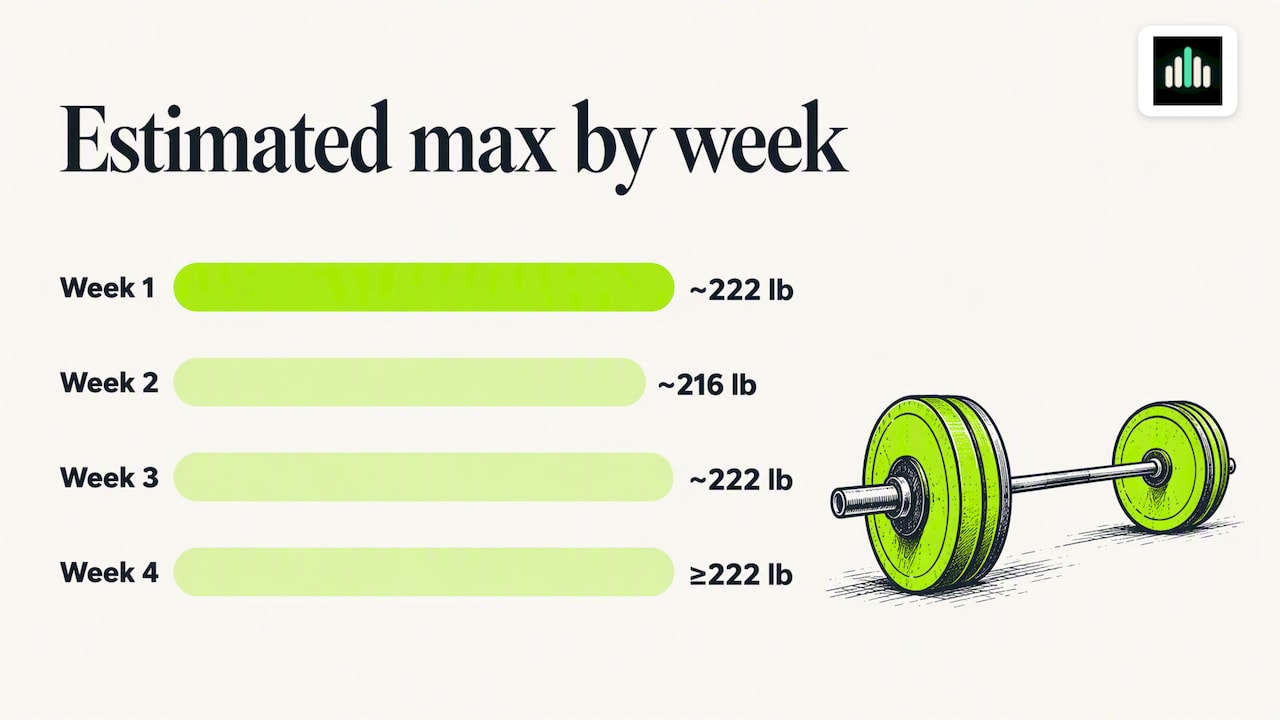
The second trap is comparing different kinds of effort. A max single and a set of five at a hard but not maximal effort are not the same test. The same source recommends comparing similar efforts, for example estimated one-rep maxes, rather than a maximal single against five reps at RPE 8. You can convert any set with the bench press calculator and put the results side by side.
Here is a worked example of the difference:
| Week | Top set | Estimated 1RM (approx.) | Read |
|---|---|---|---|
| 1 | 185 lb x 6, 1 rep in reserve | about 222 lb | Baseline |
| 2 | 185 lb x 5, 1 rep in reserve | about 216 lb | Within normal day-to-day noise |
| 3 | 190 lb x 5, 2 reps in reserve | about 222 lb | Flat, but effort was lower |
| 4 | 190 lb x 5, 1 rep in reserve | about 222 lb or higher | Not a plateau, still moving |
The estimates use the common Epley formula, and they are rough. The point is that bar weight alone would have looked like a stall in weeks two and three, while the trend of comparable efforts says otherwise.
What a true stall looks like
A real plateau shows the same estimated max, or a lower one, for three to four weeks at similar effort, with technique unchanged. That is when it makes sense to look for causes. If your effort ratings drifted (you stopped one rep short of failure on some days and went to failure on others), you have a measurement problem, not a strength problem. The strength and conditioning review on troubleshooting nonresponders makes a similar point: before labeling anyone a nonresponder, check measurement error, fatigue, sleep, nutrition, hydration, stress, and what training the person actually did.
How many lifters log reps in reserve for every working set? Few do, and that is why so many bench stalls are impossible to diagnose after the fact. If you want a refresher on rating effort, our explainer on what RPE means in lifting covers the scale.
Check the basics before you change the program
If the stall is confirmed, the same Barbell Medicine guidance says to review technique, pause length, range of motion, injury, recovery, and outside stress before changing programming. Each of these can quietly move your numbers.
Technique and range of motion
Small changes in setup add up over months. A shorter touch point, a bouncier descent, or a lazier pause makes old numbers look stronger than they were, and then an honest rep feels like a plateau. The American College of Sports Medicine describes the bench press as a controlled lowering phase followed by an upward push, and its bench press article says lifters should show control and proper technique before increasing load. It also recommends screening for musculoskeletal injury. If you feel shoulder or elbow pain on the bar, that is a conversation for a physician or physical therapist, not a programming problem.
Film a top set from the side and from the front. Compare it with a video from when the weight was moving well. Look for a flared elbow position that changed, the bar path drifting toward your face, or your hips and upper back losing tightness. Our bench press form guide lists the setup cues worth checking.
Sleep, stress, and food
Recovery is the least exciting cause and one of the most common. A systematic review of 13 studies found that sleep deprivation sometimes reduced strength, power, and muscular endurance and commonly increased fatigue, although effects varied between studies. The authors recommend prioritizing adequate sleep. If your last four weeks included travel, exam season, a new job, or a calorie deficit, a flat bench may simply reflect that. Fixing it can mean changing nothing in the gym.
Find your sticking point
A sticking point is the position in the range of motion where difficulty rises disproportionately and failure or form breakdown becomes more likely, as defined in this peer-reviewed review of the sticking point. Its practical lesson is to diagnose your individual bottleneck before choosing an intervention rather than applying one universal fix.
In a 2017 review, near-maximal bench sticking points occurred on average near the beginning of the ascent, at about 30% of the completed bar height in elite male powerlifters. Yours may differ, so test it.
How to locate it
- Film a hard set, preferably the last reps of a set taken close to failure.
- Watch for the moment the bar slows or your body changes shape (hips lifting, wrists bending, elbows drifting).
- Note whether the slowdown happens just off the chest, around the middle, or near lockout.
- Repeat on two or three sessions to confirm it is consistent.
What each location usually points to
The sticking-point review links chest-focused work to failures at the start of the upward phase and elbow-extensor (triceps) assistance to failures in the terminal stage. Use it as a starting map rather than a rule:
| Where it slows | Likely limiter | Work to try |
|---|---|---|
| Just off the chest | Chest and shoulder strength out of the bottom, setup tightness | Paused reps, dumbbell or incline work, a consistent touch point |
| Mid-range | Transition between muscle groups, bar path | Technique review, tempo reps, moderate variation changes |
| Near lockout | Triceps strength | Close-grip bench press, triceps extensions, board or pin work |
The same review lists other strategies too, including partial repetitions, momentum development, technique alteration, and accommodating resistance such as bands or chains. It adds that changes to grip, stance, joint angles, and movement timing can alter leverage, fatigue before the sticking point, and contraction speed, and that they should be introduced gradually with conservative loads.
Grip width is a lever you can test
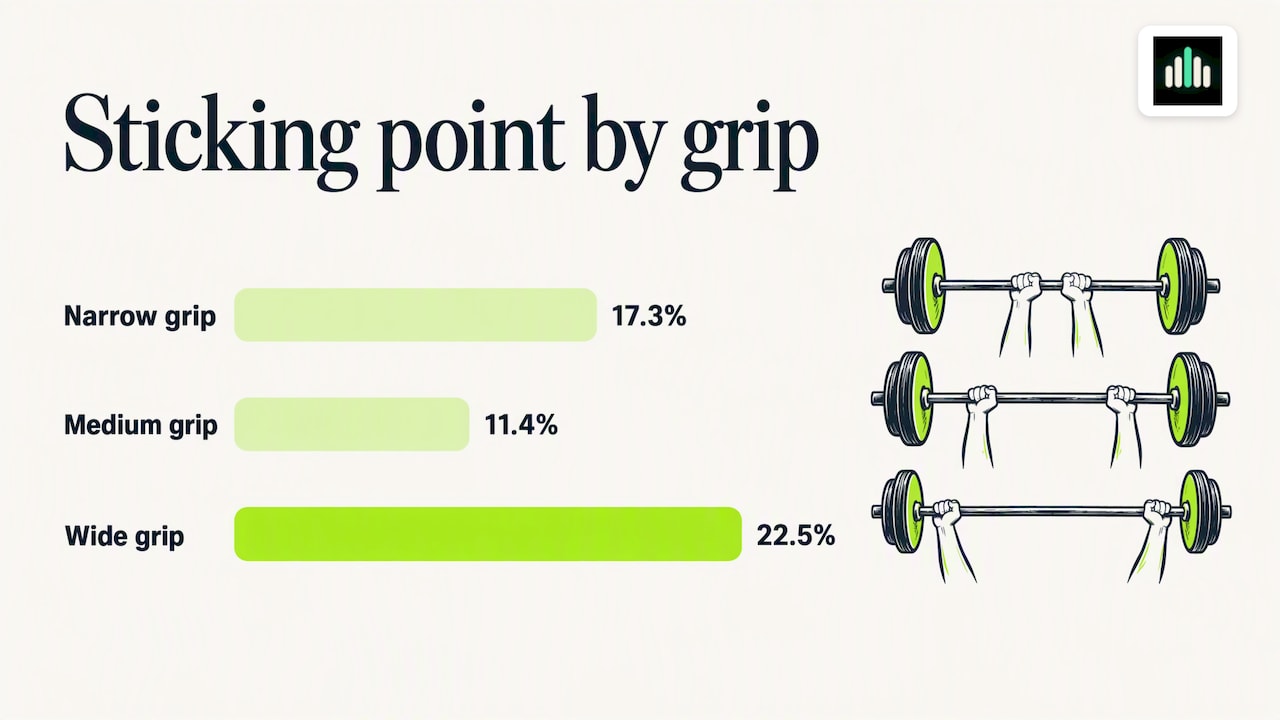
In the 2017 review, the sticking point occupied 11.4% of the ascent with a medium grip, versus 17.3% with a narrow grip and 22.5% with a wide grip in the study cited. That is one group of lifters, so treat it as a reason to experiment rather than a prescription. If your grip has drifted very wide or very narrow, a few weeks with a moderate grip and a consistent hand position is a cheap test.
Adjust frequency, load, and variation
Once the basics check out and you know where the bar slows, change the program. Make one change, run it for three to four weeks, and compare estimated maxes again.
Frequency and heavier work
The American College of Sports Medicine's position stand overview, available on PubMed Central, reports that strength is enhanced by loads of at least 80% of one-rep max, full range of motion, 2 to 3 sets, placing the exercise early in the session, and training at least twice weekly. A 2023 systematic review and Bayesian network meta-analysis of 178 strength studies found higher-load prescriptions above 80% of 1RM ranked highest for strength, and higher-load multiset training three times weekly ranked highest among the prescriptions studied.
In practice, a lifter who benches once a week with a lot of volume and moderate loads can often move to two sessions: one heavier day with sets of 3 to 6 reps, and one lighter or variation day. Moving to three sessions is reasonable if recovery allows, but it is a bigger jump in fatigue.
Volume has diminishing returns
More is not endlessly better. A 2023 umbrella review reports that higher weekly set volumes can improve hypertrophy, but the dose-response appears to level off with diminishing returns, citing larger muscle growth with at least 10 weekly sets per muscle group than with fewer than five. If you are well under that range for chest, shoulders, and triceps combined, adding hard sets can help. If you are far above it and tired, adding more is likely to make things worse.
Vary intensity within the week
Some lifters stall because every session feels the same: always five reps, always near failure. Daily undulating periodization (rotating heavy, moderate, and light days) is one way to break that pattern. In one 12-week bench and leg press study summarized by Stronger by Science, volume and average intensity were identical, yet average bench improvement was 28.8% with undulating periodization versus 14.4% with linear. That is a single study, and the percentages should not be expected in your own training, but the idea is easy to try: one heavy day, one moderate day, one light day, with the same weekly volume.
Use smaller jumps
If your plate options only allow 5 or 10 pound jumps, that can be the entire plateau. Adding 1 to 2.5 pounds per side every week or two adds up to 25 to 50 pounds over a year, which is more than most intermediate lifters add by switching programs. Fractional plates cost little, and you can compare weight plate prices across retailers before buying a pair. Our progressive overload calculator helps you plan realistic weekly increases.
Accessories that earn their place
Pick them based on the sticking point you found, not on what looks productive:
- Off the chest: paused bench press, and incline dumbbell press for a longer range of motion under load.
- Lockout: close-grip bench, overhead triceps extensions, and pin presses.
- Stability and tightness: rows and other upper back work, since a stable base helps every rep.
Keep accessories to two or three exercises, and treat them as support for the bench, not as a second program.
Track effort so you can tell what worked
You can only troubleshoot what you recorded. A 2020 review by Helms and colleagues found that sessional RPE, repetitions-in-reserve-based RPE, post-set Borg ratings, and barbell velocity can be strongly associated with resistance-training performance. It also notes that practical autoregulation can adjust load, volume, or intensity to readiness. In plain terms: logging how hard each set felt tells you more than weight alone.
A simple tracking routine for a bench stall:
- Log weight, reps, and reps in reserve for every working set.
- Convert your top set to an estimated max each week.
- Write a one-line note when technique, pause length, grip, or sleep changed.
- Review the 3 to 4 week trend before touching the program.
This also tells you whether the plateau is in your bench or in your measurement. If you want a deeper walk through the general process, we cover it in how to break a lifting plateau, and the bench press standards page can help you judge whether your current numbers are reasonable for your bodyweight and experience.
Our perspective on bench plateaus
We see the same pattern in how lifters approach a stuck bench: they change the plan before they have defined the problem. The fix we care about most is not a clever exercise but a clean record. When every set has a weight, a rep count, and a rating of how many reps were left, a plateau stops being a feeling and becomes a trend you can read.
We built RIRLift around that idea. The app logs each set, including reps in reserve, and our AI Coach works only from your own training data to suggest the next load, rather than handing you a generic template. That matters at a plateau, because the right response depends on whether you have been grinding at the edge of failure or leaving plenty in reserve. Our view is simple: diagnose first, change one thing, and judge it over weeks, not days.
— Guilherme
Put it into practice with RIRLift
If you want the logging and load suggestions handled for you, RIRLift is a fitness app for iPhone and Apple Watch that records every set with weight, reps, and reps in reserve. Coach analyzes your sessions and recommends your next load, and you can ask it questions about your own data. The core features are free, and RIRLift Pro costs $9.99 per month or $79.99 per year through the App Store. You can see what is included on the RIRLift home page.
Start by logging two or three bench sessions with effort ratings. Even without changing your program, you will know whether the stall is real.
A four-week plan for a confirmed stall
Here is one way to apply everything above. Adjust it to your recovery and schedule, and stop and see a medical professional if anything hurts in a sharp or lingering way.
- Week 0: Review the last three to four weeks of estimated maxes. Film a top set. Check sleep and stress.
- Weeks 1 to 2: Fix any technique drift, settle on one grip width, and add one extra bench exposure per week at a moderate load.
- Weeks 3 to 4: Add accessory work that matches your sticking point, and use smaller load jumps on the main lift.
- End of week 4: Compare estimated maxes at similar effort. If they are up, keep going. If not, change a different variable, such as heavier sets or a different frequency.
This plan changes few variables at once on purpose. If you change grip, frequency, accessories, and load jumps all in the same week, you will not know which one mattered.
FAQ
How long should I wait before calling it a plateau?
Wait at least three weeks, and ideally three to four, and compare similar efforts such as estimated one-rep maxes. One or two poor sessions usually reflect sleep, stress, or fatigue, not a stall.
Should I bench more often when my bench press is stuck?
Often, yes. Research on strength training supports training a lift at least twice per week, and heavier multiset training three times weekly ranked highest in one large network meta-analysis. Add sessions gradually and watch whether your recovery and elbow and shoulder comfort hold up.
Does grip width really change where I get stuck?
It can. In one review, the sticking point lasted a smaller share of the lift with a medium grip than with a narrow or wide one. Test a moderate grip for a few weeks and film your sets to see whether your slowdown moves.
Can poor sleep make my bench press stall?
It can contribute. A systematic review found sleep deprivation sometimes reduced strength, power, and endurance and commonly increased fatigue, though results varied. If your sleep has been short for weeks, fix that before rebuilding your program.
Is a stalled bench a sign I should switch programs?
Not by itself. Confirm the stall, check technique and recovery, and then change one variable at a time. Switching programs without a diagnosis usually just resets the clock.
Sources
- Training Expectations: Understanding Stalls, Barbell Medicine
- Troubleshooting a Nonresponder: Guidance for the Strength and Conditioning Professional
- Implications of sleep loss or sleep deprivation on muscle function
- The Bench Press Exercise, ACSM Health & Fitness Journal
- Understanding and Overcoming the Sticking Point in Resistance Exercise
- The Sticking Point in the Bench Press, the Squat, and the Deadlift
- American College of Sports Medicine Position Stand overview
- Resistance training prescription for muscle strength and hypertrophy: network meta-analysis
- The influence of resistance exercise training prescription variables on skeletal muscle hypertrophy
- In Defense of Program Hoppers; DUP Revisited, Stronger by Science
- Methods for Regulating and Monitoring Resistance Training
- Weight plates on sale this week