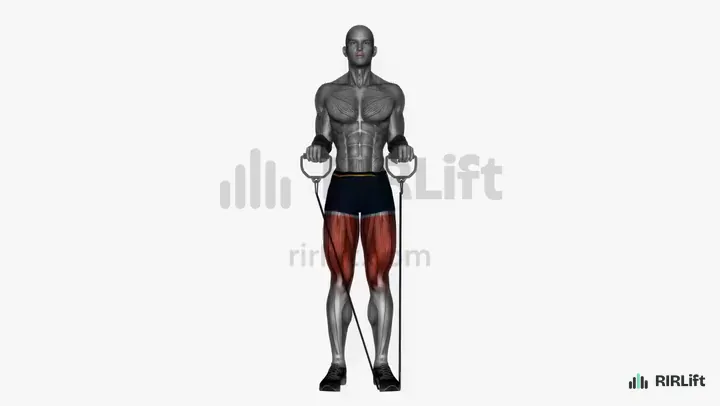
Hip exercises with resistance bands: outer hips, inner thighs, glutes and hinges

The best hip exercises with resistance bands are the lateral band walk and seated band abduction for the outer hips, band hip adduction for the inner thighs, the band hip thrust and kickback for the glutes, and the band pull-through and deadlift for the back of the hips. A mini loop covers the outer hips and glutes; a long band with handles and a door anchor adds the hinges, lunges and inner-thigh work. Take each set within 0 to 2 reps of failure, since bands only get hard near the end of a set.

  1. Lateral Band Walk Abductors
  2. Band Hip Thrust Glutes
  3. Band Pull-Through Glutes
  4. Band Seated Hip Abduction Glutes, Abductors
  5. Band Hip Adduction Adductors
  6. Band Glute Kickback Glutes
  7. Band Curtsy Lunge Glutes, Quads
  8. Band Standing Hip Abduction Abductors
Band exercises for the outer hips

A mini loop around your knees or ankles is the simplest way to load the side glutes. Use the walk and the standing press as warm-ups or finishers, and the seated version when you want to take the side hips to failure.

Outer hips, side steps against a loop

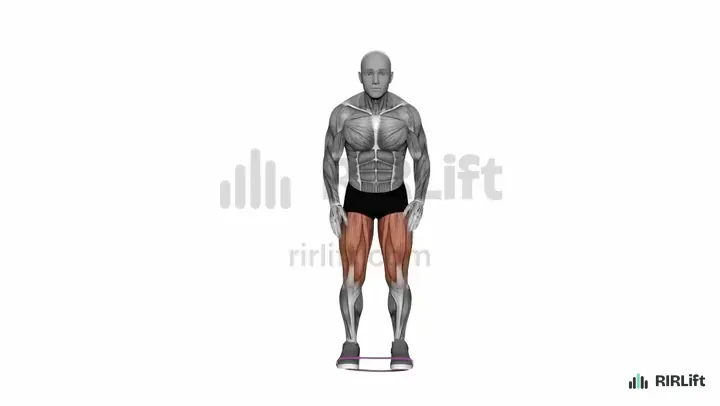
Lateral Band Walk

Abductors

A loop around your legs resists every step sideways, so the outer hip of the stepping leg pulls and the outer hip of the standing leg holds. It is the most useful band hip exercise there is, because it trains both jobs of the side glutes in one move.

How to do it

  1. Put a mini loop around your ankles, or just above your knees for an easier version.
  2. Bend your knees and hips into a shallow squat, feet under your hips and weight in the middle of each foot.
  3. Step out sideways with one foot until the band is stretched, then bring the other foot in only partway.
  4. Keep stepping in one direction for the target count, then lead with the other foot on the way back.

Cues

  • Shallow squat the whole set
  • Never let the loop go slack
  • Toes point ahead

Common mistakes

  • Rocking your shoulders side to side to move the feet: keep your torso still and let the hips do it.
  • Letting the knees fall inward as the band pulls: push them out over your toes.

Swap for: Band Standing Hip Abduction, Band Seated Hip Abduction, Band Squat

Outer hips, half-squat knee press

Band Standing Hip Abduction

Abductors
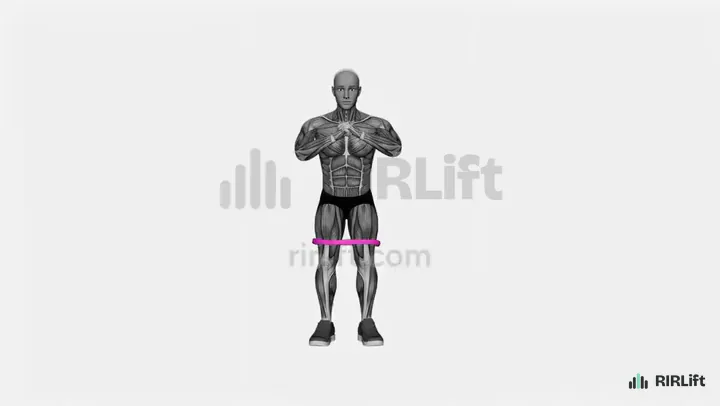
Holding a half squat with a loop above your knees, you press the knees apart and bring them back, keeping constant tension on the outer hips. It needs about a meter of floor and builds a strong burn fast, which makes it a good finisher or a warm-up before squats.

How to do it

  1. Place a mini loop just above your knees and stand with your feet about shoulder-width apart.
  2. Sink into a half squat with a slight forward lean and a flat back.
  3. Push your knees out against the loop as far as you can while your feet stay planted.
  4. Let the knees come back in slowly until they line up over your feet, then press out again.

Cues

  • Feet stay glued down
  • Knees push wide
  • Hold the half squat

Common mistakes

  • Standing up a little more every rep: keep the same squat depth from first to last.
  • Letting the knees snap back in: control the return so the band never pulls them past your feet.

Swap for: Band Seated Hip Abduction, Lateral Band Walk, Band Squat

Outer hips, seated knee press

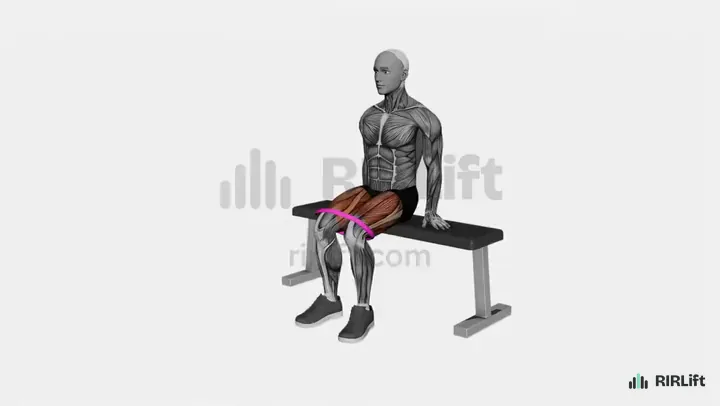
Band Seated Hip Abduction

Glutes, Abductors

Sitting removes balance from the equation, so you can take the outer hips to complete failure safely. It is the band version of the abduction machine, and the best band choice when you want the side glutes to grow.

How to do it

  1. Sit on the edge of a bench or chair with a mini loop just above your knees and your feet flat.
  2. Sit up tall or lean slightly forward with your hands on the seat beside you.
  3. Drive your knees apart as wide as the band allows, and hold the widest point briefly.
  4. Bring the knees back in slowly, stopping before they touch, and press out again.

Cues

  • Knees open, feet stay
  • Pause wide
  • Lean forward for more glute

Common mistakes

  • Using small, fast pulses: open fully on every rep.
  • Lifting the heels to get the knees wider: keep the feet flat.

Swap for: Band Standing Hip Abduction, Lateral Band Walk, Band Glute Kickback

Band exercise for the inner thighs

Anchor a long band low to one side and you can train adduction too. Pair it with an outer-hip exercise so both sides of the hip get the same attention.

Inner thighs, standing band sweep

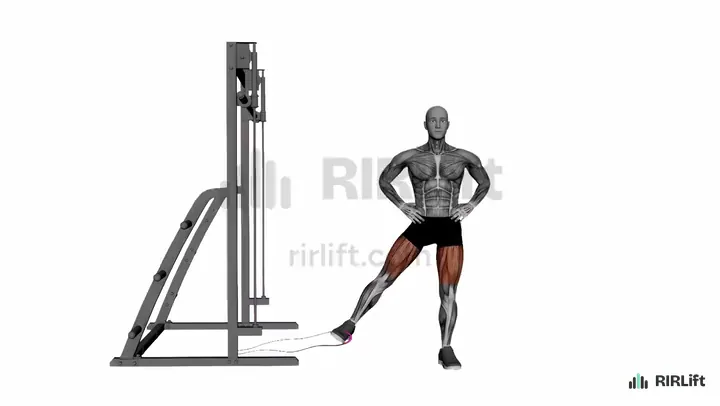
Band Hip Adduction

Adductors

Most band hip routines skip the inner thighs, which leaves the hip trained on one side only. Anchor a band low to the side and sweep your leg across your body, and you have a direct adductor exercise that matches the outer-hip work.

How to do it

  1. Tie or anchor a long band at ankle height and loop the free end around your inside ankle.
  2. Step away from the anchor until the band pulls that leg out to the side, and hold a wall or chair for balance.
  3. Sweep the banded leg across your body in front of your standing foot, leg straight.
  4. Let it return slowly to the start, keeping tension, then repeat. Turn around for the other leg.

Cues

  • Leg straight, toes forward
  • Upper body still
  • Two seconds back out

Common mistakes

  • Swinging the leg across with momentum: pause briefly where the legs cross.
  • Standing too close to the anchor so the band is slack at the start.

Swap for: Band Squat, Band Curtsy Lunge, Band Seated Hip Abduction

Band exercises for the glutes

These open the hip fully against the band. Bands are hardest at the end of the movement, which suits the glutes, since they work hardest when the hip is straight.

Glutes, floor bridge against a loop

Band Hip Thrust

Glutes

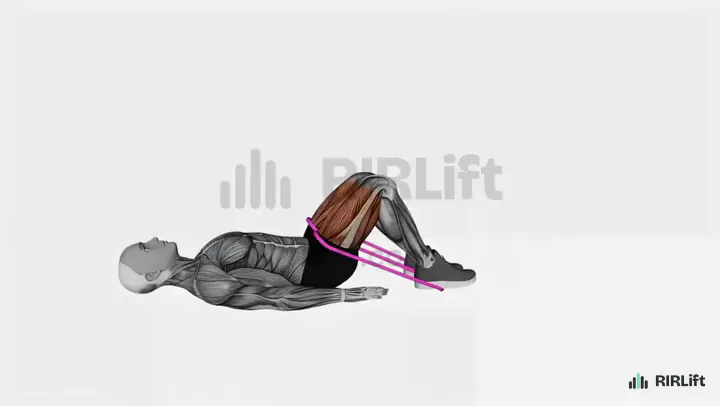
With a loop pinned under your hands or heels and stretched across your hips, the band pushes back hardest at the top of the bridge, exactly where the glutes are fully contracted. It is the best way to load hip extension with a band alone.

How to do it

  1. Lie face up, feet planted and knees bent, and lay a long loop across your hips.
  2. Pin both ends of the loop to the floor under your hands, or under your heels, so it pulls your hips down.
  3. Drive through your heels and raise your hips until your knees, hips and shoulders line up.
  4. Squeeze hard and hold the top for two seconds, then lower slowly until your hips almost touch the floor.

Cues

  • Heels drive, toes light
  • Two-second squeeze at the top
  • Ribs stay down

Common mistakes

  • Pushing the hips higher than your knees by arching the back: stop when the hips are level.
  • Letting the band slide toward your belly: keep it on the crease of your hips.

Swap for: Band Glute Kickback, Band Pull-Through, Band Deadlift

Glutes, all-fours leg kickback

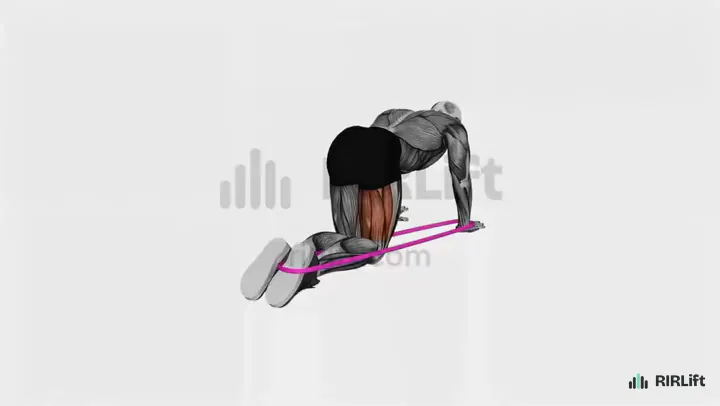
Band Glute Kickback

Glutes

On all fours with a loop under one foot, you push that leg back against the band until the hip is fully open. It isolates one glute at a time, so a weaker side cannot hide behind the stronger one.

How to do it

  1. Get on your hands and knees and hook a loop band under the arch of one foot, with the other end held under your hand on the same side.
  2. Brace your trunk so your back stays flat.
  3. Push the banded foot back and up until your leg is fully extended and level with your torso.
  4. Bring the knee back under your hip slowly and repeat. Finish the set before changing sides.

Cues

  • Push the heel back
  • Back stays flat
  • Slow return

Common mistakes

  • Arching the lower back to lift the leg higher: the leg stops level with your body.
  • Rotating your hips toward the ceiling: keep both hip bones pointing at the floor.

Swap for: Band Hip Thrust, Band Pull-Through, Band Reverse Lunge

Band hinges for the back of the hips

Hinges train the glutes and hamstrings together in a stretch. Use a long band with handles under your feet, or anchor one low behind you for the pull-through.

Glutes and hamstrings, anchored hinge

Band Pull-Through

Glutes

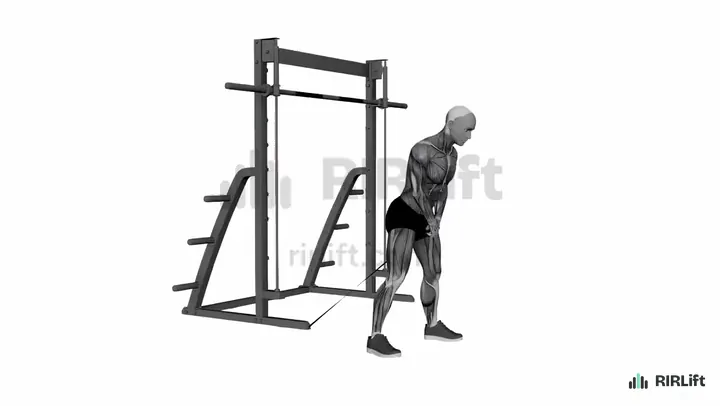
Facing away from a low anchor with the band between your legs, you hinge back and drive your hips through to stand. The band pulls hardest at lockout, which is where most people lose tension on a hinge, so the glutes finish every rep.

How to do it

  1. Anchor a long band low behind you, face away, and grip the band between your legs.
  2. Walk out until the band is tight and set your feet a little wider than your hips.
  3. Push your hips back and let your hands travel between your thighs with a flat back.
  4. Drive your hips forward to stand tall, glutes tight at the top.

Cues

  • Reach the hips back
  • Arms stay straight
  • Squeeze at the top

Common mistakes

  • Pulling the band with your arms: they only hold it.
  • Squatting down instead of pushing the hips back: keep the shins close to vertical.

Swap for: Band Deadlift, Band Hip Thrust, Band Good Morning

Glutes, hamstrings and back, standing hinge

Band Deadlift

Glutes, Hamstrings, Lower Back

With a long band under both feet and the handles in your hands, you hinge forward and stand up against the band's stretch. It trains the whole back of the hip and gets harder as you stand, so the lockout does the most work.

How to do it

  1. Stand on the middle of a long band with your feet under your hips and take a handle in each hand.
  2. Push your hips back and bend your knees a little until your hands reach your shins, back flat.
  3. Drive your feet into the floor and stand up by bringing your hips forward.
  4. Finish tall with your glutes tight, then lower under control.

Cues

  • Chest up, back flat
  • Hips and shoulders rise together
  • Finish with the glutes

Common mistakes

  • Rounding the back to reach lower: choose your depth by where your back stays flat.
  • Leaning back at the top: stand straight and stop.

Swap for: Band Pull-Through, Band Good Morning, Band Squat

Hamstrings and glutes, hinge with the band at the shoulders

Band Good Morning

Hamstrings, Lower Back

Holding the band at your shoulders makes the hinge a long lever, so even a light band gives your hamstrings and glutes a strong stretch. It adds a second hinge that feels different from the deadlift.

How to do it

  1. Stand on a long band with your feet under your hips and hold the handles at the front of your shoulders.
  2. Unlock your knees and keep your chest proud.
  3. Push your hips back and fold forward until your torso is close to level with the floor or you feel a deep hamstring stretch.
  4. Bring your hips forward to stand up, keeping the hands at your shoulders throughout.

Cues

  • Hips go back first
  • Hands stay at the shoulders
  • Long, flat spine

Common mistakes

  • Bending the knees more as you go down: keep the same slight bend all the way.
  • Dropping your head to look down: keep your neck in line with your back.

Swap for: Band Deadlift, Band Pull-Through, Band Hip Thrust

Band lunges for single-leg hip strength

On one leg, the hip has to extend and stay steady at the same time. A band under the front foot turns these lunges from a warm-up into real work.

Outer hips and glutes, crossover lunge

Band Curtsy Lunge

Glutes, Quads

Stepping the back leg behind and across forces the front hip to stop the knee from caving in, which works the side glutes under bodyweight. A band under the front foot adds load to every rep.

How to do it

  1. Stand on a long band with your left foot and hold the handles at your shoulders.
  2. Step your right foot back and across behind your left leg.
  3. Lower both knees until the front thigh is close to level with the floor, front knee over the toes.
  4. Push through the left foot to come back up, then repeat. Swap the band to the other foot for the other side.

Cues

  • Front knee over the toes
  • Hips face forward
  • Push through the front heel

Common mistakes

  • Turning the hips toward the back leg: keep them square to the front.
  • Stepping so far across that you wobble: a modest crossover is enough.

Swap for: Band Reverse Lunge, Lateral Band Walk, Band Squat

Glutes and quads, step-back lunge

Band Reverse Lunge

Quads, Glutes

Stepping back rather than forward keeps the shin of the front leg more upright, which shifts the effort toward the glute and is easier on the knee. The band under the front foot gives it load without any weights.

How to do it

  1. Stand on a long band with one foot and hold the handles at your shoulders.
  2. Step the other foot back into a long stride.
  3. Lower until your back knee nearly touches the floor, with your torso slightly forward.
  4. Drive through the front foot to step back up. Finish all reps on that side, then switch.

Cues

  • Long step back
  • Slight forward lean
  • Drive through the front heel

Common mistakes

  • Taking a short step that turns it into a quad exercise: step back far enough that the front shin stays near vertical.
  • Pushing off the back toes to stand up: the front leg does the work.

Swap for: Band Curtsy Lunge, Band Spanish Split Squat, Band Squat

Put them together: example sessions

Each session below picks from the exercises above for one situation, with the sets, reps, rest and RIR filled in. Open one in the session builder to change a pick, price it from a recent set, and add it to RIRLift.

Session 1

Only a mini loop, 20 minutes

Open in the session builder
  • Workouts3× a week
  • Working sets39 a week
  • Per workout~25 min
  • EquipmentResistance Bands

You own a set of mini loop bands and nothing else, and you want a short hip session you can do on any floor.

A mini loop trains the outer hips and the glutes well but cannot load hinges or lunges much, so this plan leans on those two groups. The walk and standing press come first as heavier hip work, then the hip thrust and kickback with the loop under your hands or foot, each taken to 0 or 1 reps in reserve because bands only get hard near failure. The curtsy lunge uses bodyweight and the loop above the knees. About 13 working sets.

Loop Hips
ExerciseSets × repsRIRRest
Lateral Band WalkSteps per direction. Loop at the ankles. 3 × 12–20 1 45 s
Band Standing Hip Abduction 3 × 15–25 0 45 s
Band Hip ThrustHold the top 2 s. 3 × 15–25 1 1 min
Band Glute KickbackPer leg. 2 × 12–20 0 45 s
Band Curtsy LungePer leg. Bodyweight, loop above knees. 2 × 10–15 1 1 min
How to run it
Do it two or three times a week with a day between. Pick a loop that lets you reach 15 reps on the walk before failing.
How to progress
When you reach the top of a rep range at the target RIR, move to the next stronger loop, or move the loop from above your knees to your ankles.

Session 2

Long bands with handles and a door anchor

Open in the session builder
  • Workouts2× a week
  • Working sets25 a week
  • Per workout~25 min
  • EquipmentResistance Bands

You have long tube bands with handles, a door anchor and a mini loop, and you want two full hip sessions a week.

Long bands make the hinges and lunges worth doing, so each day opens with one at 8 to 15 reps and 1 to 2 in reserve: the deadlift and reverse lunge on day A, the pull-through and good morning on day B. The anchor adds the inner-thigh adduction, and the seated abduction finishes each day at 0 in reserve for the outer hips. Thirteen to fourteen working sets per day.

Hips A
ExerciseSets × repsRIRRest
Band DeadliftTwo bands if needed. 3 × 10–15 2 90 s
Band Reverse LungePer leg. 3 × 10–15 1 90 s
Band Hip AdductionPer leg. 3 × 12–20 1 45 s
Band Seated Hip AbductionPause wide. 3 × 15–25 0 45 s

Open Hips A in the session builder

Hips B
ExerciseSets × repsRIRRest
Band Pull-ThroughSqueeze at the top. 3 × 12–20 1 90 s
Band Good Morning 3 × 10–15 2 90 s
Band Curtsy LungePer leg. 2 × 10–15 1 1 min
Lateral Band WalkSteps per direction. 3 × 12–20 1 45 s
Band Hip AdductionPer leg. 2 × 12–20 1 45 s

Open Hips B in the session builder

How to run it
Run Hips A and Hips B once each per week with two days between. Double up bands for the hinges if a single band runs out of resistance.
How to progress
When every set reaches the top of the range at the target RIR, use a stronger band, stand on the band with a wider stance to shorten it, or add a pause at the hardest point.

Session 3

Short sessions on long sitting days

Open in the session builder
  • Workouts3× a week
  • Working sets30 a week
  • Per workout~15 min
  • EquipmentResistance Bands

You sit for most of the day, your hips feel stiff by evening, and you would rather do three short band sessions than one long one.

Long sitting leaves the glutes switched off and the hips stiff, so each short session opens them up with a hinge and a bridge, then trains the side and inner hips. Every set stops 2 reps short of failure so you can repeat it three times a week without soreness. Ten working sets, about 15 minutes, with a mini loop and one long band.

Hip Break
ExerciseSets × repsRIRRest
Band Pull-ThroughDoor anchor low. 3 × 12–15 2 1 min
Band Hip ThrustHold the top 2 s. 3 × 12–20 2 45 s
Band Standing Hip Abduction 2 × 15–20 2 45 s
Band Hip AdductionPer leg. 2 × 12–15 2 45 s
How to run it
Do it three times a week, at lunch or after work. Keep the bands at your desk so you can start without setup.
How to progress
Add 2 reps per set each week. When you hit the top of every range at RIR 2, move to the next band.

Make it fit you

Questions

Are resistance bands good for hips?

Yes. Bands are hardest at the end of a movement, where the outer hips and glutes are fully contracted, so they suit hip abduction, bridges and kickbacks well. For heavy hinges and lunges, long bands with handles work better than mini loops.

Can I do hip abductions with a resistance band?

Yes. Seated with a loop above your knees is the band version of the abduction machine. Standing in a half squat and side-stepping with a loop around your ankles are the other two main options.

What are the best resistance bands for hip exercises?

A set of mini loops in a few strengths for the outer hips and glutes, and one or two long bands with handles plus a door anchor for hinges, lunges and adduction. Fabric loops stay in place better on bare skin.

What is the most effective hip exercise with a band?

The lateral band walk gives the most return for the least gear: it trains the outer hip of both legs, needs only a loop, and works as a warm-up or a finisher. For the glutes, the band hip thrust is the strongest pick.

How many reps should I do with resistance bands?

Most band hip exercises work best at 12 to 25 reps. Pick a band that brings you within 0 to 2 reps of failure in that range, and move to a stronger band when you can go past the top.

Can resistance bands build glutes?

Yes, as long as the sets are hard. Bands lack the heavy loading of a barbell, so take them close to failure and add sets over time. The hip thrust, kickback and pull-through are the band picks that load the glutes most.