Low impact HIIT exercises: hard intervals with no jumping

The best low impact HIIT exercises are bodyweight squats, cardio lunges, walkouts, bear crawls and shadow boxing at home; kettlebell swings, step-ups, medicine ball slams and sled pushes with weights; and stationary bike, air bike, rowing machine and elliptical sprints on machines. None of them leaves the floor: at least one foot stays down on every rep, so the intensity comes from speed, load and short rest instead of jumping. Work 30 to 45 seconds, rest 15 to 30, for 15 to 25 minutes, two or three times a week.

  1. Bodyweight Squat Quads
  2. Cardio Lunge Quads, Glutes
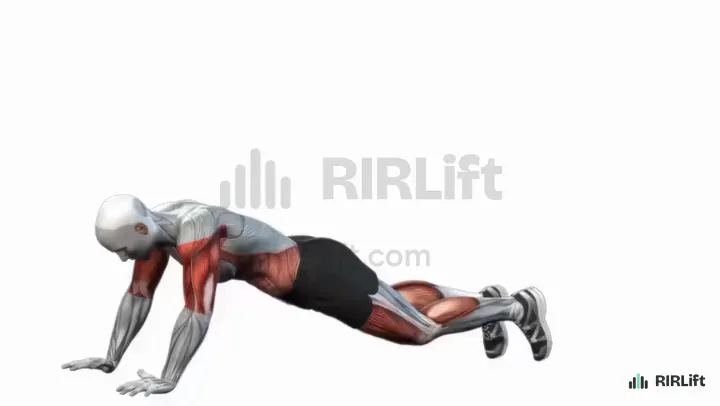
  3. Walkout Abs, Shoulders, Chest
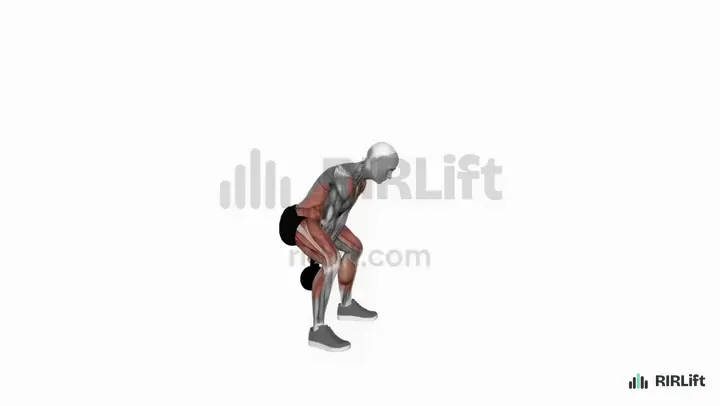
  4. Kettlebell Swing Glutes, Hamstrings
  5. Sled Push Quads, Glutes
  6. Stationary Bike Quads, Hamstrings
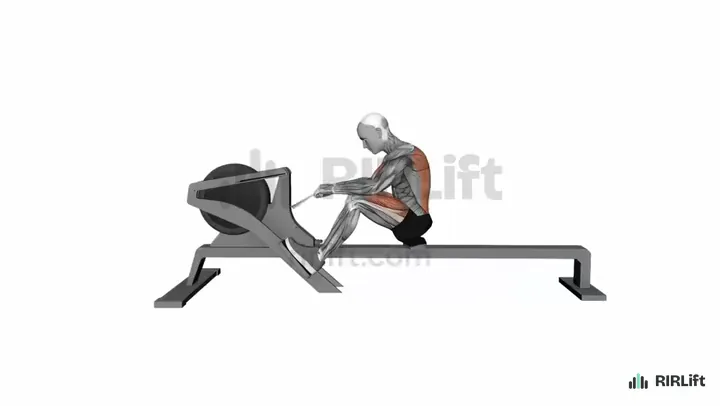
  7. Rowing Machine Quads, Hamstrings, Glutes, Lats
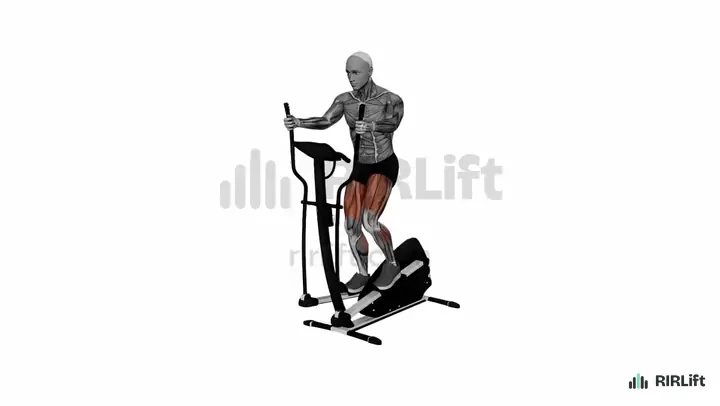
  8. Elliptical Quads, Hamstrings, Glutes
Standing bodyweight moves

Squats and lunges done fast work the biggest muscles in your body, which is what drives your heart rate up, and shadow boxing keeps you moving between them while your legs recover. Speed is the dial: a squat every two seconds is easy, one per second is hard.

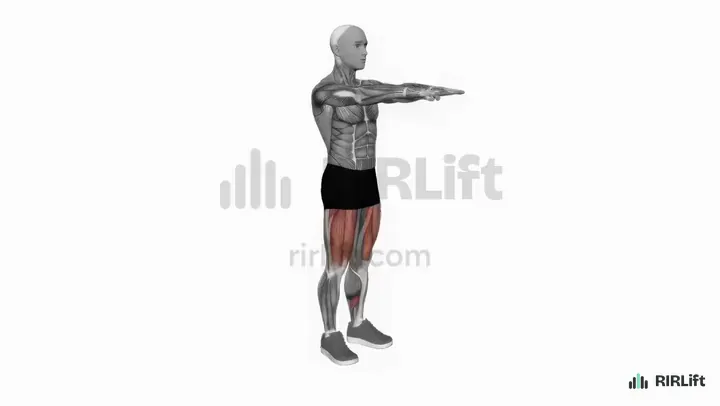
Quads and glutes, fast squat

Bodyweight Squat

Quads

Squatting at a quick, steady pace for 45 seconds works your legs hard enough to leave you breathing heavily, with both feet flat the whole time. Sit to a chair and stand up if a full squat is hard on balance.

How to do it

  1. Stand with your feet about shoulder-width apart, toes turned out slightly, arms out in front for balance.
  2. Push your hips back and bend your knees, keeping your heels flat and your chest up.
  3. Lower until your thighs are at least parallel to the floor, deeper if your heels stay down.
  4. Drive through your whole foot to stand tall, then go straight into the next rep.

Cues

  • Heels glued to the floor
  • Knees over toes
  • Thighs to parallel or lower

Common mistakes

  • Knees caving in on the way up: push them out over your little toes.
  • Quarter squats to hit a rep count: a full-depth set of 12 beats a shallow set of 30.

Swap for: Reverse Lunge, Wall Sit, Jump Squat

Legs and hips, rhythmic lunge

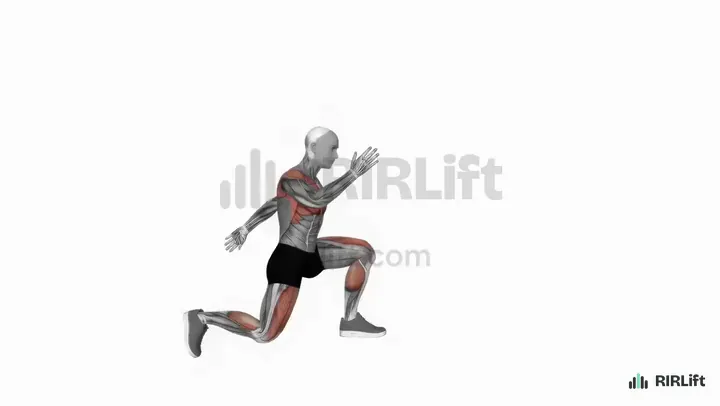
Cardio Lunge

Quads, Glutes

From a lunge stance, you drive the back foot forward a short step and straight back again at a quick, steady rhythm, so your heart rate climbs while one foot always stays on the floor. Work one side for half the interval, then switch.

How to do it

  1. Start in a lunge with one foot forward, the back knee just above the floor and your elbows bent at your sides.
  2. Push off the back foot to bring it forward a short step as the front foot slides slightly back.
  3. Return the back foot to the lunge straight away and keep a quick, steady rhythm.
  4. Finish the set, then switch which leg is in front.

Cues

  • Stay low between reps
  • Front knee over the toes
  • Quick, steady rhythm

Common mistakes

  • Standing all the way up between reps: stay in the half lunge so the legs keep working.

Swap for: Dumbbell Reverse Lunge, Band Reverse Lunge

Shoulders and core, fast punching

Shadow Boxing

Shoulders, Biceps, Triceps

Fast punches with your feet planted raise your heart rate while giving your legs a break, which is why it sits between squats and lunges. Punch faster in the last ten seconds to make the interval hard.

How to do it

  1. Stand tall with your feet planted and your hands up by your chin.
  2. Throw straight punches, alternating hands, at an imaginary target in front of you.
  3. Snap each hand back to your guard as the other one goes out.
  4. Keep a steady pace for the whole round.

Cues

  • Hands back to guard
  • Steady rhythm
  • Breathe out on each punch

Common mistakes

  • Dropping your hands as you tire: slow the pace and keep the guard.
  • Locking your elbows hard: snap each punch back before full lockout.

Swap for: Boxing Jab, Boxing Cross, Jump Rope

Walkouts and crawls

Getting down to the floor and back up, or moving on hands and feet, works your shoulders and core along with your legs, which makes a no-jump circuit full-body. Both are done at a steady pace rather than a sprint.

Shoulders, core and hamstrings, floor walkout

Walkout

Abs, Shoulders, Chest

Walking your hands out to a plank and back to standing works your shoulders, core and the backs of your legs with no jumping at all. It replaces the burpee in a low impact circuit.

How to do it

  1. Stand with feet hip-width, hinge at the hips and put your palms on the floor, bending the knees as much as you need.
  2. Crawl your hands out one at a time into a high plank.
  3. Hold a beat, then crawl the hands back toward your feet and roll up to standing.

Cues

  • Brace your stomach in the plank so your hips do not sag.
  • Keep the legs as straight as you comfortably can on the way down.

Common mistakes

  • Letting the hips drop in the plank.

Swap for: Bear Crawl, Spider Plank

Core and shoulders, crawling

Bear Crawl

Abs, Shoulders

Crawling with your knees just off the floor makes your shoulders, core and thighs work together and raises your heart rate within 20 seconds. Crawl a few steps forward and back in a small space.

How to do it

  1. Start on hands and toes with knees bent and just off the floor.
  2. Move one hand and the opposite foot forward together, then the other pair.
  3. Keep the hips low and your back flat as you crawl forward and backward.

Cues

  • Knees hover low
  • Opposite hand and foot
  • Flat back

Common mistakes

  • Hips riding high: keep them at shoulder height.

Swap for: Gorilla Walk, Walkout, Plank Shoulder Tap

Weighted moves that stay on the ground

A weight makes a no-jump interval as hard as any burpee. Kettlebell swings and medicine ball slams are explosive with both feet planted, step-ups work one leg at a time, and the sled push is the hardest 20 seconds in the gym without a single landing.

Glutes and hamstrings, explosive hinge

Kettlebell Swing

Glutes, Hamstrings

The swing is explosive work with both feet planted: your hips snap forward on every rep, and 15 to 20 swings are as hard on your lungs as a set of jump squats. It is the best weighted low impact HIIT move.

How to do it

  1. Stand with your feet a little wider than your hips, the bell set about a foot in front of you.
  2. Hinge down, grip the handle with both hands, and hike the bell back between your thighs.
  3. Snap your hips forward to stand tall, letting the bell float up to about shoulder height on straight arms.
  4. Let it fall back between your legs as you hinge again, and go straight into the next rep.

Cues

  • Hips snap, arms just hold on
  • Stand tall at the top
  • Bell passes high between the thighs

Common mistakes

  • Squatting the swing by bending the knees deeply: push your hips back and keep the shins nearly vertical.
  • Lifting the bell with your shoulders: if your arms are working, the hips are not driving it.

Swap for: Dumbbell Romanian Deadlift, Kettlebell Deadlift, Superman

Lats, core and shoulders, ball slam

Medicine Ball Slam

Lats, Abs

Lifting a ball overhead and throwing it into the floor as hard as you can is a full-body effort without leaving the ground. Use a no-bounce slam ball so you can go straight into the next rep.

How to do it

  1. Stand with feet about shoulder-width holding a medicine ball.
  2. Reach the ball overhead and rise onto your toes.
  3. Slam it into the floor in front of you as hard as you can, bending the hips and knees.
  4. Pick it up and repeat.

Cues

  • Reach tall
  • Slam with the whole body
  • Exhale hard

Common mistakes

  • Slamming with the arms only: hinge the hips into it.
  • Using a bouncy ball: use a slam ball that stays down.

Swap for: Med Ball Rotational Throw, Battle Rope Slam, Kettlebell Swing

Quads and glutes, single-leg step

Step-Up

Quads, Glutes

Stepping up onto a bench at a steady pace with dumbbells keeps one foot on a surface at all times and loads each leg properly. A knee-height step is plenty.

How to do it

  1. Stand facing the bench with two dumbbells.
  2. Place one whole foot on the bench.
  3. Lean forward a little and push through the top foot to stand up on the bench.
  4. Bring the other foot up only to touch, then lower it back to the floor.
  5. Finish all reps on one leg before switching.

Cues

  • Whole foot on the bench
  • Push through the top heel
  • Lower slowly, do not drop

Common mistakes

  • Pushing off the floor with the back foot: that halves the work. Keep the trailing foot light.
  • Using a bench so high that your knee is far above your hip: you will rock instead of step.

Swap for: Barbell Step-Up

Legs and lungs, loaded sled drive

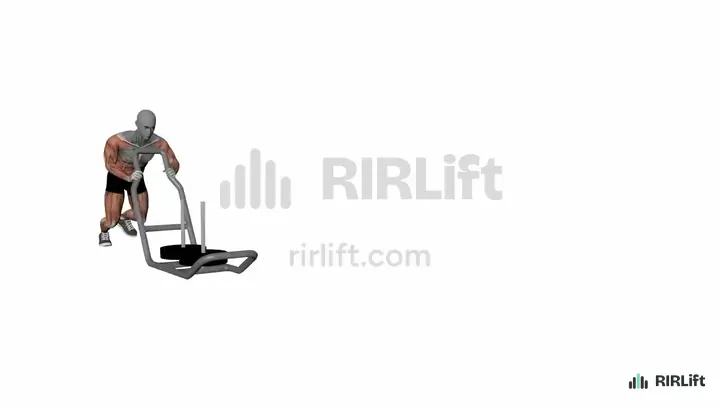
Sled Push

Quads, Glutes

Driving a sled with short steps is among the hardest efforts in the gym, with no landing and no lowering phase. Twenty seconds of pushing is a full interval.

How to do it

  1. Load the sled and grip the high or low handles with your arms extended.
  2. Lean in until your body forms a straight line from head to back foot.
  3. Drive the sled forward with short, powerful steps, pushing through the balls of your feet.
  4. Keep pushing for the target time, then rest fully.

Cues

  • Low body angle
  • Short, hard steps
  • Keep the arms locked

Common mistakes

  • Standing too upright so the sled stalls: lower the hips and lean in.
  • Long, loping strides: keep steps short and fast.

Swap for: Sled Pull, Air Bike, Barbell Back Squat

Bike, rower and elliptical sprints

Cardio machines let you go all-out with zero impact. The stationary bike and elliptical are the easiest to learn, the air bike adds your arms and gets harder the faster you go, and the rower trains your back and legs together on every stroke.

Seated cycling sprints

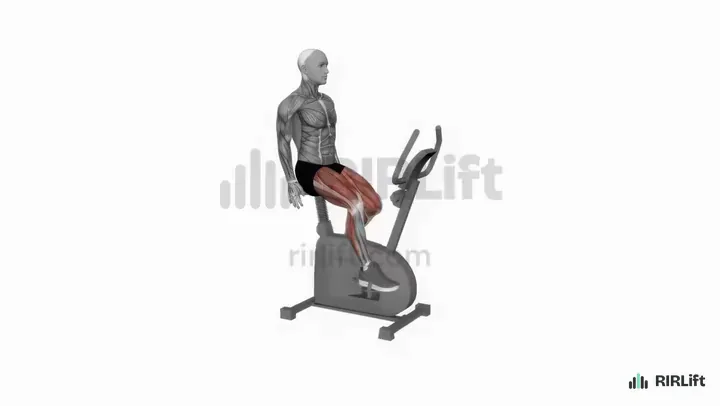
Stationary Bike

Quads, Hamstrings

Turning up the resistance and pedaling hard for 30 seconds is a true high-intensity effort with your weight fully supported by the seat. It suits a larger body and sore knees especially well.

How to do it

  1. Adjust the seat to hip height when you stand beside the bike.
  2. Pedal at a light resistance with a steady, smooth cadence.
  3. Add a little resistance in the last minute so you finish slightly out of breath.

Cues

  • Smooth circles
  • Slightly warm, not tired

Common mistakes

  • Cranking heavy resistance: this is to get warm, not to train your legs before chest day.

Swap for: Air Bike, Rowing Machine, Elliptical

Arms-and-legs fan bike sprints

Air Bike

Quads, Hamstrings, Glutes

Pushing and pulling the handles while you pedal spreads the effort across your whole body, and the fan means the sprint is as hard as you make it. Twenty-second efforts are enough.

How to do it

  1. Set the seat so your knee is slightly bent at the bottom.
  2. Let your arms drive the handles in time with your legs.
  3. Start easy for 2 minutes and 30 seconds, then build to moderate for the last 30 seconds.

Cues

  • Arms push and pull
  • Breathe through your nose at first

Common mistakes

  • Sprinting in the first minute: save it for the WOD.
  • Gripping the handles so tight your shoulders shrug.

Swap for: Rowing Machine, Stationary Bike, Ski Erg

Full-body rowing sprints

Rowing Machine

Quads, Hamstrings, Glutes, Lats

Rowing intervals train your legs, back and arms in one stroke while you stay seated. A hard 40 seconds at 26 to 30 strokes a minute, then easy rowing, is a complete interval.

How to do it

  1. Strap your feet in and hold the handle with straight arms.
  2. Push with your legs first, then lean back slightly and bring the handle to your lower ribs.
  3. Reverse the order on the way back: arms forward, body tips forward, knees bend.
  4. Keep the pace conversational, around 20 strokes a minute.

Cues

  • Legs, body, arms; arms, body, legs
  • Easy enough to talk

Common mistakes

  • Racing the first minute: this is a warm-up, so finish feeling fresher than you started.

Swap for: Stationary Bike, Air Bike, Jump Rope

Standing low impact sprints

Elliptical

Quads, Hamstrings, Glutes
Your feet never leave the pedals, so you can push hard with your legs and arms standing up without any impact. Raise the resistance for the hard minute and lower it for recovery.

How to do it

  1. Step on, hold the moving handles and start striding at a relaxed pace.
  2. Push the pedals through your whole foot and let your hips swing naturally.
  3. Add a little resistance for the last minute.

Cues

  • Tall chest
  • Long, even strides

Common mistakes

  • Leaning your weight onto the handles: stand up over your feet.

Swap for: Stationary Bike, Brisk Walk

Put them together: example sessions

Each session below picks from the exercises above for one situation, with the sets, reps, rest and RIR filled in.

Session 1

At home, no equipment, no jumping

  • Workouts3× a week
  • Working sets45 a week
  • Per workout~15 min
  • EquipmentBodyweight

You want a hard workout at home with no equipment, and jumping is off the table because of your knees, your downstairs neighbors, or simply preference.

Five no-jump moves at 45 seconds on and 15 off make a 5-minute round, done three times for 15 minutes of work. Alternating legs, upper body and floor moves lets one area recover while another works, so the heart rate stays up without any single muscle giving out. Three sessions a week is about 45 minutes of hard work.

No-jump circuit
ExerciseSets × repsRIRRest
A1 Bodyweight SquatReps in 45 seconds. 3 × 20–30 2 15 s
A2 Shadow BoxingSeconds. 3 × 45 2 15 s
A3 Cardio LungeReps in 45 seconds, switching legs halfway. 3 × 16–24 2 15 s
A4 WalkoutReps in 45 seconds. 3 × 5–8 2 15 s
A5 Bear CrawlSteps in 45 seconds, counting each hand. Rest 60 seconds before the next round. 3 × 16–24 2 1 min
How to run it
Leave a rest day between the three weekly sessions, and warm up with a minute of marching and slow squats first.
How to progress
Count your reps for each station. Each week aim to add 1 or 2 to each. When the top of every range is easy, add a fourth round, then cut the rest to 10 seconds.

Session 2

A lot of weight to lose, or joints that dislike standing work

  • Workouts2× a week
  • Working sets14 a week
  • Per workout~10 min
  • EquipmentExercise Bike, Elliptical

You have a lot of weight to lose or your knees, hips or back make standing exercise uncomfortable, and you want intervals that are hard on your lungs but easy on your joints.

Seated and gliding machines carry your body weight, so all the effort goes into pushing the pedals. Eight 30-second bike sprints on one day and six 1-minute elliptical efforts on the other add about 10 minutes of hard work a week, which is plenty to improve your fitness while you build the habit.

Bike sprints
ExerciseSets × repsRIRRest
Stationary BikeSeconds. Hard resistance and fast pedaling, easy spinning during the rest. 8 × 30 2 1 min
Elliptical intervals
ExerciseSets × repsRIRRest
EllipticalSeconds. High resistance, pushing and pulling the handles. Slow striding during the rest. 6 × 60 2 1 min
How to run it
Do Bike sprints and Elliptical intervals on two days apart, and walk or ride easily on other days if you can. Pedal easily for 5 minutes before the first sprint.
How to progress
Raise the resistance one level when all sprints feel the same. After four weeks, add two sprints to the bike day and one effort to the elliptical day.

Session 3

In the gym, strength and conditioning in one session

  • Workouts2× a week
  • Working sets36 a week
  • Per workout~20 min
  • EquipmentKettlebells, Rowing Machine, Dumbbells, Flat Bench +3

You train in a gym, you want conditioning that also builds muscle, and you would rather lift and push than jump.

Six weighted and machine stations at 40 seconds on and 20 off make a 6-minute round, done three times for an 18-minute session. Swings, step-ups and slams load your muscles like a strength session, and the sled, rower and air bike push your heart rate to the top, all without a single jump. Two sessions a week is the right amount next to other training.

Gym circuit
ExerciseSets × repsRIRRest
A1 Kettlebell SwingReps in 40 seconds. 3 × 15–20 2 20 s
A2 Rowing MachineSeconds. 3 × 40 2 20 s
A3 Step-UpPer leg, 20 seconds each side. 3 × 6–10 2 20 s
A4 Medicine Ball SlamReps in 40 seconds. 3 × 12–15 2 20 s
A5 Sled PushSeconds. 3 × 20–30 2 20 s
A6 Air BikeSeconds. Rest 90 seconds before the next round. 3 × 40 1 90 s
How to run it
Do it twice a week with two days between, after a short upper-body session or on its own. Set every station up before you start so the 20 seconds is enough to move between them.
How to progress
Log the reps you get at each weighted station and how many you had left. When every round reaches the top of the range, move up a kettlebell or dumbbell size; RIRLift sets the next session's weight from the reps in reserve you log. On the machines, aim for more calories or meters each week.

Make it fit you

Questions

Can low impact HIIT really be high intensity?

Yes. Intensity comes from how hard your heart and muscles work, not from jumping. Fast squats, kettlebell swings, sled pushes and bike sprints all push your heart rate as high as burpees do, with at least one foot on the ground.

Can HIIT workouts raise cortisol too much?

Hard exercise raises cortisol briefly, which is normal and drops back afterward. Problems come from too many hard sessions without recovery, so keep HIIT to two or three sessions a week with a rest day between.

What are some low intensity alternatives on easy days?

Walking, easy cycling, swimming and steady elliptical work at a pace you could chat at. They pair well with two or three low impact HIIT sessions a week.

How long should a low impact HIIT workout be?

Fifteen to 25 minutes of intervals plus a 5-minute warm-up. If you can keep going much longer than that, the work periods are not hard enough.

Is low impact HIIT good for weight loss?

It burns calories and helps you keep muscle while you diet, both of which help. The fat itself comes off your whole body as you eat less than you burn, not from the muscles you train.