Resistance band exercises for men: squats, deadlifts, rows and presses with bands

The best resistance band exercises for men are the band squat, band deadlift and band hip thrust for the legs and hips, band bent-over rows, face pulls, pull-aparts and band-assisted pull-ups for the back, the single-arm band overhead press, lateral raise and chest fly for the upper body, and band hammer curls for the arms, with push-ups covering the chest. Bands build muscle when sets end 1 to 2 reps short of failure, usually at 12 to 25 reps. Train three times a week, and when a band gets easy, step farther out to stretch it more, pause at the top, or move to the next band.

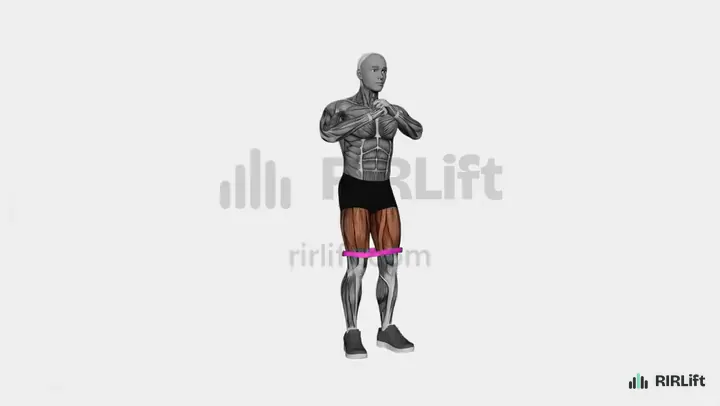
  1. Band Squat Quads
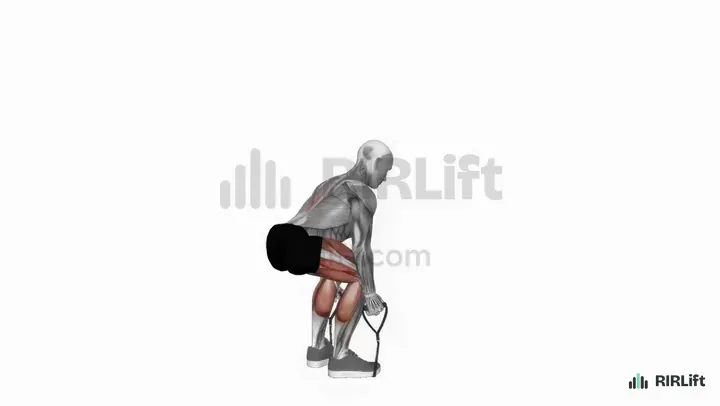
  2. Band Deadlift Glutes, Hamstrings, Lower Back
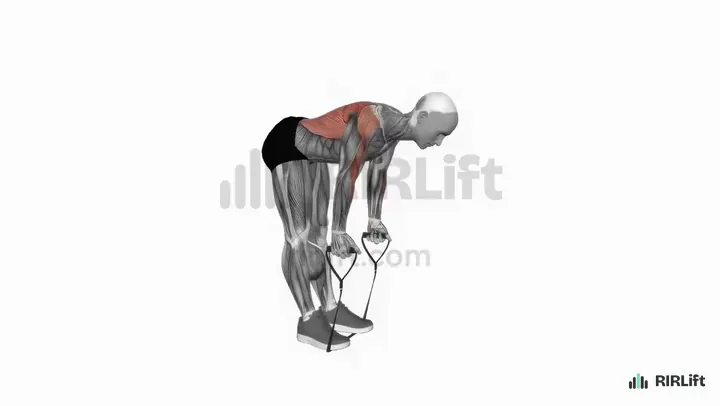
  3. Band Bent-Over Row Lats, Upper Back
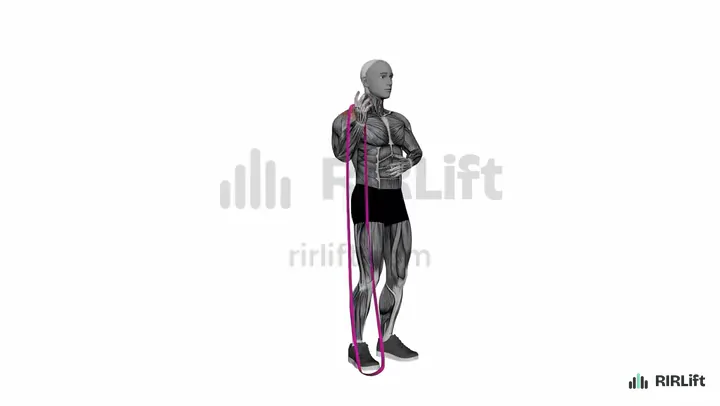
  4. Band Overhead Press Shoulders
  5. Band Hip Thrust Glutes
  6. Band Face Pull Shoulders, Upper Back
  7. Band-Assisted Pull-Up Lats

Legs and hips

Legs are the hardest muscles to load with bands, so this work leans on high reps, single-leg moves and handled bands for the hinge. Bands pull hardest at the top, so finish every rep fully upright.

Quads and glutes, mini-band squat

Band Squat

Quads

A mini loop above the knees makes you push your knees out on every rep, so the glutes work alongside the quads. Run it for 15 to 25 reps as the first leg exercise, then let the lunge and deadlift carry the heavier load.

How to do it

  1. Step into a mini loop band and slide it to just above your knees.
  2. Stand a little wider than hip-width with your hands together at your chest.
  3. Sit down between your heels, pressing your knees out against the band, as low as you can keep your heels down.
  4. Stand up, still pushing out on the band, and finish with a hard glute squeeze.

Cues

  • Knees push into the band
  • Sit between your heels
  • Tension never drops at the top

Common mistakes

  • Letting the band pull your knees together: use a lighter loop until you can hold them out.
  • Short reps: hit the same depth on every rep, then slow down to add difficulty.

Swap for: Band Spanish Split Squat, Bodyweight Squat, Goblet Squat

Quads and glutes, single-leg lunge

Band Reverse Lunge

Quads, Glutes

One leg carries the band's tension, so a band that is easy to squat with becomes hard. The best band leg exercise once squats run past 25 reps.

How to do it

  1. Step onto the center of a handled band with your left foot and bring the handles up to your shoulders.
  2. Step your right foot back and lower your back knee toward the floor.
  3. Stop just before the knee touches, with your front knee over your ankle.
  4. Drive through the left foot to bring the right foot back up beside it. Do all reps, then switch.

Cues

  • Step back long enough
  • Front foot does the work
  • Handles stay at the shoulders

Common mistakes

  • Short steps that push the front knee far over your toes: take a longer step back.
  • Letting the handles drop as you tire: keep your elbows up so the tension stays.

Swap for: Band Spanish Split Squat, Band Curtsy Lunge, Dumbbell Reverse Lunge

Glutes, hamstrings and back, banded hinge

Band Deadlift

Glutes, Hamstrings, Lower Back

Standing on the band and hinging trains the back of the legs and the lower back. The band pulls hardest at lockout, so squeeze your glutes at the top.

How to do it

  1. Step onto the center of a handled band feet hip-width, a handle in each hand.
  2. Push your hips back and bend your knees until the handles are near your shins, with your back flat.
  3. Drive your hips forward and stand up tall, keeping the handles close to your legs.
  4. Lock out with a glute squeeze, then lower back down the same way.

Cues

  • Hips back, chest forward
  • Flat back
  • Lock out with your glutes

Common mistakes

  • Rounding your back to reach the bottom: bend your knees more and stop higher.
  • Leaning back at the top: stand tall and stop.

Swap for: Band Good Morning, Kettlebell Deadlift, Band Pull-Through

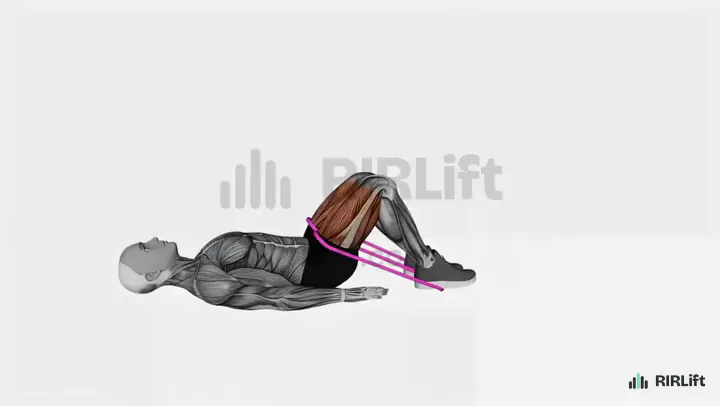
Glutes, banded bridge

Band Hip Thrust

Glutes

The band over your hips makes the top of the bridge hard, exactly where the glutes work most. It needs only floor space and a band.

How to do it

  1. Lie on your back, knees bent, and pass a long loop band over your hips, pinning both ends under your hands or feet.
  2. Plant your feet about hip-width, heels close to your glutes.
  3. Drive through your heels to lift your hips until your body is straight from shoulders to knees.
  4. Hold the top for a second, then lower slowly.

Cues

  • Ribs down at the top
  • Push through the heels
  • Pause at full lockout

Common mistakes

  • Arching your lower back at the top: tuck your pelvis so the glutes finish the rep.
  • Pushing through your toes: move your feet closer so your heels drive.

Swap for: Band Pull-Through, Glute Bridge, Single-Leg Glute Bridge

Hamstrings, standing mini-band curl

Band Leg Curl

Hamstrings

With a mini loop around both ankles, curling one heel up trains the knee-bending half of the hamstrings, which no band hinge reaches. Lower slowly; the band pulls back fast.

How to do it

  1. Put a mini loop around both ankles and stand tall, holding a wall or chair for balance.
  2. Keep your thighs side by side.
  3. Bend one knee and lift that heel toward your glutes as high as you can.
  4. Lower it slowly. Finish the set, then switch legs.

Cues

  • Knees side by side
  • Heel to glutes
  • Slow return

Common mistakes

  • Swinging the thigh back to finish the curl: keep both knees level.
  • Leaning forward: stand tall and hold onto support.

Swap for: Band Good Morning, Nordic Hamstring Curl, Stability Ball Leg Curl

Back and biceps

Bands are at their best for pulling. Rows and face pulls load the back from any door anchor or from under your feet, and a band looped on a pull-up bar takes some of your weight until you can do full pull-ups.

Upper back and lats, banded row

Band Bent-Over Row

Lats, Upper Back

Standing on the band and rowing to your waist trains the whole back with nothing to set up. Use a wide stance on the band to make it harder.

How to do it

  1. Stand on the middle of a band, hold an end in each hand, and hinge forward with a flat back.
  2. Row your hands to your lower ribs with the elbows tucked near your body.
  3. Straighten the arms slowly and keep the hinge.

Cues

  • Elbows to your hips
  • Hold the hinge

Common mistakes

  • Standing up as you row: keep the same torso angle every rep.

Swap for: Dumbbell Bent-Over Row, Inverted Row, Seated Cable Row

Rear delts and upper back, banded pull

Band Face Pull

Shoulders, Upper Back

Pulling a band toward your face with the elbows high trains the muscles that balance all the pressing. Light band, high reps.

How to do it

  1. Anchor a band at about face height in a door and hold an end in each hand, palms facing down.
  2. Step back until there is tension with your arms reaching forward.
  3. Pull the band toward your forehead, splitting your hands apart and lifting your elbows high and wide.
  4. Pause, then let the band return under control.

Cues

  • Elbows high and wide
  • Hands finish beside your ears
  • Pause at the face

Common mistakes

  • Pulling to the chest with the elbows low, which turns it into a row: aim the hands at your eyes.
  • Leaning back to move the band: stand tall and use a lighter band.

Swap for: Band Pull-Apart, Dumbbell Rear Delt Fly, TRX Face Pull

Rear delts and upper back, straight-arm pull

Band Pull-Apart

Shoulders, Upper Back

Stretching a band across your chest takes 30 seconds and trains the rear shoulders and mid-back. Do a set between other exercises or every day.

How to do it

  1. Hold a light band at shoulder height with straight arms and hands about shoulder width.
  2. Pull your hands apart until the band touches your chest.
  3. Let the band bring your hands back slowly.

Cues

  • Squeeze the shoulder blades together at the end.
  • Keep your ribs down.

Common mistakes

  • Bending the elbows to make it easier.

Swap for: Band Face Pull, Band Scapular Retraction

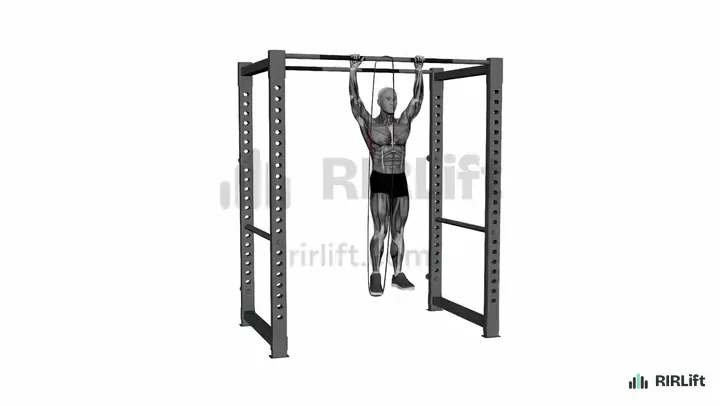
Lats and biceps, assisted pull-up

Band-Assisted Pull-Up

Lats

A band looped on the bar under your knee or foot takes some of your weight so you can do real pull-up reps. Move to a lighter band as you get stronger.

How to do it

  1. Loop a strong resistance band over the bar and pull it through itself so it hangs down tight.
  2. Grip the bar a little wider than your shoulders and step one knee or foot into the loop at the bottom.
  3. Pull your elbows down toward your hips until your chin clears the bar.
  4. Lower under control to straight arms, letting the band stretch back out, and repeat.

Cues

  • Thinnest band you can do 8 reps with
  • Full range every rep
  • Stay vertical, no swing

Common mistakes

  • Using a band so thick that the set never gets hard: move down a band once you pass 12 reps at the target reps in reserve.
  • Bouncing out of the bottom off the band: pause for a moment at the hang before each pull.

Swap for: Assisted Pull-Up, Inverted Row, Lat Pulldown

Biceps and forearms, band hammer curl

Band Hammer Curl

Biceps

Curling a band with thumbs up works the biceps and the forearm together. Step on the band with feet wider to make the top of each rep harder.

How to do it

  1. Stand on a light band and hold the ends with palms facing each other.
  2. Curl one hand up toward your shoulder, keeping the elbow beside your ribs.
  3. Lower slowly and alternate sides.

Cues

  • Elbows still
  • Squeeze, then lower slow

Common mistakes

  • Swinging the band up with your hips: use a lighter band.

Swap for: Hammer Curl, Bodyweight Bicep Curl, Dumbbell Curl

Chest and shoulders

Pressing with a band works well one arm at a time. The push-up stays your main chest builder; the band fly, overhead press and lateral raise fill in the rest.

Chest and triceps, bodyweight press

Push-Up

Chest

Bands are weak for chest pressing, so the push-up carries the chest. Raise your feet or slow the lowering when 20 reps are easy.

How to do it

  1. Set your hands slightly wider than your shoulders with your body straight from head to heels.
  2. Lower until your chest nearly touches the floor, elbows at about 45 degrees.
  3. Press back up to straight arms.

Cues

  • One straight line
  • Elbows angled back

Common mistakes

  • Flaring the elbows straight out: tuck them toward your ribs.

Swap for: Kneeling Push-Up, Incline Push-Up, Push-Up Plus

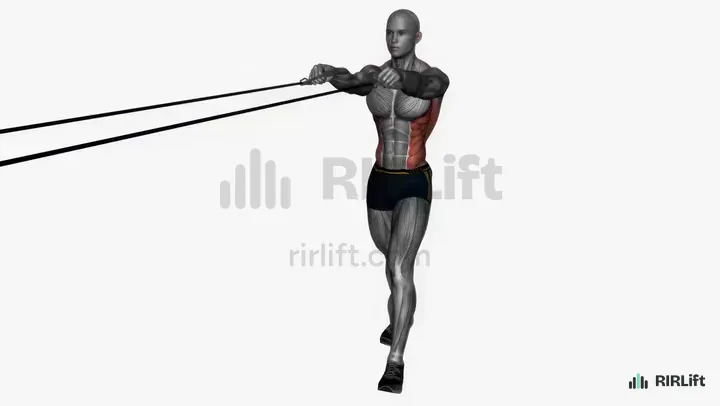
Chest, one-arm fly

Single-Arm Band Chest Fly

Chest

Anchored behind you at chest height, the band lets one arm sweep across your body against tension, the chest's main job. A good partner to push-ups.

How to do it

  1. Anchor a band at chest height in a door or around a post, take the handle in one hand and stand with your back to the anchor.
  2. Step forward until the band is taut with your arm open wide and slightly bent.
  3. Sweep your hand across until it is in front of the middle of your chest.
  4. Let the band pull your arm back open slowly, finish your reps, then switch arms.

Cues

  • Reach across your body
  • Fixed elbow angle
  • Slow on the way back

Common mistakes

  • Standing so close the band goes slack at the stretch: step forward until it pulls the whole way.
  • Turning your torso to finish: brace and move only the arm.

Swap for: Single-Arm Cable Fly, Push-Up, Dumbbell Chest Fly

Shoulders and triceps, single-arm press

Band Overhead Press

Shoulders

Standing on the band and pressing one arm overhead loads the shoulder while your trunk keeps you upright. Work one side, then the other.

How to do it

  1. Stand on one end of a handled band with your right foot and hold the handle at your right shoulder.
  2. Brace your stomach and squeeze your glutes.
  3. Press the handle straight up until your arm is nearly straight.
  4. Lower it slowly to your shoulder. Do all reps, then switch.

Cues

  • Ribs down
  • Press straight up
  • Shoulder finishes by your ear

Common mistakes

  • Leaning away from the working arm: brace harder or use a lighter band.
  • Pressing out in front: end with your arm over your shoulder, not your toes.

Swap for: Dumbbell Shoulder Press, Pike Push-Up, Band Lateral Raise

Side delts, banded raise

Band Lateral Raise

Shoulders

Raising a band out to your sides trains the shoulder width that presses miss. The band is hardest at the top, so a light band is enough.

How to do it

  1. Stand on the middle of the band with both feet and hold an end in each hand by your thighs, palms facing your legs.
  2. Raise both arms out to the sides, leading with your elbows, until your hands reach shoulder height.
  3. Pause for a beat at the top.
  4. Lower over two seconds and keep a little tension at the bottom.

Cues

  • Lead with the elbows
  • Pinkies level with thumbs
  • Slow on the way down

Common mistakes

  • Shrugging the band up with your traps: keep your shoulders down and stop at shoulder height.
  • Letting the band go slack at the bottom: widen your stance so there is tension on every rep.

Swap for: Dumbbell Lateral Raise, Cable Lateral Raise, Band Upright Row

Put them together: example sessions

Each session below picks from the exercises above for one situation, with the sets, reps, rest and RIR filled in.

Session 1

At home with a set of loop bands, three days a week

  • Workouts3× a week
  • Working sets45 a week
  • Per workout~30 min
  • EquipmentResistance Bands

You train at home with a set of long loop bands of several strengths, a mini loop and a door anchor, and you want to build muscle without weights.

Two full-body sessions alternate across three days, each with a leg, push and pull exercise plus one shoulder or arm move. Day A and Day B have 15 sets each, so over an A, B, A week the back gets about 13 hard sets, the quads 11 and the chest 9.

Day A
ExerciseSets × repsRIRRest
Band Squat 4 × 15–25 2 75 s
Push-Up 3 × 8–20 2 90 s
Band Bent-Over Row 3 × 12–20 1 75 s
Band Overhead PressPer arm. 3 × 10–15 1 1 min
Band Pull-Apart 2 × 15–25 1 45 s
Day B
ExerciseSets × repsRIRRest
Band Deadlift 4 × 12–20 2 90 s
Band Reverse LungePer leg. 3 × 8–12 2 75 s
Single-Arm Band Chest FlyPer arm. 3 × 12–20 1 1 min
Band Face Pull 3 × 15–20 1 1 min
Band Hammer Curl 2 × 12–20 1 1 min
How to run it
Alternate A and B three days a week with a rest day between: A, B, A one week and B, A, B the next.
How to progress
When every set reaches the top of its range at 1 to 2 reps in reserve, make the band harder: widen your stance, step farther from the anchor, or use the next band, and start again from the bottom of the range.

Session 2

Traveling with one band in your bag

  • Workouts3× a week
  • Working sets42 a week
  • Per workout~25 min
  • EquipmentResistance Bands

You travel for work, train in hotel rooms, and pack a single long band or a small tube set.

With one band, single-leg and one-arm work keeps the load high. 14 sets in one session, done two or three times a week, maintains the muscle you built at home.

Hotel Room
ExerciseSets × repsRIRRest
Band Reverse LungePer leg. 3 × 10–15 2 1 min
Push-Up 3 × 10–25 1 75 s
Band Bent-Over Row 3 × 12–20 1 1 min
Band Hip Thrust 3 × 15–25 1 1 min
Band Lateral Raise 2 × 15–20 1 45 s
How to run it
Two or three times a week while away, on any free morning or evening. Keep a day between when you can.
How to progress
Hold the band at a length that lets you reach the bottom of each rep range with the target reps still in reserve. As the trip goes on, add reps, then shorten the band by wrapping it around your hand once.

Session 3

Bands plus a pull-up bar, training for size

  • Workouts4× a week
  • Working sets56 a week
  • Per workout~30 min
  • EquipmentPull-Up Bar, Resistance Bands

You have heavy loop bands and a doorway pull-up bar, train four days a week, and want to get bigger.

An upper/lower split gives each muscle more sets per session than full body: 15 on upper days and 13 on lower days. Run twice a week, that is 8 pull-up and 8 push-up sets, 10 for the shoulders, and 12 to 20 for the glutes and hamstrings.

Upper
ExerciseSets × repsRIRRest
Band-Assisted Pull-Up 4 × 5–10 1 2 min
Push-Up 4 × 10–20 1 90 s
Band Overhead PressPer arm. 3 × 10–15 1 1 min
Band Lateral Raise 2 × 15–20 0 45 s
Band Hammer Curl 2 × 12–20 1 1 min
Lower
ExerciseSets × repsRIRRest
Band Squat 4 × 15–25 1 90 s
Band Deadlift 3 × 12–20 1 90 s
Band Hip Thrust 3 × 15–25 1 1 min
Band Leg CurlPer leg. 3 × 12–20 1 1 min
How to run it
Upper, Lower, rest, Upper, Lower, two days off.
How to progress
On the band-assisted pull-up, move to a lighter band when you reach 10 reps on every set, and to bodyweight pull-ups after that. On everything else, add reps, then a stronger band.

Make it fit you

Questions

Can you build muscle with resistance bands?

Yes. Muscles grow from sets that end close to failure, and a heavy band at 12 to 25 reps does that. Legs are the hardest to load, so use your strongest band and single-leg exercises there.

Can you get shredded with resistance bands?

Getting lean comes from losing body fat, which is set by your diet. Bands keep and build the muscle while you lose it, which is what makes you look defined at the end.

How do I use resistance bands at home?

Stand on the band for deadlifts, lunges, rows, curls and presses, use a mini loop around the knees or ankles for squats and leg curls, and a door anchor for face pulls and chest flies. Pick a band that makes the last 2 reps of each set hard.

Can I lose belly fat with resistance bands?

No exercise removes fat from one area. The fat comes off through overall weight loss; bands build the muscle underneath, so keep training while you diet.

How do you progress with resistance bands?

Add reps first. Once you reach the top of the range, make the band tighter by stepping farther out or widening your stance, add a 2-second pause at the top, or move to the next band.