
Shoulder exercises with resistance bands
Published October 19, 2026
The best shoulder exercises with resistance bands are the band overhead press for the front and side delts, the band lateral raise and upright row for width, and the face pull, pull-apart and rear delt fly for the back of the shoulder. A band shoulder workout needs one press, one side delt move and one rear delt move, 3 sets each for 10 to 25 reps, ending 0 to 2 reps short of failure. Move to a stronger band when you top the rep range.
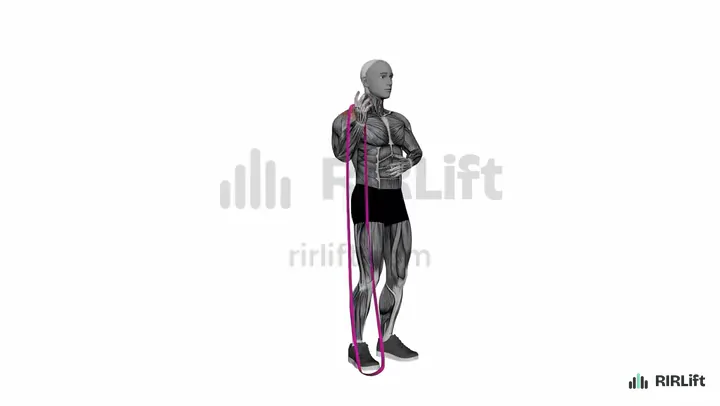
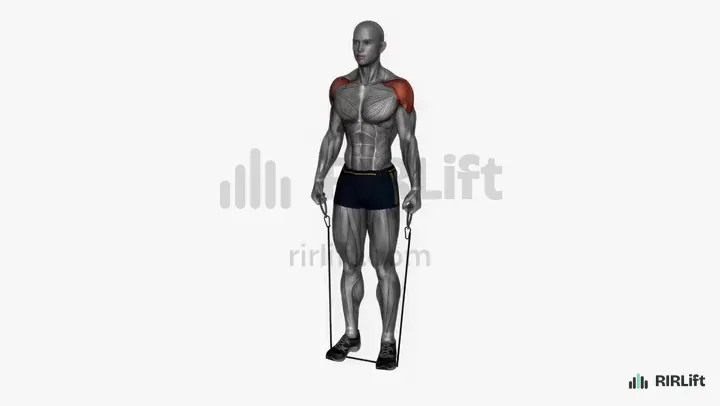
- Band Overhead Press Shoulders
- Band Lateral Raise Shoulders
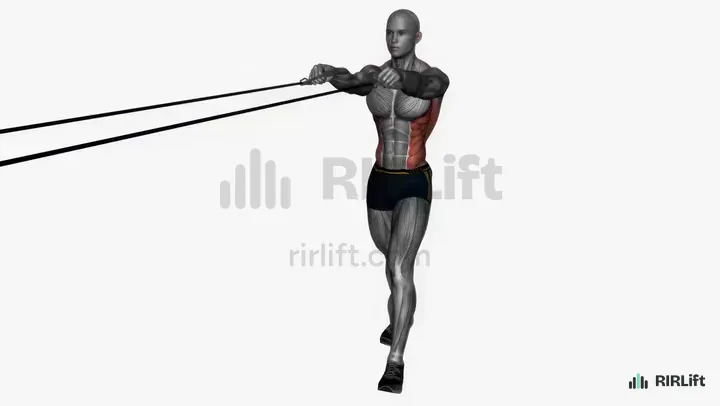
- Band Face Pull Shoulders, Upper Back
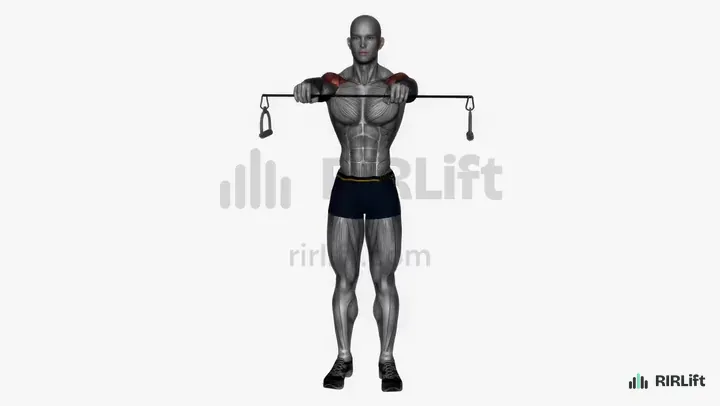
- Band Pull-Apart Shoulders, Upper Back
- Band Rear Delt Fly Shoulders
- Band Upright Row Shoulders, Traps
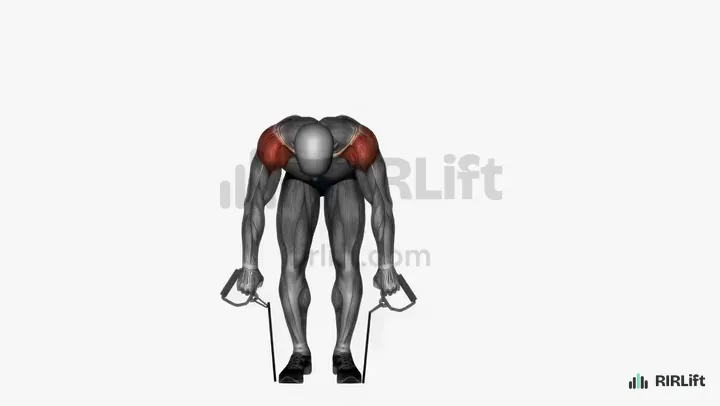
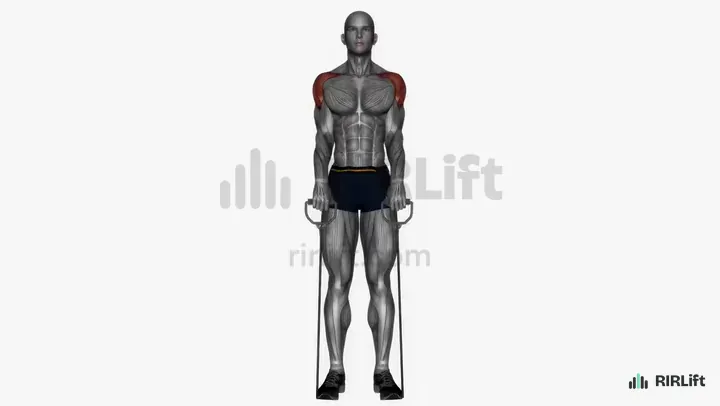
Put them together: example sessions
Each session below picks from the exercises above for one situation, with the sets, reps, rest and RIR filled in. Open one in the session builder to change a pick, price it from a recent set, and add it to RIRLift.
-
Session 1
One band, no anchor point
You have a single band and nowhere to attach it, such as when traveling or in a small apartment.
3× a week · 36 sets a week · ~20 min
-
Session 2
A door anchor and a set of bands, building size
You have bands of several strengths and a door anchor, and want bigger shoulders at home.
3× a week · 32 sets a week · ~20 min
-
Session 3
Ten minutes between desk work
You sit for most of the day and want short, frequent sessions for the back of your shoulders.
5× a week · 30 sets a week · ~10 min
Session 1
One band, no anchor point
- Workouts3× a week
- Working sets36 a week
- Per workout~20 min
- EquipmentResistance Bands
You have a single band and nowhere to attach it, such as when traveling or in a small apartment.
Every exercise here either stands on the band or holds it in both hands, so no door anchor is needed. The press and the upright row are the heavier pair; the lateral raise and pull-apart add more side and rear delt work. Sets go to 0 to 1 RIR, because a band's tension rises at the top, and the last reps are where most of the work happens.
| Exercise | Sets × reps | RIR | Rest |
|---|---|---|---|
| Band Overhead Press | 3 × 10–20 | 1 | 75 s |
| Band Upright Row | 3 × 12–20 | 1 | 1 min |
| Band Lateral Raise | 3 × 15–25 | 0 | 1 min |
| Band Pull-Apart | 3 × 15–25 | 1 | 45 s |
- How to run it
- Do this circuit three times a week. Use a shorter grip on the band to make any exercise harder.
- How to progress
- Add reps until each set reaches the top of its range, then shorten your grip or step wider on the band. When that runs out, move to the next band.
Session 2
A door anchor and a set of bands, building size
- Workouts3× a week
- Working sets32 a week
- Per workout~20 min
- EquipmentResistance Bands
You have bands of several strengths and a door anchor, and want bigger shoulders at home.
With an anchor, the face pull covers the rear delts better than any other band exercise. Session A builds around the press; Session B around the side and rear delts. Using a heavier band for the press and a lighter one for raises is the same as switching dumbbells. Each delt head gets 6 or more hard sets a week at 0 to 1 RIR.
| Exercise | Sets × reps | RIR | Rest |
|---|---|---|---|
| Band Overhead PressHeaviest band. | 4 × 8–15 | 1 | 90 s |
| Band Lateral Raise | 3 × 12–20 | 0 | 1 min |
| Band Face PullAnchor at head height. | 3 × 12–20 | 1 | 1 min |
Open Session A in the session builder
| Exercise | Sets × reps | RIR | Rest |
|---|---|---|---|
| Band Upright Row | 3 × 10–15 | 1 | 75 s |
| Band Rear Delt Fly | 3 × 12–20 | 0 | 1 min |
| Band Front Raise | 2 × 12–20 | 1 | 1 min |
| Band Lateral RaiseShorter grip than in A. | 3 × 15–25 | 0 | 1 min |
Open Session B in the session builder
- How to run it
- Alternate Session A and Session B, with two to four sessions a week in total.
- How to progress
- Hit the top of each rep range, then move to the next band or shorten your grip. Add a second band to the press when the heaviest one is too easy.
Session 3
Ten minutes between desk work
- Workouts5× a week
- Working sets30 a week
- Per workout~10 min
- EquipmentResistance Bands
You sit for most of the day and want short, frequent sessions for the back of your shoulders.
Desk days mean long hours with the arms in front of you. This plan uses only the three band exercises that pull the arms back and out: the pull-apart, the face pull and the rear delt fly. The sets end 2 RIR, so you can repeat the session most days without soreness getting in the way. It is a supplement; add a press session twice a week for full shoulders.
| Exercise | Sets × reps | RIR | Rest |
|---|---|---|---|
| Band Pull-Apart | 2 × 15–25 | 2 | 30 s |
| Band Face Pull | 2 × 15–20 | 2 | 45 s |
| Band Rear Delt Fly | 2 × 15–20 | 2 | 45 s |
- How to run it
- Do it on four or five days a week, at any break that fits. Keep the band by your desk.
- How to progress
- Add reps first, then move to a stronger band. Hold the end of each rep for two seconds when a band change is too big a jump.
Make it fit you
-
Only one band
Change the tension with your grip and stance: hold the band shorter or stand on it with your feet wider for a harder rep, and use a longer grip for raises than for presses.
-
Bands without handles
Loop bands work for every exercise here. Wrap the ends around your hands once for the press and raises, and hold the band in a light grip for pull-aparts.
-
No door anchor
Skip the face pull and do the pull-apart and the rear delt fly instead; both cover the rear delts without an anchor. A band looped around a post or banister also works.
-
Pressing bothers your shoulders
Do the band press with your palms facing each other and slightly in front of your head, and lean harder on raises and face pulls, which keep the load lighter at the hardest angles.
-
Log RIR on every set
Log each set with its RIR in RIRLift, and note the band color. Bands don't come in small steps, so watching RIR fall on the same band is how you know when to switch.
Questions
Can you build shoulders with resistance bands?
Yes. A press, a lateral raise and a face pull with bands cover all three parts of the delt, and taking sets close to failure builds muscle with light loads. The challenge is that bands come in big jumps, so you progress through reps, grip and stance between bands.
What is the best resistance band exercise for shoulders?
For width, the band lateral raise. For balance and the back of the shoulder, the face pull. If you can only do one exercise, the lateral raise is the one most people's shoulders need more of.
What are some good band exercises for the rotator cuff?
The face pull trains the muscles that rotate your upper arm outward together with the rear delts. Pull-aparts and rear delt flies support the same area. Keep the band light and the reps slow and controlled.
How do I fix rounded shoulders with bands?
Bands can strengthen the muscles that pull your shoulders back, through face pulls, pull-aparts and rear delt flies done most days. The desk break plan above is built for that. Posture also depends on how you sit and move during the day.
What are the 3 main shoulder exercises with bands?
The band overhead press, the band lateral raise and the band face pull. They hit the front, side and rear delts, and work as a complete session.
How many reps should I do with resistance bands?
Mostly 10 to 25. Bands get harder as they stretch, so the last part of each rep is tough even when the start feels easy. What matters is that the set ends 0 to 2 reps short of failure.
Related templates
-
Resistance band exercises for every muscle, with the bands you own
Band exercises for every muscle, not just shoulders.
-
Bodyweight shoulder exercises, from beginner to advanced
Pike push-ups and handstands to add pressing without weights.
-
Shoulder exercises at home, with or without weights
Combines bands with dumbbells and kettlebells.
-
Band pull-apart: how to do it for your rear delts and upper back
A full guide to the simplest rear delt exercise.
-
Lateral raises: how to do them, and what to do instead
Every lateral raise variation for wider shoulders.