TRX workout: suspension trainer exercises and plans for every level

A good TRX workout pairs a pull, a push, a leg exercise and a core exercise: TRX rows, chin-ups, face pulls and rear delt rows for the back; decline push-ups and chest flyes for the chest; split squats, leg curls and hip bridges for the legs; and the pike for the abs. You make each one easier or harder by changing your body angle or how far your feet are from the anchor. Two or three sessions a week of 3 sets per exercise, stopping 1 to 3 reps short of failure, builds real strength with only the straps.

  1. TRX Row Upper Back, Lats
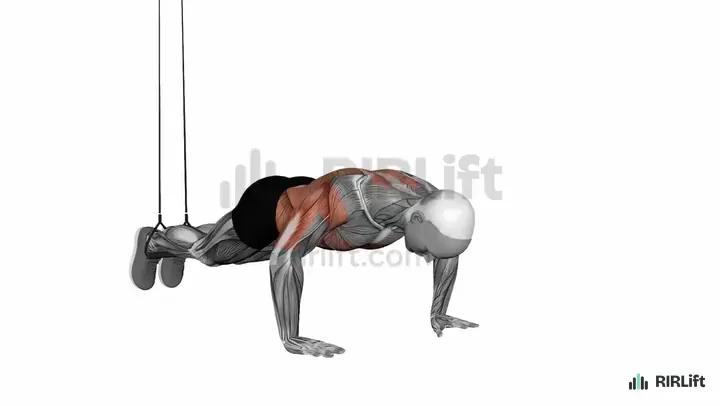
  2. TRX Decline Push-Up Chest
  3. TRX Split Squat Quads, Glutes
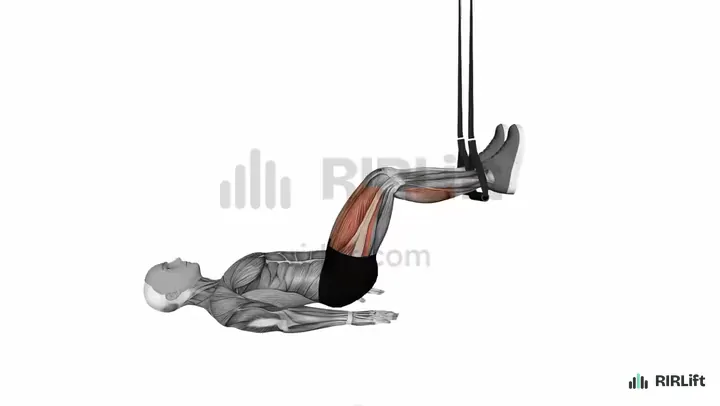
  4. TRX Leg Curl Hamstrings
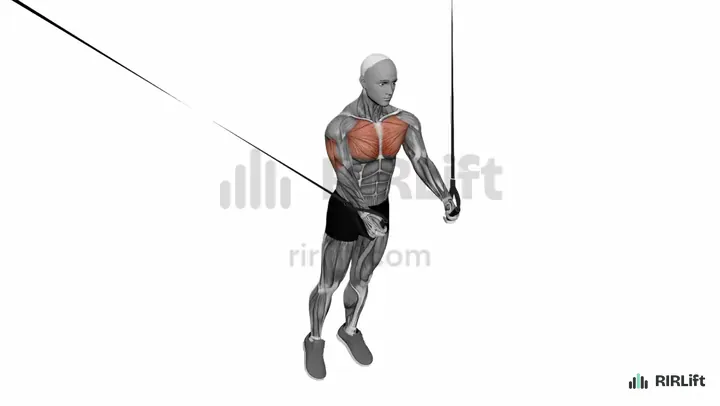
  5. TRX Chest Fly Chest
  6. TRX Face Pull Shoulders, Upper Back
  7. TRX Hip Bridge Glutes
  8. TRX Pike Abs

Pulling: rows, chin-ups and face pulls

Pulling is where a suspension trainer beats almost every other home setup. Walking your feet toward the anchor puts more of your weight on the straps, so the same row works for beginners and strong lifters.

Upper back and lats, suspension row

TRX Row

Upper Back, Lats

The first exercise to learn on a TRX and the base of every plan here. Bent knees make it a little easier than a straight-body row, and moving your feet in makes it harder.

How to do it

  1. Anchor the suspension straps above a closed door or a beam, take a handle in each hand, and sit back, knees bent, both soles planted.
  2. Lean back until your arms are straight and your body forms a line from knees to shoulders.
  3. Pull your chest up to the handles by driving your elbows back past your ribs.
  4. Lower back to straight arms under control and repeat.

Cues

  • Hips stay up in line
  • Elbows past the ribs
  • Walk the feet forward to make it harder

Common mistakes

  • Letting your hips sag as you tire: squeeze your glutes and end the set when the line breaks.
  • Pulling only with the arms and stopping short: the handles should finish beside your chest every rep.

Swap for: TRX Rear Delt Row, One-Arm Dumbbell Row, Band Bent-Over Row

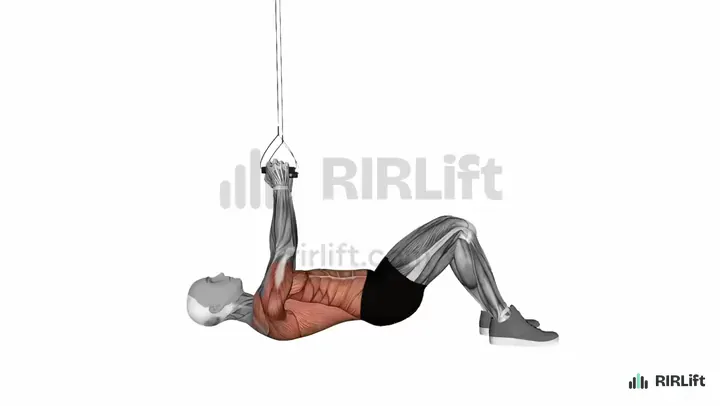
Lats and biceps, assisted chin-up

TRX Chin-Up

Lats, Biceps

With the straps set high and your feet on the floor, your legs help just enough to do full chin-ups before you can do one on a bar. It trains the vertical pull a row cannot.

How to do it

  1. Hang the straps from a high anchor and stand under the handles.
  2. Take a handle in each hand with your palms toward you, about shoulder-width apart, and hang with straight arms.
  3. Pull your shoulders down, then drive your elbows to your sides until your chin rises above the handles.
  4. Lower yourself slowly back to straight arms before the next rep.

Cues

  • Palms face you
  • Elbows to your ribs
  • Slow on the way down

Common mistakes

  • Letting the handles drift wide as you pull: keep them in line with your shoulders so both arms work evenly.
  • Dropping fast out of the top: take two seconds to lower, since that half builds strength too.

Swap for: Band-Assisted Pull-Up, Chin-Up, TRX Row

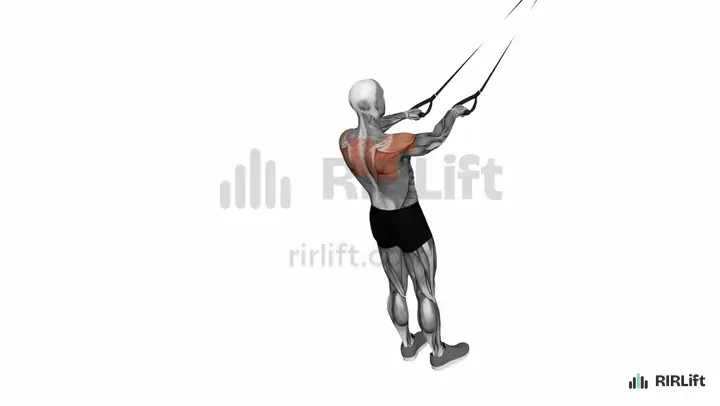
Rear shoulders and upper back, face pull

TRX Face Pull

Shoulders, Upper Back

Pulling the handles toward your forehead with elbows high trains the rear shoulders and shoulder blade muscles that pushing-heavy routines neglect. Keep the angle moderate and the reps high.

How to do it

  1. Set the straps to about chest height, hold a handle in each hand, and walk your feet forward so you lean back with straight arms.
  2. Brace so your body forms one line from your heels to your head.
  3. Pull your face toward the handles with your elbows out and up, until your hands are beside your forehead.
  4. Lower yourself back to straight arms slowly and repeat.

Cues

  • Body like a plank
  • Hands finish by your temples
  • Slow on the way back

Common mistakes

  • Letting your hips sag so they lead the pull: squeeze your glutes and keep the line.
  • Pulling with low elbows, which turns it into a row: keep the elbows at shoulder height or above.

Swap for: Band Face Pull, TRX Rear Delt Row, Band Pull-Apart

Rear shoulders, wide row

TRX Rear Delt Row

Shoulders, Upper Back

Rowing with your elbows wide and palms turned in shifts a row toward the rear shoulders. It gives the back of the shoulder direct work in fewer sets than face pulls.

How to do it

  1. Set the straps to about chest height, grip the handles with your palms turned in, and lean back with straight arms and your body in a straight line.
  2. Row your chest toward the handles by driving your elbows out to the sides.
  3. Stop when your upper arms are level with the floor and pinch your shoulder blades in.
  4. Lower back to straight arms with control and repeat.

Cues

  • Elbows out to the sides
  • Upper arms level at the top
  • Body stays straight

Common mistakes

  • Tucking the elbows to your ribs: keep them wide to keep the rear delts working.
  • Starting so upright that the row is too easy: walk your feet forward until 15 reps is hard.

Swap for: TRX Face Pull, Band Rear Delt Fly, TRX Row

Pushing: push-ups and flyes

Unstable handles make every press harder than its floor version, so start with a steep body angle. Feet in the cradles turns the push-up into the hardest pushing exercise on the straps.

Chest and triceps, feet in the straps

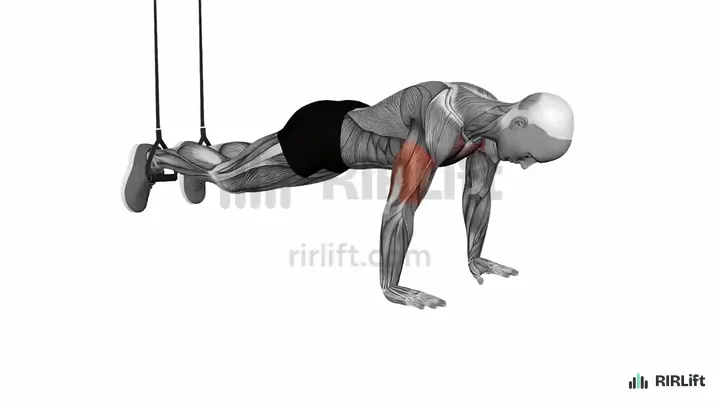
TRX Decline Push-Up

Chest

Feet in the cradles and hands on the floor turns a push-up into a decline press with a trunk that has to stay rigid. It is the main push for anyone past 15 floor push-ups.

How to do it

  1. Hang the straps from a door anchor so the foot cradles sit about knee height.
  2. Put your feet in the cradles from a kneeling position, then lift into a plank on your hands.
  3. Lower your upper chest toward the floor while keeping your legs still.
  4. Press back to straight arms without letting the straps swing.

Cues

  • Brace before you lower
  • Legs stay quiet
  • Chest down, hips level

Common mistakes

  • Letting the straps swing side to side: slow the rep down and squeeze your glutes.
  • Sagging at the hips: shorten the set and keep your body straight.

Swap for: Decline Push-Up, Push-Up, Incline Dumbbell Press

Chest, standing fly

TRX Chest Fly

Chest

Opening your arms while leaning into the straps loads the chest through a long stretch, the job dumbbell flyes do at the gym. Stand close to upright at first; the shoulder works hard at the bottom.

How to do it

  1. Set the straps to about waist height, hold the handles and face away from the anchor.
  2. Lean forward with your arms straight out in front until your weight hangs on the handles, body in a straight line.
  3. Let your arms open out to the sides, elbows slightly bent, so your chest lowers between them.
  4. Squeeze your arms back together to return to the start. Walk your feet back to make it harder.

Cues

  • Body straight like a plank
  • Arms open into a wide T
  • Start with a small lean

Common mistakes

  • Leaning too far on your first sets: the angle gets hard fast, so start nearly upright.
  • Hips sagging as your arms open: brace your stomach and squeeze your glutes.

Swap for: TRX Decline Push-Up, Single-Arm Band Chest Fly, Push-Up

Legs: split squats, curls and bridges

With a foot or both heels in the cradles, the straps load one leg at a time and the hamstrings, the two things body weight on the floor does poorly.

Quads and glutes, rear foot suspended

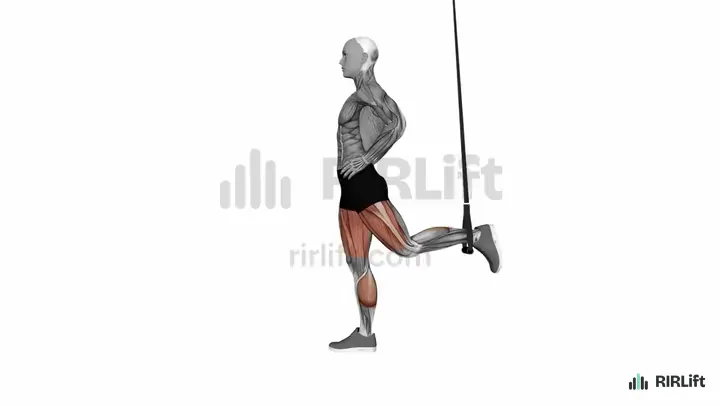
TRX Split Squat

Quads, Glutes

With your back foot in a cradle, almost all your weight goes onto the front leg, a Bulgarian split squat without a bench. It is the main leg strength exercise for a TRX-only workout.

How to do it

  1. Set the foot cradles at about knee height, stand facing away from the anchor and put the top of one foot in a cradle behind you.
  2. Step the front foot forward into a long split stance, chest up.
  3. Bend the front knee and lower until that thigh is about parallel to the floor, letting the back knee bend and the strap swing back.
  4. Push through the front heel to stand back up, then finish all reps before switching legs.

Cues

  • Front foot does the work
  • Knee tracks over the toes
  • Chest up, hips square

Common mistakes

  • Pushing down hard with the back foot: the strap swings and you lose balance. Let the back leg rest in the cradle.
  • Front foot too close to the anchor: the front knee shoots forward. Hop the front foot further out.

Swap for: Bulgarian Split Squat, Skater Squat, Dumbbell Split Squat

Hamstrings, suspended leg curl

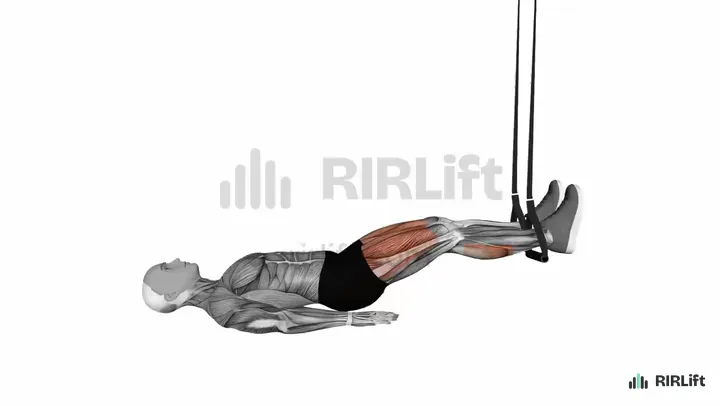
TRX Leg Curl

Hamstrings

Pulling your heels toward your hips with your hips lifted trains the hamstrings at the knee, which floor exercises cannot load well. Lift your hips higher and slow the return to make it harder.

How to do it

  1. Set the straps so the foot cradles hang about knee height, then lie face up with your heels in them.
  2. Raise your hips until your shoulders, hips and heels line up.
  3. Pull your heels toward your glutes, keeping your hips lifted as your knees bend.
  4. Straighten your legs under control and keep your hips off the floor between reps.

Cues

  • Drive the hips up as the knees bend
  • Squeeze the backs of the thighs at the top
  • Arms flat for balance

Common mistakes

  • Starting with the straps too high, so your hips sink: lower the cradles until you can hold the bridge.
  • Swinging the legs in and out: pause a moment with your knees fully bent before you extend.

Swap for: Stability Ball Leg Curl, Nordic Hamstring Curl, Band Leg Curl

Glutes, suspended bridge

TRX Hip Bridge

Glutes

Lifting your hips with your heels in the cradles makes the glutes and hamstrings work while the straps try to swing. It is a good first step before leg curls.

How to do it

  1. Lower the foot cradles to about knee height then lie face up, heels in the cradles and knees bent about 90 degrees.
  2. Press your heels down into the straps and lift your hips until they line up with your knees and shoulders.
  3. Hold briefly at the top with your glutes squeezed.
  4. Lower your hips under control until they hover above the floor, then lift again.

Cues

  • Pull the heels down and back
  • Ribs down at the top
  • Keep the straps still

Common mistakes

  • Pushing the straps away from you: the bridge turns into a wobble. Think of dragging your heels toward your hips.
  • Resting with your hips on the floor between reps: keep tension on and hover instead.

Swap for: Single-Leg Glute Bridge, Dumbbell Glute Bridge, TRX Leg Curl

Core

Every exercise above trains the trunk to hold a straight line, and the pike adds a hard ab exercise on top.

Abs and shoulders, pike from a plank

TRX Pike

Abs

Feet in the straps and hips driving toward the ceiling make the abs lift your lower body while your shoulders hold you up. It is the hardest core exercise you can do on a TRX.

How to do it

  1. Set the foot cradles at about knee height, put your feet in them and walk your hands out into a plank, hands under your shoulders.
  2. Brace so your body is in a straight line from head to heels.
  3. Keep your legs straight and lift your hips toward the ceiling into an upside-down V.
  4. Lower your hips slowly back to the plank and repeat.

Cues

  • Hips lift, legs stay straight
  • Shoulders over the hands
  • Lower slowly

Common mistakes

  • Hips sagging between reps: reset the plank before each rep.
  • Bending the knees to finish the rep: shorten the range until you can keep the legs straight.

Swap for: Jackknife, Plank, Stability Ball Body Saw

Put them together: example sessions

Each session below picks from the exercises above for one situation, with the sets, reps, rest and RIR filled in.

Session 1

New to the TRX, two days a week

  • Workouts2× a week
  • Working sets22 a week
  • Per workout~25 min
  • EquipmentSuspension Trainer

You just got a suspension trainer or use one at your gym, and you want to learn the main exercises without overdoing it.

One full-body routine done twice a week gives the chest 4 hard sets a week and the back and legs 8 to 10 each, enough to get stronger while you learn foot positions. Every set stops 2 to 3 reps short of failure, which keeps the straps steady and the reps clean.

Full body
ExerciseSets × repsRIRRest
TRX Row 3 × 8–12 3 90 s
TRX Split SquatPer leg. Hold a wall if needed. 2 × 6–10 3 90 s
TRX Chest FlyStand nearly upright. 2 × 8–12 3 75 s
TRX Hip Bridge 2 × 10–15 2 1 min
TRX Face Pull 2 × 10–15 2 1 min
How to run it
Do it twice a week with two or three days in between. It takes about 25 minutes.
How to progress
When every set reaches the top of the rep range at the target reps in reserve, take a small step toward the anchor (or a lower body angle) next session. RIRLift sets the next session's target from the reps in reserve you log, so you know when to move your feet.

Session 2

Getting stronger, upper and lower days

  • Workouts4× a week
  • Working sets50 a week
  • Per workout~30 min
  • EquipmentSuspension Trainer

You know the basic exercises, the beginner angles are easy, and you can train three or four times a week.

Splitting upper and lower lets each session go harder, about 13 hard sets on upper days and 12 on lower and core days. Done twice a week each, that is 10 or more weekly sets for the back, chest and legs, the range that builds muscle.

Upper
ExerciseSets × repsRIRRest
TRX Chin-Up 4 × 5–10 2 2 min
TRX Decline Push-Up 4 × 6–12 1 2 min
TRX Row 3 × 8–12 1 90 s
TRX Rear Delt Row 2 × 12–15 1 1 min
Lower and core
ExerciseSets × repsRIRRest
TRX Split SquatPer leg. 4 × 8–12 2 2 min
TRX Leg Curl 3 × 8–12 1 90 s
TRX Hip BridgePause 1 s at the top. 2 × 12–15 1 1 min
TRX Pike 3 × 6–10 2 75 s
How to run it
Alternate Upper and Lower, for example Monday Upper, Tuesday Lower, Thursday Upper, Friday Lower. Each takes about 35 minutes.
How to progress
Use double progression: add reps until every set reaches the top of the range at 1 to 2 reps in reserve, then lower your body angle or move your feet closer to the anchor and start again at the bottom of the range.

Session 3

Hotel room or park, 25 minutes

  • Workouts3× a week
  • Working sets48 a week
  • Per workout~25 min
  • EquipmentSuspension Trainer

You travel with the straps in your bag or train in a park, and you want a short full-body session wherever there is a door or a branch.

Three supersets cover pull and push, legs and core, and rear shoulders in about 25 minutes, giving each muscle 3 hard sets. Two or three of these a week keeps your strength up between longer sessions at home.

Circuit
ExerciseSets × repsRIRRest
A1 TRX Row 3 × 10–15 2 1 min
A2 TRX Decline Push-Up 3 × 8–12 2 90 s
B1 TRX Split SquatPer leg. 3 × 8–12 2 1 min
B2 TRX Pike 3 × 6–10 2 90 s
C1 TRX Face Pull 2 × 12–15 2 1 min
C2 TRX Leg Curl 2 × 10–12 2 1 min
How to run it
Use it on travel days or busy weeks, two or three times. Go from the first exercise of each pair straight to the second, then rest.
How to progress
Keep the reps in reserve at 2 and add a rep per set each session. When the top of the range is easy, step closer to the anchor rather than adding rounds.

Make it fit you

Questions

What kind of workout is TRX?

TRX is suspension training: you hold handles or put your feet in cradles hanging from an anchor and use your body weight as resistance. It is strength training, and changing your body angle changes how hard each exercise is.

Can you build muscle with TRX?

Yes. Rows, chin-ups, decline push-ups, split squats and leg curls can all be made hard enough that sets end within 6 to 15 reps, which builds muscle. Legs are the hardest part to load heavily over time.

How often should I do a TRX workout?

Two or three times a week for full-body sessions, or four times on an upper and lower split. Leave a day between sessions that train the same muscles hard.

What is the 3-3-3 rule for working out?

It usually means 3 exercises, 3 sets, 3 days a week. On a TRX, rows, decline push-ups and split squats make a solid 3.

Is TRX harder than Pilates?

They train different things. TRX is a strength workout where you can load your back, chest and legs close to failure. Pilates focuses more on control and mobility at lighter effort. Many people find TRX more tiring per minute.