
The AI workout planner that keeps planning after day one
Published October 27, 2026
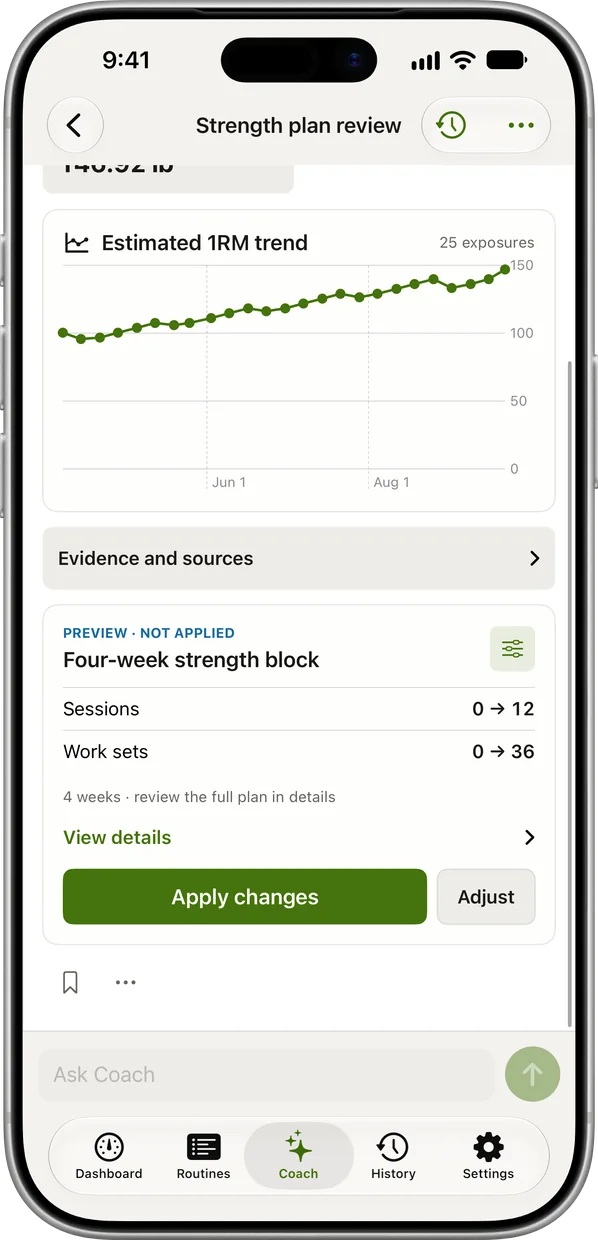
A good AI workout planner does two jobs: it builds a plan that fits your goal, equipment and days, and it keeps adjusting that plan as you train. Most stop at the first. In RIRLift you ask Coach for a plan, review it before anything changes, and from then on every weight is set from the reps you logged and how many you had left.
Free on iPhone and Apple Watch · No account · Coming to Android: join the waitlist
What an AI workout planner should actually do
-
A plan for your gym, your days and your goal
Ask Coach for a plan in plain words: four days, muscle first, a home gym with dumbbells to 50 lb. Your equipment list keeps every exercise and swap inside what you own. Under Start empty workout, AI generate workout builds a single session from a sentence.
-
Answers from your log, not a generic template
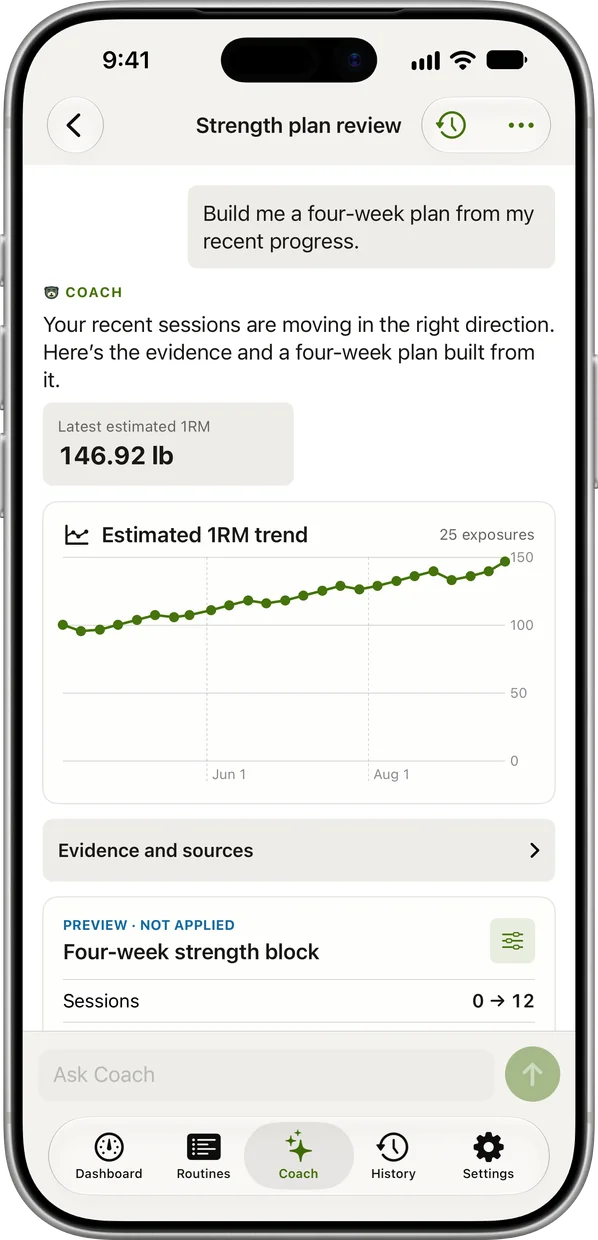
Coach reads your history, so "why has my bench stalled?" gets an answer about your bench. Importing from Hevy, Strong or FitNotes gives it your past training from day one.
-
Every weight explained
Tap any suggested load for Why this weight: what it was worked out from, and what held it back if it didn't go up. The rules are written out in how RIRLift picks your next weight.
-
Nothing changes until you say so
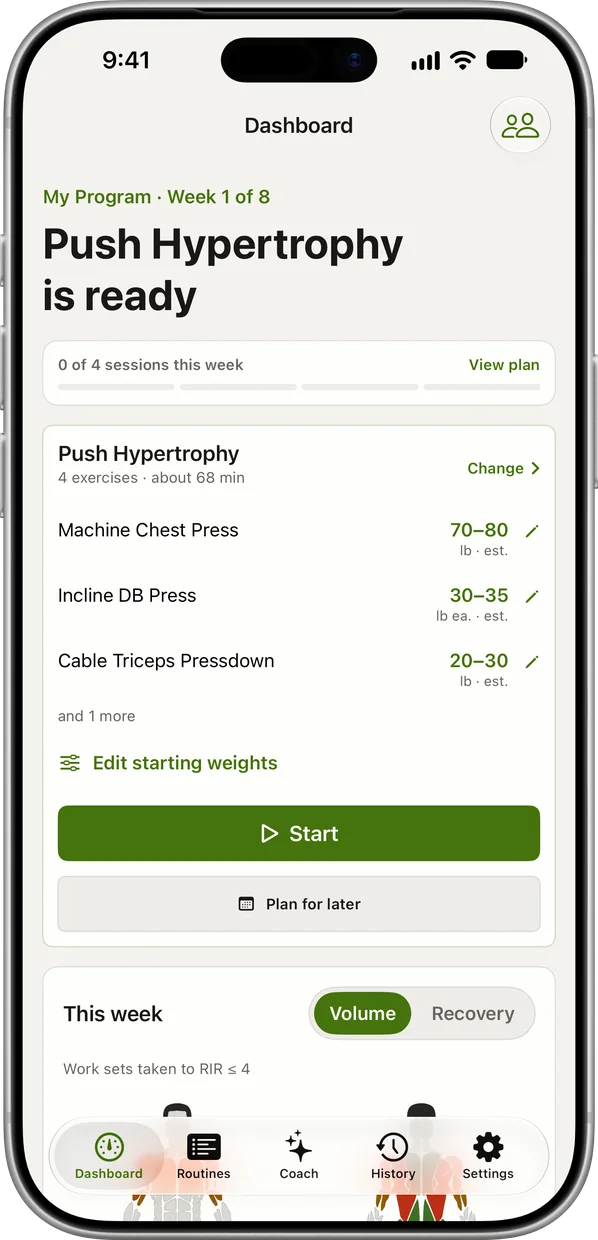
A plan, a shortened session or a swapped machine arrives as a preview with Apply changes or Adjust. You can review, edit or remove anything Coach remembers about you.
-
It keeps adapting after week one
A generated plan goes stale the moment you start lifting. Here, each session's weights come from your last one: double progression between sessions, small corrections between sets.
-
Bring your own AI if you prefer
With Pro you can connect Claude or ChatGPT to read your training and draft programs that you review in the app. You can also build a full program on a computer in the web planner and import it.
A Coach-built plan, from the first session to the first stall
Session 1: a 3-day plan Coach built, every lift new
You asked for three full-body days at a commercial gym. You've lifted a little but never logged these lifts, so each starts as an Estimate and the first set is as many good reps as you can.
| Exercise | You logged | Next session | Why |
|---|---|---|---|
| Barbell Back Squat | 95 lb (Estimate), 14 reps, nothing left | 110 lb × 6–10 | 14 reps to failure at 95 lb converts to about 110 lb for 6 reps with 2 left. |
| Incline Dumbbell Press | 25 lb pair (Estimate), 17 reps, nothing left | 30 lb × 8–12 | The estimate was light on purpose. One set measured you; the rest of the session uses the real number. |
| Lat Pulldown | 70 lb (Estimate), 15 reps, nothing left | 80 lb × 8–12 | Converted to 8 reps with 1 left, rounded to the stack. |
You typed one request and never looked up a weight. Session 2 opens with these numbers filled in.
Week 4: where a one-off plan would go stale
Same plan, a month in. A static plan would still show week 1's numbers. Here each lift has moved at its own speed.
| Exercise | You logged | Next session | Why |
|---|---|---|---|
| Barbell Back Squat | 135 lb, 10 / 10 / 10 reps, 2 left | 140 lb × 6 | Every set reached the top of 6–10: one step up and the rep target resets to the bottom. |
| Incline Dumbbell Press | 40 lb, 12 / 11 / 10 reps, 1 left | 40 lb × 11 | The weakest set hit this session's target of 10 but not the top of the range, so the weight holds and you aim for one more rep. |
| Lat Pulldown | Set 1: 100 lb × 12, 3 left (planned 1) · sets 2–3: 105 lb × 12 / 12, 1 left | 110 lb × 8 | Set 1 was easier than planned, so set 2 went up: 100 × 44 ÷ 42 ≈ 105. Both sets at 105 reached 12, the top of 8–12: one step up, reps back to 8. |
The plan stayed the same. The weights inside it changed because your sets did.
Week 7: one lift stops moving
The incline press has sat at 40 lb for three sessions without a new rep. You open Coach and ask why.
| Exercise | You logged | Next session | Why |
|---|---|---|---|
| Incline Dumbbell Press | 40 lb × 10 / 10 / 9, three sessions running | 35 lb × 8–12, if you tap Deload | Three sessions with no new rep is a stall. The recap suggests about 10% lighter, rounded to your dumbbells. Not yet keeps 40 lb. |
| Barbell Back Squat | 155 lb, 8 / 8 / 7 reps, 2 left | 155 lb × 8 | Not a stall: the weakest set missed this session's target of 8, so weight and target both stay. |
Coach's answer points to the same numbers you see in the log. You decide whether to step back.
Ready-made plans to start from, or to hand Coach
-
The best workout routine for the days you can train
3 days a week: full body
The plan the examples above follow: three full-body days, squat, incline press and pulldown up front.
3× a week · 51 sets a week · ~45 min
Add to RIRLiftSee the planAdd to RIRLift
Scan with your iPhone camera to add this plan.
-
The best workout plan for muscle gain, for where you are now
Past a year of lifting, gains have stalled
A year in and stuck? Four days with more weekly sets. Ask Coach to tailor it to your gym.
4× a week · 76 sets a week · ~50 min
Add to RIRLiftSee the planAdd to RIRLift
Scan with your iPhone camera to add this plan.
-
The best workout routine for the days you can train
4 days a week: upper/lower
Four days, every muscle twice a week. A sensible next step once three days feels easy.
4× a week · 68 sets a week · ~40 min
Add to RIRLiftSee the planAdd to RIRLift
Scan with your iPhone camera to add this plan.
Make it fit you
-
Tell it your equipment first
Pick what your gym or garage actually has. Plans Coach builds and every swap stay inside that list, and the swap picker shows the weight a replacement would start at.
-
Ask in plain words
"Build me four days for bigger shoulders." "Shorten today, I have 35 minutes." "Swap the leg press, it's taken." Each comes back as a preview to apply or adjust.
-
Give the plan a finish line
Set a program as a journey, such as week 3 of 8, and Coach shows where your main lift is headed by the end.
-
Choose how hard it pushes
Settings has three paces: Steady, Standard and Push. With Ask first, next session's weights show on the recap and only save when you confirm them.
-
Check what Coach remembers
Coach keeps notes from your conversations so you don't repeat yourself. Review, edit or remove any of them.
Questions
Is there a free AI workout planner?
RIRLift's free tier includes unlimited workouts, Coach's suggested weights and progression, a weekly allowance of Coach conversations and up to 4 active routines, with no account and no ads. Pro adds far more conversations and unlimited routines.
Can AI make a good workout plan?
It can write a reasonable first plan. The hard part is week 4, when your lifts have moved at different speeds. A planner that reads your logged sets keeps the plan matched to you; one that only writes text can't.
Is an AI personal trainer app as good as a real trainer?
It handles what a trainer does with a clipboard: picking weights, adding them when you've earned it, and spotting a stall early. Pair it with a session or two on technique if you're new.
Can I use ChatGPT or Claude to plan my workouts?
Yes. With Pro, connect either one to RIRLift and it can read your training and draft a program you review in the app. Here's how.
What does Coach base its suggestions on?
Your logged weight, reps and reps in reserve for each set, your routine's rep ranges and targets, and your equipment. Had a rough night? Log what actually happened and the next set adjusts to it.
Read next
-
How RIRLift picks your next weight
The exact rules behind every number Coach suggests.
-
Connect your AI to RIRLift
Set up Claude or ChatGPT to read your training and draft programs.
-
The best workout routine for the days you can train
Full-body, upper/lower and push/pull/legs plans to start from.
-
Progressive overload workout plan
The part most generated plans skip: what happens after week one.
-
What is RIR (reps in reserve)?
The one number you log that lets the planner adapt.
More ways lifters use RIRLift
-
The workout planner app where your plan keeps up with you
Build your week on a laptop or with Coach, give it a finish line, and let the weights follow your sets.
-
The progressive overload app that decides your next weight
Next weight and rep target set from your weakest set, corrected between sets, with stalls caught early.
-
The workout app for intermediate lifters whose gains have slowed
Progression past the beginner stage: jumps sized by RIR, stalls caught early, and years of history imported.