
The workout app for intermediate lifters whose gains have slowed
Published October 27, 2026
Past the first year, adding weight every session stops working, and a log that only records numbers can't tell you why. An intermediate lifter needs an app that decides when a lift has earned a jump, sizes the jump by how hard the sets were, and notices a real stall. RIRLift does that from the weight, reps and RIR you log: double progression judged on your weakest set, two steps when the sets were clearly easy, and a 10% step back offered only after a measured stall.
Free on iPhone and Apple Watch · No account · Coming to Android: join the waitlist
What an intermediate lifter needs from a workout app
-
Progression that's strict about the weakest set
The weight goes up only when every working set reaches the top of the rep range. One good top set doesn't count. Otherwise the weight holds and the rep target moves when your weakest set earns it. Double progression, applied lift by lift.
-
Jumps sized by how hard it was
RIR decides the size of the step, not whether you get it. Sets clearly easier than your target can earn two steps instead of one. Within a session, the next set moves up or down from what you just logged.
-
Stalls caught by the numbers, not the calendar
When a lift goes three sessions without a new rep, the workout recap suggests about 10% lighter. You choose Deload or Not yet. Nothing is scheduled for week 4 because it's week 4. More on deloads.
-
Trends you can read at a glance
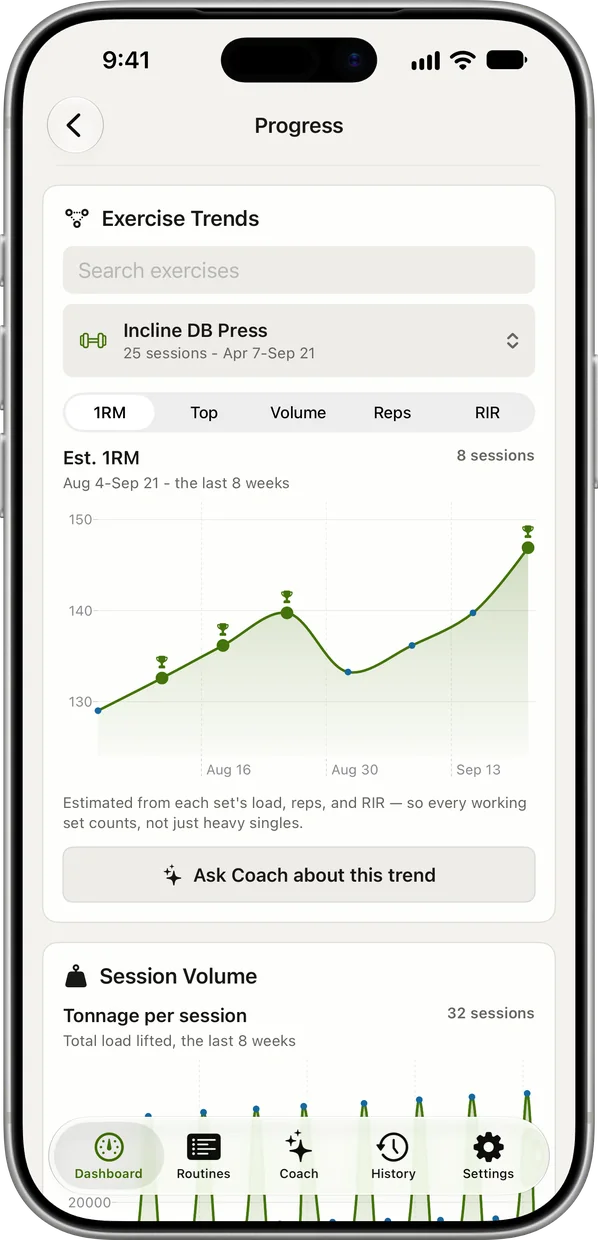
Each lift's estimated 1RM is charted over time, so you see the slope, not just the last session. Pro adds all-time analytics.
-
A block with a finish line
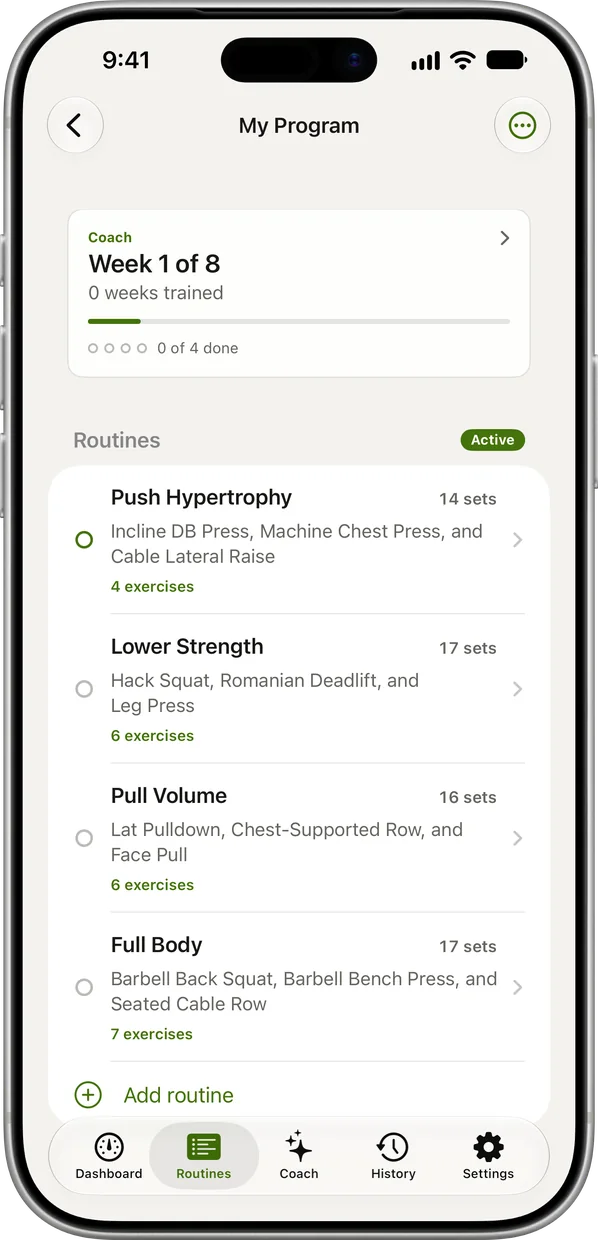
Give a program a length, like week 3 of 8, and Journey shows where your main lift is headed. Coach can build the block from your recent progress; it shows a preview and changes nothing until you tap Apply changes.
-
Your history comes with you
Import your log from Hevy, Strong or FitNotes. Coach reads it from day one, so your first session starts from your real numbers, marked From history.
What the weights do once progress gets hard
A bench press that's stopped moving
Leo has trained for three years and runs the 4-day plan for stalled lifters below. Upper Heavy: bench for 5–8 reps with 2 left, rows for 6–10.
| Exercise | You logged | Next session | Why |
|---|---|---|---|
| Barbell Bench Press | 235 lb, 7 / 6 / 6 / 6 reps, 2 left, third session in a row | Recap offers 210 lb × 5–8 | Three sessions without a new rep is a measured stall. 235 × 0.9 ≈ 212, rounded to 210 lb. Tap Deload and the target resets to 5; tap Not yet and nothing changes. |
| Barbell Row | 185 lb, 10 / 10 / 10 / 10 reps, 2 left | 190 lb × 6–10 | Rows didn't stall. Every set at the top of the range: one 5 lb step, target back to 6. |
One lift steps back, the others keep going. The deload is a response to your numbers, and the call is yours.
A squat day that went better than planned
Lower Heavy, then Lower Volume later in the week. Squat targets 5–8 reps with 2 left; hack squat 8–12 with 1 left.
| Exercise | You logged | Next session | Why |
|---|---|---|---|
| Barbell Back Squat | Set 1: 275 lb × 8, 4 left | Set 2: 290 lb | Two more left than planned: 275 × 41 ÷ 39 ≈ 289, rounded to 290 lb. |
| Romanian Deadlift | 225 lb, 10 / 10 / 9 reps, 2 left (target 9) | 225 lb × 10 | The weakest set hit the target but not the top. Same weight, one more rep. |
| Hack Squat | Lower Volume: 180 lb, 12 / 12 / 12 reps, 1 left | 185 lb × 8–12 | Every set at the top of 8–12 at the planned effort: one step up, reps back to 8. |
When a set says the weight is light, the next set fixes it. When a lift isn't ready, it holds. Neither needs a spreadsheet.
Six days of push/pull/legs
Maya is an advanced lifter on the 6-day split. Push day: lateral raises for 12–20 taken to failure, incline press for 8–12 with 1 left.
| Exercise | You logged | Next session | Why |
|---|---|---|---|
| Dumbbell Lateral Raise | 25 lb, 20 / 18 / 16 reps, nothing left (target 16) | 25 lb × 17 | The weakest set hit 16, so the next target is 17 at the same weight. |
| Incline Dumbbell Press | Set 1: 70 lb pair × 8, 3 left | Set 2: 75 lb pair | 70 × 40 ÷ 38 ≈ 74, rounded to the next dumbbell. |
| Cable Fly | 40 lb, 15 / 15 reps, 1 left | 45 lb × 12–15 | Both sets at the top of the range: one stack step up, reps back to 12. |
Every lift in a high-volume week gets its own decision. You train; the app keeps the books.
Plans for lifters past the first year
-
The best workout plan for muscle gain, for where you are now
Past a year of lifting, gains have stalled
Leo's plan: four days with heavy and volume days, built for lifters whose gains have slowed on a full-body routine.
4× a week · 76 sets a week · ~50 min
Add to RIRLiftSee the planAdd to RIRLift
Scan with your iPhone camera to add this plan.
-
The best workout routine for the days you can train
4 days a week: upper/lower
A plainer 4-day upper/lower split, for more sets per muscle than full body fits.
4× a week · 68 sets a week · ~40 min
Add to RIRLiftSee the planAdd to RIRLift
Scan with your iPhone camera to add this plan.
-
The best workout routine for the days you can train
6 days a week: push/pull/legs
Maya's plan: six days, the most weekly sets without any single session running long.
6× a week · 102 sets a week · ~45 min
Add to RIRLiftSee the planAdd to RIRLift
Scan with your iPhone camera to add this plan.
Make it fit you
-
Set the pace
Standard is plain double progression. Push takes bigger jumps and waits longer before suggesting a step back; Steady takes smaller, surer steps.
-
Review the weights before they're saved
Set Coach to Ask first and next session's weights appear on the recap for you to confirm. Override any set, any time; the engine carries on from what you logged.
-
Fine-tune the step sizes (Pro)
Set the biggest jump allowed within a session and between sessions, and how much a step back takes off.
-
Load your own plates and bar
With Pro, enter your plates and bar so every suggestion rounds to what you can actually load.
-
Connect Claude or ChatGPT (Pro)
Give your AI read access to your training and draft a program with it; you review and import it in the app. How to connect.
When a different app fits better
- You're peaking for a powerlifting meet. A percentage-based peaking program fits better.
- You train by bar speed. RIRLift measures effort from the RIR you log, not velocity. A velocity-based training app fits better.
Questions
What's the difference between an intermediate and an advanced lifter?
Roughly, how long progress takes. A beginner adds weight most sessions; an intermediate needs weeks; an advanced lifter may need a whole block for a small gain. Newbie gains covers when the first stage ends.
How do I break a plateau?
First check it's real: three sessions without a new rep at the same weight. Then take about 10% off and build back up, or change the rep range. How to break a lifting plateau goes deeper.
Can I import my workouts from another app?
Yes, from Hevy, Strong and FitNotes. Coach reads the imported history from day one, and your first weights are worked out from it.
Does it work for powerlifting?
For building strength and size on the big lifts, yes. For peaking to a meet, no: there's no taper toward a single heavy rep.
Do I need Pro?
No. Progression, stall suggestions, Ease back in and the Pace setting are free. Pro adds Fine-tune for step sizes, custom plates and bar, all-time analytics, unlimited routines and more Coach conversations.
Read next
-
The best workout plan for muscle gain, for where you are now
The full plan for lifters whose gains have stalled.
-
How RIRLift picks your next weight
Every rule behind the numbers in the examples above.
-
How to break a lifting plateau and start progressing again
What to change when a lift stops moving.
-
What is a mesocycle?
How to structure a training block with a finish line.
-
Upper/lower split
Why the upper day decides whether the split works.
More ways lifters use RIRLift
-
The progressive overload app that decides your next weight
Next weight and rep target set from your weakest set, corrected between sets, with stalls caught early.
-
The RPE and RIR app where effort sets the weight
Log reps in reserve on every set, and your effort decides the next set's weight and the next jump.
-
The hypertrophy app that sets your load from reps in reserve
RIR on every set, weekly sets per muscle, and deloads when a lift stalls instead of on a calendar.