
The progressive overload app that decides your next weight
Published October 27, 2026
A tracker shows what you lifted last time and leaves the decision to you. A progressive overload app makes it: the weight to use today, when to add a rep, when to add load and when to step back. RIRLift does that for every exercise from the reps you log and how many you had left, and explains each number.
Free on iPhone and Apple Watch · No account · Coming to Android: join the waitlist
What a progressive overload app has to get right
-
The next weight, before you lift
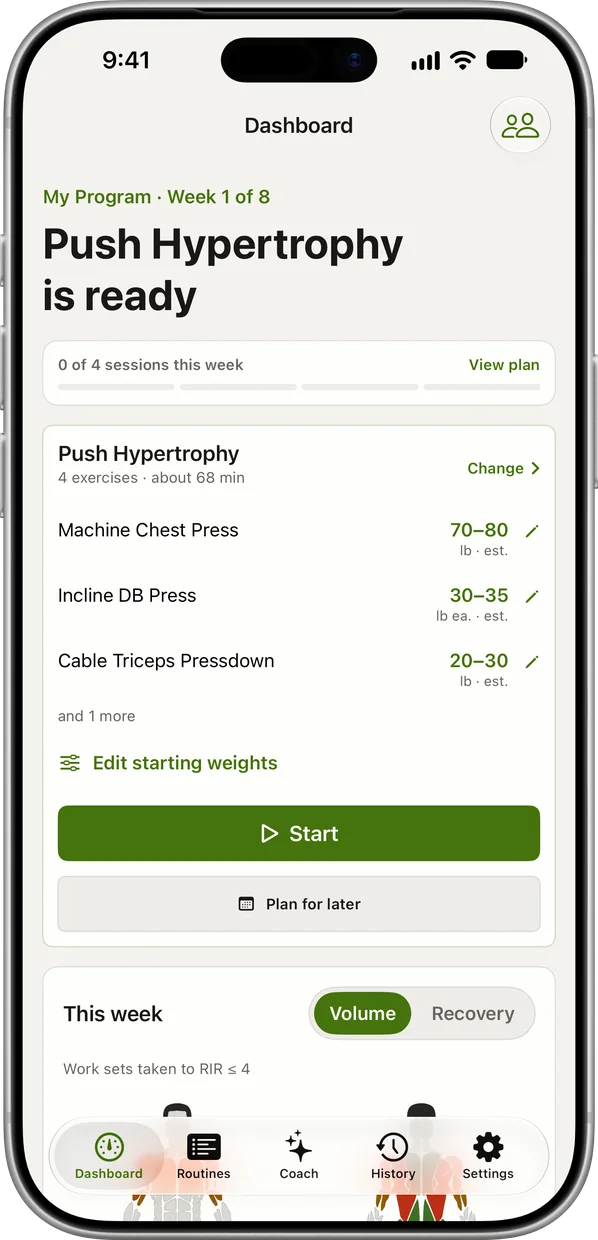
Every exercise opens with a weight and a rep target already set. The Dashboard shows the next session's loads, and Why this weight says what each one came from.
-
Reps first, then load, judged on your weakest set
When every working set reaches the top of the rep range, the weight goes up one step and reps reset to the bottom. Until then the weight holds, and the rep target climbs by one only when your weakest set hit it. Your target is never quietly overwritten by your best set. It's double progression, applied for you.
-
Corrections between sets, not just between sessions
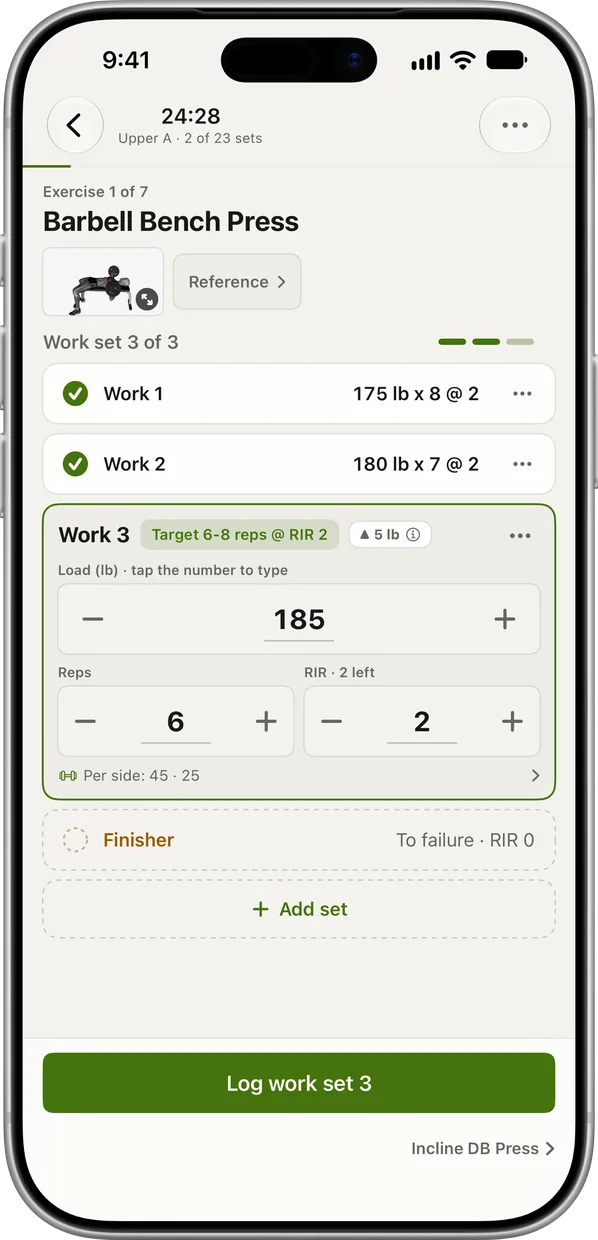
More left in the tank than planned? The next set goes up. Fell below the rep range? It comes down. Pushed closer to failure but got the reps? It holds, so a hard set never costs you weight.
-
Steps your equipment can actually make
Every weight rounds to your plates, your dumbbell jumps or your machine's stack. Save a gym's machines and each one remembers its own loads.
-
It notices when progress stops
Three sessions without a new rep and the recap suggests about 10% lighter. You choose Deload or Not yet. A missed session never counts as a stall. More on that in how to break a lifting plateau.
-
Proof it's working
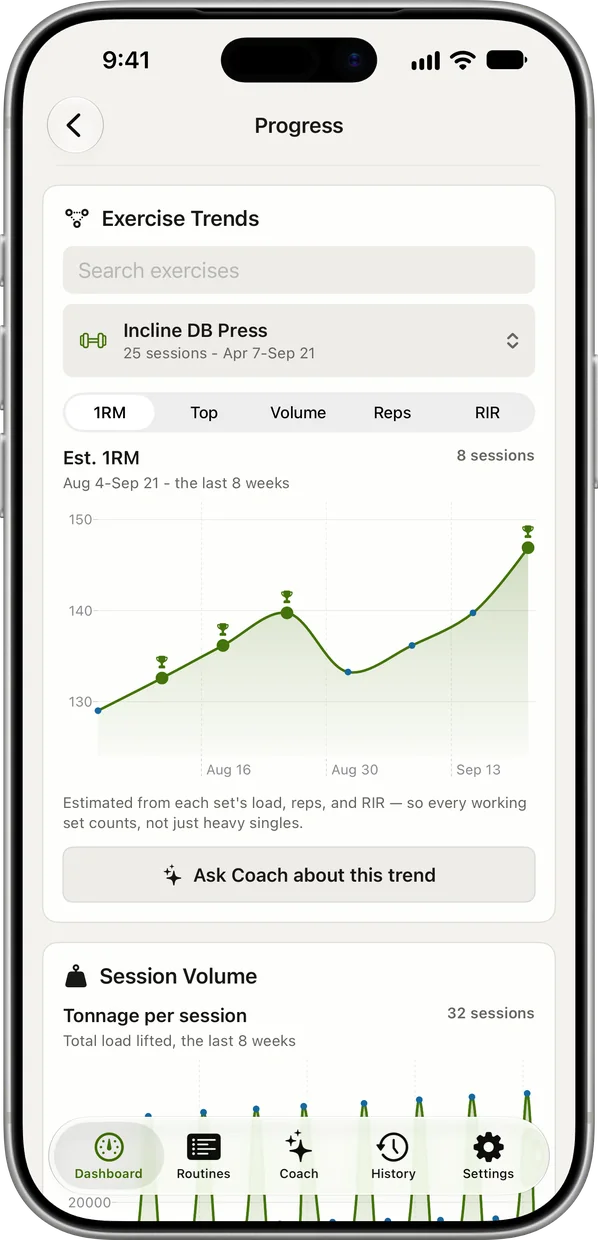
Progress shows each lift's estimated 1RM over time, so a held weight with more reps still reads as progress.
Progressive overload, set by set and week by week
Upper day: the first set was too easy
A year or two of lifting, running a 4-day upper/lower split. Bench is set at 185 lb for 6 reps with 2 left, in a 6–10 range.
| Exercise | You logged | Next session | Why |
|---|---|---|---|
| Barbell Bench Press | Set 1: 185 lb × 6, 3 left | Set 2: 190 lb × 6 | 9 reps to failure against a target of 8: 185 × 38 ÷ 37 ≈ 190 lb. |
| Barbell Bench Press | Set 2: 190 lb × 6, 2 left | Set 3: 190 lb × 6 | Exactly on plan, so it holds. |
| Barbell Bench Press | Set 3: 190 lb × 6, 1 left | Next session: 190 lb | Closer to failure than planned, but you got the reps. It holds rather than cutting you for pushing. |
The first set measured today's strength and the rest of the session followed it. The bump is marked as a correction, not the plan.
Next upper day: three lifts, three different answers
Same split, a week later. Each exercise is judged on its own weakest working set.
| Exercise | You logged | Next session | Why |
|---|---|---|---|
| Chest-Supported Row | 100 lb, 12 / 12 / 12 reps, 1 left | 105 lb × 8 | Every set at the top of 8–12: one step up, reps back to the bottom. |
| Lat Pulldown | 130 lb, 12 / 11 / 10 reps, 1 left | 130 lb × 11 | The weakest set hit this session's target of 10. Same weight, one more rep. |
| Dumbbell Shoulder Press | 45 lb, 9 / 8 / 8 reps, 1 left | 45 lb × 9 | The weakest set missed its target of 9, so weight and target both stay. |
Your best set doesn't set the bar. The weakest one does, so a lift only moves when every set has caught up.
Week 9: bench stops moving
Bench has sat at 205 lb for three sessions without a new rep on the weakest set.
| Exercise | You logged | Next session | Why |
|---|---|---|---|
| Barbell Bench Press | 205 lb × 7 / 6 / 6, three sessions running | 185 lb × 6–10, if you tap Deload | About 10% lighter, rounded to your plates. Reps restart at the bottom and you build back up. Not yet keeps 205 lb. |
| Lat Pulldown | 140 lb, 10 / 10 / 9 reps, 1 left | 140 lb × 10 | Still gaining a rep every week or two, so nothing is flagged. |
The step back is a response to a measured stall, offered to you, not a deload scheduled because it's week 4.
Plans built for steady progressive overload
-
The best workout routine for the days you can train
4 days a week: upper/lower
The split the examples use: bench, rows, pulldowns and presses twice a week.
4× a week · 68 sets a week · ~40 min
Add to RIRLiftSee the planAdd to RIRLift
Scan with your iPhone camera to add this plan.
-
The best workout plan for muscle gain, for where you are now
Past a year of lifting, gains have stalled
Progress slowed after a year? More weekly sets, heavy and volume days, a planned deload.
4× a week · 76 sets a week · ~50 min
Add to RIRLiftSee the planAdd to RIRLift
Scan with your iPhone camera to add this plan.
-
The best workout for full body, for your week
Full gym, 3 days: heavy, moderate, light
Three days with a heavy, moderate and light zone, each progressing on its own.
3× a week · 50 sets a week · ~45 min
Add to RIRLiftSee the planAdd to RIRLift
Scan with your iPhone camera to add this plan.
Make it fit you
-
Pick a pace
Steady takes smaller, surer steps. Standard is double progression. Push takes bigger jumps and waits longer before suggesting a step back.
-
Confirm before it saves
Set Coach to Ask first and next session's weights appear on the recap for you to accept or edit.
-
Set your real increments
Choose your equipment so every jump is one you can load. With Pro, add custom plates and bar, and use Fine-tune to set the biggest step within and between sessions.
-
Log RIR the same way every time
Consistency matters more than precision, because your answer is compared with targets you judge the same way. The RIR guide shows what 0 to 4 feel like.
When a different app fits better
- You run a percentage-based peaking program for a meet. A powerlifting-specific app fits that block better.
Questions
What is the best app for progressive overload?
One that decides, not just records: it sets the next weight, adds reps before load, holds when you haven't earned it and catches stalls. RIRLift does all four for free on iPhone and Apple Watch.
Does it add weight every session?
No. Weight goes up only when every working set reaches the top of the rep range. Until then you add reps at the same weight.
What happens if I have a bad day?
Log what happened. Falling below your rep range brings the next set down within the session, and one weak session holds the weight rather than resetting it.
Do I need to know my one-rep max?
No. Each new lift starts from a light Estimate and one max-reps set. After that, everything comes from your logged sets.
Is progressive overload only about adding weight?
No. More reps at the same weight is progress too, which is why the app moves reps first. Progressive overload: a practical guide covers the other levers.
Read next
-
Progressive overload: a practical guide
Every way to progress, and when to use each.
-
How RIRLift picks your next weight
The full rules behind the examples on this page.
-
When to increase weight
The signals, how much, and how often.
-
Deload week
The signs you need one and how to run it.
-
Bench press progression calculator
Project a lift's progress before you start.
More ways lifters use RIRLift
-
The workout app for intermediate lifters whose gains have slowed
Progression past the beginner stage: jumps sized by RIR, stalls caught early, and years of history imported.
-
The hypertrophy app that sets your load from reps in reserve
RIR on every set, weekly sets per muscle, and deloads when a lift stalls instead of on a calendar.
-
The RPE and RIR app where effort sets the weight
Log reps in reserve on every set, and your effort decides the next set's weight and the next jump.