
The dumbbell workout app that knows when to grab the next pair
Published October 27, 2026
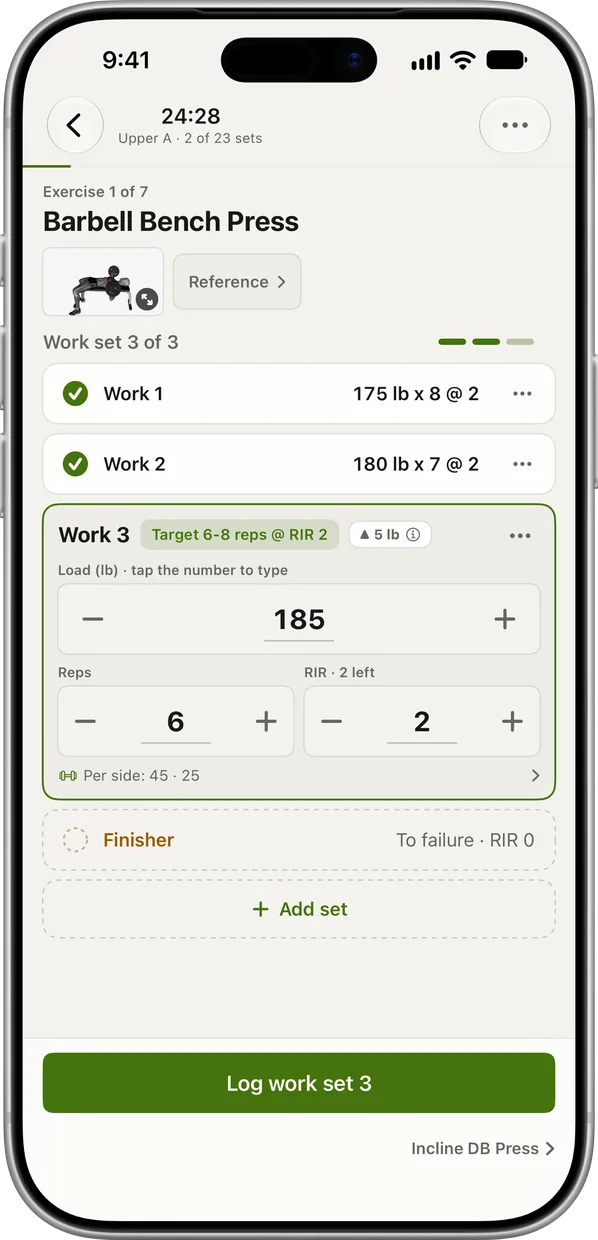
A dumbbell workout app should fit the dumbbells you own, give you a plan with or without a bench, and tell you when it's time for the next pair. RIRLift does that free on iPhone and Apple Watch. Log weight, reps and how many reps you had left, and it sets the next weight in the jumps your dumbbells actually make.
Free on iPhone and Apple Watch · No account · Coming to Android: join the waitlist
What matters in a dumbbell workout app
-
Jumps that match your dumbbells
Dumbbells move in fixed steps, and on a light lift one step is a big change: 15 to 20 lb is a third more weight. RIRLift rounds every suggestion to a dumbbell you can pick up and only raises the next set when the next dumbbell is close enough to what your last set earned.
-
A plan for what's on your rack
One light pair and no bench, adjustable dumbbells and a bench, or 30 minutes and a flat bench: each has its own plan. Tell the app what you own and swaps stay inside it, so a missing bench turns a press into a floor press.
-
A clear sign to go up
When every set reaches the top of the rep range, the weight goes up one step and the rep target resets to the bottom. Otherwise it holds and you chase one more rep. That's double progression, and it's the rule behind every example below.
-
Every move shown, offline
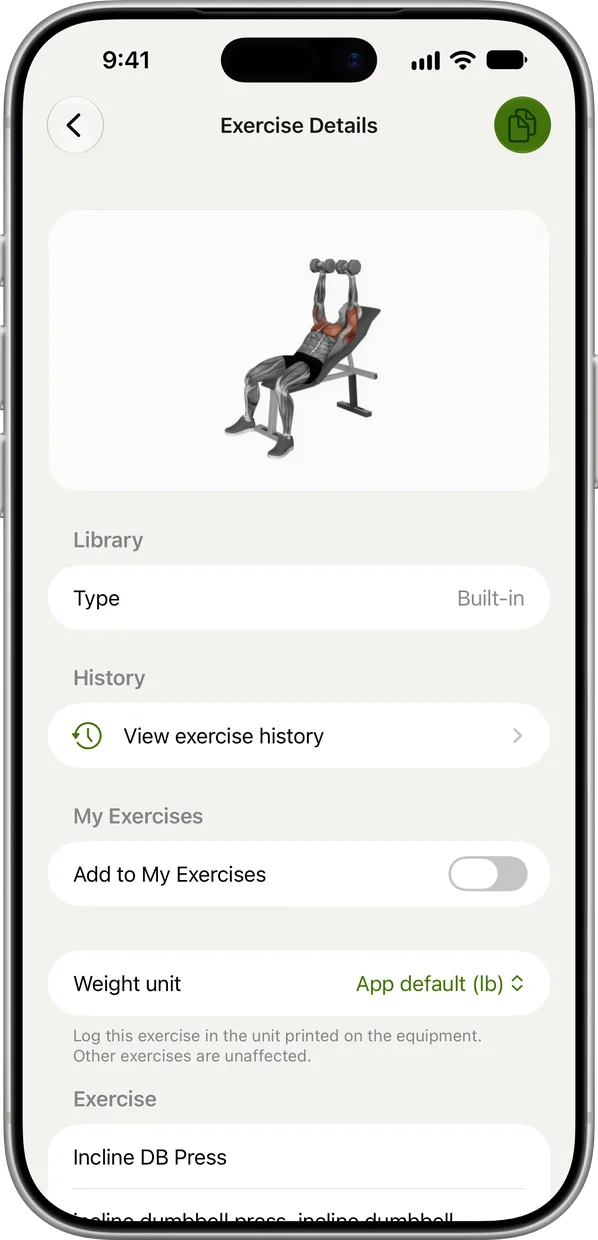
Each exercise opens to an illustration, the muscles it trains and your history on it. The dumbbell exercise library has the full list by muscle.
-
Short sessions that still count
Supersets are built in, the rest timer fills the screen and shows on the Lock Screen, and Apple Watch can run the whole session from your wrist.
Dumbbell sessions, set by set
Adjustable dumbbells, 5 to 50 lb in 5 lb jumps
Upper 1 of the 4-day adjustable dumbbell plan below, in a spare room with an adjustable bench.
| Exercise | You logged | Next session | Why |
|---|---|---|---|
| Flat Dumbbell Press | Set 1: 50 lb × 10, 4 left (target 8 with 2 left) | Set 2: 55 lb | 10 reps with 4 left converts to about 55 lb for 8 with 2 left: 50 × 43 ÷ 39. Your dumbbells make 55, so the next set goes up. |
| Dumbbell Lateral Raise | 15 lb, 20 / 20 / 20 reps, 0 left | 20 lb × 12 | Top of 12–20 on every set: one step up. The rep target drops to 12 so the bigger jump is something you can handle. |
| Incline Dumbbell Row | 40 lb, 12 / 11 / 11 / 11 reps, 1 left | 40 lb × 12 | Your weakest sets hit today's target of 11. Same weight, aim for 12, the top of the range. |
One lift went up mid-session, one goes up next week, one holds. Each followed its own sets.
Mid-session, when the next dumbbell is too far
Same plan, arms at the end of the session. The answer you need here is "stay", not "go up".
| Exercise | You logged | Next session | Why |
|---|---|---|---|
| Seated Dumbbell Overhead Triceps Extension | Set 1: 25 lb × 15, 2 left (target 12 with 1 left) | Set 2: 25 lb | That converts to about 27 lb, and your dumbbells go from 25 to 30. The weight holds and you bank the extra reps. |
| Hammer Curl | 30 lb, 12 / 12 / 12 reps, 1 left | 35 lb × 8 | Every set reached 12, the top of 8–12. Next session: one step up, reps reset to 8. |
| Dumbbell Shoulder Press | 40 lb, 9 / 8 / 8 reps, 1 left | 40 lb × 9 | Today's target was 9 and two sets got 8, so the target stays at 9. |
A jump your dumbbells can't make never shows up. When the next step is earned, it's waiting next session.
One fixed pair of 20s, no bench
Running the one-pair plan below in an apartment. The dumbbells will never get heavier unless you buy more, so reps do the work.
| Exercise | You logged | Next session | Why |
|---|---|---|---|
| Bulgarian Split Squat | 20 lb, 16 / 15 / 14 reps per leg, 1 left | 20 lb × 15 | Your weakest set hit today's target of 14, so the next target is 15 on every set. |
| Dumbbell Floor Press | 20 lb, 25 / 25 / 25 reps, 1 left | 25 lb × 10 | Top of 10–25 on every set, so the app calls for the next step. No 25s? Follow the plan's rule: slow the lowering to 3 seconds or add a pause, and work back up the range. |
When a fixed pair runs out, the app says so plainly. That's the day to buy the next pair or switch to a harder move.
Dumbbell plans that open in RIRLift
-
The best workout with dumbbells, for the dumbbells you actually have
Adjustable dumbbells and a bench, 4 days
The plan the first two examples use: adjustable dumbbells, a bench, four days.
4× a week · 71 sets a week · ~45 min
Add to RIRLiftSee the planAdd to RIRLift
Scan with your iPhone camera to add this plan.
-
The best workout with dumbbells, for the dumbbells you actually have
30 minutes, 3 days, supersets
Dumbbells and a flat bench, three 30-minute sessions built from supersets.
3× a week · 48 sets a week · ~25 min
Add to RIRLiftSee the planAdd to RIRLift
Scan with your iPhone camera to add this plan.
-
The best workout with dumbbells, for the dumbbells you actually have
One light pair at home, no bench
The third example's plan: one fixed pair, a chair, no bench.
3× a week · 45 sets a week · ~35 min
Add to RIRLiftSee the planAdd to RIRLift
Scan with your iPhone camera to add this plan.
Make it fit you
-
Tell it whether you have a bench
Select dumbbells and, if you own one, a flat or adjustable bench. Plans and swaps use only what's on the list.
-
Log the weight per dumbbell
Enter what one dumbbell weighs, the number on the handle. Units are per exercise, so a kg set at the gym and an lb set at home can live side by side.
-
Pick the pace
Settings has three progression paces. Steady takes smaller, surer steps, which suits light lifts where one dumbbell jump is a lot. Push is for lifts you're recovering fast on.
-
Let the next weight wait for you
Set Coach to Ask first and the recap shows next session's weights for you to confirm, handy before you rearrange an adjustable set.
-
Starting a new lift
No history? The app picks a light starting weight marked Estimate and asks for one set of as many good reps as you can. The dumbbell weight calculator gives you a number before you start.
Questions
Can you build muscle with only dumbbells?
Yes. Dumbbells train every major muscle, and growth comes from hard sets that get harder over time. Once a pair tops out, the next pair or a harder variation keeps it going.
Should I buy fixed or adjustable dumbbells?
Adjustable if you want to keep progressing at home, because the jumps are small and the range is wide. One fixed pair works for a while; the one-pair plan gets the most out of it with reps and harder versions.
How heavy should my first dumbbells be?
You don't need to know. On a new lift the app starts light and uses one set of max reps to find your number. What weight dumbbells should I use? gives a starting point by exercise.
How many days a week should I do dumbbell workouts?
Three or four. The plans run three full-body superset sessions or four upper and lower days, so each muscle gets worked twice a week.
Is RIRLift free?
Yes. Unlimited workouts, suggested weights, progression and up to 4 active routines are free with no account and no ads. Pro is $9.99/month or $79.99/year in the US.
Read next
-
The best workout with dumbbells, for the dumbbells you actually have
All three dumbbell plans, with every exercise shown.
-
Dumbbell exercises for every muscle, and how to put them together
The full list of dumbbell moves by muscle.
-
What weight dumbbells should I use?
A starting weight for each dumbbell exercise.
-
Double progression: how to run it and where it breaks
The rule that decides when you grab the next pair.
-
What is a superset? Types, benefits, and how to log one
How the 30-minute plan fits a full session into half the time.
More ways lifters use RIRLift
-
The workout app for home that plans around what you own
Bare floor, a pull-up bar, bands or one kettlebell: a plan for your gear that gets harder as you do.
-
The home gym app that loads your own plates
A rack, a bar and your own plates: weights rounded to what you can load, and a plan that skips the machines.
-
The kettlebell app that tells you when to buy the next bell
One bell or a few: reps that climb every week and a clear signal when it's time for the next size.