
The hypertrophy app that sets your load from reps in reserve
Published October 27, 2026
Hypertrophy training comes down to hard sets, enough of them per muscle, and load that rises as you get stronger. RIRLift logs how many reps you had left on every set, counts this week's sets for each muscle, and sets the next load from those numbers, during the session and between sessions. When a lift stops moving, it suggests a lighter week. It's free on iPhone and Apple Watch.
Free on iPhone and Apple Watch · No account · Coming to Android: join the waitlist
What hypertrophy training needs from an app
-
Proximity to failure, logged on every set
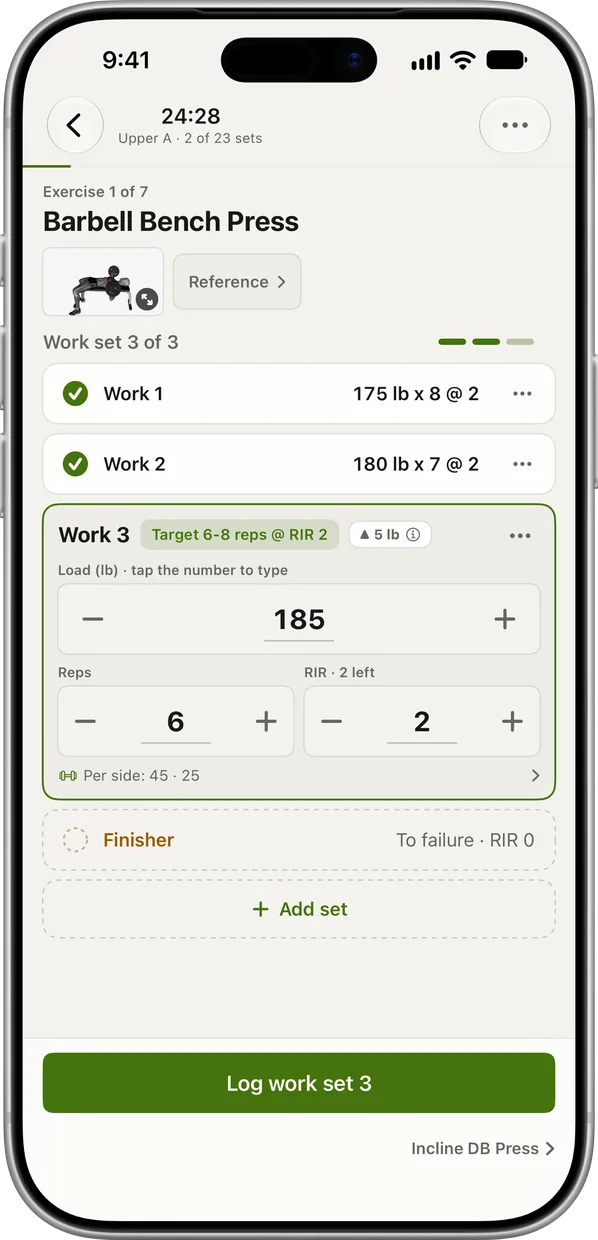
Each set records weight, reps and reps in reserve, from 0 to 4+. The app adds reps and RIR into one number, the reps you could have done, and compares it with the set it asked for. That's how a set of 10 with 4 left is read differently from 10 with none left. More in the RIR guide.
-
Weekly sets per muscle
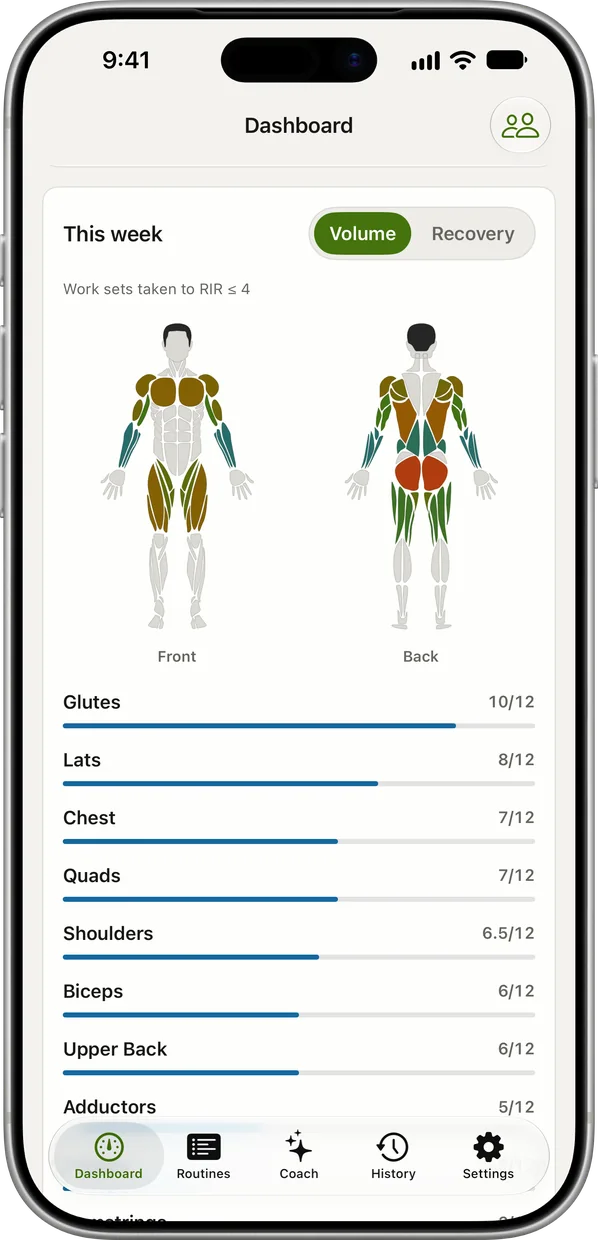
The weekly muscle map shades a front and back body by this week's sets and lists the count per muscle. You can see which muscles are short on work before the week ends, and recovery per muscle group sits next to it.
-
A block with a finish line
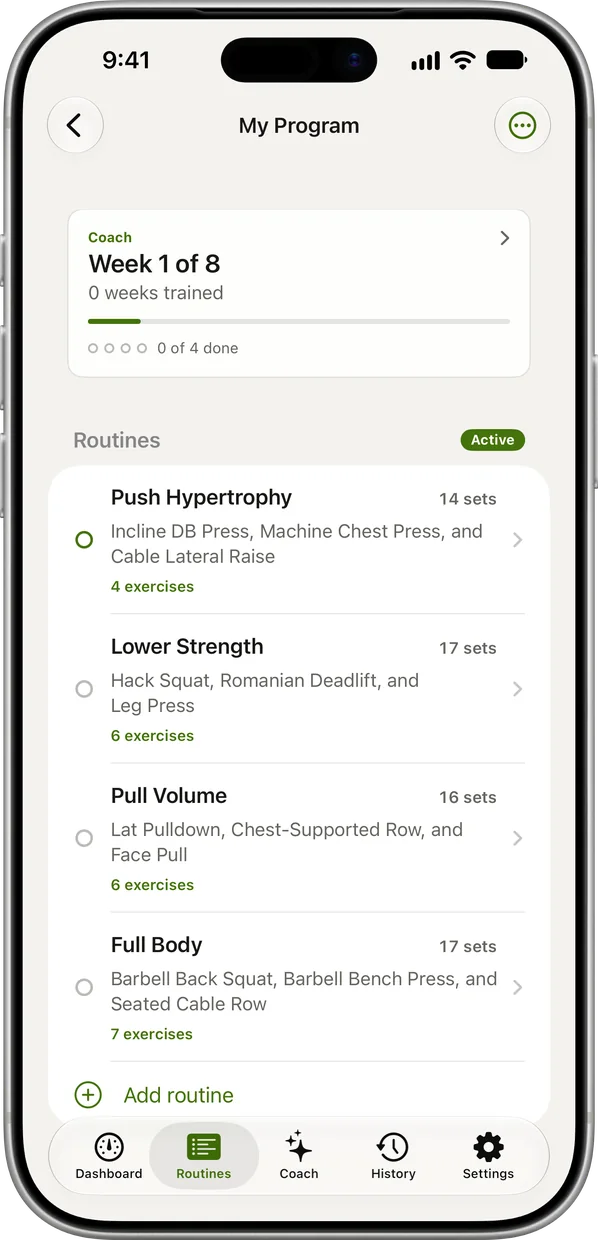
Give a program a length, say 8 weeks, and Journey shows the week you're in and where your main lift is headed by the end. The weights themselves always come from what you logged, never from a week number. See mesocycles for how a block is built.
-
Deloads when you stall, not when the calendar says
If a lift goes three sessions without a new rep, the recap offers about 10% lighter. You choose Deload or Not yet. A lift that's still climbing is left alone.
-
Progress you can read per lift
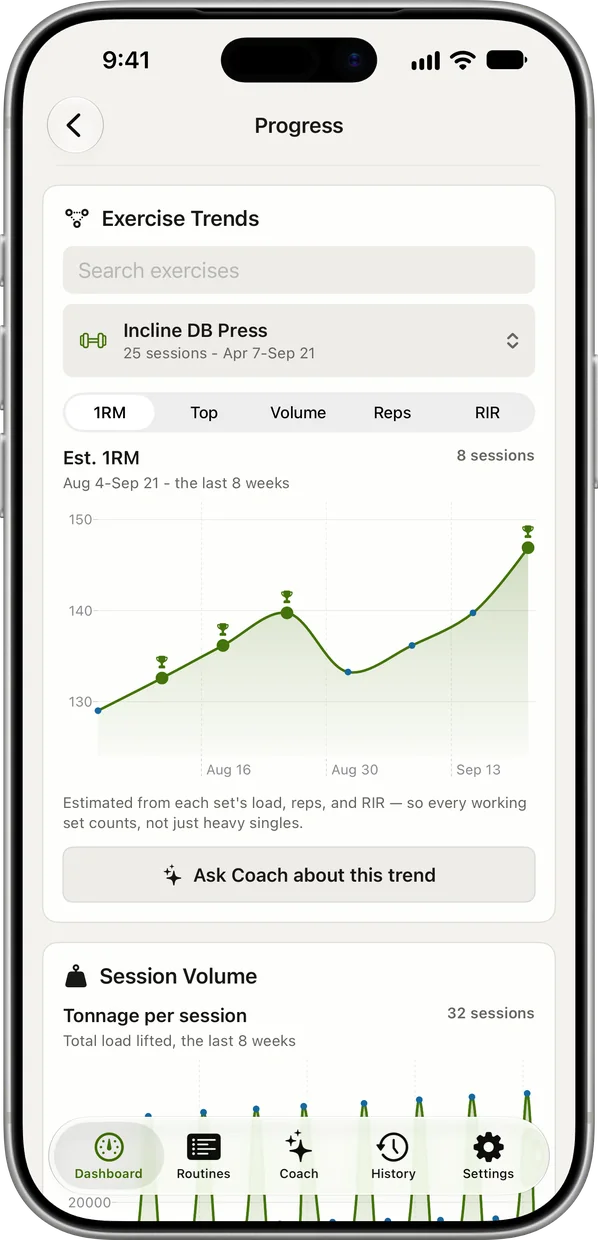
Each exercise charts its estimated 1RM over time, built from your working sets. A flat line on one lift and a rising line on another tells you where the next block should go.
A hypertrophy block, set by set
Upper volume day, week 2 of an 8-week block
Past a year of lifting, running a four-day upper/lower plan with most sets 1 rep short of failure and the last isolation work taken to failure.
| Exercise | You logged | Next session | Why |
|---|---|---|---|
| Incline Dumbbell Press | 65 lb pair, 12 / 12 / 12 / 11 reps, 1 left | 65 lb × 12 | The weakest set decides. It hit today's target of 11, so the weight holds and the target moves to 12. |
| Chest-Supported Row | Set 1: 100 lb, 10 reps, 4 left (target 10, 1 left) | Set 2: 110 lb | Three more left than planned. 100 × 43 ÷ 40 is about 108 lb, rounded to the 110 your plates can make. |
| Cable Fly | 40 lb, 15 / 15 / 15 reps, 1 left | 45 lb × 12 | Every set at the top of 12–15. One step up the stack, reps back to 12. |
| Cable Triceps Pressdown | 70 lb, 14 / 13 / 12 reps, 0 left (target 13) | 70 lb × 13 | The last set missed 13. Same weight, same target. A tired third set doesn't cost you weight. |
Four exercises, four different outcomes, each from your own sets.
Lower heavy day: the first squat set flies up
Same block. The squat is set at 245 lb for 8 reps with 2 in reserve, in a 5–8 range.
| Exercise | You logged | Next session | Why |
|---|---|---|---|
| Barbell Back Squat | Set 1: 245 lb × 8, 4 left (target 2) | Set 2: 260 lb | Two more reps left than planned: 245 × 41 ÷ 39 ≈ 258, rounded to 260 on the bar. |
| Barbell Back Squat | Sets 2–4: 260 lb × 8 / 8 / 8, 2 left | 265 lb × 5–8 | Every set at 260 reached 8, the top of 5–8, at the planned effort. One 5 lb step, reps back to 5. |
| Romanian Deadlift | 205 lb, 10 / 10 / 10 reps, 2 left | 210 lb × 6–10 | Top of 6–10 at exactly the planned effort. One step, and the reps start again at 6. |
| Leg Extension | 130 lb, 15 / 14 / 13 reps, 1 left (target 13) | 130 lb × 14 | The weakest set hit 13. Hold the weight, aim for one more rep. |
An easy first set moved the squat up the same day. The reps at the new weight decided next week.
Week 6: one lift stops moving
Fatigue builds late in a block. The recap flags the lift that hasn't gained a rep in three sessions.
| Exercise | You logged | Next session | Why |
|---|---|---|---|
| Lat Pulldown | 150 lb × 11 / 10 / 10, third session with no new rep | 135 lb × 10, if you choose Deload | About 10% lighter, and the target goes back to the bottom of 10–15. You build up again from there. |
| Incline Dumbbell Curl | 30 lb, 12 / 12 / 12 reps, 1 left | 35 lb × 8–12 | Every set at the top of 8–12. A stall on one lift doesn't hold back the others. |
The deload is a response to a measured stall, one lift at a time. Choose Not yet and nothing changes.
Hypertrophy plans that open in RIRLift
-
The best workout plan for muscle gain, for where you are now
Past a year of lifting, gains have stalled
The four-day upper/lower in the examples: heavy and volume days, with isolation work taken to failure.
4× a week · 76 sets a week · ~50 min
Add to RIRLiftSee the planAdd to RIRLift
Scan with your iPhone camera to add this plan.
-
The best workout for full body, for your week
Full gym, 3 days: heavy, moderate, light
Three full-body days, from 5–8 reps to 15–20, each muscle trained three times a week.
3× a week · 50 sets a week · ~45 min
Add to RIRLiftSee the planAdd to RIRLift
Scan with your iPhone camera to add this plan.
Make it fit you
-
Set an RIR target per exercise
Each exercise in a routine has its own rep range and RIR target. Leave the big lifts at 2 and take the last isolation sets to 0.
-
Pick a pace for the block
Standard is plain double progression. Steady takes smaller steps; Push takes bigger ones and waits longer before suggesting a deload.
-
Decide who calls deloads and weights
Run your own deload week? Turn Step back when stuck off. Set Coach to Ask first to approve next session's weights on the recap.
-
Ask Coach to review the block
Ask which muscles are behind, or to shorten today's session. Coach answers from your log and nothing changes until you tap Apply changes.
-
Fine-tune the step sizes
With Pro, set the biggest step allowed within a session and between sessions, and how much a deload takes off.
When a different app fits better
- You want weekly set counts adjusted from soreness and pump ratings. RIRLift changes the load from your reps and RIR. Set counts change when you or Coach edit the program.
Questions
What is a hypertrophy app?
A workout app built around muscle growth: it plans sets per muscle, tracks how close each set is to failure, and adds load as you get stronger. RIRLift does that from the reps in reserve you log.
Is there a free hypertrophy app?
RIRLift is free with no account: unlimited workouts, load suggestions, deload suggestions, the weekly muscle map and up to 4 active routines. Pro adds unlimited routines, all-time analytics and Fine-tune.
How many sets per muscle per week for hypertrophy?
Most lifters grow on roughly 10 to 20 hard sets per muscle per week, starting lower and adding sets when progress slows. The training volume guide goes through it.
How close to failure should hypertrophy sets be?
Usually 0 to 3 reps in reserve. Compound lifts tend to sit at 1 to 3, isolation work can go to 0. RIR vs going to failure covers the trade-off.
Does it plan deload weeks?
It suggests a deload when a lift stalls for three sessions, about 10% lighter, and you decide. You can also turn suggestions off and run your own deload week.
Read next
-
How many sets per week for muscle growth?
How many sets per muscle per week, and how to add them.
-
What is a mesocycle?
How a block is built, from the first week to the deload.
-
How many sets per muscle group per week?
A weekly set target for each muscle, from your experience.
-
The hypertrophy rep range is wider than 8 to 12
Why the plans above use 5–8 on some lifts and 15–20 on others.
-
The best workout plan for muscle gain, for where you are now
The four-day plan from the examples, with every exercise demonstrated.
More ways lifters use RIRLift
-
The bodybuilding app that counts every set and sets the next weight
Run a size split, see weekly sets per muscle, and let each set's reps in reserve decide the next weight.
-
The RPE and RIR app where effort sets the weight
Log reps in reserve on every set, and your effort decides the next set's weight and the next jump.
-
The periodization app that runs your block from what you lift
Training blocks with a finish line, weights set from your sets, and deloads offered when a lift stalls.