
The periodization app that runs your block from what you lift
Published October 27, 2026
A periodization app should give a training block a start and an end, set each session's weights, and know when you need a lighter week. RIRLift does that on iPhone and Apple Watch. A block runs as a journey, such as week 3 of 8, but every weight comes from your logged sets, and a deload is offered only when a lift has actually stopped moving.
Free on iPhone and Apple Watch · No account · Coming to Android: join the waitlist
What a lifter running blocks needs from an app
-
A block with a finish line
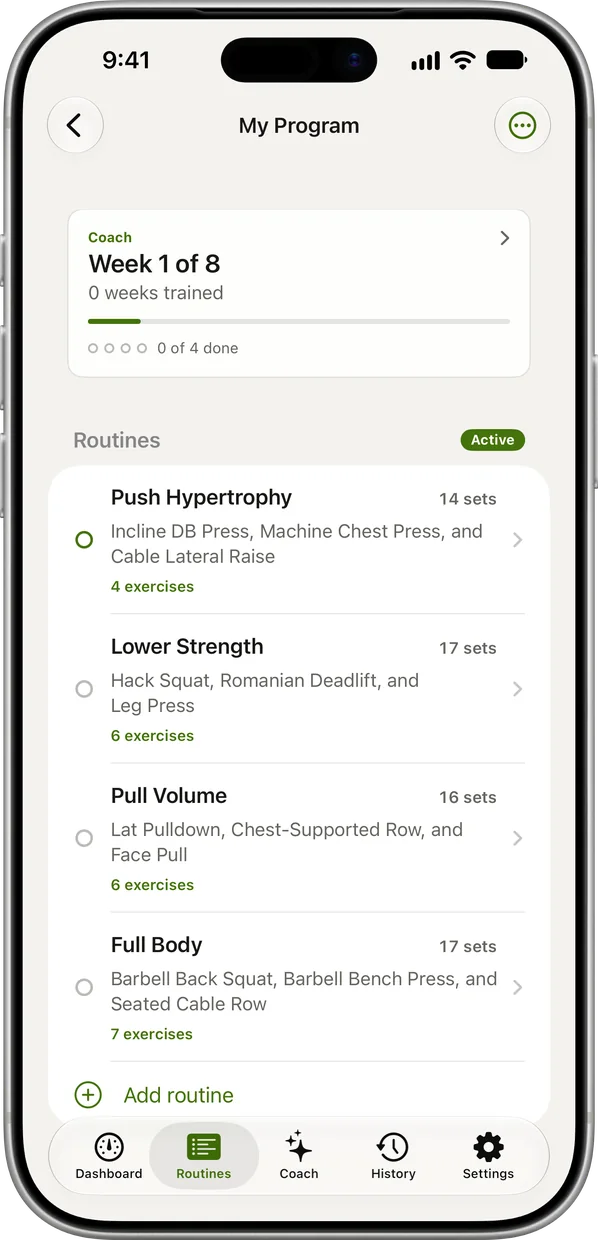
Give a program an end, say week 8, and the Journey shows where you are and where your main lift is headed. Group routines into programs and switch the active one when a block ends.
-
Weights from your sets, not the calendar
No load table is planned for week 5 in advance. Each weight is worked out from the reps and reps-left you logged, so a good week moves you on and a bad week doesn't bury you. How RIRLift picks your next weight has the full rules.
-
Deloads when a lift stalls, per lift
A few sessions without a new rep and the recap suggests about 10% lighter for that lift. You tap Deload or Not yet. Lifts still moving keep moving. With Pro, Fine-tune sets how much a step back takes off.
-
A new block drafted from your history
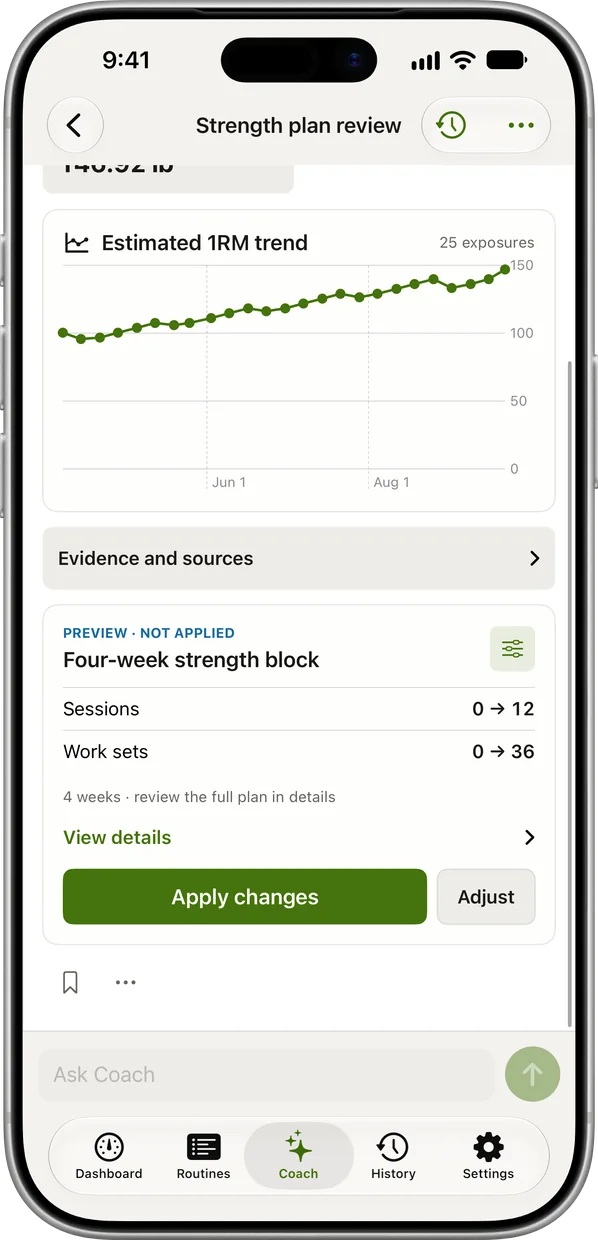
Ask Coach to build the next block from your recent progress. It shows the plan as a preview, and nothing changes until you tap Apply changes or Adjust.
-
Weekly volume you can see
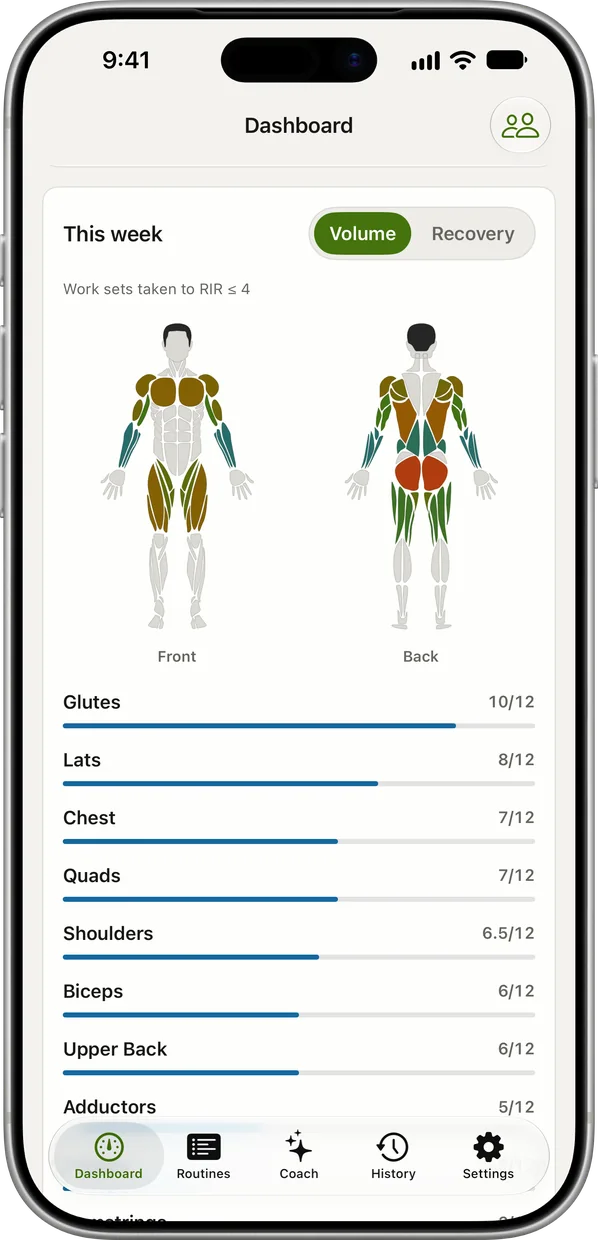
The weekly muscle map counts hard sets per muscle, so you can check a volume block is actually delivering more sets than the last one.
Inside a block, session by session
Week 3 of 8: an upper/lower hypertrophy block
Four years of lifting, four days a week, heavy and volume days. The Journey says week 3; the weights come from last week's sets.
| Exercise | You logged | Next session | Why |
|---|---|---|---|
| Barbell Bench Press | Upper Heavy: 185 lb, 8 / 8 / 8 / 8, 2 left | 190 lb × 5–8 | Top of 5–8 on every set. One step up, target back to 5. |
| Barbell Row | Upper Heavy: 155 lb, 10 / 9 / 9 / 9, 2 left | 155 lb × 10 | The weakest set hit today's target of 9. Same weight, aim for the top of 6–10. |
| Hack Squat | Lower Volume, set 1: 180 lb × 12, 3 left (planned 1) · sets 2–4: 190 lb × 12 / 12 / 12, 1 left | 200 lb × 8–12 | Set 1 was easier than planned, so set 2 went up: 180 × 44 ÷ 42 ≈ 189, loaded as 190. Every set at 190 reached 12: one step up. |
Week 3 is a label on the block, not a percentage. Each lift is where its sets put it.
Week 6: the squat stops moving
Same block. Squat has logged 6 / 6 / 5 / 5 at 265 lb for three sessions. Romanian deadlifts are still climbing.
| Exercise | You logged | Next session | Why |
|---|---|---|---|
| Barbell Back Squat | 265 lb, 6 / 6 / 5 / 5, third session in a row | 240 lb × 5–8 if you tap Deload | No new rep in three sessions. About 10% lighter: 265 × 0.9 ≈ 239, rounded to 240 lb. |
| Romanian Deadlift | 205 lb, 10 / 10 / 10, 2 left | 210 lb × 6–10 | Not stalled, so no deload. Top of 6–10, one step up. |
The deload lands on the lift that needs it, in the week it needs it. Tap Not yet to push one more session.
Starting a new block after four weeks off
A month away between blocks. The first session back shows an Ease back in offer.
| Exercise | You logged | Next session | Why |
|---|---|---|---|
| Barbell Bench Press | Last session: 190 lb × 6, 2 left | 170 lb × 5–8 | Three weeks or more off: one week about 10% lighter. 190 × 0.9 = 171, rounded to 170 lb. |
| Barbell Back Squat | Last session: 240 lb × 8, 2 left | 215 lb × 5–8 | Same easier week: 240 × 0.9 = 216, rounded to 215 lb. Normal progression from the week after. |
Choose Pick up where I left off instead if you kept training somewhere else.
Block-friendly plans that open in RIRLift
-
The best workout plan for muscle gain, for where you are now
Past a year of lifting, gains have stalled
Heavy and volume upper/lower days for lifters past their first year. The block in the examples above runs this plan.
4× a week · 76 sets a week · ~50 min
Add to RIRLiftSee the planAdd to RIRLift
Scan with your iPhone camera to add this plan.
-
The best workout for full body, for your week
Full gym, 3 days: heavy, moderate, light
Heavy, moderate and light days in one week: undulating periodization on three days.
3× a week · 50 sets a week · ~45 min
Add to RIRLiftSee the planAdd to RIRLift
Scan with your iPhone camera to add this plan.
Make it fit you
-
Give the program a finish line
Set how many weeks the block runs. The Journey tracks the week and projects your main lift to the end, so you can judge the block before it's over.
-
Set how hard it pushes
Steady takes smaller steps, Standard is double progression, Push takes bigger jumps and waits longer before suggesting a step back. Change it any time.
-
Decide how deloads work
Keep Step back when stuck on and the recap offers a lighter week when a lift stalls, or turn it off and deload on your own schedule. Set Coach to Ask first and next session's weights are saved only when you confirm them on the recap.
-
Draft the block on a computer
Build the program on any computer in the web planner, then import it. With Pro you can also draft programs with Claude or ChatGPT and review them in the app.
When a different app fits better
- You want volume that ramps on a set schedule, with a deload fixed to the last week of every block. RIRLift sets load and deloads from your logged sets, not from the week number. An app built around planned mesocycle ramps fits better.
- You're peaking for a powerlifting meet. A meet-prep program fits better.
Questions
Is there a free periodization app?
Yes. RIRLift's free tier includes the Journey, weight suggestions, progression and deload offers, with up to 4 active routines. Pro adds unlimited routines and cycles and Fine-tune for step sizes.
What is a mesocycle?
A training block of a few weeks, usually 4 to 8, with one goal, often ending in a lighter week. Mesocycle explains how to set one up.
Is there a deload app?
RIRLift handles deloads for you: when a lift goes a few sessions without a new rep, the recap offers to drop it about 10%. After three weeks off it offers Ease back in.
Should deloads be scheduled or based on fatigue?
Both work. A deload triggered by a real stall spends fewer weeks light. Deload week covers the signs that you need one.
Does RIRLift do undulating periodization?
Yes, in the sense of different rep ranges on different days. Each exercise on each day progresses on its own. Undulating periodization covers whether it builds more muscle.
Read next
-
What is a mesocycle?
How to plan a training block from start to deload.
-
Macrocycle, mesocycle, microcycle: the three training cycles
How the three layers of periodization fit together.
-
Deload week: the signs you need one and how to run it
When a lighter week helps, and how light to go.
-
Undulating periodization: does changing reps daily (DUP) build more muscle?
The evidence behind heavy, moderate and light days.
-
How to break a lifting plateau and start progressing again
What to change when a lift stalls mid-block.
More ways lifters use RIRLift
-
The hypertrophy app that sets your load from reps in reserve
RIR on every set, weekly sets per muscle, and deloads when a lift stalls instead of on a calendar.
-
The progressive overload app that decides your next weight
Next weight and rep target set from your weakest set, corrected between sets, with stalls caught early.
-
The workout app for intermediate lifters whose gains have slowed
Progression past the beginner stage: jumps sized by RIR, stalls caught early, and years of history imported.