
The strength training app that turns heavy sets into your next weight
Published October 27, 2026
To get stronger you need a plan built around a few big lifts, a weight for every set, and a rule for adding load that you can trust on heavy days. RIRLift does all three, free. Log the weight, the reps and how many you had left. The next set and the next session are worked out from what you just did.
Free on iPhone and Apple Watch · No account · Coming to Android: join the waitlist
What a strength training app has to get right
-
No max test before you start
You never test or type in a one-rep max. Every weight comes from the sets you log: the load, the reps and the reps you had left. A set of 4 with 2 left tells the app you had about 6 in you, and that's enough to set the next one.
-
Heavy sets that adjust while you're still under the bar
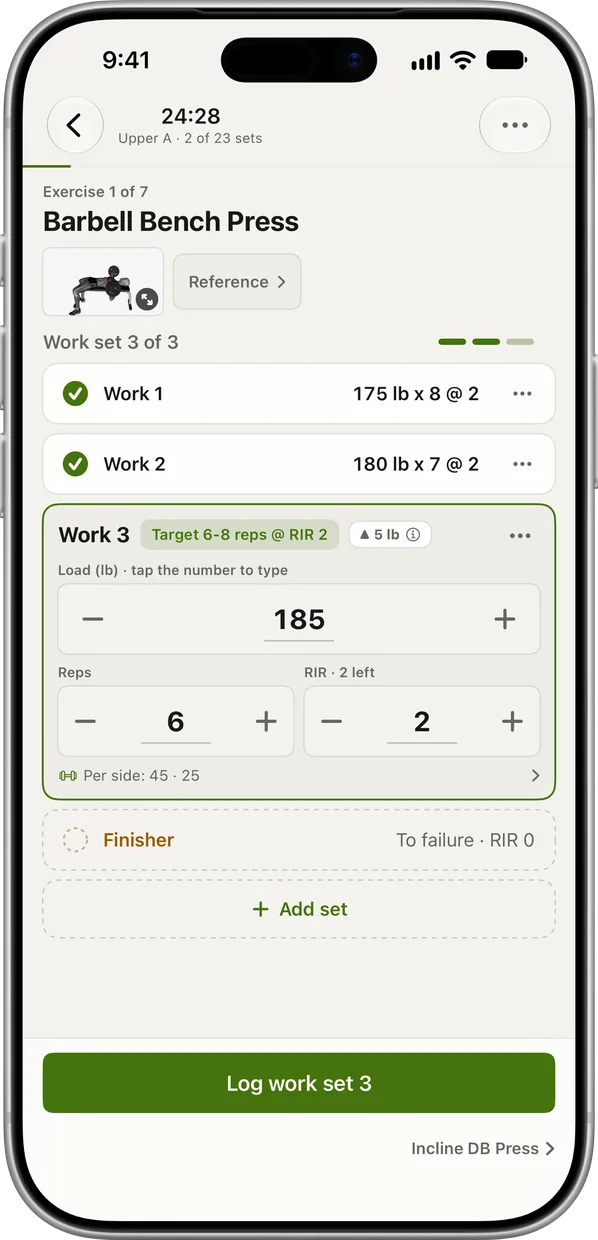
After every working set the next one can change. More left than planned and the bar goes up a step. Short of the rep range and it comes down. Got the reps but it was a grind, and it holds. Every number is rounded to plates you can actually load.
-
A rule for adding weight on low reps
Between sessions the app uses double progression, judged on your weakest set. When every set of 3 to 5 reaches 5, the bar goes up one step and you start again at 3. If your sets were clearly easier than planned, it can jump two steps.
-
An answer when a lift stops moving
Three sessions without a new rep and the workout recap offers a step back, about 10% lighter. You choose Deload or Not yet. Nothing is scheduled by the calendar; it responds to what your sets did. More in how to break a plateau.
-
Where your squat is headed
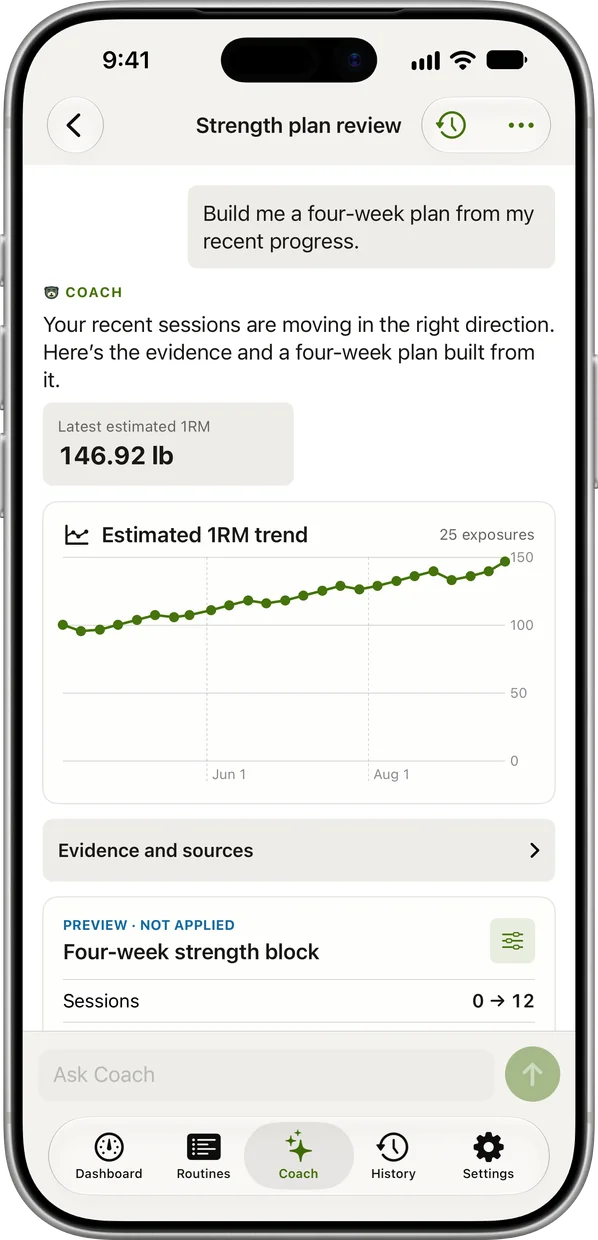
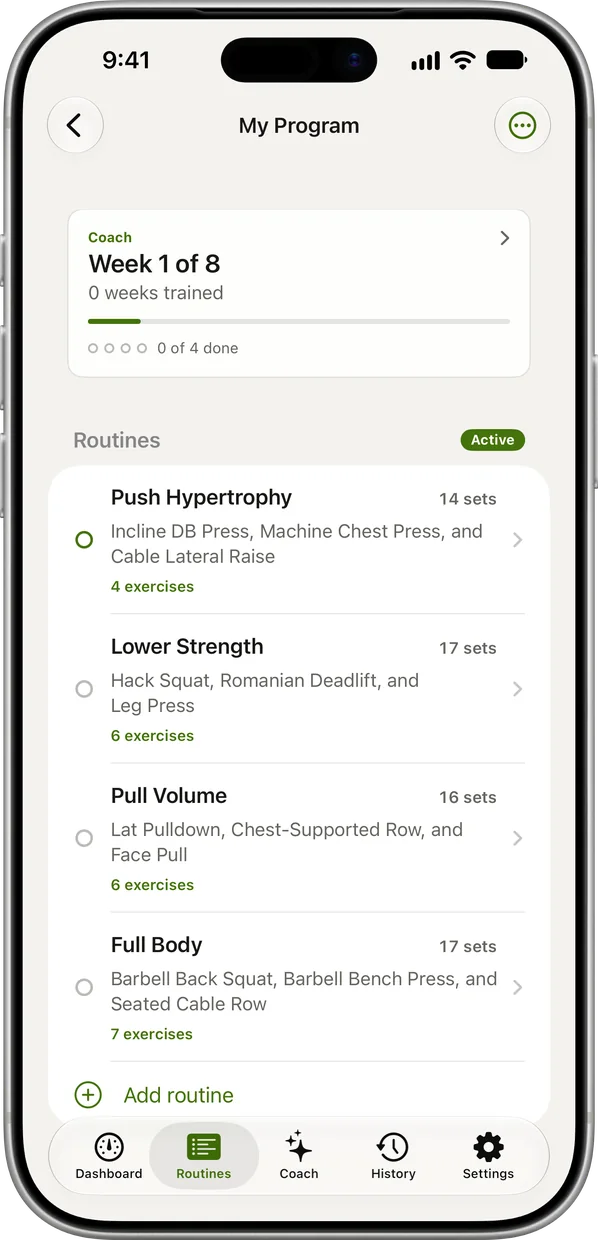
Give a program a finish line, like week 3 of 8, and see where the main lift is projected to land. Ask Coach to build the next block from your progress and it shows a preview first; nothing changes until you tap Apply changes.
-
Plates worked out for you
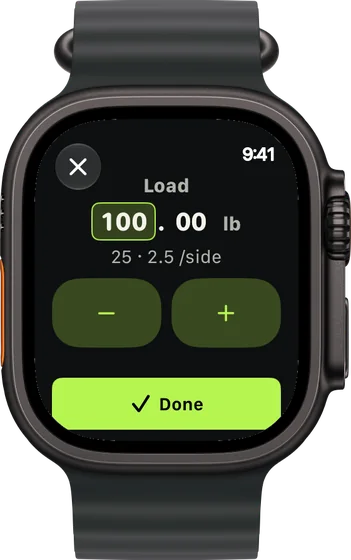
The plate calculator shows what goes on each side, on iPhone and on Apple Watch. On a heavy day you can run the whole session from your wrist, rest timer included.
A strength week on the Big 3 plan, set by set
Heavy day: the next set changes before you rest
Each day's main lift on the Big 3 plan below: squat on Day 1, bench on Day 2, deadlift on Day 3. All 3 to 5 reps, aiming for 4 with 2 left.
| Exercise | You logged | Next session | Why |
|---|---|---|---|
| Barbell Back Squat | 225 lb × 4, 3 left | 230 lb × 4 | One more rep left than planned. 225 × 36 ÷ 35 is about 231, rounded to 230. |
| Barbell Bench Press | 185 lb × 3, 1 left | 185 lb × 4 | One short of the target but still inside 3 to 5, so the weight holds. You don't get cut for a hard set. |
| Barbell Deadlift | 315 lb × 2, nothing left | 280 lb × 4 | Below the rep range with nothing left: 315 × 31 ÷ 35 is about 279, rounded to 280. |
A bad set costs you one lighter set, not the session. The correction is marked as one, so the plan underneath stays intact.
Next week: what moves and what holds
Same plan, a week later. Your gym has 2.5 lb plates, so one barbell step is 5 lb.
| Exercise | You logged | Next session | Why |
|---|---|---|---|
| Barbell Back Squat | 230 lb, 5 / 5 / 5 / 5, 2 left | 235 lb × 3–5 | Every set hit the top of 3 to 5. One step up, and the rep target resets to 3. |
| Barbell Bench Press | 185 lb, 5 / 5 / 4 / 4, 2 left | 185 lb × 5 | The weakest set made this session's target of 4, so the next target is 5 at the same weight. |
| Barbell Row | Set 1: 155 lb × 10, 4 left (target 10, 2 left) | Set 2: 165 lb | Two more left than planned: 155 × 43 ÷ 41 ≈ 163, rounded to 165. |
The squat moves, the bench builds a rep, the row jumps before set 2. Each lift goes at its own speed.
Week 7: the deadlift stalls
Three deadlift sessions in a row with no new rep. The bench is still climbing.
| Exercise | You logged | Next session | Why |
|---|---|---|---|
| Barbell Deadlift | 335 lb, 4 / 3 / 3, three sessions running | Recap suggests 300 lb × 3–5 | No new rep in three sessions. About 10% lighter, rounded to your plates. Choose Deload or Not yet. |
| Barbell Bench Press | 195 lb, 5 / 5 / 5 / 5, 2 left | 200 lb × 3–5 | A stall on one lift changes nothing on the others. Top of the range on every set: one step up. |
Accept the deload and the target goes back to 3 reps at 300 lb, then builds again. Say Not yet and nothing changes.
Strength plans that open in RIRLift
-
The best workout routine for men, for your week
Stronger squat, bench press and deadlift
The plan the examples use: one day each for squat, bench and deadlift at 3 to 5 reps, with lighter work on the other lifts.
3× a week · 49 sets a week · ~55 min
Add to RIRLiftSee the planAdd to RIRLift
Scan with your iPhone camera to add this plan.
-
The best workout for full body, for your week
Full gym, 3 days: heavy, moderate, light
Three full-body days, one heavy, one moderate, one light. Strength and size from the same week.
3× a week · 50 sets a week · ~45 min
Add to RIRLiftSee the planAdd to RIRLift
Scan with your iPhone camera to add this plan.
-
The best workout for women, for your week
4 days a week, upper/lower split
Four days with a heavy lower and a heavy upper day, for lifters with a year or more behind them.
4× a week · 59 sets a week · ~40 min
Add to RIRLiftSee the planAdd to RIRLift
Scan with your iPhone camera to add this plan.
Make it fit you
-
Choose how fast the bar climbs
Settings has three paces. Steady takes smaller, surer steps, Standard is plain double progression, and Push takes bigger jumps and waits longer before suggesting a step back.
-
See next week's weights before they're saved
Set Coach to Ask first and the recap shows next session's weights for you to confirm. Pro adds Fine-tune, where you set the biggest step allowed and how much a deload takes off.
-
Set warm-ups on the main lifts
Give the squat, bench and deadlift their warm-up sets in the routine. Warm-ups don't count toward progression, so ramping up never drags your numbers down. The warm-up calculator gives a ramp for any top weight.
-
Rate effort the same way every time
Your reps-left answer is compared with targets you judge the same way, so consistency matters more than precision. On heavy triples, 2 left means you could clearly do two more. The RIR guide has the feel of each number.
When a different app fits better
- You're peaking for a powerlifting meet. A meet-prep program fits that job better.
- You train by bar speed. A velocity-based training app is the better fit.
Questions
Is RIRLift a free strength training app?
Yes. Unlimited workouts, every suggested weight, in-session corrections, progression and stall suggestions are free with no account. Pro adds more Coach conversations, unlimited routines, Fine-tune and all-time analytics.
Do I need to know my one-rep max?
No. The app works from the sets you log. On a lift you've never done, it starts light, marks the weight Estimate, and one set of max reps gives it a real measurement.
Strength or muscle: which is this built for?
The engine is built around hypertrophy-style double progression, and it works the same way on heavy sets of 3 to 5. Most lifters chasing either goal train both. Hypertrophy vs strength training covers what actually differs.
How many days a week should I train for strength?
Three is enough to squat, bench and deadlift heavy once a week each and practice them again lighter. Four lets you split upper and lower and add volume.
What happens if I miss a session?
Nothing changes. The next session picks up at the weight you'd earned. After three weeks or more off, the app offers Ease back in: one week about 10% lighter.
Read next
-
The best workout routine for men, for your week
The Big 3 strength plan in full, with every exercise demonstrated.
-
How RIRLift picks your next weight
Every rule behind the numbers in the examples above.
-
Hypertrophy vs strength training: what actually differs
Rep ranges, rest and load for each goal.
-
Strength standards calculator
See where your squat, bench and deadlift stand.
-
Deadlift: how to set up, pull and program the barbell deadlift
Setup and programming for the lift that stalls first.
More ways lifters use RIRLift
-
The powerlifting app for building your squat, bench and deadlift
Heavy triples adjusted set by set, plate math on your wrist, and no max test to get started.
-
The progressive overload app that decides your next weight
Next weight and rep target set from your weakest set, corrected between sets, with stalls caught early.
-
The weightlifting app that knows what's on the bar
Prefilled sets, plates worked out per side, and a next weight your plates can actually make.
-
The workout app for men over 40 who still want to get stronger
Back under the bar after years off? Light first weights, honest corrections on bad days, steady progress.