
Blog
Bench Grip Width: How to Find Yours (Wide vs. Close)
Published November 13, 2026 · 14 min read
For most lifters the best bench press grip width is about 1.5 times your biacromial width, the distance between the bony points on top of your shoulders, and that is a little wider than shoulder width. Go narrower to load the triceps and spare the shoulders, go wider only if it stays pain-free and keeps the bar path short.
That number comes from biomechanics and coaching literature, not from a feel for the knurling. Below you will find how to measure it, what wide and close grips each change, how to test your own grip with a fixed protocol, and how to log the result so you can tell whether it is working.
TL;DR
- Measure your biacromial width (acromion to acromion), multiply by 1.5, and start there. The American College of Sports Medicine recommends hands slightly wider than shoulder width.
- Grips wider than 1.5 times biacromial width are linked to more shoulder torque and a higher risk of shoulder and collarbone problems, with only a small strength difference.
- Narrower grips shift work toward the triceps and elbow extension, wider grips shift it toward the shoulder horizontal adductors and chest.
- If you stall, test a grip 1 to 2 inches wider and narrower at around 80% of your max, then change only if one feels nearly as strong.
- Log grip width with every bench set so you can compare like with like.
Table of Contents
- Why grip width changes the bench press
- How to measure your bench grip width
- What the research says about the best grip width
- Wide vs. close grip bench: what each one trains
- How to test and set your grip
- If your shoulders bother you
- Match grip width to your goal
- Track grip width like any other variable
- Try it in RIRLift
- FAQ
- Sources
Why grip width changes the bench press
Grip width changes the geometry of the lift. As your hands move out, the bar sits closer to your shoulders horizontally and vertically, so the range of motion shortens. A 1992 study in the Journal of Applied Biomechanics with 24 experienced male weight trainers found this pattern, and it also found that the two moderate grip widths produced significantly more strength than either the narrowest or widest grips.
That explains why the answer is rarely "as wide as possible" or "as narrow as possible." A shorter range of motion helps you move more weight, but a very wide grip also raises the demand on the shoulder joint. The goal is the grip where range of motion, leverage and joint comfort overlap for your body.
How to measure your bench grip width
Your reference point is biacromial width. The acromion is the bony tip at the top of your shoulder blade, and biacromial width is the distance between the two. It is a better baseline than the width of your torso or the spacing of your feet because the research below is built around it.
- Find the acromion points. Run a finger along your collarbone to the outer end of your shoulder, where it meets a bony ridge. Mark each point or have a partner do it.
- Measure between them. Use a soft tape measure across your upper back or chest, in inches. Stand relaxed, not with your shoulders pulled back.
- Multiply by 1.5. That is your starting distance between your hands, measured between the index fingers or the same point on each palm.
- Mark it on the bar. Chalk, a tape mark or a note of where your hands sit relative to the knurling and the rings makes the grip repeatable.
Here is what the arithmetic looks like for three different builds. The widths are examples, not norms.
| Biacromial width | Starting grip (1.5x) | Wide-grip ceiling (2.0x) |
|---|---|---|
| 14 in | 21 in | 28 in |
| 15 in | 22.5 in | 30 in |
| 16 in | 24 in | 32 in |
In practice, the 1.5x column is where you begin and where most lifters stay. Federation rules in powerlifting also cap how far apart your hands may be, so if you compete, check your federation's current rulebook before moving out toward the 2.0x column.
Lifters with longer arms often prefer a somewhat wider grip and those with shorter arms a narrower one, so treat the multiplier as a starting point and not a verdict.
What the research says about the best grip width
Coaching guidance converges on 1.5 times
The ACSM's Health & Fitness Journal recommends hands slightly wider than shoulder width, which it puts at a little wider than 1.5 times biacromial width. The same article notes that grips of 2.5 times biacromial width or more can increase loading on the end of the collarbone at the acromioclavicular joint, the small joint at the top of the shoulder, especially in the deepest part of the lowering phase.
Greg Nuckols of Stronger by Science says that around 1.5 to 2 times shoulder width is the strongest and most comfortable grip for most people. For building muscle he suggests the more moderate end, around 1.5 times, with the pinky fingers near the rings, because it allows a slightly longer range of motion.
Wider than 1.5 raises shoulder risk without a big strength payoff
A review by Green and Comfort in the NSCA journal linked grips wider than 1.5 biacromial width to a higher risk of shoulder problems, including anterior shoulder instability, distal clavicle osteolysis (breakdown of the outer end of the collarbone) and pectoralis major rupture. They found that keeping the grip at 1.5 times or less appears to lower that risk without changing muscle recruitment patterns, and that the one-rep-max difference was only about 5% either way.
The same authors report that a grip wider than 1.5 times biacromial width increases shoulder torque by about 1.5 times compared with a narrow grip, and that moving from 100% to 190% biacromial width did not significantly change activation of the pectoralis major or anterior deltoid. What did change was the triceps: the narrower the grip, the greater its activation.
A more recent 2024 musculoskeletal modeling study in Frontiers in Physiology on 10 experienced strength athletes points the same way. Grips narrower than 1.5 biacromial widths reduced acromioclavicular compression, and combining that grip with scapular retraction (pulling the shoulder blades together and back) reduced backward shear force at the shoulder ball-and-socket joint and rotator cuff activity.
Moderate grips tend to lift the most
In a 2021 Frontiers in Sports and Active Living study, 14 bench-press-trained men lifted 109.8 kg with a wide grip, 108.9 kg with a medium grip and 103.7 kg with a narrow grip. Wide and medium were not meaningfully different from each other, and both beat narrow. Triceps activity was higher with the medium and narrow grips than with the wide one.
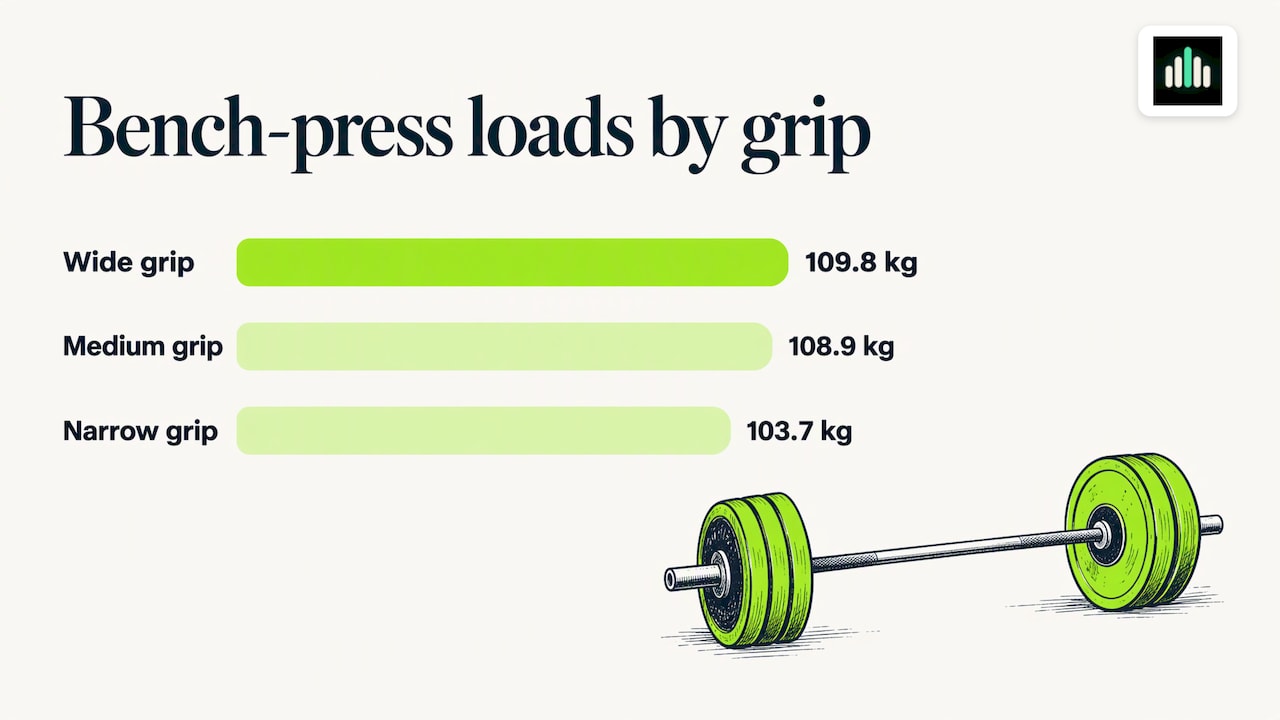
Put together, the evidence says a medium grip gives you almost everything a wide grip does for strength, with less joint stress.
Wide vs. close grip bench: what each one trains
A 2022 study in the Journal of Strength and Conditioning Research of 35 strength-trained adults compared grip widths directly. Narrower grips produced larger elbow joint moments and more activity in the lateral triceps, anterior deltoid and clavicular (upper) chest. Wider grips produced larger shoulder joint moments and more activity in the abdominal (lower) head of the pectoralis major. The authors concluded that grip width affects the shoulder more than the elbow, and that wider grips may favor adaptations in the shoulder horizontal adductors while narrower ones favor the elbow extensors.
Here is how that translates to the bar:
| Close grip (about 1.0x to 1.2x) | Medium grip (about 1.5x) | Wide grip (about 2.0x) | |
|---|---|---|---|
| Range of motion | Longest | Moderate | Shortest |
| Main emphasis | Triceps, elbow extension | Balanced chest, shoulders, triceps | Shoulder horizontal adduction, lower chest |
| Shoulder load | Lowest | Moderate | Highest |
| Best for | Lockout work, shoulder comfort, triceps volume | Most training, hypertrophy and strength | Short-range strength once shoulders tolerate it |
The percentages in the first row are working labels for the table, not figures from the studies. Use them as a rough map, not as cut-offs.
When a close grip earns a place in your week
If your triceps limit your lockout, a narrower grip is the direct fix. Keep the elbows tucked and the wrists stacked over the forearms, and do not go so narrow that your wrists bend. Our guide to the close-grip bench press covers form and grip width for that variation, and the barbell triceps exercise list shows where it sits among other options.
When a wider grip is worth it
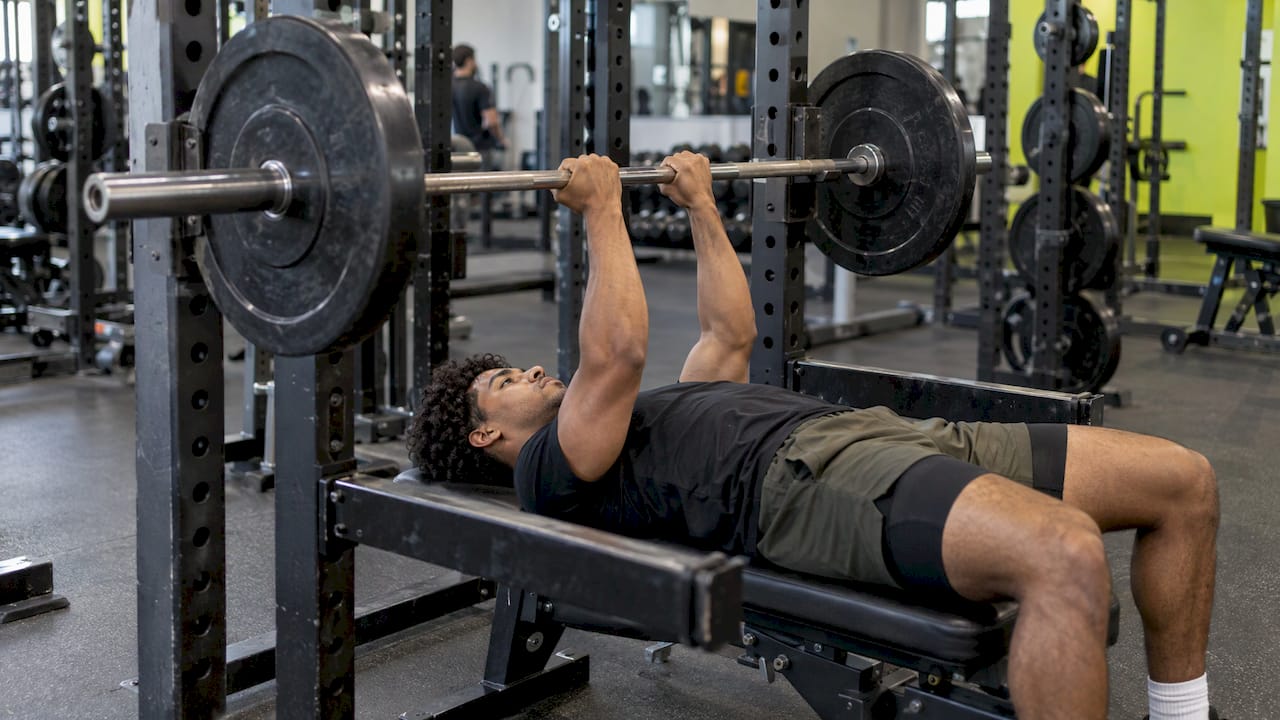
A grip near the upper end of the 1.5 to 2 times range suits lifters who feel no pain at the shoulder or collarbone, have longer arms, and want to shorten the bar path. If you feel pinching at the top of the shoulder or soreness at the end of the collarbone, that is your cue to move your hands in, not to push through.
How to test and set your grip
Start with the 1.5x grip and make it repeatable before you experiment. The ACSM lists several cues that keep any grip honest: keep your back flat, hold the chest up and out, squeeze the shoulder blades together, look straight up at the bar, and grip the bar firmly. It also names hands placed too far apart for comfortable shoulder positioning as a common error.
Then run this protocol, adapted from Stronger by Science's troubleshooting method:
- Work up to around 80% of your max using your current grip.
- Do 2 to 3 singles with a grip 1 to 2 inches wider.
- Rest, then do 2 to 3 singles with a grip 1 to 2 inches narrower.
- If either alternative feels almost as strong as your current grip, use it for about half of your pressing for a month or two.
- If one clearly feels stronger than your current grip, keep exploring in that direction in small steps.
Two checks make the test more informative. First, have a training partner watch for symmetry, since one hand sitting further out than the other muddies everything. Second, film the set from the front. At the bottom, your forearms should look close to vertical. If they flare out sharply, your grip is probably too wide for your arm length.
A thumbless grip is also worth dropping at any width, because the bar can roll out of your hands.
If your shoulders bother you
The ACSM has specific guidance for lifters with a history of shoulder pain who have been medically cleared to resume upper body resistance training. It recommends a grip no wider than 1.5 times biacromial width, the upper arm at roughly 45 degrees from the torso, and no more than 15 degrees of humeral extension (the elbow dropping behind the torso) at the lowest point of the press. If pain persists, shows up at rest or follows a sudden pop, see a physician or physical therapist before you keep pressing.
Shoulder position matters as much as hand position. Setting your shoulder blades before you unrack is what makes a narrower grip reduce joint stress in the modeling data above. Our explainer on scapular retraction shows the movement, and a short scapular activation routine is a good primer before benching. If your shoulders feel stiff rather than painful, this overview of joint mobilization for shoulder stiffness explains what manual therapy for that problem involves.
Before your first working set, a five-minute shoulder warm-up and the pre-bench chest activation routine give the joint a few light reps in the position you are about to load.
Match grip width to your goal
Strength. Use a medium grip near 1.5 times biacromial width. The 1992 and 2021 studies both found moderate grips among the strongest, and nothing in the evidence suggests that going extra wide is worth the shoulder cost.
Muscle growth. Stay near 1.5 times for the longer range of motion, and rotate a close-grip variation in to hit the triceps harder. The 2022 study suggests grip width tilts emphasis between the shoulder and the elbow, so varying it across a training block is reasonable.
Shoulder comfort. Stay at 1.5 times or narrower, use the 45-degree upper arm angle and set your shoulder blades. If the barbell still bothers you after that, dumbbell pressing and the close-grip bench alternatives let your hands find a natural path.
Competition. Pick the widest grip that is legal and pain-free, then confirm it against your federation's rulebook.
Track grip width like any other variable
Grip changes only mean something if you can compare them across weeks. Write down the grip each session in the same way, for example "22.5 in, index finger on the ring edge," and log it with your weight, reps and reps in reserve (RIR), the number of reps you could still have done at the end of a set. A grip that looks stronger on one day may only be the day you felt fresh.
In RIRLift you log weight, reps and RIR for every set on your iPhone or Apple Watch, so a grip experiment shows up as a clean comparison of load and effort. Its AI Coach recommends the next load from your logged sessions, and later mentions of it are simply Coach. Our guide to reps in reserve explains how to rate those sets.
Try it in RIRLift
RIRLift has a free plan for core set logging. Pro costs $9.99 per month or $79.99 per year and unlocks advanced coaching, analytics and unlimited routines. If you are running a grip test and want every bench set, with its RIR, saved and analyzed, start from the RIRLift home page.

For a wider look at how logging turns into load changes, see the gym tracker app overview.
FAQ
What is the best grip width for bench press?
For most lifters it is about 1.5 times biacromial width, which is slightly wider than shoulder width. Coaching guidance from the ACSM and the research on shoulder load point to this range as the best balance of strength and joint comfort. Adjust in 1 to 2 inch steps from there.
Is a wide grip better on bench press?
Not necessarily. A wide grip shortens the range of motion and can feel strong, but a 2021 study found a medium grip lifted about the same load as a wide one. Grips wider than 1.5 times biacromial width also raise shoulder torque, so wide is only better if it stays pain-free and you have a clear reason for it.
Is wide or close grip bench better for chest?
Wider grips increased activity in the lower head of the pectoralis major in the 2022 study, while narrower grips raised triceps, front delt and upper chest activity. The chest is worked in both, so a medium grip is a sound default, with a narrower grip added for triceps work.
Is it harder to bench press if you have long arms?
Longer arms mean a longer bar path, so many long-armed lifters grip a bit wider to shorten it. Use your biacromial measurement and the 80% test above to find the width that fits your build, and stay within what your shoulders tolerate.
Sources
- The Bench Press Exercise, ACSM Health & Fitness Journal (2018)
- The Effect of Grip Width on Bench Press Performance, Journal of Applied Biomechanics (1992)
- How to Bench Press: The Definitive Guide, Stronger by Science
- The affect of grip width on bench press performance and risk of injury, Green and Comfort (2007)
- The Affect of Grip Width on Bench Press, Green and Comfort (2007, full text)
- Effects of bench press technique variations on musculoskeletal loading, Frontiers in Physiology (2024)
- A Biomechanical Analysis of Wide, Medium, and Narrow Grip Width Bench Press, Frontiers in Sports and Active Living (2021)
- Understanding Bench Press Biomechanics, Journal of Strength and Conditioning Research (2022)
- Joint Mobilization for Shoulder Stiffness: What to Expect