
Blog
Scapular Retraction: Muscles, Form and Exercises
Published November 2, 2026 · 14 min read
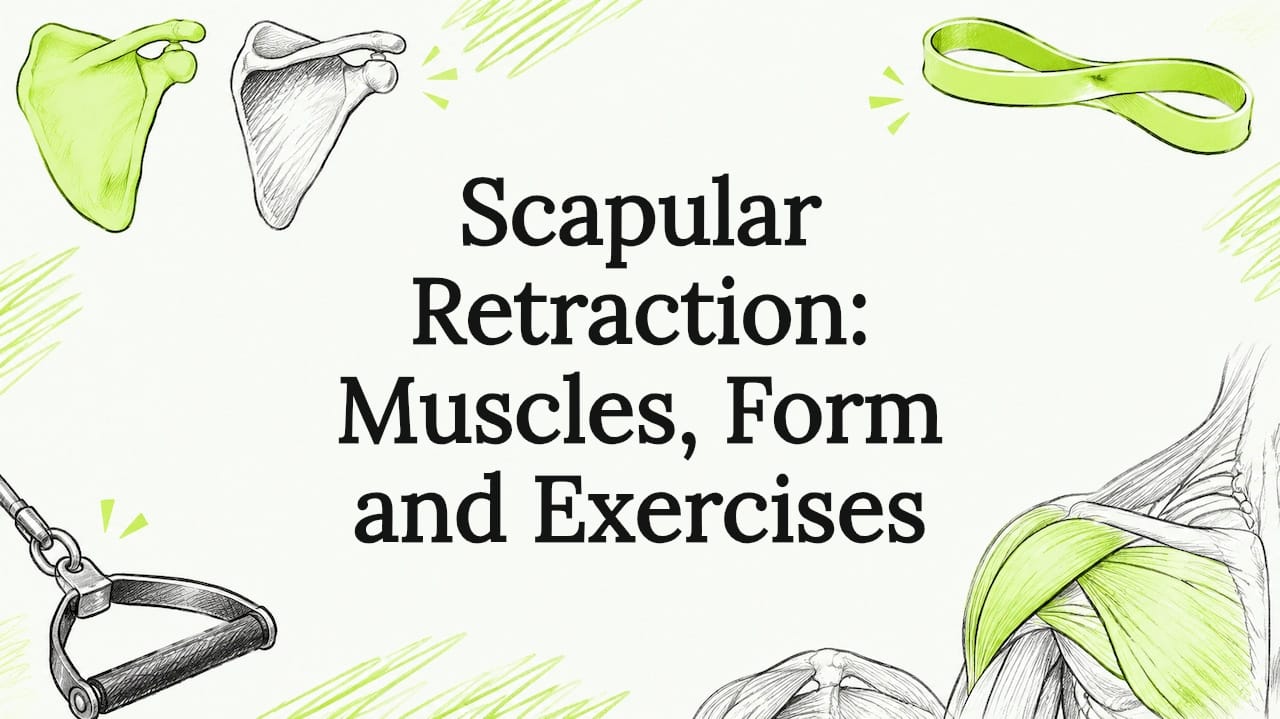
Scapular retraction is the movement of pulling your shoulder blades back and toward your spine, and the middle trapezius does most of the work, with the rhomboids and lower trapezius helping. To do it correctly, stand tall, draw the blades together and slightly down, hold for a few seconds, and release without shrugging or flaring your ribs.
That sounds simple, yet it is one of the most commonly mis-cued movements in the gym. Lifters either skip it entirely and let the shoulders roll forward, or they overdo it and lock the blades back before the arm has even started to move. This guide covers what retraction is, which muscles produce it, how to feel it, which exercises train it, and where it belongs in your lifting.
TL;DR
- Scapular retraction pulls the shoulder blades toward the spine. The middle trapezius is the primary mover, with the rhomboids and lower trapezius in secondary roles.
- A clean rep is a squeeze back and slightly down, held for a few seconds, with no shrug, no head-bob and no lower-back arch.
- Rows, band pull-aparts and prone Y, T and W raises train it well. Lower-trapezius emphasis matters if your shoulders round forward.
- In pulldowns and presses, do not force a hard retraction before the arm moves. Let the shoulder blades move freely.
Table of Contents
- What scapular retraction is and which muscles produce it
- How to retract your scapula correctly
- How to tell you are retracting and not shrugging or forcing it
- Which exercises train scapular retraction
- Retraction in the big lifts: where to use it and where not to
- Why it is worth training
- Our perspective
- Make scapular work part of your tracked training
- FAQ
- Sources
What scapular retraction is and which muscles produce it
Your shoulder blade (scapula) is a flat, triangular bone that glides over the back of your rib cage. It can move in several directions: up, down, forward, back, and it can rotate. Retraction is the backward and inward glide, a medial and posterior motion around the rib cage that brings the two blades closer together. The opposite motion, protraction, spreads them apart, as at the top of a push-up or when you reach forward.
Three muscles do the work:
| Muscle | Role in retraction | Where you feel it |
|---|---|---|
| Middle trapezius | Primary mover | Between the shoulder blades, level with the bony ridge of the scapula |
| Rhomboids | Secondary mover, also helps hold the blade against the ribs | Just inside the inner edge of the blade |
| Lower trapezius | Secondary mover, pulls the blade down as it retracts | Lower mid-back, toward the bottom tip of the blade |
Research comparing people with a protracted (forward-sitting) shoulder blade posture to people without it describes the middle trapezius as the primary retractor, with the rhomboids and lower trapezius as secondary muscles. The same paper notes that these muscles are particularly active during pulling movements, and that weakness in the lower trapezius or rhomboids reduces how far the blade can retract.
This matters in practice because the three muscles do not contribute equally in every exercise. A heavy row with the elbows flared recruits plenty of upper trapezius and rear delts. A slow, light, low-elbow squeeze puts the emphasis back on the muscles between and below the blades, which is usually where lifters with rounded shoulders are weakest.
How to retract your scapula correctly
The cleanest way to learn the movement is without any load at all. Standard patient-education guidance for shoulder blade retraction is to sit or stand upright, pull the shoulder blades together and down toward your buttocks, hold for 3 to 5 seconds, then relax.
Here is the drill broken into steps:
- Set your posture. Stand with your feet hip-width apart, ribs stacked over your pelvis, chin level. Do not lift your chest dramatically; that just arches the lower back.
- Let the shoulders drop. Start with your arms hanging and the shoulders relaxed, away from your ears.
- Draw the blades back and slightly down. Imagine sliding them into your back pockets, not squeezing them up toward your neck.
- Hold for 3 to 5 seconds. Breathe normally. You should feel a firm contraction between the blades, not a pinch in the neck or a cramp in the lower back.
- Release slowly. Let the blades glide forward again over about two seconds. The return is part of the rep.
Start with 2 to 3 sets of 8 to 10 holds. Because this is a motor-control drill and not a strength set, stop when the quality drops, not when you hit a number.
Adding a band
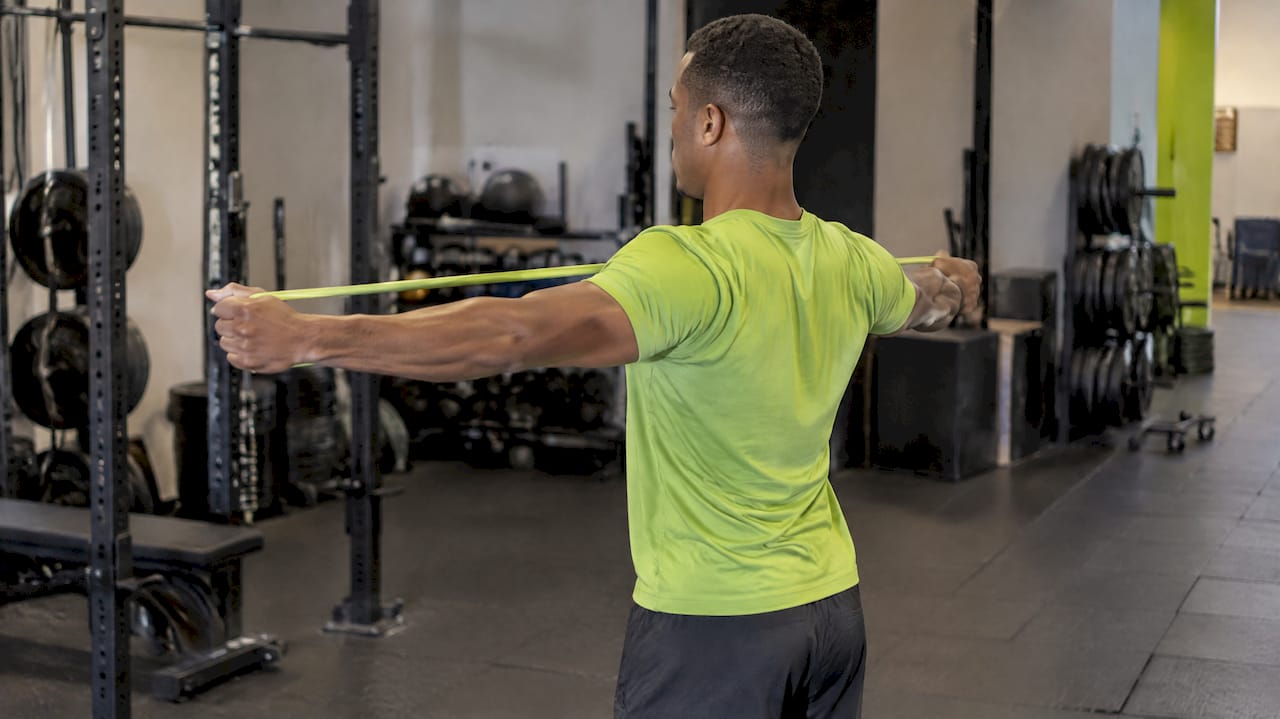
Once the bodyweight version feels clear, add light resistance. With a band, start with light tension and control both the pull and the return. Hold the band at chest height with straight arms, pull it apart or toward your torso, and let the shoulder blades lead. If your hands and elbows are doing the work while your shoulder blades barely move, the band is too heavy.
If you want a ready-made sequence, our 6-minute scapular activation routine strings these drills together as a warm-up, and the band pull-apart guide covers form, muscles and rep ranges for the most popular retraction exercise.
How to tell you are retracting and not shrugging or forcing it
The most frequent error is substituting a different movement for the one you want. Compensation tends to show up as shoulder hiking, head-bobbing or overuse of the back. Each has a simple test.
- Shrugging. Look in a mirror or film a side view. If your shoulders rise toward your ears as the blades come together, the upper trapezius has taken over. Cue "down and back" instead of just "back" and shorten the range.
- Head poking forward. If your chin juts out during each squeeze, the neck is compensating. Tuck the chin slightly and keep your gaze level.
- Lower-back arch. If your ribs flare and your lower back tightens, you are leaning into extension rather than moving the blades. Brace lightly and keep the ribs down.
- Moving from the hands. Practical band-row cues are to focus the movement on the shoulder blades rather than the hands, keep the elbows low rather than flared, and keep the chest open. If you can feel the squeeze only when you pull harder with your arms, drop the load.
A quick self-check: place your fingertips lightly on the inner edge of one blade. When you retract, you should feel that edge move toward the spine, and the muscles beside it should firm up. If nothing moves, you are probably just tensing.
Which exercises train scapular retraction
The right exercise depends on what you want: a strong middle back for rowing, better posture, or a shoulder that is ready for heavy pressing. A systematic review of electromyography studies looked for exercises that produce a high lower-trapezius activation relative to the upper trapezius, and it identified prone flexion, high scapular retraction and prone external rotation with the shoulder abducted to 90° and the elbow flexed as exercises with optimal ratios. That matches what most lifters find: prone work with the arms at an angle to the body is better at hitting the muscles below the blades than a plain shrug-prone row.
Low-load activation drills
These work well before a session or on a light day.
- Prone Y, T and W raises. Lie face down on a bench or the floor. Raise the arms into a Y, then a T, then bend the elbows into a W, pausing each time with the blades drawn back and down. Use no weight or 1 to 2 pounds.
- Wall angels. Stand with your back to a wall and slide the arms up and down while keeping the blades in contact with the wall.
- Band pull-aparts. Light tension, straight arms, pull to chest level. Our shoulder exercises with resistance bands page has variations.
For a clinician-written set of band and lower-trapezius movements aimed at stubborn shoulder blade control problems, this plan of scapular winging exercises shows how the same drills are progressed.
Loaded strength work
Once the movement pattern is clear, the strength work builds the muscle.
- Chest-supported rows. The bench removes lower-back involvement, so the blades can do the work.
- Seated cable rows. Pause at the end of each rep for one second, with the elbows close to the body.
- One-arm dumbbell rows. Let the blade glide forward at the bottom, then pull it back first, before the elbow travels behind the torso.
- Face pulls. Pull the rope toward your forehead, then rotate the hands back so the rear delts and middle back share the load.
For more options, see our lists of dumbbell upper back exercises and resistance band back exercises, and the rounded shoulders exercise picks if posture is your main concern.
A sample 10-minute block
| Exercise | Sets x reps | Cue |
|---|---|---|
| Standing retraction hold | 2 x 8 (3-second hold) | Down and back, no shrug |
| Band pull-apart | 2 x 12 to 15 | Light band, blades lead |
| Prone Y raise | 2 x 8 | Thumbs up, pause at the top |
| Chest-supported row | 3 x 8 to 12 | Pause one second, elbows low |
Finish each exercise with a couple of reps left in the tank. If the shoulders are shrugging or the neck is tight, you have gone past the point where the target muscles are doing the work.
Retraction in the big lifts: where to use it and where not to
Here is the nuance that most exercise lists skip. Retraction is a movement, not a posture you should hold permanently. In some lifts you want the blades set and stable; in others, forcing them back early makes the lift worse.
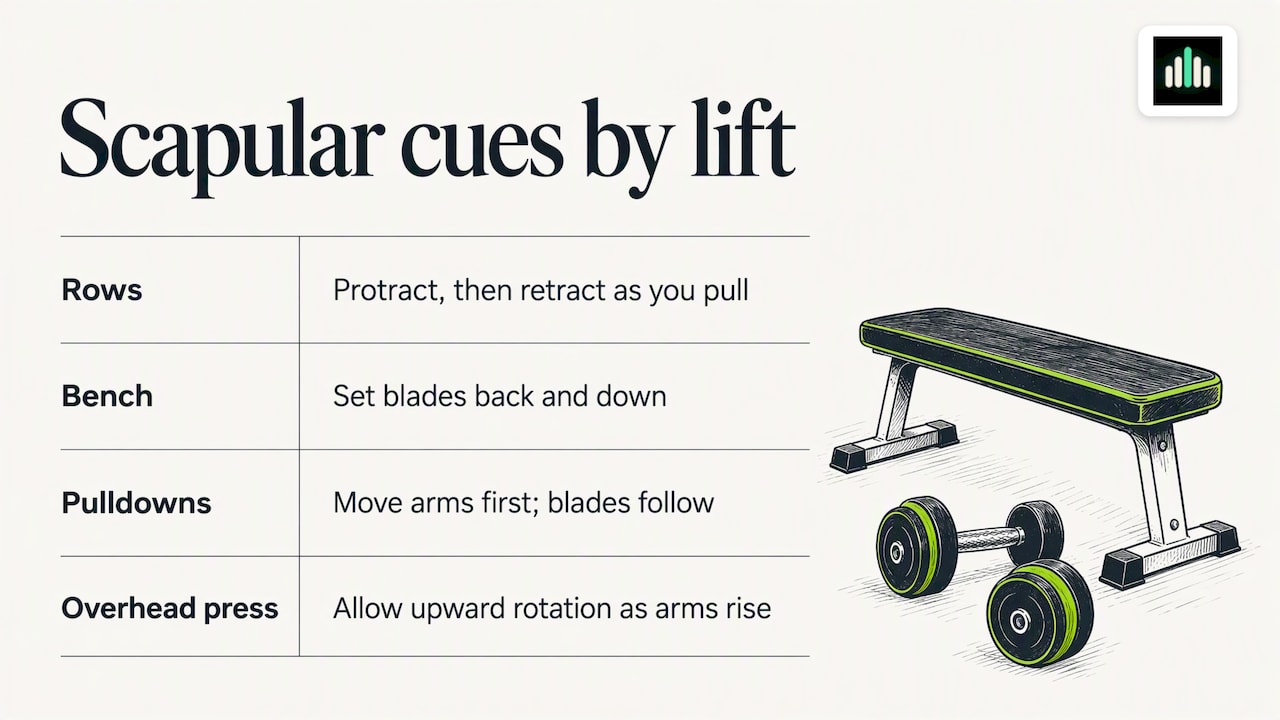
Rows. Retraction is the point. Let the blade protract slightly at the bottom for a full stretch, then retract as you pull.
Bench press. Lifters commonly set the shoulder blades back and down against the bench before unracking to create a stable base. That is a gym-practice convention rather than a research claim, and it works best when the setup is comfortable and does not pinch the shoulder.
Pulldowns and pull-ups. This is where overcueing hurts. Trainers advise against starting a pulldown with a strong, forced retraction and depression before the upper arm has begun to move, because the shoulder blades should still move freely. The same source describes overemphasizing pre-movement retraction as a significant error, since it disrupts the normal rhythm between the shoulder blade and the upper arm by making the blades move before the humerus does. In practice: start the pull by moving the arm, let the blades follow, and finish with the elbows driving down.
Overhead presses. The shoulder blades need to rotate upward as the arms rise. Pinning them back hard at the start limits that. Keep them stable, not frozen.
Another frequent mistake is loading too heavily for the form you have. The same ACE article warns that overloading at the expense of technique can lead to head-bobbing, shoulder hiking or back overuse. If you notice any of those in your last reps, that set was too heavy for the movement you are trying to train, and it is a good moment to log it and adjust.
Why it is worth training
The shoulder blade is the base of the shoulder joint. A review of scapular function notes that neglected scapular musculature and the altered mechanics that follow can place abnormal stress on the anterior shoulder capsule and raise the risk of rotator cuff compression. You do not need to take that as a reason to worry. It is a reason to include a few sets of scapular work in a program that is otherwise heavy on pressing, which most lifting programs are.
For lifters, the practical payoff looks like this: a more stable platform for pressing, a stronger mid-back for rowing, and better control when the shoulders are tired. If your shoulders feel pinched during overhead lifts, see our guide to shoulder activation exercises for the rotator cuff as a companion to retraction work.
If you have pain that does not ease, numbness or tingling down the arm, or a shoulder blade that visibly sticks out from your back (winging), stop testing it yourself and see a physical therapist or sports medicine physician. Those signs can point to nerve or muscle problems that need a proper assessment, not more squeezing.
Our perspective
Most retraction advice stops at "squeeze your shoulder blades." That is a useful cue for a single drill, but a lifter's real problem is judging how hard to squeeze, on which set, and with how much load. We think that is a tracking problem as much as a technique one.
When you log a row or a band pull-apart with the weight, the reps and your reps in reserve (RIR), you can see whether the quality of the movement holds as the load climbs. If your RIR estimate says you had three reps left but the shoulders shrugged on the last two, the number was lying to you, and the next load should reflect it. Our approach is built around that feedback: the AI Coach reads your logged sets and recommends the next load from your own performance, not from a generic template.
We also built the Apple Watch app so you can log those light activation sets between heavy work without pulling out your phone. Small accessory work gets skipped when it is a hassle, and scapular work is exactly the kind that gets skipped.
Guilherme
Make scapular work part of your tracked training
If you want these drills to stick, put them in your log like any other lift, with load, reps and reps in reserve. RIRLift is free to start and runs on iPhone and Apple Watch, and Pro, which unlocks advanced coaching, analytics and unlimited routines, costs $9.99 per month or $79.99 per year. You can see the plans on the RIRLift home page.

If you are not sure how many sets and which loads suit your equipment, the Session Builder is a quick place to start.
FAQ
What muscle causes retraction of the scapula?
The middle trapezius is the primary muscle, and the rhomboids and lower trapezius assist. Research on the scapular retractors describes this primary and secondary split, and notes that weakness in the lower trapezius or rhomboids limits how far the blade can retract.
What is the best exercise for scapular retraction?
There is no single best one, because it depends on your goal. For motor control, start with a standing retraction hold or a light band pull-apart. For strength, chest-supported and cable rows are the practical choice. For the lower trapezius, prone Y raises and similar prone movements with the arms angled out are well supported, since the systematic review of lower-trapezius exercises lists prone flexion and high retraction among the best-ratio options.
How can I tell if I am retracting without shrugging?
Film yourself from the side. If your shoulders rise, your head pokes forward or your lower back arches, you are compensating. Lower the load, cue "down and back," and keep the elbows low. Those are the common compensation patterns trainers watch for.
Should I squeeze my shoulder blades together during every pull?
No. Retract on rows and as the finish of a pull, but do not force a hard pinch before the arm moves in pulldowns or pull-ups. Let the shoulder blades move freely, and let the arm start the movement.
Sources
- Comparison of Isolation Ratios of the Scapular Retraction Muscles between Protracted Scapular and Asymptomatic Groups (PMC)
- Shoulder blade retraction (FloridaHealthFinder)
- Banded Scapular Retraction: How to Do It Properly
- A Systematic Review of the Exercises That Produce Optimal Muscle Ratios of the Scapular Stabilizers (PMC)
- Correct Cues for Scapular Motion (ACE)
- The role of the scapula (PMC)