Blog
Short Strength Workouts: What 20 to 30 Minutes Can Do
Published November 18, 2026 · 12 min read

Scan with your phone camera
Yes, a short strength workout of 20 to 30 minutes, done at least twice a week, is enough to get stronger, as long as the sets are hard and the movements cover your whole body. Mayo Clinic says people may notice stronger muscles with about 20 to 30 minutes of strength training at least twice weekly, and the research on time-efficient training explains how to get the most from those minutes.
This guide shows what counts as a short session, which approaches have the strongest support, how to choose exercises, three sample workouts and how to track effort so a short session keeps getting more productive.
TL;DR
- Twenty to thirty minutes, twice a week, covering every major muscle group is a legitimate strength program. One set per exercise is enough for health and fitness benefits, according to Mayo Clinic.
- Single-set sessions and a single weekly session are the best-supported minimal-dose approaches. Daily "exercise snacks" are still an emerging idea.
- Pick full-range, multi-joint lifts: a squat or leg press, a pull and a push. They give the most return per minute.
- Effort is what a short workout runs on. Stop sets with a rep or two left in reserve, log them, and add load when the target reps get easy.
Table of Contents
- What counts as a short strength workout
- What the research says about doing less
- Choose movements that cover the whole body
- Three sample short strength workouts
- How often to train
- Make every set count with effort and tracking
- Where RIRLift fits
- FAQ
- Sources
What counts as a short strength workout
A short strength workout is a session of roughly 10 to 30 minutes that trains the big movement patterns with few sets, so the time goes to lifting rather than to volume for its own sake. The usual range in public-health guidance is 20 to 30 minutes, and the shorter 10-minute formats are built around very high effort.
Three features separate a useful short session from a rushed long one:
- Few exercises, chosen on purpose. Five or six movements that each load several joints beat ten isolation exercises.
- Hard sets. A hard set is one taken close enough to failure that the last reps slow down and take real effort. Mayo Clinic advises choosing a resistance that tires the muscle after about 12 to 15 repetitions.
- A plan you repeat. Two sessions you actually do every week beat one perfect 90-minute session you skip.
If you want a broader list of lifts to draw from, the full-body exercises for strength page covers twelve of them.
What the research says about doing less
Two academic reviews map the ground. A 2024 overview by Nuzzo, Pinto, Kirk and Nosaka sorted minimal-dose resistance training into five approaches and concluded that all five can increase strength. They are not equally well supported:
| Approach | What it looks like | Strength of support |
|---|---|---|
| One weekly session | A single full-body workout per week | Best supported |
| Single-set, multi-exercise sessions | One hard set of each of several exercises | Best supported |
| Daily "resistance snacks" | Brief bouts spread across the day | Emerging |
| Strength-test practice | Regularly testing a max effort on a lift | Emerging |
| Eccentric-only, low-volume work | Lowering phases only | Emerging |
The table follows the authors' own ranking: weekend-warrior style training and single-set training are best supported, while snacking and eccentric approaches are still emerging concepts. If you want to build your week around something proven, build it around one or two full-body sessions with one to a few sets per exercise.
A 2021 review in the same family, No Time to Lift?, adds two points. First, techniques such as supersets, drop sets and rest-pause work can roughly halve training time while keeping volume, though they may favor muscle growth more than strength and need more long-term research. Second, weekly volume matters more than how many days you split it across. That is why a handful of well-chosen sets twice a week works.
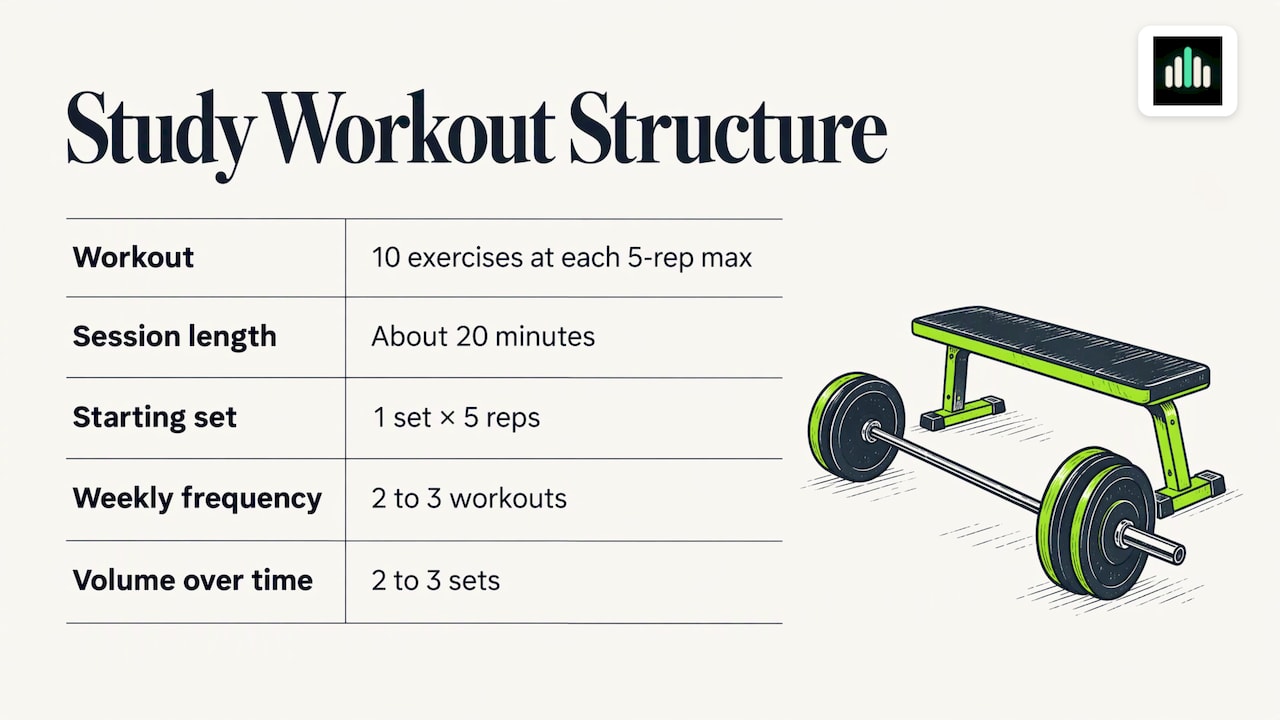
One trial reported by ACE shows what this looks like in practice. In the study ACE summarized in February 2023, the high-intensity group did one set of five reps across 10 exercises in 20 minutes or less, while the comparison group needed about 45 minutes. Both groups improved every measured one-rep-max and five-rep-max value, and body fat fell in both.
Choose movements that cover the whole body
When you only have a few sets to spend, each one has to count. Iversen and colleagues recommend full-range, multi-joint movements, including at least one leg press or squat, one upper-body pull such as a pull-up, and one upper-body push such as a bench press.
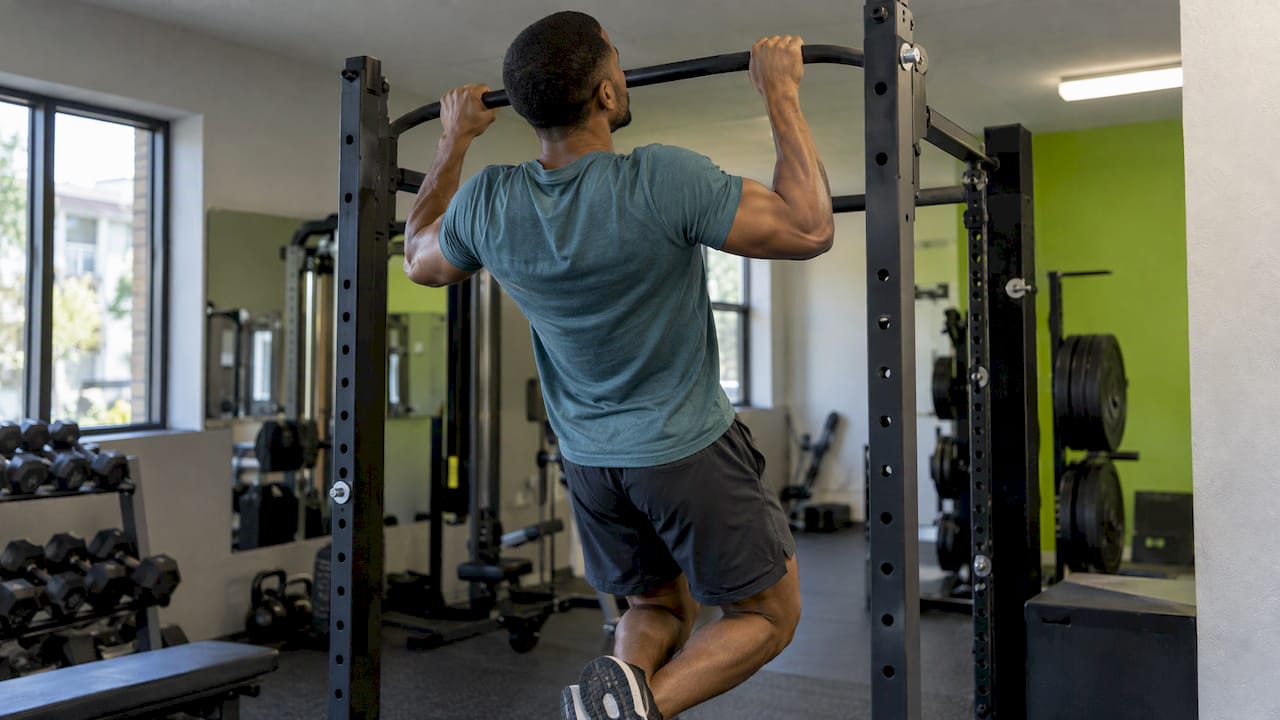
For general health, Mayo Clinic wants you to train all major muscle groups at least twice a week. It lists the major groups as shoulders, arms, chest, abdomen, back, hips and legs. A squat pattern covers hips and legs, a row or pull-up covers back and arms, and a press covers chest, shoulders and triceps. Add a carry or a plank-style hold and the abdomen is covered too.
A simple template for any equipment:
- Squat or hinge: squat, leg press, step-up or deadlift variation.
- Horizontal push: bench press, dumbbell press or push-up.
- Horizontal or vertical pull: row, lat pulldown or pull-up.
- Overhead push or carry: shoulder press or farmer's carry.
- Optional trunk work: plank or a loaded carry.
No gym? These pages show how to fill the template with what you own: full-body exercises at home, full-body exercises without equipment, and resistance band exercises for full-body work with bands. If you train with dumbbells, dumbbell exercises for men lists fourteen options and three plans.
Three sample short strength workouts
The three sessions below come from the structures in the research. Pick the one that matches your experience, and ease in: Harvard Health advises taking longer breaks if needed and stopping for pain or discomfort. If you have an injury, a heart condition or a bone-density diagnosis, talk to your doctor before you start.
The 10-minute dumbbell session
Harvard Health's September 2026 article describes a low-volume routine with two dumbbells and three exercises: three rounds take about 10 minutes, with 30 to 45 seconds of rest between exercises. It suggests choosing dumbbells that make 10 to 12 repetitions challenging, or fewer reps if five or six is all you can manage with effort. This is the best format for a busy day or a first week back.
The 30-minute full-body session
This is the format closest to what most lifters need. Pick one movement from each of the first four template slots above, then:
- Warm up with one light set of the first movement.
- Do two working sets of each movement in a circuit or straight through, with 6 to 15 reps per set, leaving a rep or two in reserve on the first set and getting closer to your limit on the second.
- Finish inside 30 minutes.
Done twice a week, that gives you four weekly sets per muscle group, which matches the lower bound of the 2021 review (at least four weekly sets per muscle group, using loads you can lift 6 to 15 times). It also lines up with the practical target Brad Schoenfeld gave NPR in January 2026: two workouts of about 30 to 45 minutes and four to six weekly sets per muscle group for substantial gains, adjusted to your goals and how you respond.
The 20-minute high-intensity session for experienced lifters
The ACE workout builder describes a six-week study using one set of five reps across 10 exercises at each person's five-rep max, moving from two to three workouts weekly, with sessions of about 20 minutes. It advises starting with one set of five reps per exercise and growing to two or three sets over time, finishing the full circuit before starting another round.
A five-rep max is a very heavy load. Work up to it over several weeks, use a spotter or safety bars on barbell lifts, and treat the study as a ceiling, not a starting point.
How often to train
Twice a week is the floor for general health. Mayo Clinic also advises resting one full day between training the same muscle group, and not training a muscle group on consecutive days. A Monday and Thursday pair, or Tuesday and Friday, handles that naturally.
A few scheduling rules that follow from the research:
- If you are a beginner, one weekly workout is a reasonable first stage. NPR's January 2026 report cites expert advice to start with one weekly workout for the first three months, using several compound movements for one set of roughly 6 to 15 reps each.
- If your sets are close to failure or heavy, leave more recovery between sessions. ACE stresses that recovery between high-intensity sessions matters most when loads are heavy or sets approach failure.
- If you can only spare 15 minutes at a time, the 2021 review describes very short, frequent sessions as a plausible alternative to longer ones, while noting the evidence is limited. Treat it as a fallback to your twice-weekly session, not a replacement.
Some people ask whether short sessions suit older lifters or people with low bone density. Single weekly sessions, single-set workouts and brief bouts are all formats used in that setting, and this guide to resistance training for osteoporosis explains how to start safely.
Make every set count with effort and tracking
In a 10-minute routine, Harvard-affiliated physical therapist Vijay Daryanani points to effort as the limiting factor, while also recommending that people ease into intensity rather than force the full prescription at once. That is the core idea behind reps in reserve (RIR): the number of good reps you could still have done when you stop a set. A set that ends with one or two reps in reserve is hard enough to count and controlled enough to repeat. The guide to reps in reserve explains the scale, and the RIR chart converts it to RPE and percent of 1RM.
Progression in a short plan is simple, and it only works if you write things down:
- Log weight, reps and RIR for every working set.
- When you hit the top of your rep range with a rep or two in reserve, raise the load next time. Mayo Clinic puts it this way: gradually increase resistance when more repetitions become easy.
- If a set lands well below your target, repeat the load instead of forcing it.
With only four to eight working sets in a session, you cannot remember last week's numbers reliably. A phone in a gym bag costs time between sets too. That is where a wrist helps: RIRLift runs on iPhone and Apple Watch, so you can log a set on your watch, with the option to work out with just the watch, and see how to track weight lifting on Apple Watch for the setup.
If you want the weights chosen for you, the page on a progressive overload app that sets the next weight shows how that works from your logged sets.
Where RIRLift fits
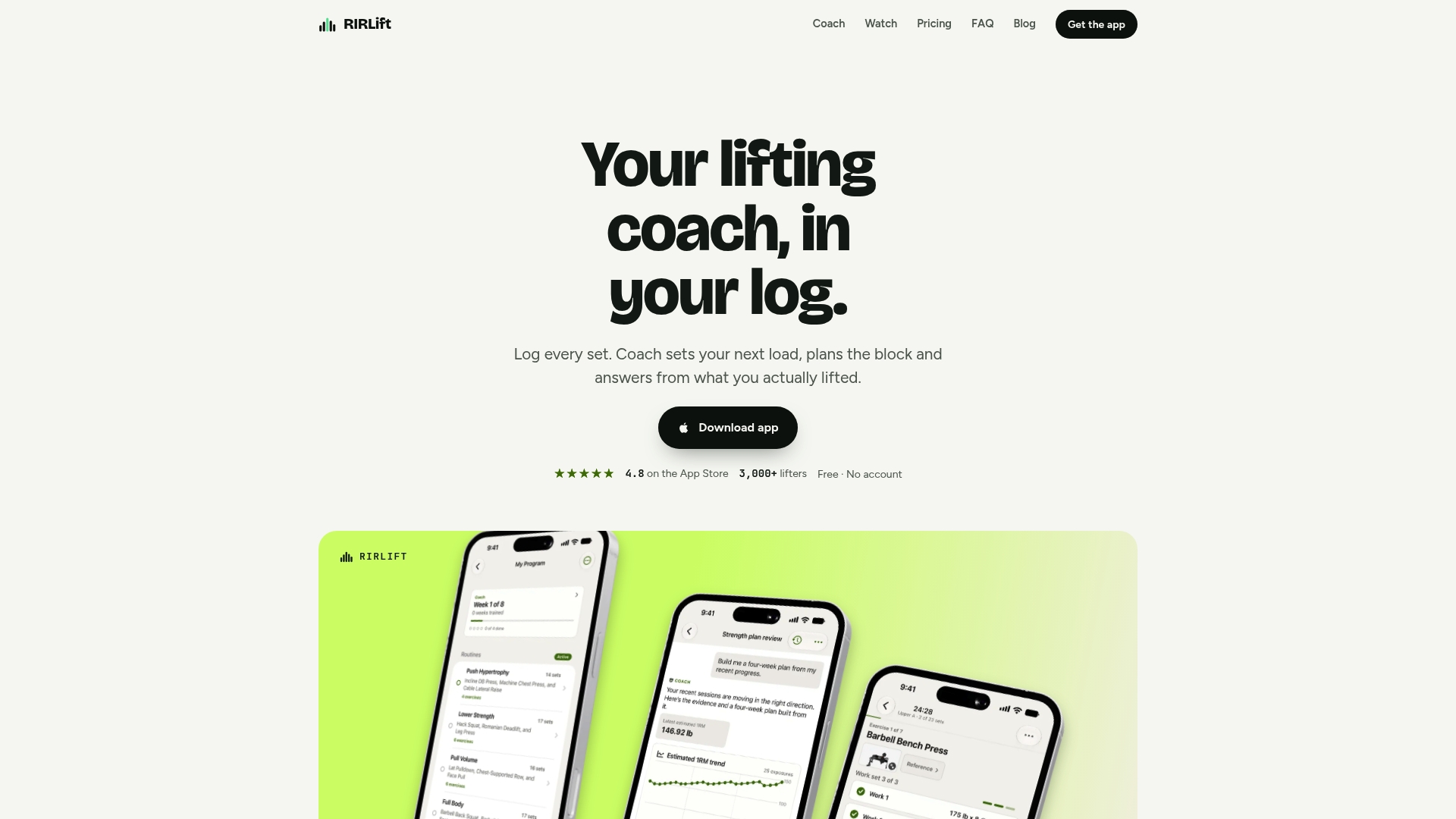
A short plan has little slack, so the load for each session has to be right the first time. RIRLift is a lifting app for iPhone and Apple Watch where you log every set with weight, reps and RIR. Its AI Coach analyzes those logs and recommends your next load, adjusts future sets and can plan multi-week training blocks. You can also talk with Coach about your own data.
The Free plan covers core logging. Pro costs $9.99 per month or $79.99 per year and unlocks advanced coaching, analytics, unlimited routines, AI integration and customization. Both plans are on rirlift.com.
For a twice-weekly 30-minute plan, the free logger is enough to start, and Coach is there when you want the next load decided from your sets rather than from guesswork.
FAQ
Can you strength train in 30 minutes?
Yes. Mayo Clinic says people may notice stronger muscles with about 20 to 30 minutes of strength training at least twice a week. Train all major muscle groups and pick weights that make the target reps hard.
Is one set per exercise really enough?
For health and fitness benefits, Mayo Clinic says one set of each exercise is enough. For faster strength and size gains, the 2021 review suggests at least four weekly sets per muscle group, which two sessions of two sets each provide.
How many days a week should I do short workouts?
Two days a week is the minimum for general health, with a rest day between sessions that train the same muscles. Beginners can start with a single weekly workout, and lifters who train closer to failure should leave more recovery between sessions.
Are 10-minute workouts worth doing?
They can be, if the effort is high. Harvard Health describes a three-exercise dumbbell routine of about 10 minutes for three rounds. Choose a weight that makes 10 to 12 reps challenging, and ease in if you are new to it.
Sources
- Strength training: Get stronger, leaner, healthier (Mayo Clinic)
- Fitness Strength training (Mayo Clinic)
- Resistance Exercise Minimal Dose Strategies for Increasing Muscle Strength (PMC)
- No Time to Lift? Designing Time-Efficient Training Programs (PMC)
- Save Time With This HIIT Resistance-Training Workout (ACE, February 2023)
- The ACE Workout Builder for High-Intensity Resistance Training (ACE, April 2025)
- Two dumbbells, three exercises, and 10 minutes (Harvard Health)
- For strength training, short workouts can deliver results (NPR)
- Resistance Training for Osteoporosis: How to Start Safely