
Blog
Shoulder External Rotation: Muscles, Form and Programming
Published October 26, 2026 · 16 min read
Shoulder external rotation is the movement of turning your upper arm outward, so your forearm swings away from your belly, and it is driven mainly by two rotator cuff muscles, the infraspinatus and the teres minor. You train it with light, slow, controlled reps: a band, cable or small dumbbell, an elbow bent to 90 degrees, and a stable shoulder blade. Below you will find the muscles involved, four proven variations, a sets-and-reps table built from published clinical programs, and the point where a stiff or weak shoulder needs a professional rather than another set.
TL;DR
- The infraspinatus and teres minor are the primary external rotators. The infraspinatus does more work with your arm at your side, and the teres minor does more when the shoulder is raised to 90 degrees.
- Keep the load light enough that you can move slowly and stop the shoulder from rolling forward. Heavy weight turns a rotator cuff exercise into a shrug and a swing.
- A common clinical starting point is 3 sets of 8 repetitions, 3 days per week, progressing to 3 sets of 12 as it gets easier. Treat it as a conditioning program of about 4 to 6 weeks, then maintain with 2 to 3 days per week.
- Warm up first, never train through pain, and see a doctor or physical therapist if you lose the ability to rotate your arm or have pain that persists.
Table of Contents
- What shoulder external rotation actually is
- Which muscles control shoulder external rotation
- Why lifters train it
- Four ways to do shoulder external rotation
- Sets, reps and progression
- Common mistakes
- Why can't I rotate my arm backward?
- Where external rotation fits in a lifting week
- Our view on training small muscles with data
- Track your cuff work alongside your main lifts
- FAQ
- Sources
What shoulder external rotation actually is
Your shoulder is a ball-and-socket joint, and rotation is the ball spinning in the socket along the length of the upper arm bone. Internal rotation turns the arm inward, as when you reach behind you to tuck in a shirt. External rotation turns it outward, as when you cock your arm back to throw or open a door with the back of your hand leading.
The elbow position matters, because it changes which muscles carry the work and how the joint feels. Two reference positions come up constantly in rehab and gym programming:
- Arm at your side (0 degrees of abduction): the elbow is bent to 90 degrees and tucked against your ribs. This is the easiest position to control and the usual starting point.
- Arm raised to 90 degrees (the 90/90 position): the shoulder is out to the side at shoulder height, the elbow is bent to 90 degrees, and the forearm points forward or up. This position resembles throwing and pressing, so it carries over to sport and overhead lifting, but it is also less forgiving.
The American Shoulder and Elbow Surgeons describe external rotation at 0 and 90 degrees of abduction and advise keeping resistance light, especially after shoulder replacement or rotator cuff surgery. That advice is written for surgical patients, but the logic holds for everyone: this is a precision movement for small muscles, not a strength test.
Which muscles control shoulder external rotation
The main answer to the question people search most often is the infraspinatus and the teres minor. A Japan Shoulder Society study of muscle activity patterns reports that the infraspinatus contributes more with the arm at the side, while the teres minor contributes more once the shoulder is abducted to 90 degrees.
Both are part of the rotator cuff. According to Cleveland Clinic, the rotator cuff is a group of muscles and tendons that helps rotate and lift the arm and stabilize the shoulder joint, and the infraspinatus and teres minor are the cuff muscles that help rotate the arm.
Other muscles join in, depending on the variation. The ACSM Health & Fitness Journal's guide to the prone W exercise lists the supraspinatus, infraspinatus, teres minor, middle and posterior deltoid, middle and lower trapezius, rhomboids and levator scapulae as involved. That list explains why the exercise looks like a shoulder movement but feels like an upper back movement when you do it well.
| Muscle | Role in external rotation | Where you feel it |
|---|---|---|
| Infraspinatus | Primary rotator, especially with the arm at your side | Back of the shoulder blade |
| Teres minor | Primary rotator, more active with the arm raised to 90 degrees | Just below the infraspinatus, outer edge of the shoulder blade |
| Posterior deltoid | Assists, especially in the prone and 90/90 versions | Rear of the shoulder |
| Middle and lower trapezius, rhomboids | Hold the shoulder blade in place so the cuff can work | Between the shoulder blades |
The last row is the one most lifters neglect. The cuff rotates the arm, but the shoulder blade has to stay put while it does, which is why every good cue below starts with the scapula.
Why lifters train it
This is a practice-based point rather than a research claim: heavy pressing, rowing and pulling all load the shoulder, and the external rotators are the small muscles that help keep the ball centered in the socket while the big muscles move the weight. Lifters who press often and row rarely tend to have a forward-leaning shoulder posture, and light external rotation work is a common way coaches and therapists balance that out.
It is not a replacement for compound back work. If your pulling volume is low, start there. A dumbbell row and a few upper back dumbbell exercises will do more for your shoulder blade control than extra rotation sets alone. Use external rotation as the finishing detail, not the foundation.
Four ways to do shoulder external rotation
Each version below has a published description from a clinical or academic source. Pick one, learn it, and stay with it for a few weeks before switching.
Standing band external rotation at your side
This is the easiest to learn and the one most people already own the equipment for. The American Shoulder and Elbow Surgeons' band exercise keeps the elbow bent and at your side, the shoulders square and the shoulder blades retracted. You rotate outward against light resistance and return slowly.
To set it up:
- Anchor a light band at elbow height, to a door frame or a post.
- Stand sideways to the anchor with the band in the hand farthest from it.
- Tuck a small rolled towel between your elbow and your ribs. The Stone Clinic's band variation uses a rolled towel at the elbow, a neutral wrist and a shoulder blade held down.
- Pull the band outward slowly, stop before your elbow drifts off the towel, and return under control.
The towel is a feedback tool. If it falls, your arm drifted away from your side and the rotation turned into a shoulder-hiking compensation.
Side-lying external rotation
The side-lying version removes gravity from the equation in the bottom half and adds it back as light resistance on the way up. According to the Merck Manual's video guide, you lie on the uninvolved side with a pillow between the involved arm and your body, and bend the involved elbow to 90 degrees. Then you retract and depress the scapula, rotate the forearm upward at the shoulder, and return slowly.
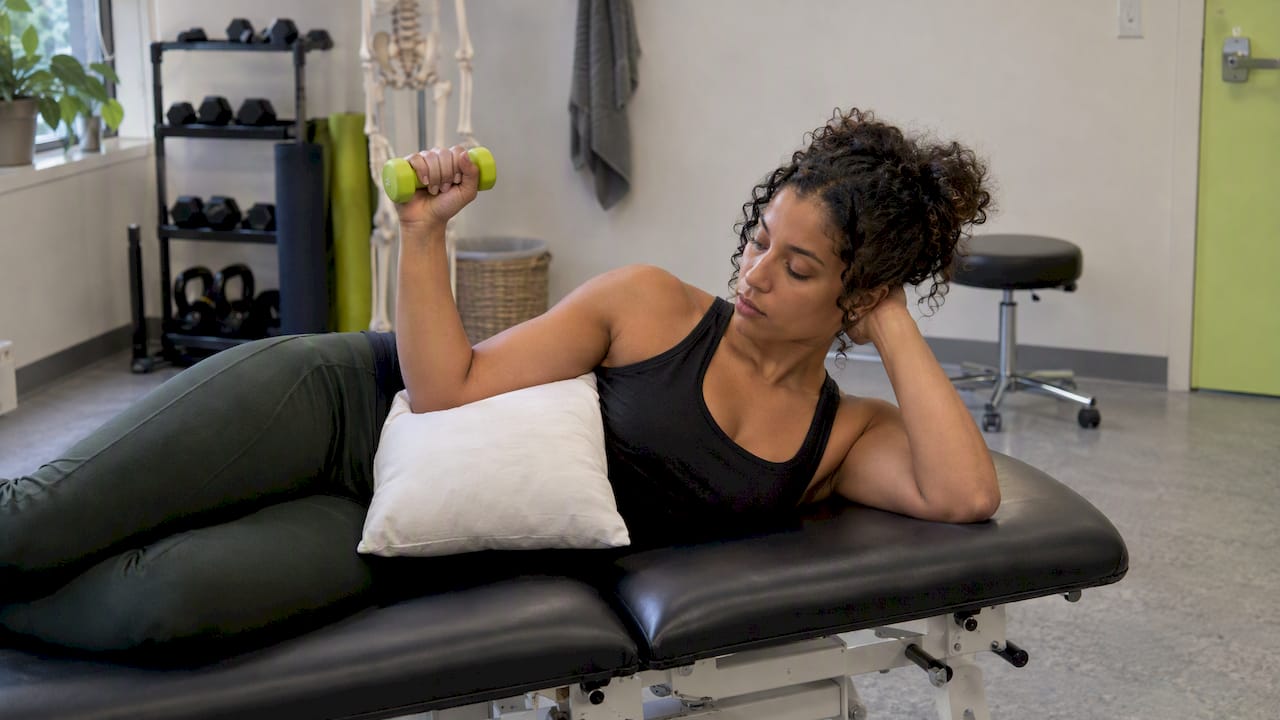
This is a good option for beginners and for anyone who finds standing versions too shaky. It also lets you add a very small dumbbell once the unweighted version feels easy. Merck's example prescription is 3 sets of 10 repetitions once daily, adding light weight as tolerated.
Standing external rotation at 90 degrees
This is the harder cousin, with the elbow raised to shoulder height. Cornell's physical therapy video instructs you to stand upright, set the shoulder blade, move the arm just below parallel, and avoid letting the shoulder roll forward.
A few practical points from that description:
- Set your shoulder blade before you rotate, not during.
- Do not raise your elbow above shoulder height just to find more range.
- Treat the first few sessions as practice with the lightest band you have.
This is the position where the teres minor gets more involved, so it earns its place for overhead athletes and lifters who press heavy overhead. It is also the one most likely to irritate a cranky shoulder, so skip it if the side-lying or at-your-side version already hurts.
Prone W
The prone W combines external rotation with scapular work. The ACSM Health & Fitness Journal says it can be done on a floor, treatment table or bench, with dumbbells or cuff weights added as tolerated, and the shoulder abducted to about 90 degrees. Moving from a supported surface to a bench increases the intensity because you have to lift your arm higher.
The same article recommends exhaling while lifting and inhaling while lowering, and says external loading should never prevent controlled movement. That second point is the rule of the whole article: if you cannot control the weight, it is too heavy.
There is also a related move, the prone I. The ACSM's prone I guide describes shoulder extension in neutral or external rotation, and says it can be adapted to standing or supine hook-lying with tubing, bands or cable equipment for people who cannot tolerate lying face down.
What about cables?
A cable set to elbow height gives smoother tension than a band, because the load does not ramp up as it stretches. It suits the at-your-side version well. Use the lightest stack plate, check that the pulley is level with your elbow, and follow the same cues: towel at the ribs, square shoulders, slow return.
Sets, reps and progression
The published programs are consistent: low load, moderate reps, frequent exposure. They are written for conditioning and rehab, so use them as a starting framework rather than as a strength-training prescription.
| Source | Prescription | Notes |
|---|---|---|
| AAOS OrthoInfo | 3 sets of 8, 3 days per week; progress to 3 sets of 12 | Program generally continues 4 to 6 weeks, then 2 to 3 days per week to maintain |
| Merck Manual | 3 sets of 10, once daily | Side-lying, light weight added as tolerated |
| Stone Clinic | 2 to 3 sets of 10 to 15 | Band version with a rolled towel, avoiding pain |
The AAOS notes the conditioning program generally continues for 4 to 6 weeks unless a clinician specifies otherwise, and that 2 to 3 days per week can maintain shoulder strength and range of motion. If you are healthy and adding this to a lifting week, 2 to 3 short exposures per week is a sensible reading of that range.
A simple progression
This part is practice, not research, but it follows the logic of the sources above.
- Start with the at-your-side or side-lying version, 3 sets of 8 with no load or the lightest band.
- When 3 sets of 8 feel easy with good form, move to 3 sets of 12, as the AAOS suggests.
- When 3 sets of 12 are clean, add a small amount of resistance and drop back toward 8 reps.
- Only then consider the 90/90 or prone W versions.
A useful way to judge "easy" is reps in reserve (RIR), the number of clean reps you could still do at the end of a set. For small rotator cuff muscles, many lifters keep sets at roughly 3 to 4 reps in reserve and rarely push to failure, since form breaks down before the muscle truly fails. That is a coaching convention, not a studied standard. If you want to track the numbers, the progressive overload calculator can help you plan small, steady increases.
Common mistakes
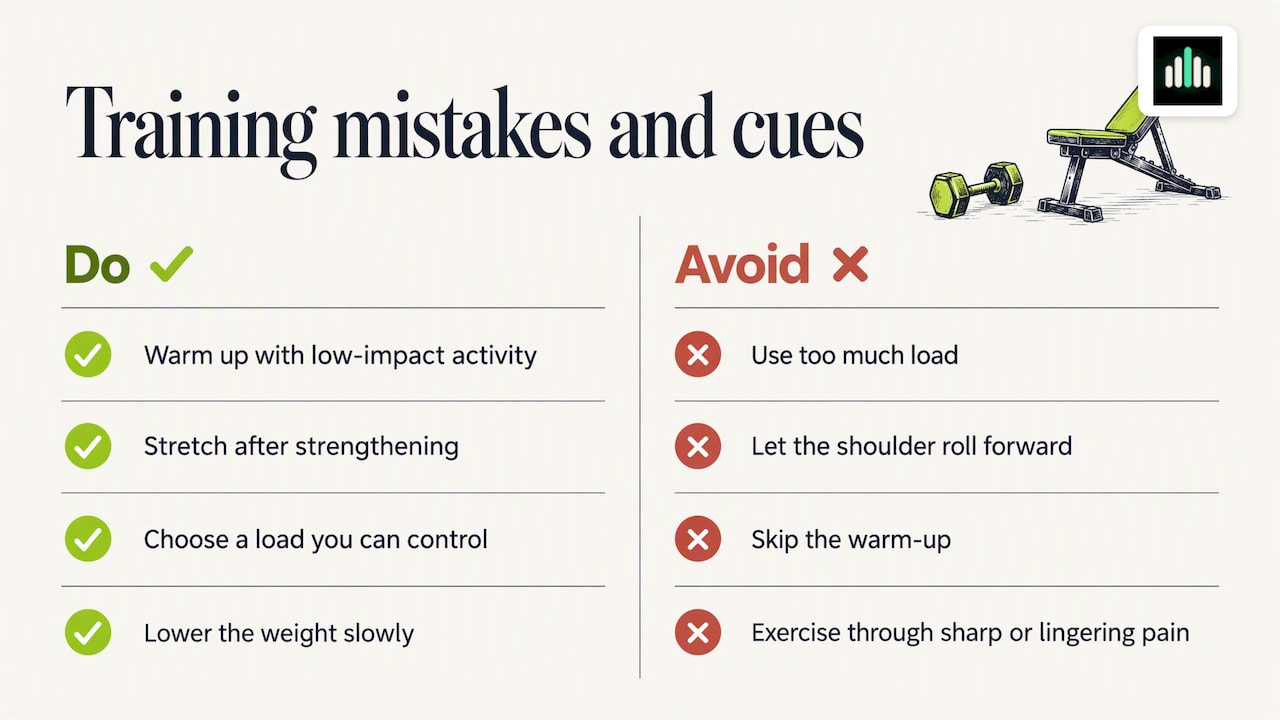
Using too much load. The elbow drifts, the shoulder hikes toward your ear, and the trap takes over. The ACSM's guidance that external loading should never prevent controlled movement is the simplest filter.
Letting the shoulder roll forward. Cornell's cue to avoid letting the shoulder roll forward is worth repeating. If the front of the shoulder rounds as you rotate, the rotation is coming from the wrong place.
Skipping the warm-up. The AAOS recommends warming up for 5 to 10 minutes with low-impact activity and stretching after strengthening.
Training through pain. The same AAOS program says not to exercise through pain. A dull burn in the muscle at the end of a light set is normal fatigue. Sharp, pinching or lingering pain is not.
Rushing the return. Every source above says to return slowly. The lowering phase is where much of the control training happens.
Why can't I rotate my arm backward?
If you struggle to turn your arm outward, the cause can be stiffness, weakness or pain, and each points to a different problem. Do not self-diagnose from an article. The patterns below are the ones professionals look for.
- Stiffness in every direction, with or without pain. The AAOS describes frozen shoulder (adhesive capsulitis) by an inability to move the shoulder, either on your own or with someone else's help. It most commonly affects people between 40 and 60 and occurs more often in women. Physical therapy focused on flexibility is the primary treatment recommendation. If someone else cannot move your arm outward either, the problem is in the joint capsule rather than the muscle.
- Weakness or pain when rotating or lifting. Cleveland Clinic lists difficulty, pain and weakness when raising, lowering or rotating the arm among rotator cuff tear symptoms, and says the risk of a tear increases with age.
- Sudden loss after a fall, a heavy pull or an accident. This needs prompt evaluation, not a stretching routine.
The ACSM guidance for the prone W says exercisers should be free of shoulder or upper-extremity injury and pain, and that injury-related pain means you stop and consult a physician, physical therapist or other health professional. If you cannot rotate your arm outward normally, or the pain wakes you at night or lingers after training, book a visit with a physician or physical therapist before adding exercises. A phase-based approach to shoulder pain physical therapy explains how guideline-based rehab usually moves from calming symptoms to restoring motion and then rebuilding strength, which is a helpful picture of what to expect once you are assessed.
Where external rotation fits in a lifting week
You do not need a separate shoulder day. Fit two or three short sets into sessions you already do:
- After pressing: pair it with your overhead or incline pressing day, once the heavy sets are done.
- Before pressing: use one light set as part of a warm-up, not to fatigue the cuff.
- On pull days: finish with prone W or a cable version.
If your shoulder work is currently mostly front and side delts, balance it with exercises that train the rear shoulder and upper back. The guides to dumbbell shoulder exercises and bodyweight shoulder exercises cover a range of options, and lateral raise form is worth checking if your side delt work irritates the joint.
Our view on training small muscles with data
We build RIRLift around a simple idea: the number on the bar matters less than what you did with it and how hard it felt. That applies to external rotation more than anywhere. Rotator cuff work is the classic place where lifters either do nothing or do far too much, because there is no obvious scoreboard.
What we would do is treat these exercises like any other lift. Log the load, the reps and the reps in reserve. If a set felt like 4 reps in reserve and the next session felt like 1 with the same band, something changed: fatigue, sleep, a sore shoulder. That information is more useful than the band color. The Coach in RIRLift works strictly from what you log rather than from a template, so if you record light cuff sets honestly, it has something real to recommend from.
We also think the small-muscle conversation should stay humble. We are a training app, not a clinic, and we do not diagnose pain. When a shoulder hurts, the right move is a professional assessment first and a logged program second.
— Guilherme
Track your cuff work alongside your main lifts
If you want to log external rotation sets with weight, reps and reps in reserve, and get load suggestions based on your own sessions, RIRLift is a free iPhone and Apple Watch app, and Pro is $9.99 per month or $79.99 per year for advanced coaching and analytics. You can see the plans on the RIRLift home page, or plan your session first with the session builder.
FAQ
Which muscle controls shoulder external rotation?
The infraspinatus and teres minor are the primary external rotators. Research on muscle activity patterns shows the infraspinatus contributes more with the arm at your side, and the teres minor contributes more when the shoulder is abducted to 90 degrees. The posterior deltoid and the muscles between the shoulder blades assist.
How often should I do shoulder external rotation?
The AAOS conditioning program uses 3 days per week for 4 to 6 weeks, then 2 to 3 days per week to maintain strength and range of motion. If you are healthy and already lifting, two or three short sessions per week is a reasonable range. If you have pain or a diagnosed problem, follow the schedule your clinician gives you.
What is the rotator cuff?
The rotator cuff is a group of muscles and tendons that helps rotate and lift the arm and keeps the shoulder joint stable. The infraspinatus and teres minor, the main external rotators, are part of it. It is a small group, so light loads and controlled reps are the standard for training it.
Can I do external rotation with a shoulder injury?
Only with guidance from a doctor or physical therapist. Published guides for these exercises say people should be free of shoulder injury and pain, and that pain from an injury means you stop and consult a health professional. After shoulder replacement or rotator cuff surgery, the ASES advises keeping the resistance light.
Sources
- Muscle activity pattern of the shoulder external rotators (Japan Shoulder Society)
- Rotator Cuff and Shoulder Conditioning Program (AAOS OrthoInfo)
- Prone Shoulder External Rotation From 90 Degrees of Abduction (ACSM Health & Fitness Journal)
- The Shoulder Prone I Exercise (ACSM Health & Fitness Journal)
- Side-Lying Shoulder External Rotation (Merck Manual)
- Shoulder External Rotation at 90 Degrees (Cornell)
- Patient Exercise Programs (American Shoulder and Elbow Surgeons)
- Shoulder Theraband External and Internal Rotation (Stone Clinic)
- Rotator Cuff: Muscles, Tendons, Function and Anatomy (Cleveland Clinic)
- Rotator Cuff Tear: Symptoms and Treatment (Cleveland Clinic)
- Frozen Shoulder (AAOS OrthoInfo)